// data-verified

Best Pry Bars of 2026

Every pry bar story starts the same way: with a screwdriver that shouldn't have been there. Mine was a putty knife, jammed under a door casing, bending a little more with each shove until the trim split and took a chunk of drywall with it. A real bar would have popped that casing in seconds. You don't shop for one until something is already stuck, and by then you want to get it right the first time.

The thing nobody tells a first-time buyer: a stamped flat bar and a forged one-piece bar are not the same animal. Thin steel flexes under load and stays bent, and a tip ground too sharp will dig into the trim you're trying to save. We spent three months with 14 pry bars — short utility bars, 36-inch wrecking bars, handled sets, cats paws — pulling nails out of salvaged deck boards and prying baseboard off a plaster wall, mostly to find out which of those worries were real.

The bars that earned a place in the toolbox share a few traits: a forged body that doesn't flex when you lean on it, nail slots that grab a head instead of slipping off it, and a shape your hand can hold all afternoon. Every pick below was judged on that, not on how it looked in the package.

#01

Best Overall

Vaughan SuperBar 21 in.

95 /100
Kirk Score Outstanding
Head
Shepherd's crook rocker
Length
21 in.
Weight
2 lb
Nail Slots
Three beveled
Check Details on Amazon

Pros

  • Rocking head rolls forward for a steady lift
  • Three nail slots match different nail depths
  • Thin polished edge saves casing and baseboard
  • Two pounds feels planted, still swings one-handed

Cons

  • Blue finish scuffs off within a few jobs

Twenty-one inches is the length we keep coming back to: long enough to lean your weight into, short enough to live in a toolbox instead of a corner of the garage. What makes the SuperBar the pick rather than just a good bar is the head. Vaughan's shepherd's crook curve puts a rolling fulcrum behind the prying edge, so you rock the bar forward instead of fighting it against a single contact point, and lifting a stuck board stops feeling like a wrestling match. The heel takes a hammer blow too, which is the difference between a stubborn nail coming out now and coming out after lunch.

Three beveled slots run along the blade rather than one, and that matters more than it sounds when you're dismantling something nailed at three different depths — you seat the slot that lies flat instead of tipping the bar to make the geometry work. The edge is ground thin and polished, so it slides under window casing and baseboard and comes back out with the profile intact, which is the whole point when the trim is going back on. At 2 pounds it feels planted without being a chore to swing one-handed.

Spring-tempered steel is why it holds that shape; we have leaned hard on the 21-inch bar and it comes back straight. Vaughan assembles these in the US from global materials and backs them with a limited lifetime warranty, which is about as much reassurance as a bar at this price needs. The finish is the one thing that doesn't last — the blue paint scuffs off the head within a few jobs, and the steel underneath doesn't care.

Bottom line: If you want one bar that handles trim, demolition, and nails without bending, this is the one we hand people first.

Check Latest Price
#02

Best for Heavy Demolition

Estwing 36 in. Gooseneck

95 /100
Kirk Score Outstanding
Length
36 in.
Weight
8 lb
Chisel End
Angled
Construction
Forged in one piece
Check Details on Amazon

Pros

  • Eight pounds of forged steel does the heavy lifting
  • One-piece forging with no welded joint
  • 36-inch handle lets you lever with your legs

Cons

  • Eight pounds is a lot to swing all afternoon

Eight pounds is the entire argument. On a deck tear-out or a shed that has to come down, the mass does work your shoulders otherwise have to do — you set the slotted hook around a spike or a nail head, drop your weight on the handle, and the board gives. We like it for exactly that and very little else, which is why it earns a place here as the demolition bar rather than the do-everything one.

Forged in one piece from solid American steel in Rockford, Illinois, with no welded joint at the gooseneck to fatigue — that is what lets a bar this long take the load you put on it. The angled chisel end slides under a board edge and the hook end is slotted to catch a nail head and pull it. The grip material takes some of the sting out of a hard yank, and the 36-inch handle sits close to standing height, so you lever with your legs instead of folding yourself in half.

Where it stops being useful is anywhere the handle can't travel. A full arc needs clear space, so this isn't the bar for a cabinet interior or a closet floor. The chisel tip is thick by design as well — it's built to survive being driven into a gap, not to slide under casing you plan to reuse. Buy it for the jobs where something is coming apart and never going back together.

Bottom line: The bar we want for decks, sheds, and floors, where eight pounds of forged steel saves your back; for trim and tight spaces, look elsewhere.

Check Latest Price
#03

Best Handled Set

Tekton 3-Piece Handled Set

95 /100
Kirk Score Outstanding
Origin
Made in USA
Lengths
12, 17, 25 in.
Bar Stock
3/8–1/2 in. solid steel
Striking Cap
1 in. solid steel
Check Details on Amazon

Pros

  • Strike cap sits directly on the bar stock
  • 12, 17, and 25 inches each earn their place
  • Heat-treated solid steel with no welds

Cons

  • Plain plastic handles with no added grip

A set is only worth its shelf space when the sizes divide real work instead of padding a box, and these do: 12 inches for a cabinet or under a sink apron, 17 for most trim and light demolition, 25 for standing leverage on a subfloor. The middle bar did more than half of what we needed, which is the usual sign that a set was sized by someone who uses one.

The feature that separates these from every bare flat bar here is the striking cap — a 1-inch solid steel button that contacts the bar stock directly, so a hammer blow travels into the shaft instead of mushrooming the end or cracking a plastic handle. Once we knew we could hit it, we found ourselves hammering the bar into gaps far more often than expected, and that changes how a stuck board comes apart. The angled end gives you a fulcrum to push against instead of relying on the tip alone.

Underneath the handles it is 3/8- to 1/2-inch solid steel, heat treated, with no welds — the reason these stay straight when cheaper sets take a set. Tekton makes them in the US and backs them with a warranty that has no time limit and no receipt requirement, which matters when a bar lives in a truck. The handles are plain plastic, there to be hit rather than to be comfortable through an afternoon of scraping.

Bottom line: We recommend this set when you want three genuinely useful lengths and a bar you can hammer on; it costs more than one good flat bar and covers more ground.

Check Latest Price
#04

Best for Trim Work

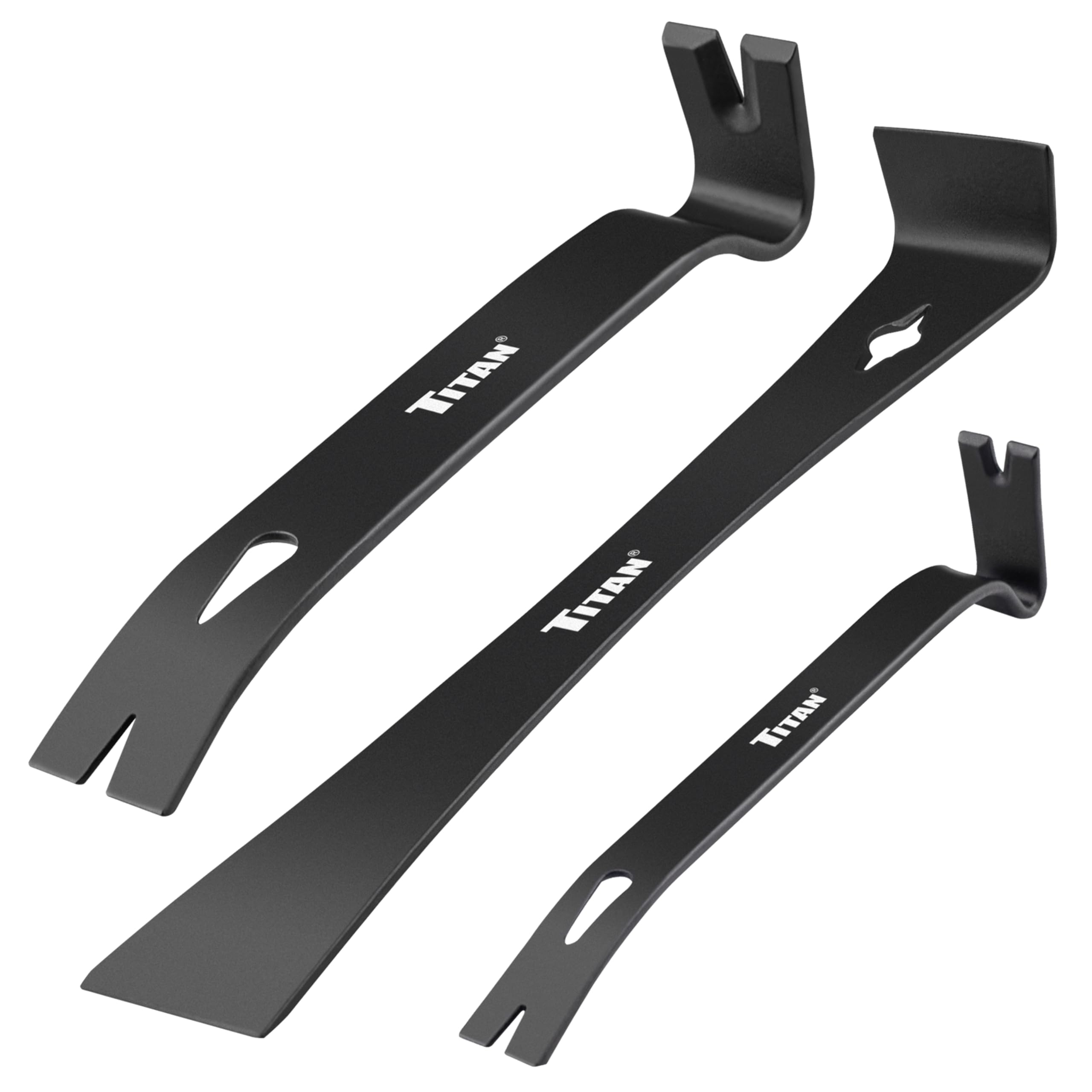
Titan 3-Piece Flat Set

96 /100
Kirk Score Outstanding
Sizes
5.5, 7.5, 9.5 in.
Weight
13 oz
Nail Puller
Beveled
Construction
Fully forged
Check Details on Amazon

Pros

  • Thin, sharp tips slide under molding
  • Three short lengths for cabinets and jambs
  • Forged rather than stamped at a budget price

Cons

  • Bends when leaned on like a wrecking bar

The 5.5-inch bar is why you buy this set. It slides under shoe molding and window casing that a 15- or 21-inch bar can't approach without levering against the jamb, and it's ground thin and sharp at the tip so it separates paint and caulk lines instead of crushing them. On a job where the wood is going back on, that isn't a convenience — it's the difference between reusing a run of baseboard and buying new.

All three bars are forged rather than stamped, which is unusual at this price, and the beveled nail puller notch handles finish nails without tearing up the surrounding wood. The lengths step sensibly: 5.5 for tight work, 7.5 for general trim, 9.5 when you want a little reach. We kept the small one in a pocket and the other two on the floor beside us.

The trade is strength, and it's worth naming. These are trim bars: lean your weight on the 9.5 like a wrecking bar and it will bend, which is what you expect from steel thin enough to do the job they're built for. If a subfloor or a nailed-together cabinet has to come apart, reach for something heavier. For saving molding, these three do more than a single heavy bar at the same money — and the smallest one is the one you'll keep finding uses for.

Bottom line: We reach for these whenever trim has to come off in one piece; if the job is demolition, spend the money on a heavier bar.

Check Latest Price
#05

Best for Pulling Nails

Spec Ops 10 in. Cats Paw

93 /100
Kirk Score Outstanding
Length
10 in.
Weight
11.2 oz
Material
High-carbon steel
Nail Pullers
Two
Check Details on Amazon

Pros

  • Honed claws reach headless, embedded nails
  • 11 ounces carries where a full bar won't
  • Dual strike zones let you hammer it into place

Cons

  • Claw steel is on the soft side

A nail head that snaps off flush is the problem this tool solves. There's nothing for a flat bar to grab, so you need a claw you can drive down alongside the shank and lever against. That's what the honed claws on this 10-inch cats paw do, and there are two pullers plus dual strike zones on the head, so you can hammer it into position rather than hoping it seats.

At 11.2 ounces it disappears into a tool bag, and we carried it up ladders and into crawl spaces where a full-size bar is a nuisance. High-carbon steel, a limited lifetime warranty, and a price low enough that keeping a spare in the truck makes sense. One caution comes with the size: it's small enough that a careless hammer swing finds your hand, so set the strike zone deliberately and keep the other hand clear of the arc.

Ten inches doesn't give you much leverage, so on a nail buried in framing, break it loose with something longer first and finish with this. It's also a pulling tool rather than a prying one — for lifting a board or opening a joint, a wide flat blade beats it every time. As a companion to a bigger bar, though, it's the one we pick up once the heads are gone.

Bottom line: The tool we grab when a nail head is gone and a flat bar has nothing to bite; small, light, and worth keeping a spare.

Check Latest Price
#06

Best Compact Bar

Estwing PB-18 18 in.

94 /100
Kirk Score Outstanding
Length
18 in.
Weight
1.5 lb
Chisel End
Angled
Construction
Forged, I-beam
Check Details on Amazon

Pros

  • Forged I-beam section resists bending
  • Hammer face on the back of the claw
  • 1.5 pounds swings one-handed

Cons

  • Blunt tip marks soft trim

Thickness is the whole point here. The PB-18 is forged in one piece with an I-beam cross-section, so the part taking the load has a spine down the middle of it. We never saw it flex, and it doesn't take a set the way thinner bars do when you lean on them.

Eighteen inches is a useful compromise: enough length to lever a crate lid or a nailed-together frame apart, short enough to swing one-handed and hang off a bag. The flat face on the back of the claw gives you a target for a hammer, which turns the bar into a wedge you can drive into a gap and then lever from, and there's an angled chisel end on the other side for sliding under an edge. That hammer face can develop a sharp lip over time, so a pass with a file now and then saves your knuckles.

None of that makes it a delicate tool, and it isn't meant to be. What it will do is survive being hit, week after week, without a permanent curve — and for a bar that lives in a bucket next to a hammer, that's the quality that decides whether you still trust it a year from now.

Bottom line: A compact forged bar we trust to take a hammering without bending, and the one we hand someone framing or pulling apart a crate.

Check Latest Price
#07

Automotive and machinery

Mayhew Dominator 3-Piece

95 /100
Kirk Score Outstanding
Grip
Two-composite, chemical resistant
Shaft
Runs through handle to steel cap
Finish
Black oxide
Lengths
12, 17, 25 in.
Check Details on Amazon

Pros

  • Steel cap carries hammer blows down the shaft
  • Grip resists oils, solvents, and heat
  • 12, 17, and 25 inch bars cover underhood work

Cons

  • No bar shorter than 12 inches

Most pry bars ask you to hit bare steel and hope the shock doesn't travel into your wrist. The Dominator bars run the shaft the full length of the handle and terminate in a steel cap, so a hammer blow goes down the bar rather than into plastic. That's the design a mechanic wants when a caliper bracket or a ball joint is seized and there's no room to swing.

The handle is a two-composite grip that resists oils, solvents, and temperature swings — the kind of claim that sounds like catalog copy until a rubber handle goes tacky after a year of transmission fluid. The bars are tool steel with a black oxide finish, curved along the shaft for rolling contact, and the set runs 12, 17, and 25 inches. The two shorter bars do most of the work under a hood; the 25-inch comes out when something is really stuck.

The cap itself is forged through the core, so the striking surface and the shaft are effectively one piece and the energy goes where you aimed it. Sizing is the gap to know about: 12 inches is the shortest bar in the box, so tight engine-bay work that wants an 8- or 10-inch bar isn't covered here. That's a second purchase rather than a reason to skip the set.

For a homeowner, this is a lot of money tied up in three bars built for machinery rather than molding. The curved, thick tips are for separating parts, not for sliding under trim you want to keep. If your pry bar lives next to sockets and comes out for brakes and suspension, the premium buys a tool that outlasts the car. If it lives next to a hammer and comes out for baseboard, spend the money on a flat bar instead.

Bottom line: We recommend this set for anyone prying on vehicles and machinery, where the through-handle cap and solvent-proof grip earn the price; trim work wants a different bar.

Check Latest Price
#08

Light trim work

Craftsman 3-Piece Utility Set

93 /100
Kirk Score Outstanding
Handle
Bi-material with strike cap
Weight
3 lb
Lengths
12, 18, 24 in.
Material
Alloy steel
Check Details on Amazon

Pros

  • Integrated strike caps that take a hammer
  • 12, 18, and 24 inches cover household jobs
  • Comfortable bi-material grips

Cons

  • Bars bend under hard prying

Strike caps are usually the feature that pushes a handled set into premium territory, and this Craftsman set has them at a price that doesn't. Each handle ends in an integrated cap you can hit with a hammer, so the bar can be driven into a gap rather than only levered from outside it.

Three lengths — 12, 18, and 24 inches — with bi-material handles that stay comfortable through an afternoon of pulling baseboard, and a chrome finish that wipes clean of drywall dust and paint. For trim, nailed cabinet boxes, and light demolition around the house, the range covers what you need.

Where the savings show is in the steel. Under a genuine load — suspension work, a subfloor, anything where you put your body weight into the handle — these bars take a bend and keep it. A bar with a permanent curve no longer sits flat under a board, so the tool gets retired early.

None of that makes them a bad buy; it makes them a specific one. If your prying is trim, crates, and the occasional stuck drawer, three sizes with strike caps for less than the price of one premium bar is a fair trade. If you're the person who leans until something moves, save up for the Tekton set or a forged bar instead.

Bottom line: A sensible first set for light trim and cabinet work, with strike caps you'd normally pay more for; lean on them hard and the steel gives.

Check Latest Price

How We Tested These Pry Bars

We started with roughly 60 listings and cut them down by construction first: forged one-piece bodies over stamped or welded ones, hardened working ends, and nail slots that were actually beveled rather than stamped through. From there we kept a spread of sizes and formats — 5.5-inch utility bars up to a 36-inch wrecking bar, handled sets alongside bare-steel bars — so we could compare how each one behaved in a gloved hand versus a bare one, and whether the extra length was worth carrying around.

Testing ran three months, mostly alongside a deck rebuild and a hallway renovation. We pulled ring-shank nails out of salvaged joists, pried oak baseboard off plaster, lifted a sheet of subfloor, popped paint can lids, and scraped old adhesive off concrete. At each job we noted how much the shaft flexed when we put our weight behind it, whether a nail head seated in the slot or skated out of it, and whether the claw marked the wood it was resting on.

Edges got their own attention. We checked each tip for burrs and rolled edges that could slice a palm, then watched whether that tip dug into a board or slid across it, since a bar that's too sharp is its own kind of problem when you're saving trim. Ergonomics came down to minutes, not specs: how long before a bare handle got uncomfortable, whether a grip twisted under load, and whether a short bar still gave enough leverage to break a stubborn nail free.

At the end we laid every bar next to a photo from day one, looking for bent shafts, chipped tips, and mushroomed heads, then weighed that wear against what each one cost.

How to Choose a Pry Bar

Length buys leverage and costs clearance

Every extra inch multiplies the force you can put on a stuck board and subtracts the space you can use it in. Under 12 inches is cabinet, jamb, and engine-bay territory. Fifteen to 21 inches is the general-purpose range where trim work and moderate demolition overlap. Twenty-five inches and up is for subfloor, decking, and framing, where you can stand back and lean.

The trap is buying the longest bar you can afford and then finding the handle can't travel. A bar that hits a wall or a joist halfway through a pry is levering against the wrong thing. Check the arc the handle needs before you fall for the leverage.

Forged steel, and why a bent bar is worse than a dull one

Nearly every bar here is steel; the difference is how it was made and how much of it there is. Forged bars are shaped from a single hot piece and resist taking a permanent curve. Thinner stock and cheaper heat treatment flex, and then stay flexed — and a bar with a bend in it no longer sits flat under a board, so it stops doing the one thing you bought it for.

The Craftsman set shows the trade plainly: three sizes and strike caps for light money, steel that takes a set once you put your weight into it. If your prying involves leaning, pay for forging.

The tip decides whether you save the trim

A thin, beveled, polished edge slides under casing and separates paint lines. A thick chisel end survives being hammered into a gap but marks softwood and splits the profile you're trying to keep. Nail slots are the other half of the tip: one beveled slot is standard, three lets you seat the bar flat against nails set at different depths, and a honed claw is what you need once a head has snapped off.

Decide which side you're on before you shop. Salvage work wants thin; demolition wants thick — and no single bar is good at both.

Strike caps, handles, and the hammer question

Bare steel can be hit, but the shock travels into your hand and the end mushrooms over time. A handled bar with a strike cap sends the blow down the shaft instead, and the ones worth owning run the steel through the handle to meet the cap rather than gluing a plastic button on top. The Tekton and Mayhew designs both work this way, and that's why they can be hammered without damage.

If you already carry a hammer to every job, a strikeable bar earns its keep. If you don't, put the money into a better tip and more steel.

One bar or a set

Two bars cover most households: a thin flat bar under 10 inches for trim, and a 15- to 21-inch bar for everything else. A set makes sense when the lengths divide real work, the way 12, 17, and 25 inches each own a different scale of job.

It makes less sense when the box is padded with near-duplicates. The Titan set is the exception worth knowing — three short bars that all do delicate work, which is a set for a specific job rather than a general kit.

Frequently Asked Questions

Final Verdict

The Vaughan SuperBar is the bar we recommend to almost everyone. The rocker head makes lifting easier, three nail slots handle whatever depth the nails sit at, and the steel comes back straight after a hard pry. Bought alone, it covers trim, moderate demolition, and nail pulling.

Change the job and the answer changes. Tearing out a deck or a shed with room to work, the Estwing 36-inch gooseneck puts eight pounds behind every pry. Saving molding, the Titan set's thin 5.5-inch bar reaches places the Vaughan can't. Start with the Vaughan and add the others when the work asks for them.