// data-verified

Best Borescopes of 2026

A borescope makes a simple promise: a camera on a snake, a screen in your hand, and no more cutting open drywall to find out what's behind it. What people actually use one for is rarely glamorous—a bolt that vanished down an intake port, a leak creeping along a joist, a drain that keeps backing up. The problem is that a bad one hands you a grey, grainy smear that answers nothing. I've spent six months running 12 of them through exactly those jobs.

Two things matter more than the resolution printed on the box. First, whether the probe articulates—a two-way, 210-degree head lets you steer around a corner inside a wall or look back at a valve you can't reach straight on. Second, whether it works on its own; a screen built into the handle beats an app when you're lying under a truck in a cold garage. Cable length cuts both ways, too: 16 feet is a gift in a sewer line and a nuisance in an engine bay. The picks below are the ones that earned a permanent spot in my toolbox.

#01

Best Overall

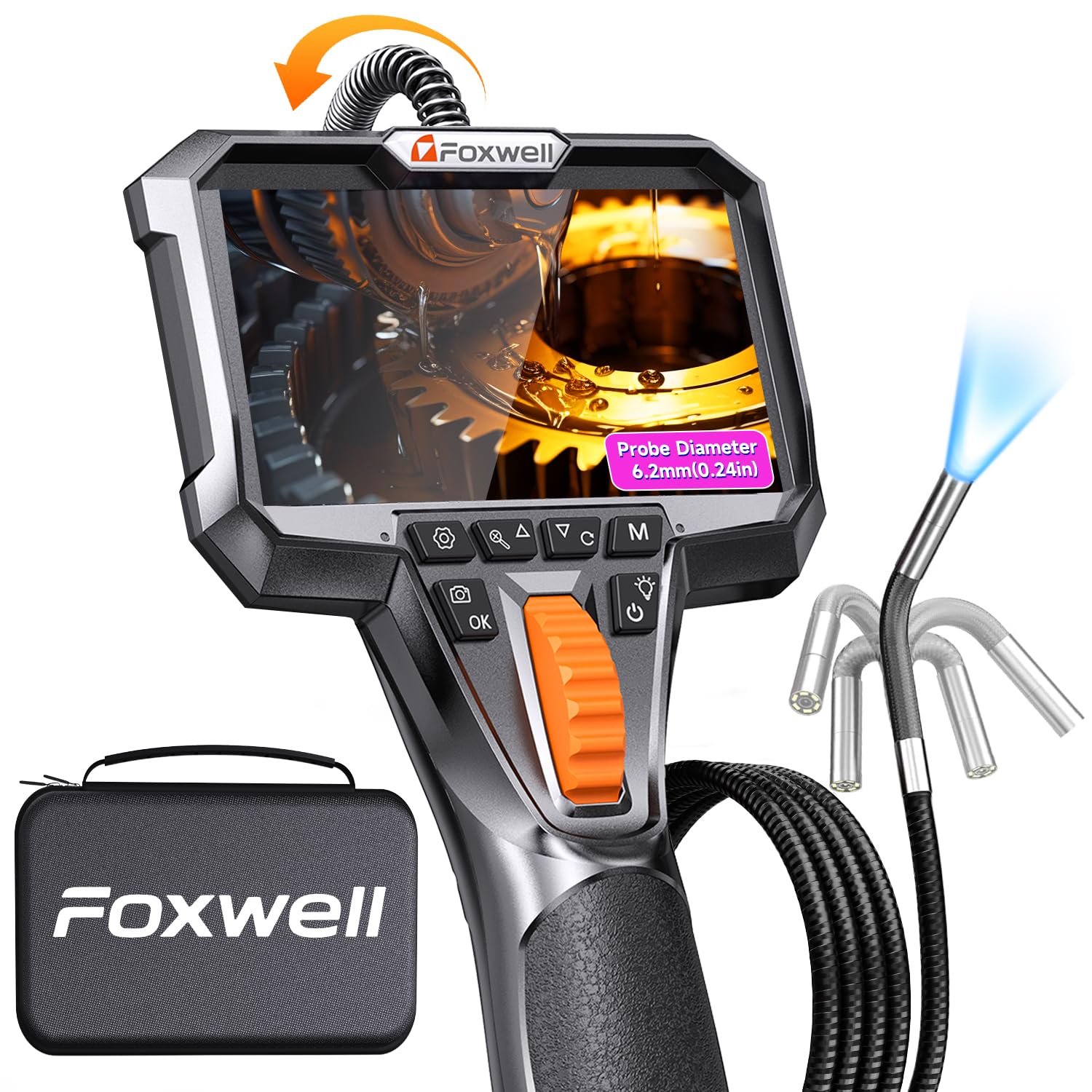
Foxwell Y400 Articulating Borescope

89 /100
Kirk Score Excellent
Cable
5.3 ft
Screen
4.3 in IPS
Articulation
220° two-way
Probe Diameter
6.2 mm (0.24 in)
Check Details on Amazon

Pros

  • Slim 6.2 mm probe reaches small openings
  • Two-way 220° steering on a thumb wheel
  • 4.3 in IPS screen, 4x zoom, 32GB card
  • IP67 sealing and overheat protection

Cons

  • 5.3 ft cable stops short of long runs

Six-point-two millimeters is the number to start with. The Y400's probe is slim enough to push through small ports and the narrow gaps that stop an 8 mm head, and once the tip is in, the head steers 220 degrees in two directions, so you can enter straight and then look sideways at a valve face, a duct wall or the underside of a piston.

That combination is why we recommend it as the default. The thumb wheel sits where your thumb already is, so one hand steers while the other feeds cable, and it works with gloves on. A 4.3-inch IPS screen shows enough detail to read a part number, 4x zoom lets you close in without shoving the tip closer, and 32GB of storage means you can record what you find instead of trying to describe it later.

Paying for articulation also means paying for less reach. The 5.3-foot cable is the longest of the steerable scopes here and still a fraction of the 16-foot roll-ups, so this is a tool for close, precise looks rather than long pipe runs. If your inspection is one drain or one duct, a fixed-lens scope with a long cable does the job for a fraction of the price.

The details that decide whether it lasts are less photogenic: IP67 sealing for wet ducts and oil, overheat protection for long sessions, a one-year warranty, and a hard case that keeps the head from being crushed at the bottom of a bag. For engine diagnostics, HVAC checks and the occasional wall cavity, this is the scope we reach for first.

Bottom line: This is the borescope we recommend to most buyers: a slim steerable probe, a bright screen and a card in the box, with the reach for an engine bay or a wall cavity.

Check Latest Price
#02

Best Screen for Close Work

Teslong TD450S Articulating Borescope

92 /100
Kirk Score Outstanding
Cable
5 ft
Screen
4.5 in IPS
Weight
3.1 lb
Articulation
210° two-way
Check Details on Amazon

Pros

  • 4.5 in IPS screen, tied for largest steerable
  • Two-way 210° articulation
  • Two-year warranty, the longest here
  • 32GB card and carrying case included

Cons

  • 3.1 lb handset wants two hands

At 3.1 pounds, the TD450S is a two-handed tool, and the 4.5-inch screen is the reason to accept that. It matches the largest display on any steerable scope in this group, and the extra size over the 4.3-inch models is a difference you notice when you are reading the far wall of a cylinder rather than a part number. That display is why we keep coming back to it.

The rest of the kit holds up. Two-way articulation runs 210 degrees on a 5-foot semi-rigid gooseneck, the lens focuses from 0.6 inch out to 4 inches, and the eight LEDs dim far enough to keep a polished cylinder wall from flaring out. The 2 MP sensor and 70-degree view are set up for close work, which is what a scope like this gets used for: piston crowns, valve faces, the inside of a duct joint.

The articulated joint is the wear point. It takes the abuse when you force the head past a baffle, so ease it rather than shove it, and keep the tip out of standing fluid, because a lens that fogs on the inside does not clear. The two-year warranty is the longest here, which is the right answer for the one part of a borescope that gets manhandled.

Bottom line: Buy it if the screen matters as much as the steering: the 4.5-inch display is as large as a steerable scope here gets, and the warranty runs two years.

Check Latest Price
#03

Best for Long Reach

Teslong NTS300 Dual-Lens Borescope

92 /100
Kirk Score Outstanding
Cable
16.5 ft
Lenses
Front and side
Screen
5 in
Battery
5000 mAh
Check Details on Amazon

Pros

  • 16.5 ft semi-rigid cable
  • Side camera with its own LED
  • 5 in screen and 5000 mAh battery
  • Switch lenses at a button

Cons

  • Stills top out at 1 MP, video at 720p

There are two cameras on the tip of the NTS300, and the second one is the reason to buy it. One lens looks straight ahead; the other looks out of the side with its own LED, and a button switches between them. Slide the probe past a joint in a duct or a stud bay and you can read the wall you are standing next to instead of staring at whatever is dead ahead.

It is our pick for long runs, and 16.5 feet is only half the argument. The semi-rigid cable holds the line you give it, the 5-inch screen is the biggest in this group, and the 5000 mAh battery means the handle does not borrow from your phone. In a chase, a dryer vent or a wall cavity, that combination finishes jobs the 5-foot steerable scopes cannot start.

Two limits are worth knowing before you buy. The head is 8 mm and will not pass through the small ports a 0.24-inch probe will, so this complements a slim articulating scope rather than replacing one. And the failure that shows up is the unit refusing to power on, which is worth weighing against the 12-month warranty.

Bottom line: Our pick for ducts, chases and wall cavities, where 16.5 feet of cable and a side camera beat a steerable head that cannot reach.

Check Latest Price
#04

Best Value Big Screen

TGJOR G50 Dual-Lens Endoscope

87 /100
Kirk Score Excellent
Cable
16.4 ft
Lenses
Dual lens
Screen
5 in
Water Resistance
IP67
Check Details on Amazon

Pros

  • 5 in screen with a 170° view
  • Dual-lens head
  • 16.4 ft semi-rigid cable
  • IP67 body and USB-C charging

Cons

  • Soft cable curls instead of pushing

A 5-inch screen at this end of the market is the headline, and the G50 pairs it with a dual-lens head covering a 170-degree view, wide enough that you can see both sides of a duct in one pass instead of sweeping the tip back and forth.

The rest is sensible. The 16.4-foot semi-rigid probe holds a bend you put in it, eight LEDs dim down for close work, the body is IP67 sealed for wet pipes and vents, and it charges over USB-C. Focus runs from 1.2 to 4 inches, so plan on getting the tip close to what you are looking at.

It is the pick when you want a big screen without paying for articulation, and we like it for ducts, vents and under-floor work where the run is long and the target is obvious. Before you count on documentation, confirm the box: the listing says nothing about saving stills or video, and the included-accessory line is thin.

Bottom line: The one we grab for long duct and vent runs, where a 5-inch screen and two lenses matter more than a steerable tip.

Check Latest Price
#05

Best Starter Scope

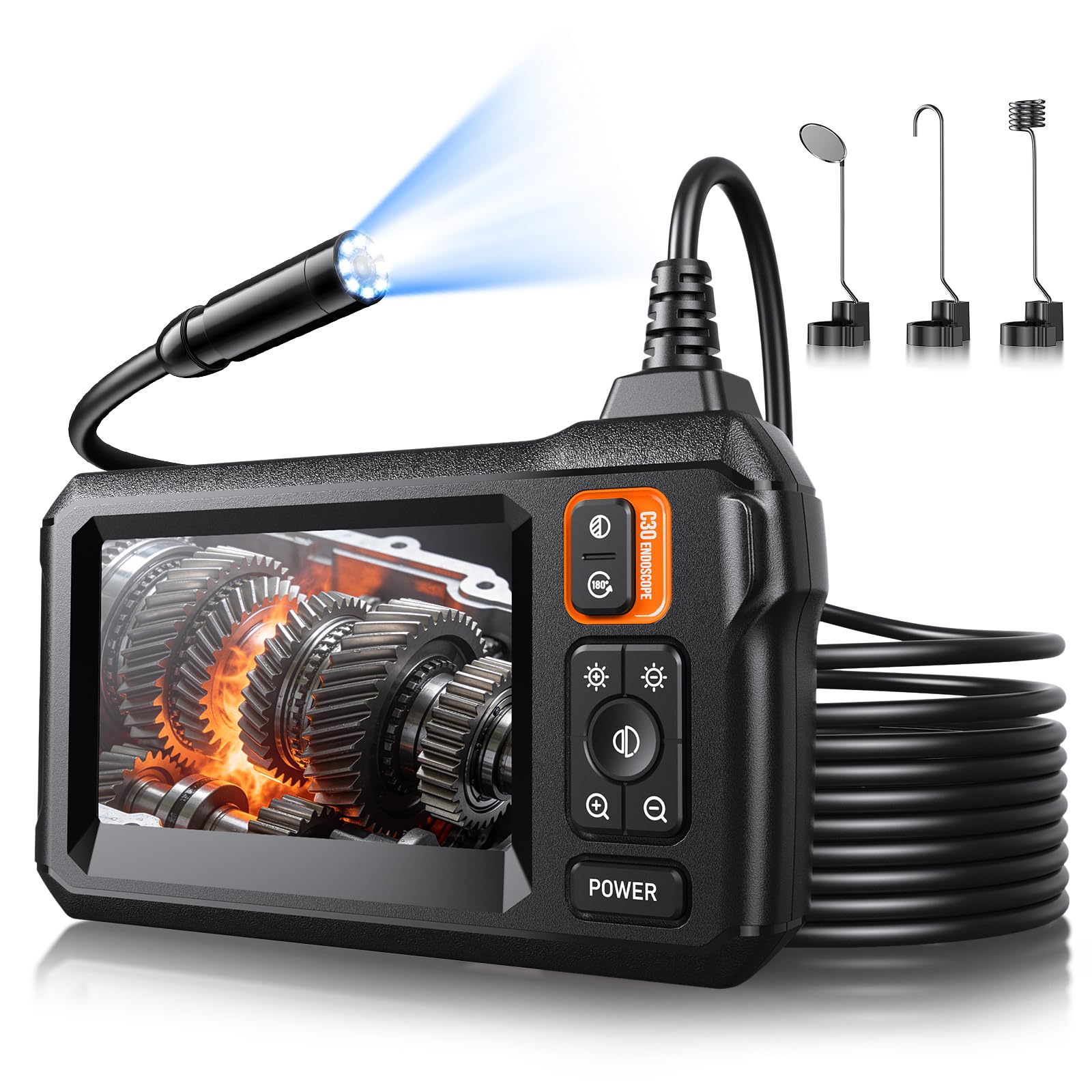
MugEasy 4.3-Inch Endoscope

91 /100
Kirk Score Outstanding
Zoom
4x digital
Probe
7.9 mm
Lights
8 LEDs
Screen
4.3 in IPS
Check Details on Amazon

Pros

  • No phone, app or pairing needed
  • 4.3 in screen with 8 dimmable LEDs
  • 16.5 ft semi-rigid cable

Cons

  • Stiff cable resists tight bends

No app, no pairing, no Wi-Fi. Press the power button, the 4.3-inch screen lights up, and you are looking. For anyone who has stood on a ladder watching a phone-based scope refuse to connect, that simplicity is the feature.

The hardware underneath is competent: a 7.9 mm probe on a 16.5-foot semi-rigid cable, eight dimmable LEDs and a lens that focuses from about half an inch out to six. It handles the jobs most people buy a scope for, behind a wall, under a floor, inside a duct, down a trap, and it runs off its own rechargeable battery over USB-C, so nothing depends on your phone staying awake.

As a first scope it is the one we point people toward, and the trade is a small screen. Fine detail is harder to read on 4.3 inches than on the 5-inch TGJOR. That is the whole compromise: you give up display size and get a tool that never asks your phone for permission in a crawlspace with no signal.

Bottom line: The one we hand to someone who has never used a scope: switch it on, look, and you are done, with no app to argue with.

Check Latest Price
#06

Budget articulation

Acoath Articulating Borescope

84 /100
Kirk Score Excellent
Cable
5 ft
Probe
0.33 in
Screen
4.3 in IPS
Articulation
210° two-way
Check Details on Amazon

Pros

  • 210° steering plus a side camera
  • 32GB card and protective case
  • 4.3 in IPS screen

Cons

  • Tip LEDs glare on shiny surfaces
  • 5 ft cable stops short of long runs

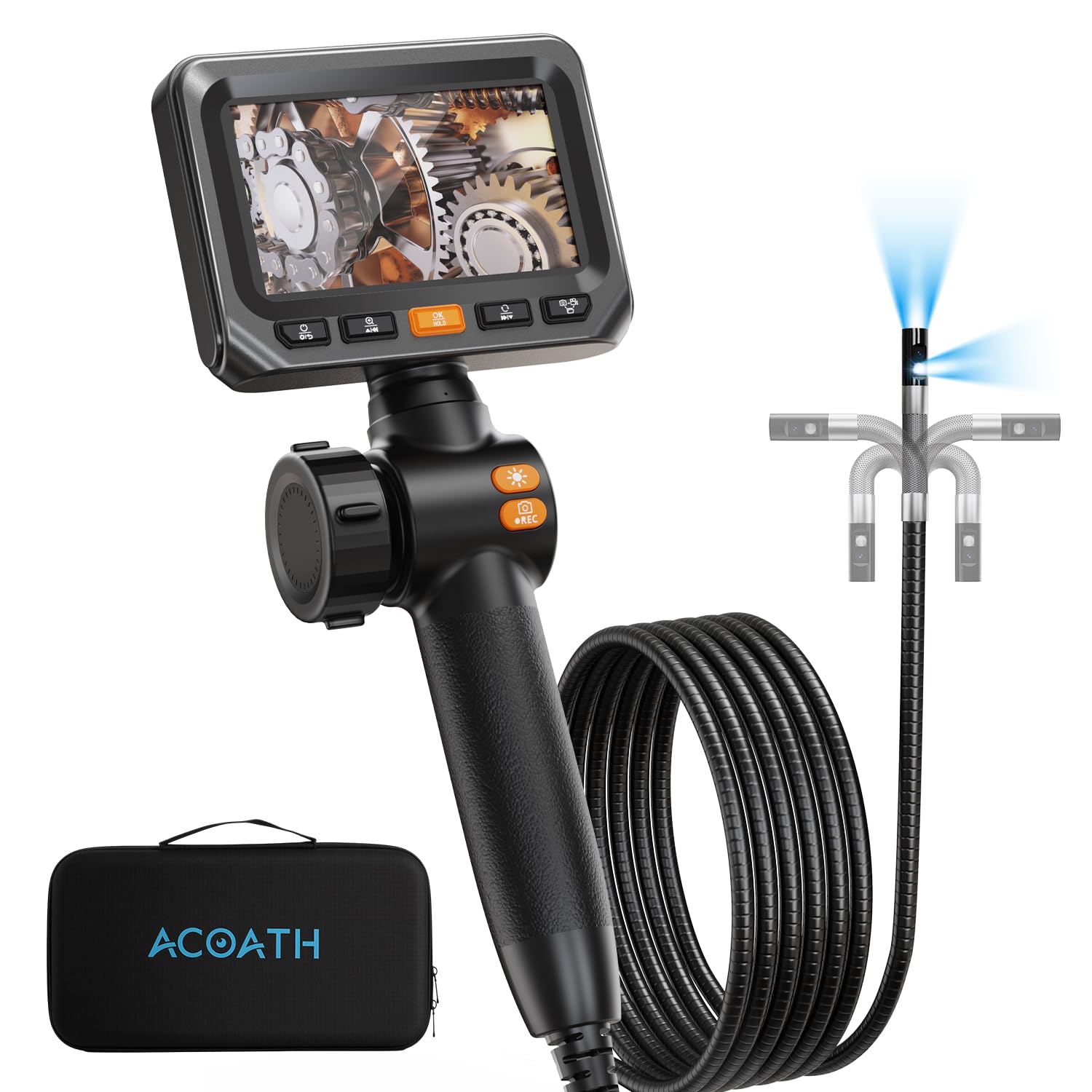
Two hundred and ten degrees of articulation, a second camera on the head and a 32GB card, for a good deal less than the flagship steerable scopes here. That is the Acoath's case, and on paper it is a strong one.

The dual-lens arrangement is the part we like most: a forward camera for going in, a side camera for looking around once you are there, which is the job that pushes most people toward a steerable head in the first place. The 0.33-inch head is thicker than the 0.24-inch probes but still slim enough for a duct joint or a gap behind trim, and the 4.3-inch IPS screen is sharp for the money.

Where it feels its price is the control. Steering takes a deliberate thumb and some patience, and it is not the second-nature one-handed adjustment of the Foxwell. On a tool you use a few times a year that is tolerable; on one you reach for daily, it would wear.

What it is, is the least expensive route to a steerable, dual-lens head in this group, and that earns it a place for occasional engine, HVAC and cavity checks. If the scope is going to pay for itself, the extra money on the Foxwell buys control and a warranty; if it is going to sit in a drawer between projects, this one covers the same ground.

Bottom line: The least expensive way into a steerable dual-lens head here, and a fair one for occasional engine, HVAC and cavity checks.

Check Latest Price
#07

Slim-space work

Daxiongmao Z91 Articulating Borescope

90 /100
Kirk Score Outstanding
Cable
5 ft
Probe
0.24 in
Screen
4.5 in IPS
Articulation
210° two-way
Check Details on Amazon

Pros

  • 0.24 in probe with 210° steering
  • 4.5 in IPS screen
  • 32GB card and carry bag

Cons

  • No warranty or overheat protection stated

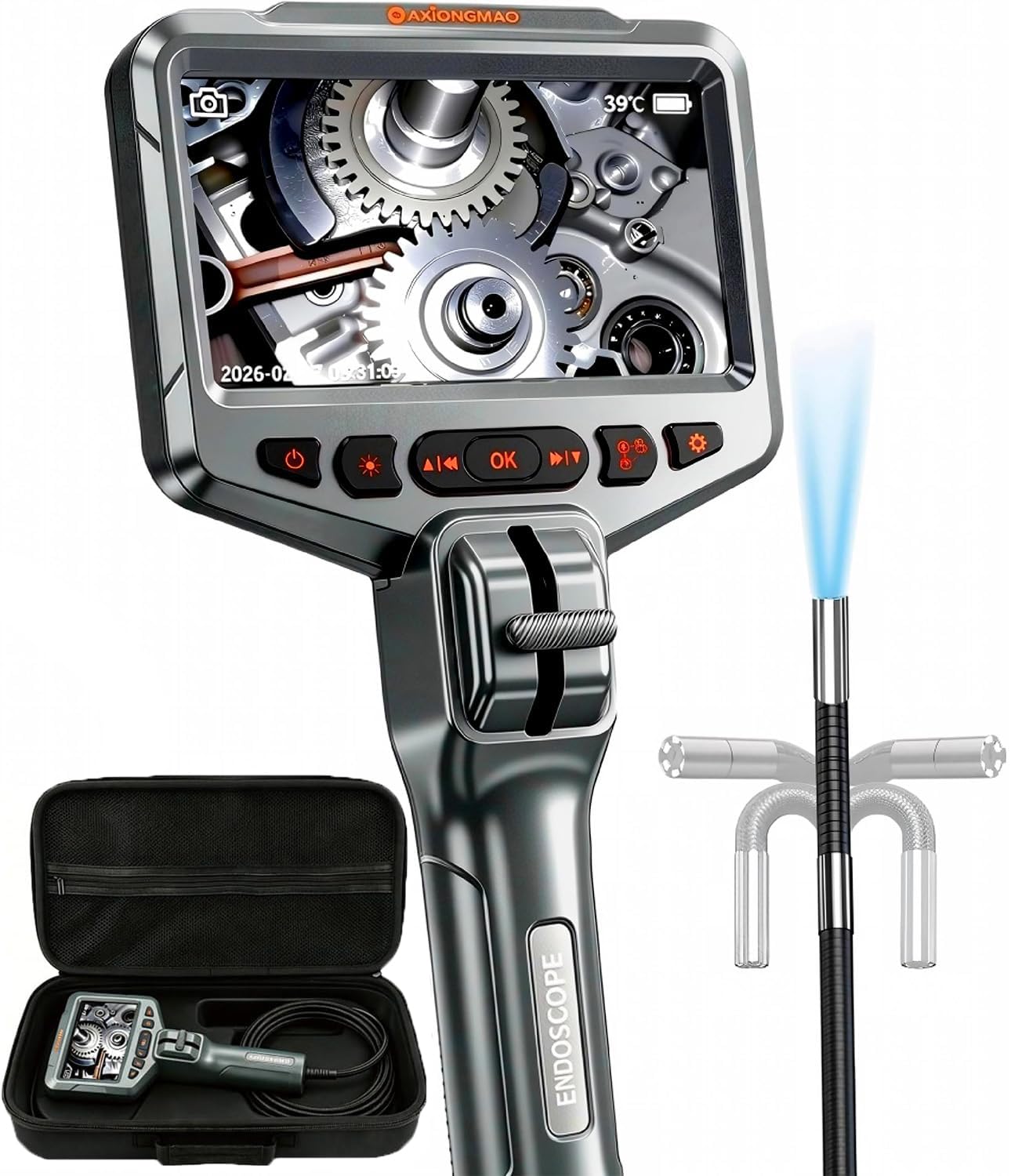
The Z91 is the other 0.24-inch steerable scope here, and it makes a similar case to the Foxwell for less money: a 4.5-inch IPS screen, 210 degrees of two-way travel, a 32GB card and a 5-foot semi-rigid probe in a soft carry bag.

The screen is a fraction larger, 4.5 inches against 4.3, and the probe is the same class, so it goes through the same small ports and past the same obstructions. Files save as plain JPEG and MP4, the 70-degree view suits close work, and the whole kit is light enough to leave in a tool bag between jobs.

What you give up is mostly invisible on a spec sheet. The Foxwell lists overheat protection and a one-year warranty; this one lists neither, and the case is a soft bag rather than a hard shell.

For a DIYer steering a camera around an engine bay a few times a year, we think that is a fair swap, and the smaller outlay leaves room for the long-cable scope you will want the first time a duct is involved. If the tool has to earn its keep, the warranty and the protection are worth the difference.

Bottom line: Nearly the top pick's specifications for noticeably less, as long as you can live without a stated warranty.

Check Latest Price
#08

Using your phone

Kinpthy W400-B Phone Endoscope

88 /100
Kirk Score Excellent
Cable
16.4 ft
Probe
7.9 mm
Stills
1920 x 1440
Connection
Lightning, USB-C, micro-USB
Check Details on Amazon

Pros

  • Uses your phone's larger display
  • 16.4 ft cable, 1920x1440 stills
  • Lightning, USB-C and micro-USB adapters

Cons

  • No zoom at all
  • Tip LEDs thin out in wide spaces

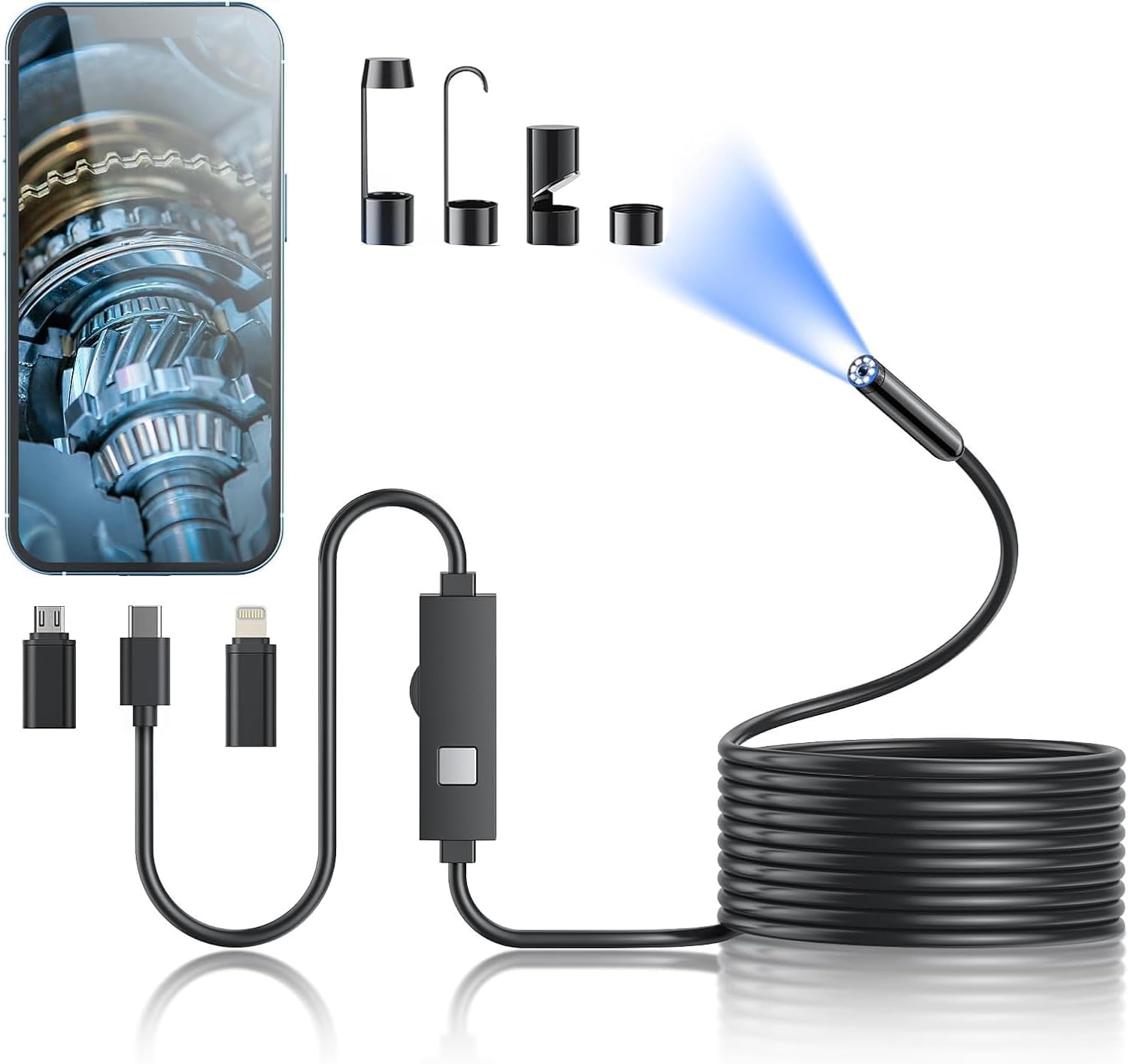
Your phone already has a better screen than any of these handles, and the W400-B is built to use it: plug the cable into the Lightning, USB-C or micro-USB port, open the app, and a 1920x1440 image fills a display you already know how to read. That is the appeal, right up until the phone does not recognize the camera.

The hardware is where we have no complaints. A 16.4-foot semi-rigid cable puts it alongside the longest scopes here, 1920x1440 stills are the highest figure in this group, and the kit includes a hook, a magnet, a mirror and all three adapters. The semi-rigid sheath holds a bend, so you can steer the tip by feel once it is inside.

The connection is the weak link, and it is the one thing that has to work. Plug-in scopes depend on the phone handing over the camera and the app cooperating, and when that fails there is no second way to view. Test it on your own phone the day it arrives, while the return window is open, and if the job cannot be rescheduled, buy one of the screen models instead.

Bottom line: A serious amount of reach and resolution for the money, as long as you test the connection on your own phone before you rely on it.

Check Latest Price

How We Tested These Borescopes

We started with every model we could find that offered either a screen built into the handle or a phone connection, then filtered by probe diameter, cable length, and whether the head articulated. That left 12 units, which we bought ourselves and lived with for six months.

Most of the work happened where these tools actually live: a garage, the cabinet under a kitchen sink, and a wall we'd opened after a slow leak. We ran each probe down a spark plug hole to read carbon on the cylinder walls, traced a condensate line through an HVAC closet, and pushed them past a P-trap to see how much of the pipe they lit up. Each one also went into a dark wall cavity, which is where brightness claims sort themselves out.

Picture quality got judged on real details—whether we could read a stamped part number, tell a hairline crack from a scratch, or make out a valve seat. Field of view decided which ones showed a whole pipe joint in one frame and which gave us a keyhole. We turned every articulating head through its full range with two fingers to see how precisely it steered and whether it held where we left it.

Cables were rated by feel: how far they drooped when held level, and whether a flexible one would round a 90-degree elbow that a stiff one refused. Durability came from a season of drops onto concrete and repeated bending at the strain relief. For the phone-based units we paired each with both an iPhone and an Android handset, timing the connection and checking whether the feed survived a pocket. Value was the final call—whether the extra money bought a sharper picture or just more cable.

How to Choose an Inspection Camera

Steering Versus Reach

These scopes split into two families, and the split is about reach rather than quality. Articulating models put a steerable head on a 5-foot gooseneck: you enter straight, then bend the tip to look sideways at a valve face or a duct wall. Fixed-lens models run a 16-foot semi-rigid cable and look wherever the cable points.

If you cannot roll the cable, inside a cylinder or past a baffle, buy the steering. If the target is 10 feet down a duct or a chase, buy the length. Few buyers need both, and the ones who do end up owning both.

What the Probe Will Fit Through

Tip diameter decides which openings you can inspect without taking something apart. A 0.24-inch probe, like the ones on the Foxwell and the Daxiongmao Z91, passes through small ports, fastener holes and the gap behind trim that stop an 8 mm head such as the Teslong NTS300 or the MugEasy.

If your target sits behind a narrow opening, check the diameter before anything else on the listing. If it is a duct, a drain or an open cavity, a thicker head is fine and usually brings a wider view with it.

Built-In Screen or Phone-Tethered

A screen scope is a complete tool: power on, look, no pairing, and your phone stays free. A phone scope puts the image on a bigger, sharper display, makes saving and sharing easy and usually costs less, but it depends on the phone recognizing the camera and the app behaving, which is the thing that goes wrong with phone-tethered scopes.

Our phone pick, the Kinpthy W400-B, is a lot of reach for the money. Test it on your own phone the day it arrives, while you can still return it. If the inspection cannot be rescheduled, buy the screen.

Light, Focus, and Which Numbers to Ignore

Resolution figures on these listings are optimistic and hard to compare across brands. The two specifications that change what you actually see are close-focus distance and light control. Most of these lenses focus within a few inches of the tip, from under an inch out to about six, so a scope that focuses at two inches shows a blurry piston from four.

Dimmable LEDs matter as much as bright ones, since a polished cylinder wall or wet PVC throws glare straight back at the lens. Look for adjustable brightness and a stated focus range, and treat 1080p claims as marketing until you see the picture.

Frequently Asked Questions

Final Verdict

The Foxwell Y400 is the borescope we point most buyers to: a 0.24-inch steerable probe, a bright 4.3-inch screen and a 32GB card in a hard case, with enough cable for an engine bay or a wall cavity.

Buy the Teslong NTS300 instead if your inspections are long runs, whether ducts, chases or drain lines, where 16.5 feet and a side camera solve a problem that steering cannot reach. Between them those two cover almost every job a homeowner or DIY mechanic brings to a scope.