// data-verified

Best Caulk Remover Tools of 2026

A sharp metal blade strips a decade of hardened silicone off a tub surround in one pass. Tilt it wrong and it takes the shine off the fiberglass with it. That trade-off — sharp enough to break the bond, gentle enough to leave the acrylic or tile underneath unmarked — is the whole game with caulk removers, and it's why two tools that look alike can end very differently for your shower pan.

I've recaulked every bathroom in my house, and I once gouged a pan edge with a plain putty knife because it was the only thing in the drawer. Over the past three months, my team and I worked through 16 caulk removers — plastic hook tools, stainless scrapers, razor-style scrapers with stacks of replacement blades, and multi-tools that smooth the fresh bead too — running them over tub surrounds, a kitchen backsplash, window frames, and a sink edge. What surprised me is that replaceable blades matter more than blade material: plastic dulls after a few feet of cured silicone, while a tool that takes refills keeps biting. The ones below stayed sharp and left the tile intact.

#01

Best Overall

Bates 5-in-1 Putty Knife 2-Pack

95 /100
Kirk Score Outstanding
Pack
2 scrapers
Handle
Wood
Length
7.75 in.
Blade Material
Stainless steel
Check Details on Amazon

Pros

  • Rigid stainless blade slides under cured beads
  • Two scrapers keep one in the toolbox and one in the house
  • Wood handle gives good leverage without flex
  • 5-in-1 tip handles corners and paint-can opening

Cons

  • Stiff blade can gouge soft or painted surfaces

Our top pick is not a specialty scraper. It is a two-pack of putty knives, and the one we kept reaching for during a weekend of tub and sink seams had a rigid stainless blade that slid under a cured bead instead of skating across it. The 7.75-inch length gives you enough handle to pull with control, and the wood grip does not flex when you lean into a stubborn line. The two-pack matters: one knife stays with the caulk, the other lives in the kitchen drawer.

What we liked most is the blade's composure. It is sharp enough to score the edge of old caulk and stiff enough to lift a long run without turning into a noodle. The 5-in-1 tip also earns its keep for opening a paint can or cleaning a corner, so it is not a single-job tool. The blade is stiff, which is exactly what makes it useful here.

Compare it with the dedicated hooks here and it gives up a little in a tight inside corner. For the long straight seams that make up most of a recaulk, though, the wide blade and the leverage are what we want. The second knife has already been borrowed for a stovetop scrape, which tells you how likely it is to stay within reach.

Bottom line: We tell most people to start with this two-pack: a rigid stainless blade and a comfortable wood handle do the real work for less than a specialty kit.

Check Latest Price
#02

Best for Recaulking Jobs

ALLWAY CT31 3-in-1 Caulk Tool

89 /100
Kirk Score Excellent
Handle
Soft-grip plastic
Weight
3.36 oz
Bead Profiles
3
Removal Blade
Stainless steel
Check Details on Amazon

Pros

  • Stainless removal blade gets under old caulk
  • Three bead profiles smooth fresh caulk
  • Soft-grip handle stays comfortable on small jobs

Cons

  • Silicone smoothing triangle can tear with heavy use

A caulk tool that removes and smooths can feel like a compromise, but the CT31 is the one here that makes the combination work. The removal end is a proper stainless blade, not a plastic fin, and the handle is light enough at 3.36 ounces to control in a shower surround. We used it on a tub seam where the old bead had gone hard at the edges; the blade got underneath, and the silicone triangle left a cleaner line than a finger alone.

The smoothing end is the part that makes it worth keeping: three bead profiles, a rotatable triangle, and a soft grip that stayed comfortable through a small recaulk. On thick, fully cured silicone the removal blade needed a few passes, and we found that letting the blade work instead of forcing it saved the surface. This is a tool for the person who is already buying a tube of caulk and wants to remove the old bead and finish the new one without changing tools.

This is not the tool for a tile corner packed with old silicone; a metal hook does that better. It is the tool for the everyday recaulk, where the old bead is soft enough to lift and the new bead needs a tidy edge. The small size means it disappears into a drawer, which is exactly where we found ours when the next tub seam started leaking.

Bottom line: Buy this if you are recaulking a tub or shower and want one small tool to lift the old bead and shape the new one with a clean edge.

Check Latest Price
#03

Best for Stubborn Silicone

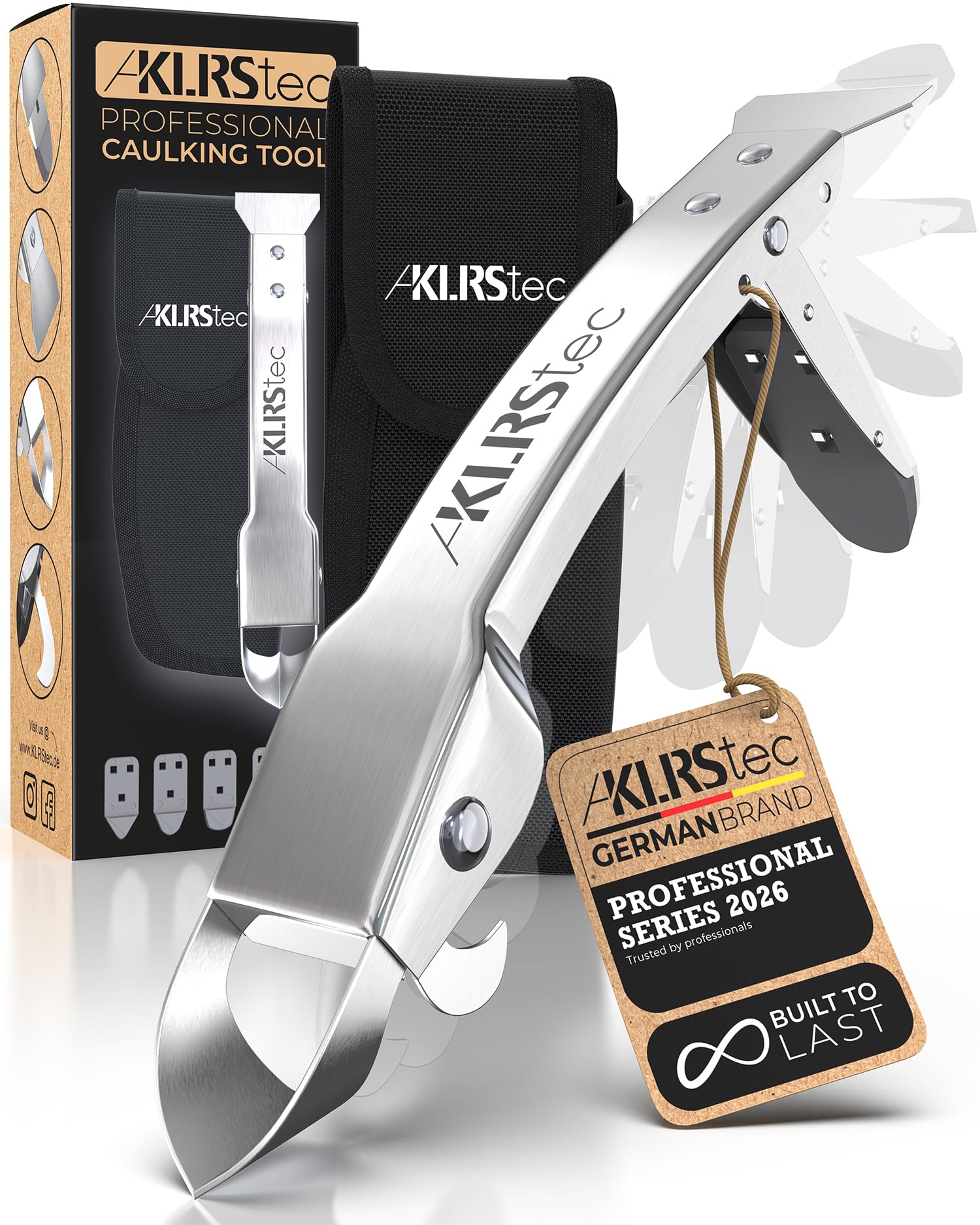
KLRStec Stainless Caulk Removal Kit

88 /100
Kirk Score Excellent
Length
7.87 in.
Weight
5.6 oz
Material
Stainless steel
Silicone Pads
10
Check Details on Amazon

Pros

  • All-stainless body resists bending on cured silicone
  • 90-degree blade and corner hook reach narrow joints
  • Ten silicone pads add finishing flexibility
  • Folds into a compact kit with belt bag

Cons

  • Premium price for occasional caulk jobs

When a bead of silicone has cured into a hard, thin ridge, a plastic scraper tends to skate over it. The KLRStec's 90-degree stainless blade is the one that bit in during our tile-and-tub work, and the corner hook reached the inside joint where a flat putty knife could not. The all-metal body does not flex, which is the difference between a controlled pull and a scraper that bends away from the caulk.

At 5.6 ounces and 7.87 inches, it feels more like a small specialty tool than a disposable scraper. The fold-out smoothing arm and ten silicone pads are a real bonus if you are laying a new bead, but the removal end is why we kept it out of the bag. We liked the storage pouch with the belt clip more than we expected; it keeps the hook and pads together instead of loose in a drawer.

The trade-off is specialization. It is more tool than someone needs for a single thin bead, and the narrow hook asks for a light angle on drywall or soft grout. For a bathroom recaulk with old silicone in the corners, it is the one we pack first.

Bottom line: Choose this when the old silicone has cured hard in a tile corner; the all-steel hook and 90-degree blade give you control a plastic scraper cannot.

Check Latest Price
#04

Best Heavy-Duty Painter's Tool

Red Devil EZ Grip Knife

92 /100
Kirk Score Outstanding
Handle
Ergonomic grip
Length
9 in.
Functions
7-in-1
Blade Material
High-carbon steel
Check Details on Amazon

Pros

  • High-carbon blade stays rigid under prying
  • Seven functions cover caulk, paint, and trim tasks
  • Blade extends through handle for strength
  • Nail-setting head adds a useful third hand

Cons

  • Rusts if stored wet

If you want one tool for a painting job that includes caulk, the EZ Grip Knife is the one we reached for. The high-carbon blade runs through the handle, so it stays rigid when you pry under a bead, and the 9-inch length gives you room to pull with control. It is a painter's multi-tool first, with a putty knife, scraper, gouger, and nail setter in one body.

We used it on a shower stall where the old caulk had pulled away from the tile; the stiff blade got behind the edge and lifted a long section without folding. The wide blade is less precise in a narrow inside corner, and a dedicated hook is the better choice there. That is the honest split: it is excellent for long seams and paint scraping, not a surgical corner tool.

The handle is comfortable enough for a long session, and the blade holds an edge well enough for detailed work. It is not a delicate tool; the same stiffness that makes it good at prying makes it a poor match for soft fiberglass or a painted sill. Keep a plastic scraper nearby for those surfaces.

The surprise was the nail-setting head. We tapped a loose trim nail back before scraping the bead, and it saved a walk to the toolbox. That is the detail that makes this the multi-tool we recommend for a painting job that includes caulk.

Bottom line: This is the painter's multi-tool we recommend for a job that mixes caulk, paint, and trim, as long as you do not need a surgical corner hook.

Check Latest Price
#05

Best for Delicate Surfaces

FOSHIO Plastic Razor Scraper Set

93 /100
Kirk Score Outstanding
Scrapers
2
Scraper Size
1.6 x 3.9 in.
Blade Material
Plastic
Included Blades
100 double-edge
Check Details on Amazon

Pros

  • Plastic blades scrape without metal scratch risk
  • 100 double-edge blades keep the tool working
  • Angled heads give control on flat glass
  • Lightweight handle is easy to keep on a job

Cons

  • Plastic blades can snap under a hard edge

Plastic blades sound like a compromise for caulk, and on hard silicone they are. On a painted windowsill or a fiberglass panel, though, that compromise is the point: the FOSHIO scraper lets you lean into a label or a thin bead without the sickening scratch of metal. The angled head and the 1.6-by-3.9-inch body give you more control than a bare plastic razor, and the two scrapers mean one can live with the decal kit.

The 100 double-edge blades are the reason it keeps working; changing one is quick, and the plastic edge conforms to a curve instead of digging in. We used it on a glass panel and a painted trim board, and it was the tool we handed over when someone was nervous about the surface. It is not the first thing we pick for a thick tub seam; a metal blade does that faster.

What we did not expect was how often the second scraper got used for stickers and adhesive around the house. For delicate scraping, that versatility is the value. Keep the metal tools for the hard cured caulk and let this one handle the surfaces you care about.

Bottom line: Keep this set for glass, fiberglass, and painted trim where a metal blade is too risky; it is not the first tool for hard tub silicone.

Check Latest Price
#06

Best Budget Two-in-One

YUUMEA 2-Pack Razor Scraper

93 /100
Kirk Score Outstanding
Blades
12 plastic, 7 metal
Material
ABS
Scrapers
2
Dimensions
4.7 x 1.8 x 0.4 in.
Check Details on Amazon

Pros

  • Two handles and 19 blades cover household scraping
  • Metal and plastic blades suit different surfaces
  • Compact curved handle fits tight spaces
  • Safety cover and knobs add control

Cons

  • Plastic blades are the weaker half of the kit

The YUUMEA kit is the budget two-pack here: two handles, twelve plastic blades, and seven metal blades in a compact 4.7-by-1.8-inch body. One side takes the metal blade, the other takes plastic, so the same tool can move from a windshield sticker to a glass cooktop. The small size is the first thing you notice.

What we liked is the two-sided convenience: the metal side cuts, the plastic side lifts without the same scratch risk, and switching is faster than changing a blade. The clamp is the part to watch. We tightened the knob before each pass after it crept once, and that is a habit worth building into the tool. With that check, it handled light caulk and adhesive cleanly.

It is not the tool for a thick, fully cured silicone bead in a shower corner; the blade is small and the handle is short. For a first scraper, a spare in the garage, or a household tool kit, it earns its place. The second handle went into the glove box, where it has already dealt with a parking sticker.

Bottom line: This is our budget pick for a household scraper you can keep in two places; check the blade clamp, and do not expect it to replace a metal caulk hook.

Check Latest Price
#07

Removal plus finishing

THINKWORK 4-in-1 Caulking Tool Kit

86 /100
Kirk Score Excellent
Weight
3.88 oz
Included
Scraper, trowel, joint tool, gloves
Material
Stainless steel
Silicone Pads
5 (3R to 17R)
Check Details on Amazon

Pros

  • Stainless body and tips handle old caulk and grout
  • Five silicone pads cover multiple bead sizes
  • Compact kit includes protective gloves
  • Pointed tips reach tile joints and tight corners

Cons

  • Silicone pads need a firm press to stay on

The part of the THINKWORK kit we ended up using most is not the scraper. It is the set of pointed tips and the five silicone pads, which turn a removal tool into something that can finish a bead without a separate smoothing tool. The stainless body is compact at 8.46 inches, and the 110-gram weight feels substantial without being tiring in a kitchen sink or a tile joint.

We used the flat scraper on old caulk around a sink and the pointed tip in the tile line; the hook end is less precise than the dedicated KLRStec when a joint is deep, but it is useful for lifting a corner. The five pads cover the usual bead sizes, and the included gloves are a small but welcome touch when the old caulk has gone gritty.

This is a kit for someone who wants removal and finishing in one compact set, not a pro who wants the most rigid scraper in the drawer. The pads need a firm press to stay on the finishing arm, and the hook is a secondary tool rather than the star. For a weekend recaulk, the convenience is real.

Bottom line: A sensible second-tier kit for a weekend recaulk when you want removal and finishing together, though its hook and pads are not the most precise here.

Check Latest Price

How We Tested the Best Caulk Removers

We started with the tools people actually reorder — hook-style plastic removers, stainless multi-tools, razor scrapers that ship with a stack of refill blades, and putty-knife hybrids — and cut anything that couldn't reach a 90-degree inside corner or offered only one fixed, non-replaceable edge.

Sixteen made the final cut and lived in a bucket in my hallway for three months. They got used on a tub surround with years of hardened silicone behind it, a kitchen backsplash, three window frames, the seam where a sink meets a countertop, and a pile of stubborn decals on glass. That meant working standing in a bathtub, kneeling on a counter, and leaning out a window, because that's where caulk actually lives.

Each tool got the same six-inch strip of old silicone as a first test. We timed the pass and noted whether the caulk lifted in a ribbon or crumbled into chips, whether the tip dug in or skated, and whether the surface underneath came out clean. Plastic blades were pushed until they skipped, then swapped for metal on the same seam, which is how we learned metal wins on glass and ceramic while plastic wins on acrylic and painted trim.

Build quality came down to abuse: handles got twisted, dropped on tile, and left sitting in a wet bucket. We counted refill blades and smoothing pads against what each tool cost, logged how many feet an edge cut before it dulled, and kept an eye on our own knuckles — a few designs leave a razor corner exposed right where your thumb goes.

How to Choose a Caulk Remover Tool

Start With the Blade, Not the Kit

Old silicone is elastic, so a soft plastic edge skates across it while a rigid metal blade shears underneath. For a hard bead on tile or glass, start with a stainless scraper or a stiff putty knife; for fiberglass, painted trim, or a surface you cannot risk, use a plastic blade. Width matters too: a broad putty knife covers a long seam quickly, while a narrow hook or pointed tip is what reaches an inside corner. We reach for the Bates knife on straight runs and the FOSHIO scraper when the surface is the thing we are protecting.

Blade Security Matters More Than Blade Count

Spare blades are useful only if the one in the tool stays put. Look for a clamp that tightens onto the blade, a seat that holds it flat, and a handle that lets you pull without your hand sliding forward. A blade that creeps sideways can scrape the wrong surface or leave a jagged edge. The all-metal KLRStec feels the most planted in this group; the plastic two-in-ones ask for a firm knob check before each session. Make that check a habit and a budget scraper becomes predictable.

Removal First, Finishing Second

If the old bead is the hard part, spend your money on the removal end. A combination tool earns its place only when the scraper is strong enough to do the real work; the silicone pads are a bonus for laying a new bead, not a substitute for a proper blade. The ALLWAY CT31 makes sense for a tub or shower recaulk because it removes and smooths in one pass. The THINKWORK kit goes further with five pad sizes, but its hook is less precise in a deep corner. Choose by the removal job first.

Plan for Corners, Cleanup, and Storage

Walk the joint before you buy. Long straight runs reward a wide, stiff blade, while inside corners and narrow joints need a hook or a pointed tip; a 90-degree blade is the one that sits flat against tile and glass. After the job, peel cured silicone off the tool, wipe latex or acrylic before it sets, and dry high-carbon steel before it goes back in the drawer. Store loose blades in their own container, not loose in a pouch. The right tool is the one you can find and handle safely next time.

Frequently Asked Questions

Final Verdict

For most people, the Bates 5-in-1 putty knife two-pack is the caulk remover to buy first: a stiff stainless blade, a comfortable handle, and a second tool for the drawer make it the most useful default in this group. If you are fighting thick, fully cured silicone in a tile corner, the KLRStec's all-metal hook is worth the step up. And if you plan to lay a new bead in the same session, the ALLWAY CT31 earns its place by smoothing what it removes.