// data-verified

Best Circular Saws of 2026

A corded circular saw will cut all afternoon and never ask you for a charger. A cordless one follows you up a ladder, out to a fence line, and into a backyard with no outlet in sight. That tradeoff sits underneath almost every decision in this category, and it's usually the first thing I weigh when I pick one up — right before I check how the thing actually tracks through a 2x4 and whether the base stays where I set it.

I learned that lesson the hard way on a borrowed saw that wandered a quarter inch off my line through every cut. Since then I've been picky. Over the past eight months, my team and I have put 12 saws through real work — corded and cordless, worm drive and sidewinder — crosscutting framing lumber, ripping plywood, and making enough bevel cuts to know which bases drift. One piece of wisdom worth having before you shop: a 6-1/2-inch blade gives up roughly an inch of cut depth to a 7-1/4-inch one, which only matters the moment you tilt the base for a 45-degree cut.

Weight, price, and how long a battery really lasts all shaped the final list as much as raw power did. What follows is sorted by the kind of cutting you actually do, so start there.

#01

Best Overall

DEWALT DWE575SB

96 /100
Kirk Score Outstanding
Weight
8.8 lb
Blade Size
7-1/4 in.
Power Source
Corded, 15 amps
Max Depth At 90°
2-9/16 in.
Check Details on Amazon

Pros

  • Deepest cut of the corded saws here at 2-9/16 in.
  • 8.8 lb with a 15-amp motor
  • Electric brake settles the blade between cuts
  • 57-degree bevel with stops at 22.5 and 45

Cons

  • Corded

At 8.8 pounds, this is as light as any full-size corded saw in this group, and lighter than the two premium models by a margin you feel by the third sheet of plywood or the tenth cut from a ladder. The SKIL 5280 weighs within an ounce of it, but gives up the brake and six degrees of bevel to get there. The 15-amp motor turns a 7-1/4-inch blade at 5,200 rpm, cuts 2-9/16 inches deep at 90 degrees, and bevels to 57 with positive stops at 22.5 and 45.

The electric brake is what we came back to. It slows the blade hard rather than stopping it dead — count a couple of seconds after you let off the trigger — but that's enough to set the saw down between cuts instead of standing there waiting for it to wind down. The depth and bevel levers lock down firmly, so settings survive a ride in the truck. A carbide blade, a wrench, and a contractor bag come in the box, which means you can cut the first board without another trip.

The cord is the trade you make. This saw wants an outlet and a properly heavy extension cord — fine in a garage or a house mid-renovation, a nuisance at the far end of a yard. Everything else about it is a compromise we're glad to live with: enough power for hardwood, light enough to control with one hand, and simple enough that a blade change or a bevel set takes a minute.

Bottom line: We tell most people to buy this one: it cuts deeper than any other corded saw here, adds a brake and a 57-degree bevel, and stays light enough to steer with one hand.

Check Latest Price
#02

Best for Clean, Accurate Cuts

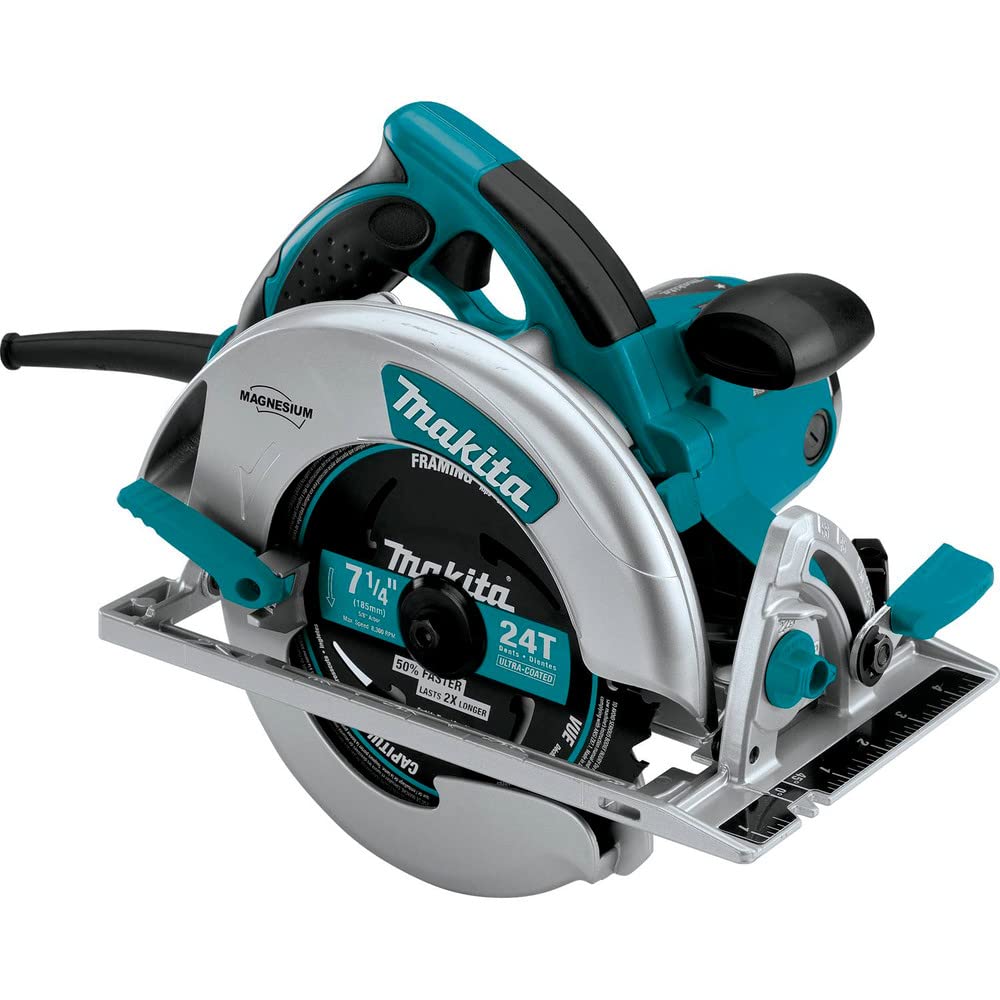
Makita 5007MG

95 /100
Kirk Score Outstanding
Weight
10.6 lb
Blade Size
7-1/4 in.
Power Source
Corded, 15 amps
No-load Speed
5,800 rpm
Check Details on Amazon

Pros

  • 5,800 rpm leaves cleaner edges in plywood
  • Two built-in LEDs light the line of cut
  • Rip fence and hard case included
  • Bevels 0-56 degrees with positive stops

Cons

  • Lower guard takes coaxing on deep bevel cuts

The 5007MG is the saw we reach for when a cut has to be right the first time. Its 15-amp motor spins at 5,800 rpm, as fast as anything in this group, and the higher blade speed leaves a cleaner edge in plywood and trim than the slower saws here. Two LEDs sit just behind the blade and light the line of cut — a detail we expected to be a gimmick and ended up relying on every time the work went under a bench or into a dim garage.

What the premium over our top pick buys is that light, the extra speed, and a hard case with a rip fence inside it. The fence is the piece we miss whenever we pick up another saw on this list, and the case packs flat with the guard closed. The 2-1/2-inch depth at 90 degrees and the 0-to-56-degree bevel with stops at 22.5 and 45 cover everything from decking to stair stringers.

Weight is the trade. At 10.6 pounds this is a bench-and-framing-floor saw rather than one you'll happily run overhead, and it's the heaviest of the corded sidewinders here. If your cuts are mostly sheet goods broken down on sawhorses and trim that has to fit on the first pass, those are two easy pounds to carry.

Bottom line: When clean edges matter more than a light saw, this is the one we hand you — the twin LEDs and the rip fence make accurate work easier.

Check Latest Price
#03

Best Worm Drive for Framing

SKILSAW SPT77WML-01

95 /100
Kirk Score Outstanding
Weight
11.5 lb
Blade Size
7-1/4 in.
Drive Type
Worm drive
Power Source
Corded, 15 amps
Check Details on Amazon

Pros

  • Worm drive tracks straight through long rips
  • 15 amps with a 53-degree bevel
  • On-board wrench and cut-ready depth scale

Cons

  • Heaviest saw in this group at 11.5 lb
  • No rip guide in the box

Framers have carried a version of this saw for decades, and the SPT77WML shows why. On a worm drive the motor sits behind the blade, so the weight is at the back and the saw pulls itself through the cut while you steer. On long rips in OSB and plywood that turns a push into a walk, and the blade stays in the kerf with almost no correction.

The 15-amp motor and 7-1/4-inch blade handle wet pressure-treated and engineered lumber without straining, and the 53-degree bevel covers the occasional splay cut. The cut-ready depth system sets from a visible scale instead of by eye, the anti-snag lower guard clears small offcuts, and the wrench stores on board so a blade change doesn't turn into a search.

What we like most is how little it asks of you once the shoe is flat on the material. That's worth it when your day is framing and sheet goods, and it's the wrong tool for trimming out a closet or cutting overhead — the same rearward balance that steadies a rip makes it awkward above your shoulders.

Bottom line: We choose the worm drive for all-day ripping: it tracks almost by itself, and the weight buys control you can feel in a long cut.

Check Latest Price
#04

Best Cordless for Corded Power

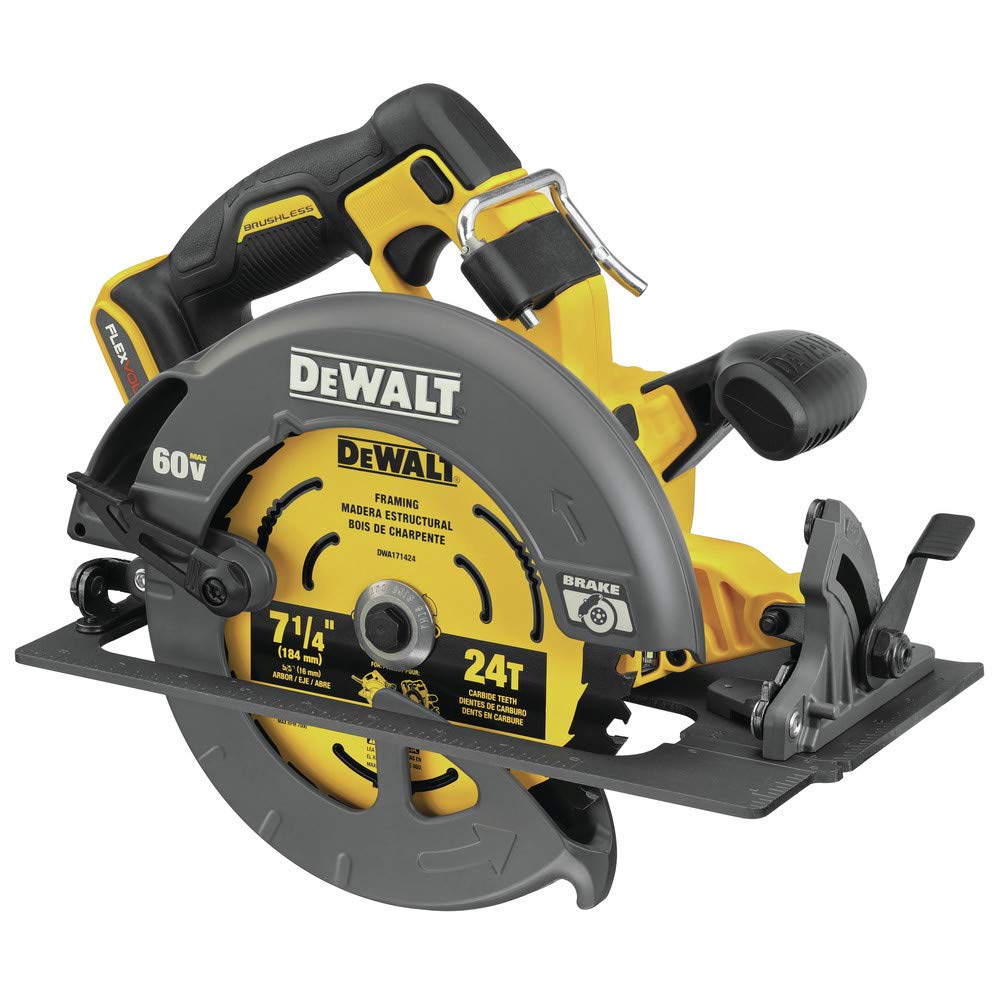
DEWALT FLEXVOLT DCS578B

93 /100
Kirk Score Outstanding
Weight
8.2 lb
Blade Size
7-1/4 in.
Power Source
60V battery, tool only
Max Depth At 90°
2-9/16 in.
Check Details on Amazon

Pros

  • Full 7-1/4 in. blade and 2-9/16 in. depth
  • 5,800 rpm with a brake and LED
  • 57-degree bevel with stops at 22.5 and 45

Cons

  • Runtime shortens noticeably on smaller packs

Open the box and you get a saw, a blade, and a wrench. No battery, no charger — and the packs it needs are 60V FLEXVOLT, which means the 20V MAX batteries from your DEWALT drill won't run it. That's the decision with this saw in one sentence: it's the closest thing here to corded performance without a cord, and the batteries are a separate commitment.

The performance part is real. A full 7-1/4-inch blade, 2-9/16 inches of depth at 90 degrees, 5,800 rpm, and a 57-degree bevel with stops at 22.5 and 45 — the same cutting envelope as the corded DEWALT we recommend, at 8.2 pounds. It moves through engineered lumber and 2-by stock without bogging, the brake brings the blade down fast between cuts, and the LED is genuinely useful in a shadowed corner.

Where it earns its place is a site without a convenient outlet: decks, fences, a renovation with the power shut off. If FLEXVOLT packs are already in your shop from a miter saw or a grinder, this is the easiest cordless saw here to say yes to. If they aren't, the honest comparison is against a corded saw and a long extension cord, and the corded saw wins on weight and on money.

Bottom line: Our pick if you want corded power without a cord — budget for the 60V packs first, because the batteries you already own won't run it.

Check Latest Price
#05

Best Budget Corded Saw

SKIL 5280-01

93 /100
Kirk Score Outstanding
Weight
8.7 lb
Blade Size
7-1/4 in.
Laser Guide
Single beam
Power Source
Corded, 15 amps
Check Details on Amazon

Pros

  • 15 amps and 5,300 rpm at a budget price
  • Laser guide keeps the cut line visible
  • Dust blower and an 8.7 lb body

Cons

  • Depth-adjustment lever is the part that gives trouble

A laser on a circular saw sounds like a gimmick until you use one on a long rip. With the beam on the mark you keep your eye on the work instead of crouching to sight the notch, and the line stays visible while the blade is buried in the cut. The 5280-01 has one, along with a 15-amp motor at 5,300 rpm and a 51-degree bevel, and it costs less than any other corded saw here.

It cuts like a bigger saw. Fifteen amps and the 24-tooth carbide blade go through 2-by lumber and plywood without bogging, the dust blower keeps the line clear, and at 8.7 pounds it's within a few ounces of our top pick. The included blade is a framing blade, though — put a 60-tooth blade on for trim and cabinet work and the same saw leaves a much cleaner edge.

Set the bevel against a square the first time and it holds where you put it. For breaking down sheet goods, sizing 2-by, or trimming a door to length, it does what a homeowner asks, and it does it while costing less than everything else on this list.

Bottom line: On a tight budget with full-size cuts to make, we send you here: 15 amps, a laser line, and a clean edge once you fit a finer blade.

Check Latest Price
#06

Best Lightweight Cordless

Makita XSS02Z

94 /100
Kirk Score Outstanding
Weight
7.3 lb with battery
Blade Size
6-1/2 in.
Power Source
18V LXT, tool only
Max Depth At 90°
2-1/4 in.
Check Details on Amazon

Pros

  • 7.3 lb with a battery for one-handed control
  • Machined aluminum base stays flat
  • 2-1/4 in. depth at 90 with a 0-50 degree bevel

Cons

  • Tool only
  • Runtime shortens on repeated long rips

The cut we remember is a run of rafter tails overhead — one hand on the saw, one on the ladder. At 7.3 pounds with a battery aboard, the XSS02Z makes that comfortable: light enough to hold at chest height, short enough to fit between joists, and stable enough that the machined aluminum base stays flat when you only have one hand to give it.

It's a 6-1/2-inch saw, so the numbers are smaller: 2-1/4 inches of depth at 90 degrees, a 0-to-50-degree bevel, and 3,700 rpm. Cutting 2-by stock and 3/4-inch plywood to length is the whole job, and it does it without drama. A bevel eats into that depth quickly, so anything approaching a deep 45-degree cut in thick material belongs to a 7-1/4-inch saw.

What we didn't expect was how often we pick it up for one or two cuts instead of dragging out a corded saw. There's no cord to run and no extension cord to untangle, and the body is short enough to work in places a full-size saw won't fit. If LXT batteries are already in your shop, it's an easy addition to the kit.

Bottom line: For overhead and one-handed work this is the saw we grab: 7.3 pounds with a battery, a flat aluminum shoe, and a body short enough to fit between joists.

Check Latest Price
#07

M18 owners

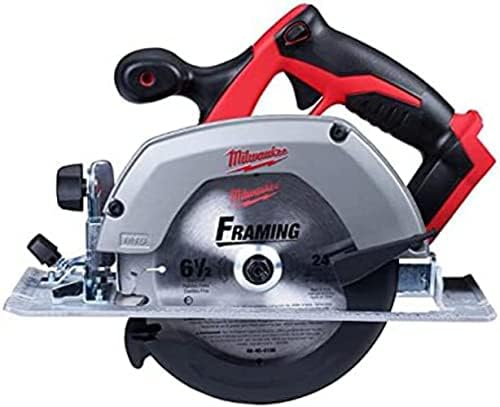
Milwaukee M18 2630-20

91 /100
Kirk Score Outstanding
Weight
7.3 lb
Blade Size
6-1/2 in.
Power Source
18V, bare tool
No-load Speed
3,500 rpm
Check Details on Amazon

Pros

  • Magnesium guards and a flat aluminum shoe
  • Comfortable over a long session at 7.3 lb
  • Quieter than most saws in this group

Cons

  • Bare tool
  • 6-1/2 in. blade limits depth in thick stock

At 3,500 rpm, this is the slowest saw in the group. The corded DEWALT and Makita spin at 5,200 and 5,800, and every other cordless saw here turns faster. In thin plywood you won't notice. In wet pressure-treated 2-by you will — the blade labors where a faster saw keeps its speed, and you find yourself pushing to make up the difference.

The bones are good. Magnesium upper and lower guards, an aluminum shoe that stays flat, a soft-grip handle that's comfortable over a long session, and 7.3 pounds with a battery on it. It crosscuts 2x4s accurately, it runs quieter than most of the saws here, and the 6-1/2-inch blade is easy to keep on a pencil line.

Where it fits is a home shop or a truck box where M18 packs already live. Crosscutting framing lumber and breaking down plywood are what it does, and it does them comfortably for an afternoon of work.

Our honest read is that this is a good saw that has been passed by. Brushless motors have moved the class on since this design, and within this group it offers the least to someone starting fresh. If you already own M18 packs and find one at a good price, it will earn its keep. We just don't see a reason to go looking.

Bottom line: We keep it in the roundup for the M18 owner who finds a deal: the guards and shoe are solid, but the blade speed is the slowest here and the batteries cost extra.

Check Latest Price
#08

Light DIY

Ryobi ONE+ P505

92 /100
Kirk Score Outstanding
Weight
4.1 lb
Blade Size
5-1/2 in.
Power Source
18V ONE+, tool only
No-load Speed
4,700 rpm
Check Details on Amazon

Pros

  • 4.1 lb
  • Clear lower guard keeps the blade visible
  • 50-degree bevel and a left side handle

Cons

  • Bare tool
  • Motor is the weak point when pushed hard

Four point one pounds is the number that sells this saw. Add a battery and it's still the lightest thing here by a wide margin, small enough to live on a shelf in a closet, and cheap enough to make sense as the only saw in a small house.

It's a 5-1/2-inch blade, which sets the ceiling on what it can do: crosscutting 2x4s and sizing 3/4-inch pine are its work, and it bogs down if you force it through anything heavier. The clear polyurethane lower guard is a genuinely nice touch — you can watch the blade meet the line instead of guessing — and the side handle on the left gives you a second grip without blocking your view.

Depth is the thing to check before you buy. The smaller blade means shallower cuts than every other saw here, so anything approaching full-depth work in thick stock belongs to a 7-1/4-inch saw. The bevel runs to 50 degrees, and the rubber overmold on the handles does help when your hands are damp.

As a grab-and-go saw for a homeowner with a couple of ONE+ batteries already charged, it's a sensible buy: light, easy to get into, and small enough to keep within reach. Just don't ask it to be the saw you frame a deck with.

Bottom line: We recommend it to homeowners already on the ONE+ platform who need light cuts — not to anyone planning a deck.

Check Latest Price

How We Tested Circular Saws

We started with every 7-1/4-inch and 6-1/2-inch saw we could get our hands on from brands we'd trust on a job site, then narrowed by what shoppers actually compare: corded versus cordless, worm drive versus sidewinder, blade size, and what comes in the box for the money. Anything with a base plate that flexed under hand pressure, a lower guard that dragged, or a price that didn't match its build got cut. That left 12 saws, which we've been using for eight months.

Most of the testing happened where these saws live — a deck rebuild and a garage shelving project. We crosscut stacks of 2x4s, broke down sheet goods on sawhorses, and ripped long boards to width. For cutting performance, we drew a line, cut freehand, and measured how far the blade drifted from it, then timed cuts through pressure-treated lumber and listened for bog-down when the motor hit a knot. We also cut with the blade buried deep and with only an inch of tooth exposed, because a saw that only behaves on shallow passes isn't much of a saw.

Blade adjustment got its own round of abuse. After every bevel change we re-checked the blade against a combination square to see whether the detents returned to true, and whether the locking knobs still held after a dozen or so adjustments. Each saw was weighed with its battery or cord, and the cordless models were run until they died so we could count cuts per charge and note how long a refill took. Durability got judged the unglamorous way: saws rode in a truck bed, sat down in grit, and were checked afterward for loose screws, wobbly base plates, and guards that no longer snapped back cleanly.

How to Choose a Circular Saw

Start With Power: Corded or Cordless

Corded saws give full power at any moment, weigh less for the same cutting capacity, and cost less. Cordless saws free you from outlets and extension cords, but the saw is only half the purchase: most of the models here are bare tools, so you are really buying into a battery platform. If you already own packs in one system, staying inside it usually settles the question. If you don't, price the saw plus two packs and a charger before you compare anything.

The trap is the tool-only listing. A cheap bare-tool price is not the price of a working saw, and a saw that shares nothing with the batteries on your shelf is a new system, not a deal.

Blade Size Sets the Depth, and Depth Sets the Jobs

Every circular saw's real limit is how deep the blade reaches at 90 degrees: the 7-1/4-inch saws here run 2-1/2 to 2-9/16 inches, the 6-1/2-inch models about 2-1/4, and a 5-1/2-inch saw less again. A 2x4 on the flat is only 1-1/2 inches thick, so most of these clear it easily. Tip the saw to 45 degrees, though, and the usable depth falls by roughly a third, which is where the smaller saws run out of room.

Check the depth rating at 90 degrees and subtract before you plan a bevel through thick stock. If your work is thin material and trim, a smaller blade is lighter and easier to control; if it's dimensional lumber at an angle, you want the 7-1/4.

Sidewinder or Worm Drive

A sidewinder puts the motor beside the blade, which keeps the saw light and the line of cut visible — that covers most of this list. A worm drive puts the motor behind the blade, moving weight rearward so the saw pulls itself through long rips. Worm drives are heavier and happiest in framing and sheet goods; sidewinders are better overhead, in trim, and for one-handed control. If you cut framing lumber all day, the worm drive earns its weight. If you cut a bit of everything, buy the sidewinder.

Pick It Up Before You Commit

Weight matters more than any figure on the box because it decides how long you can hold the saw where the cut actually is. The range here runs from about four pounds to 11.5, and the gap between an 8.8-pound saw and a 10.6-pound one shows up in your wrist by mid-afternoon. Handle the saw with a battery fitted if you can, and think about the position you'll cut in: overhead, on a ladder, or flat on sawhorses. Balance counts as much as the number.

Brakes, Lights, and Details Worth Paying For

An electric brake slows the blade when you release the trigger. None of them stop it instantly — a second or two is normal — but that's enough to set the saw down safely between cuts, and it makes a run of short cuts noticeably faster. Lights and lasers earn their place if you work indoors or in poor light: twin LEDs flood the line of cut, a laser projects it, and a dust blower keeps sawdust from hiding either one.

Bevel stops at 22.5 and 45 degrees save setup time on repeat work, and a rip fence in the box is a small thing you notice most when it's missing.

Frequently Asked Questions

Final Verdict

Most people should buy the DEWALT DWE575SB. It cuts deeper than any other corded saw here at 2-9/16 inches, adds a brake and a 57-degree bevel, and stays light enough at 8.8 pounds to steer with one hand along a straightedge. The cord is the only real compromise, and a garage or a renovation site has outlets.

If your cuts have to be right off the saw, the Makita 5007MG's extra blade speed, twin LEDs, and included rip fence are worth the two pounds and the premium. If you're framing or breaking down sheet goods all day, the SKILSAW worm drive does the thing a sidewinder can't: it pulls itself through the rip.