// data-verified

Best Combination Square of 2026

A combination square is the one tool in your shop that can lie to you without making a sound. A head half a degree out of true doesn't feel wrong in the hand — it just draws a line a hair off, and you find out about it when the cabinet door gaps at the top or the stringer sits proud of the skirt board.

I learned that the slow way, trimming out a hallway with a square I'd owned for years. Since then my team has put 14 of them through six months of trim work, cabinet installs, stair layout, and weekend repairs, checking each against a known-true reference and living with it long enough to see what works loose. The blade is rarely the problem. The head, the lock bolt, and how those two meet are what decide it.

Cast iron outlasts zinc, hardened blades shrug off a drop onto concrete, and a reversible bolt earns its keep when you're working tight to a stud. Below are the ones worth their price, from a first-timer's budget pick to a head you'd hand down.

#01

Best Overall

IRWIN 1794469 Combination Square

95 /100
Kirk Score Outstanding
Head
Cast zinc
Weight
14.4 oz
Graduations
1/16 in.
Blade Length
12 in.
Check Details on Amazon

Pros

  • Heavy cast-zinc head stays put on the work
  • Black-etched scales don't rub off
  • Marks 45 and 90 and transfers measurements
  • Limited lifetime warranty

Cons

  • Thumb screw needs a firm twist to hold the rule

Twelve inches of stainless blade on a cast zinc head, 14.4 ounces in the hand — the IRWIN 1794469 has enough mass to sit flat on a board and stay there while you hunt for a pencil. The head gives you 45 and 90 degrees, the rule doubles as a depth gauge and a transfer tool, and the black-etched scales run in 16ths.

That weight is why it's the square we hand most people first. On a door slab or a sheet of plywood it stays where it lands instead of skating, the etchings don't wear away the way printed markings do after a few hundred passes through the head, and the price leaves room in the budget for a second square later. It is the least fussy tool in this group, and fuss is what you notice at the end of a long layout.

What you have to settle is squareness. A combination square is only a square if the head sits at a true 90 degrees, and the IRWIN's record on that is genuinely divided: many arrive dead on, and some don't. Check yours against a reference you trust the day it arrives, and if it's out, the limited lifetime warranty is the remedy.

What you give up is fine work. Sixteenths won't split a pencil line for a dovetail, and there's no metric scale on this blade, so the Starrett and the Johnson below take over where this one stops. Up to cabinet-grade layout, though, it's the square that leaves the drawer most often.

Bottom line: For most workshops this is the combination square to buy: heavy enough to stay put, etched so the numbers last, and priced so a second one is an easy call.

Check Latest Price
#02

Best for Precision

Starrett C11H-12-4R Combination Square

93 /100
Kirk Score Outstanding
Head
Cast iron
Weight
1.2 lb
Graduations
1/64 in. (4R)
Blade Length
12 in.
Check Details on Amazon

Pros

  • Satin-chrome 4R blade reads cleanly to 64ths
  • Cast-iron head holds its setting and sits flat
  • Hardened steel blade resists shop wear
  • Reversible lock bolt and scribe included

Cons

  • Heaviest square here at 1.2 pounds

The blade is the tell. The Starrett C11H-12-4R wears a satin-chrome finish, and its 4R graduations run in 8ths, 16ths, quick-reading 32nds, and 64ths that stay legible under a bench light where a polished blade throws glare back at you. Markings that fine are worthless if you can't see them, and the finish is what makes them usable.

The rest of the tool is built to match. The head is cast iron rather than zinc, the blade is hardened steel, and there's a reversible lock bolt and a scribe in the head. Cast iron is the difference you feel first: the square plants on a board and doesn't skate the way a lighter head can, even when you're marking one-handed.

We reach for this one when the work has to close — dovetails, hinge gains, machine setup, checking a plane sole. The precision shows up in the marking: once you've laid out a 64th off a satin blade, going back to a stamped 16th scale feels like guesswork. It is also the only square here that has never made us re-check a line twice.

Nobody needs to pretend it's a bargain in the ordinary sense. It costs many times what the IRWIN does, and for decks, fences, and framing that trade is a bad one. For furniture and small-scale work it's the last square you'll buy, and the price stops mattering about a year in.

Bottom line: If layout accuracy is what you're paid for, this is the square to own: the satin 4R blade and cast-iron head justify the price, and its weight is the only real cost.

Check Latest Price
#03

Best Inch/Metric

Johnson 400EM-S Combination Square

90 /100
Kirk Score Outstanding
Head
CNC-machined
Scales
Inch and metric
Graduations
1/8, 1/16, and 1/32 in.
Blade Length
12 in.
Check Details on Amazon

Pros

  • Inch and millimeter scales on one blade
  • CNC-machined head with clean 45 and 90 faces
  • Auto-lock assembly clamps with a twist
  • Made in the USA

Cons

  • Graduations stop at 1/32 inch

Millimeters on one edge, 8ths, 16ths, and 32nds on the other, all permanently imprinted into a stainless blade: the Johnson 400EM-S is the square for anyone who moves between the two systems, and that single feature is why we kept it in a group where several picks do similar work.

The blade is the practical part, etched and readable in ordinary shop light, with graduations that don't rub away under the head. The square head is CNC-machined, which shows in clean 45 and 90-degree faces, and the auto-lock assembly clamps the rule with a twist instead of a wind. It's also made in the USA, which some shoppers look for and we're glad to note.

The trade is heft. The zinc head is lighter in the hand than the cast-iron squares here, which is fine at a bench and a little less planted on a slick panel. If your plans are in millimeters and half your hardware came from overseas, that's a trade worth making.

Bottom line: For anyone whose drawings and hardware run in millimeters as often as inches, this is the square that stops the conversions.

Check Latest Price
#04

Best Value

Swanson TC132 Combination Square

92 /100
Kirk Score Outstanding
Head
CNC-machined zinc
Weight
12.3 oz
Graduations
1/32 in.
Blade Length
12 in.
Check Details on Amazon

Pros

  • 1/32 graduations at the lowest price here
  • Acrylic block vial resists drops better than tubes
  • Brass scriber and spring-loaded bolt included

Cons

  • Brass thumb wheel can break if the square is dropped

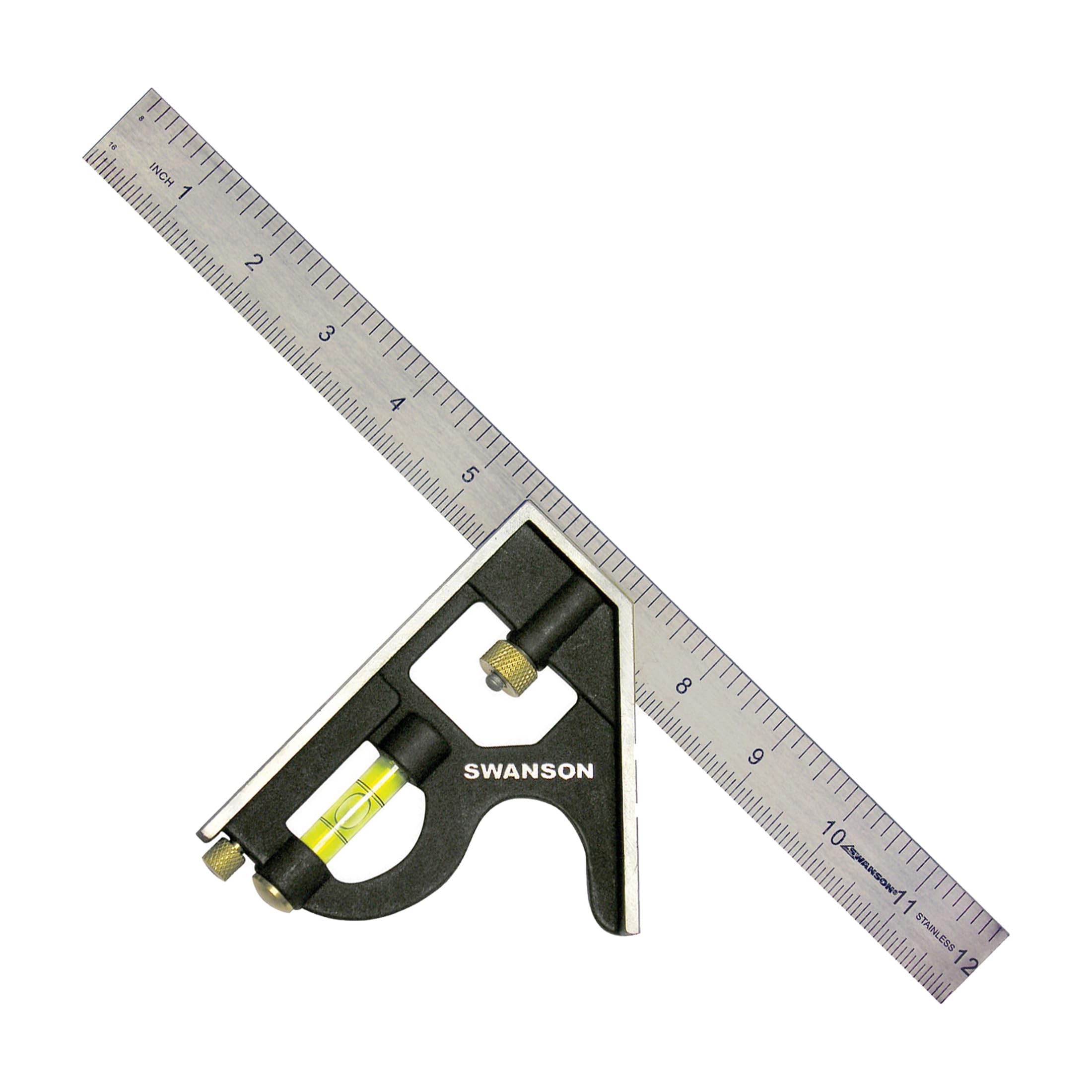
The Swanson TC132 is the least expensive square we kept, and it doesn't feel like a compromise in the hand: a CNC-machined zinc head, a black-etched stainless blade graduated to 32nds, a brass scriber, and a spring-loaded brass bolt that locks the head where you set it. For outfitting a first bench, this is the one we point to.

Two details earn it the spot. The 32nd graduations are a step finer than the IRWIN's 16ths, which matters the moment you're marking a reveal or a hinge leaf, and the vial sits in an acrylic block rather than a tube, the kind that survives the third time the square slides off a sawhorse. At 12.32 ounces it's a touch lighter than the IRWIN, and you feel that as a slightly less planted head on a slick board.

Squareness is the caveat. Some of these arrive true and some don't, which is the reality at the bottom of the price range: check yours against a trusted reference the day it lands and exchange it if it fails. Do that and you own a 32nd-reading square with a scriber and a vial for less than any other pick here.

Bottom line: If you want a 32nd-reading square without spending much, this is the one; check it for square the day it lands.

Check Latest Price
#05

Dual-scale layout

Arrow 12-Inch Combination Square

91 /100
Kirk Score Outstanding
Vial
Bubble level in head
Scales
Metric and SAE
Graduations
1/16 and 1/32 in.
Blade Length
12 in.
Check Details on Amazon

Pros

  • Metric and SAE markings on both faces
  • Textured handle holds in oily hands
  • Bubble level and copper draw pin built in

Cons

Two faces of markings — metric on one, SAE on the other, down to 32nds — plus a bubble level in the head and a copper draw pin for scribing. The Arrow packs a lot into a 12-inch square, and none of it feels bolted on as an afterthought.

In the hand it's a step up from the bargain-bin squares. The handle is textured, which sounds like a marketing line until your hands are oily, and the brass screw slides smoothly and locks where you leave it. That lock is the thing we test hardest on any square, and this one held through a morning of repeated marking at the same setting.

What keeps it out of the top tier is overlap rather than a fault. The Johnson does the same dual-scale job with a machined head and domestic manufacture for similar money, and the IRWIN is steadier for general layout. Where the Arrow earns its place is as the second square in the truck box or the one that lives in a kit — good enough to trust, inexpensive enough not to fret over.

Bottom line: A well-made dual-scale square that does its job without drama — buy it as a second square, or as a first one for a small kit.

Check Latest Price
#06

Compact metric work

Starrett 10MH-150 Student Square

90 /100
Kirk Score Outstanding
Head
Cast iron
Blade
Hardened and tempered steel
Scales
Inch and metric
Blade Length
150 mm
Check Details on Amazon

Pros

  • Cast iron head and hardened blade at a lower price
  • 150 mm blade fits into assembled cabinets
  • Inch and millimeter graduations on one rule

Cons

A 150-millimeter blade, just under six inches, on a cast iron head: the Starrett 10MH-150 is the compact square, the one that reaches into a cabinet carcass or a drawer box where a 12-inch blade fouls on the sides. The blade is hardened and tempered, and the graduations run in both inch and millimeter.

It's built like the bigger Starretts, which is what we want from a square this small. The head is cast iron rather than zinc, the blade is hardened and tempered steel, and the markings are crisp on a satin face. Starrett sells it as a student's and apprentice's square, and the lower price reflects the market it's aimed at rather than a lighter build.

Reach is the limit. A blade this short won't lay out a door, check a sheet of plywood, or mark a long 45 across a stair stringer, so it isn't a first square for most people. It's the second one — the square you keep in an apron and pull out for hinge gains, narrow stock, and checking a corner you can barely get a hand into.

Where it earns its place in this group is metric work at close quarters. If your drawings are in millimeters and your stock is small, this earns more use than any 12-inch square on the list, and it's the one tool here that disappears into a pocket without complaint.

Bottom line: The compact square to buy if your work is small, metric, or both — just don't make it the only one in the drawer.

Check Latest Price
#07

Conduit and panels

Klein 935CSEL Combination Square

91 /100
Kirk Score Outstanding
Body
Aluminum
Graduations
1/8 and 1/16 in.
Blade Length
12 in.
Rule Attachment
Magnetic
Check Details on Amazon

Pros

  • Magnet makes the rule quick to remove and reset
  • Conduit template and panel schedule on the blade
  • Machined 45 and 90 edges for saw setup

Cons

  • Magnetic rule can creep under a heavy hand

The Klein 935CSEL isn't a woodworker's square wearing orange paint; it's laid out for conduit. The 12-inch stainless blade is double-sided, with 1/8 and 1/16-inch graduations on one face and an electrical panel schedule and conduit layout template on the other, and the aluminum body has machined 45 and 90-degree edges for setting a miter saw or a table saw.

The rule is held by rare-earth magnets instead of a thumb screw, which makes this the quickest square here to change: pop the blade off to use as a straightedge, snap it back, no re-clamping. We found that genuinely useful during panel work, and the deeply etched markings mean the numbers survive all that sliding.

For an electrician marking knockouts and panel schedules, that speed is worth more than a clamp. The integrated conduit template does in one pass what a folding rule and a reference card do in three, and the machined edges let you set a saw without hunting for a second tool. As a specialist's square, it's a good one.

If you build cabinets, half of that blade is printing you'll never read, and the template is space you're paying for. Buy it for the trade it was designed for and it earns its keep; buy it for furniture and the thumb-screw squares here are the better answer.

Bottom line: For electrical layout this is the sharpest tool here: a magnetic rule you can pop off one-handed and a conduit template that replaces a reference card.

Check Latest Price
#08

Two-blade kit

iGaging 6 & 12-Inch Square Set

87 /100
Kirk Score Excellent
Case
Storage case with foam insert
Blades
6 in. and 12 in.
Graduations
1/64 in. (4R)
Blade Finish
Satin chrome
Check Details on Amazon

Pros

  • 6-inch and 12-inch 4R blades in one set
  • Satin-chrome blades read cleanly to 64ths
  • Foam-lined case protects both blades

Cons

  • Thumb nut can bind and need pliers to release

Two blades, one head, and a fitted case: the iGaging set gives you a 6-inch and a 12-inch 4R blade, both hardened, precision-ground, and satin-chromed, graduated to 64ths, with laser-etched markings. For a small shop that wants one purchase to cover bench and detail work, the package makes sense.

The machining is the pleasant part. The heads fit their blades with almost no slop, the edges are crisp, and we found the satin finish keeps the fine graduations readable under a bench light. Set beside the budget squares here it feels like a different class of tool, and the foam-lined case keeps both blades out of the drawer's gravel.

Squareness is the thing to verify. A square that isn't square is scrap, and this set's record on that score is less consistent than the Starrett's: check both blades against a reference before the return window closes, then re-check after the first drop.

What you're buying is range without a second purchase — the 6-inch blade for small stock and hinge work, the 12-inch for panels — plus a case that keeps them honest. For a shop that wants 64th graduations without Starrett money, it's the most economical route to both sizes, and the case is the part you'll appreciate longest.

Bottom line: Two well-machined blades and a case for a fraction of the Starrett's price — as long as you check both for square the day they arrive.

Check Latest Price

How We Tested the Best Combination Squares

We started by pulling spec sheets on several dozen squares and narrowing to 14: cast iron heads and zinc heads, imperial-only and inch/metric blades, plain and magnetic versions, and a spread of prices that runs from a student's first tool to a machinist's daily driver. Testing ran six months, and most of it happened where a square actually gets used — miter saw stations, cabinet installs, stair stringers, and a long string of small repairs around the house.

Accuracy came first. For each square we drew a line along a known-straight factory edge, flipped the square over, and drew the same line again from the other side; if the two lines diverged, the head was out. We checked every 45-degree face and every vial against a machinist's reference, then set each one on a bench we'd deliberately shimmed out of level to see whether the bubble actually moved. For the lock, we tightened the bolt the way you would in real use and pushed the head sideways with a thumb to see if it crept, and slid each head along its blade to feel for grit, slop, or rock.

Then we were careless with them. Each square got knocked off a bench onto a concrete floor, because that's what happens in a real shop, and we noted which blades dimpled and which heads picked up dings that made them sit unevenly. Magnetic heads went onto a saw table and a steel fence and got tilted to see whether they held. We checked graduations by eye and by fingernail — etched deep enough to catch, still legible after months in a tool bag — and used the scribe, the 45-degree face, and the blade as a depth gauge to see how much each one could do beyond marking a right angle.

How to Choose a Combination Square

Start with the blade length for your work

A 12-inch blade is the default because it spans a door stile and a cabinet side, lays out sheet goods, and marks a 45 long enough to cut to. A 150 mm or 6-inch square is for reaching into an assembled cabinet, checking a hinge gain, and living in an apron without poking you in the ribs. Buy the 12-inch first and add the small one when you catch yourself laying the big blade across finished faces just to check a corner.

Length doesn't buy accuracy, either. The head decides whether the tool is square, and a long blade on a sloppy head is a longer wrong line.

Match the graduations to how fine you actually work

Framing and trim live in 16ths, cabinet reveals want 32nds, and joinery, machine setup, and most metal layout want 64ths. It's easy to pay for fineness you never read, and easier still to buy a blade you can't read at all.

Contrast matters as much as the count. A satin or matte blade with deep etching stays legible under a bench light, while a highly polished blade throws glare exactly where you're marking. Work out the finest cut you actually make, then buy one step finer than that.

The lock is the part that fails first

Every square here adjusts; the question is whether it stays adjusted. A brass thumb screw or a spring-loaded bolt clamps the head to the rule and holds it through a hundred marks, provided it's snugged properly. The failure that ruins work is a rule that creeps mid-line, because you don't notice until the joint is cut.

Test it on the shelf: set the head, lock it, brace the blade against your palm, and push. If the setting moves, put it back. Magnetic holds are fast to adjust, but they are not clamps, and they belong on a specialist's tool rather than a layout square.

Head material decides how the square sits

Cast iron is the traditional choice and still the best on a bench: dense, planted, and able to take a knock without losing its setting. Zinc die-cast is the practical middle and what most affordable squares use, light enough to carry and heavy enough to stay put on a flat board. Aluminum is the lightest, which is what you want in a tool bag and not what you want when you're marking a slick melamine panel one-handed.

Buy cast iron for the shop and lighter metal for the pouch, and don't read a heavier head as a more accurate one.

Check it before you trust it

Any square can arrive out of true at any price, so test it on day one. Hold the head against a straight edge you trust, scribe a fine line along the blade, then flip the square over and scribe a second line from the same edge. The two lines should land on top of each other; if they diverge, the square is out and should go back while the return window is open.

Re-check after any drop, and store it in a case or a drawer rather than loose in a bag with chisels, where the blade takes hits and the head takes worse.

Frequently Asked Questions

Final Verdict

For most workshops we point people to the IRWIN 1794469: heavy enough to stay put, etched so the numbers survive, and inexpensive enough that a second one for the truck is an easy call. Check it for square the day it arrives and you're set for years of layout.

If your work lives in 64ths and you read markings under a bench light, the Starrett C11H-12-4R is the upgrade that earns its price. Work in millimeters as often as inches, and the Johnson saves you the arithmetic.