// data-verified

Best Construction Pencils of 2026

For years my pencil of choice was a flat carpenter's pencil, whittled to a nub with a utility knife. What broke the habit was a pilot hole I couldn't reach: the fat graphite slab that survives a drop onto concrete never fits where the mark actually matters, and it's dull again halfway through a cut list. A good construction pencil fixes both — a slim long-reach tip or a mechanical advance gets into deep holes and tight corners, and the graphite holds a point long enough that you're not sharpening every ten minutes.

We've spent the past three months working through 16 pencils and sets — some with built-in sharpeners, some with long nibs for deep holes, several with refills in five or six colors. What separates them has little to do with the packaging. It's whether the cap stays on inside a tool bag, whether the lead holds when you bear down on concrete, and whether a refill costs more than the pencil did. The picks below cover framing, finish work, and the marks in between.

#01

Best Overall

Pica-Dry 3030

95 /100
Kirk Score Outstanding
Length
5.91 inches
Lead Size
2mm and above
Sharpener
Built into the cap
Lead Hardness
2B
Check Details on Amazon

Pros

  • Sharpener built into the cap
  • Dark 2B line reads on rough lumber
  • Water-resistant body for wet stock
  • Light enough to keep in a shirt pocket

Cons

  • Clip and lead sleeve loosen with hard use

The sharpener lives in the cap, and that single decision is why this is the pencil we reach for first. Nobody on a site carries a knife sharp enough for a clean point, or walks back to the truck for a grinder, so the cap does the work: twist it off, dress the lead, twist it back on. No shavings on the bench, no hunting through a pouch for a tool.

As a do-everything marking pencil for lumber, this is the best one in this group. The 2B lead is dark enough to read across a framing bay, the lead is sized at 2mm and above so the mark survives a saw kerf, and the body is listed as water resistant — which matters more than it sounds when you are marking treated lumber that is still wet. At just under six inches and 20 grams it disappears into a shirt pocket, and the clip keeps it on an apron strap.

The lead is soft, and that is the trade for a line you can actually see. It dulls faster than a harder H lead will, so you twist that cap more often than you expect — but because the sharpener is attached to the pencil, a fresh point costs five seconds instead of a walk. Replacement leads come in other colors, which is handy for flagging a cut list or a second fix.

Bottom line: The one we recommend first: a pocketable pencil with a sharpener in the cap and a dark 2B line that reads on framing lumber.

Check Latest Price
#02

Best Value

Irwin 66400 6-Pack

96 /100
Kirk Score Outstanding
Lead Type
Medium, broad
Body Shape
Oval, will not roll
Pack Count
6 pencils
Lead Hardness
H
Check Details on Amazon

Pros

  • Lowest outlay of any pick here
  • Oval body will not roll off a bench
  • Broad lead marks rough and wet stock
  • Lead core does not crumble when sharpened

Cons

  • Arrives unsharpened, so the first one needs a knife
  • Wears down shorter with each sharpening

These are the cheapest pencils in the group, and still the ones we keep in the truck for whoever forgot theirs. There is no mechanism to jam, no cap to lose, and no lead to feed: the oval body sits flat on a bench or a roof deck without rolling away, and there is nothing on it that can break.

The lead is medium and broad, which is right for this job. It lays a fat, dark line across rough-sawn framing, and you can dress it finer with a block plane, a belt sander, or a utility knife when you move to trim. The wood is clean — no voids — so they sharpen without the core crumbling and dropping grit into the line.

Where a wooden pencil beats a mechanical one is the ugly surfaces. Wet pressure-treated boards, concrete formwork, anything with grit on it: a fine 2.8mm lead skates or snaps, and a broad carpenter lead just marks it. One for the bench, one for the saw horses, one for the jacket you actually wear to work — that is how a six-pack gets used up.

Bottom line: Six pencils for the least money here, and the ones we keep in the truck: no cap, no feed, no jam.

Check Latest Price
#03

Best Kit for Crews

Nicpro 12-Pencil Set

95 /100
Kirk Score Outstanding
Lead Size
2.8 mm
Nib Length
45 mm
Lead Colors
6 colors
Refills Included
52
Check Details on Amazon

Pros

  • Screw-on sharpener stays with the pencil
  • 52 refills across six lead colors
  • 45mm nib reaches into drilled holes
  • Thick 2.8mm lead resists snapping

Cons

  • Lead can crack inside the barrel after a drop

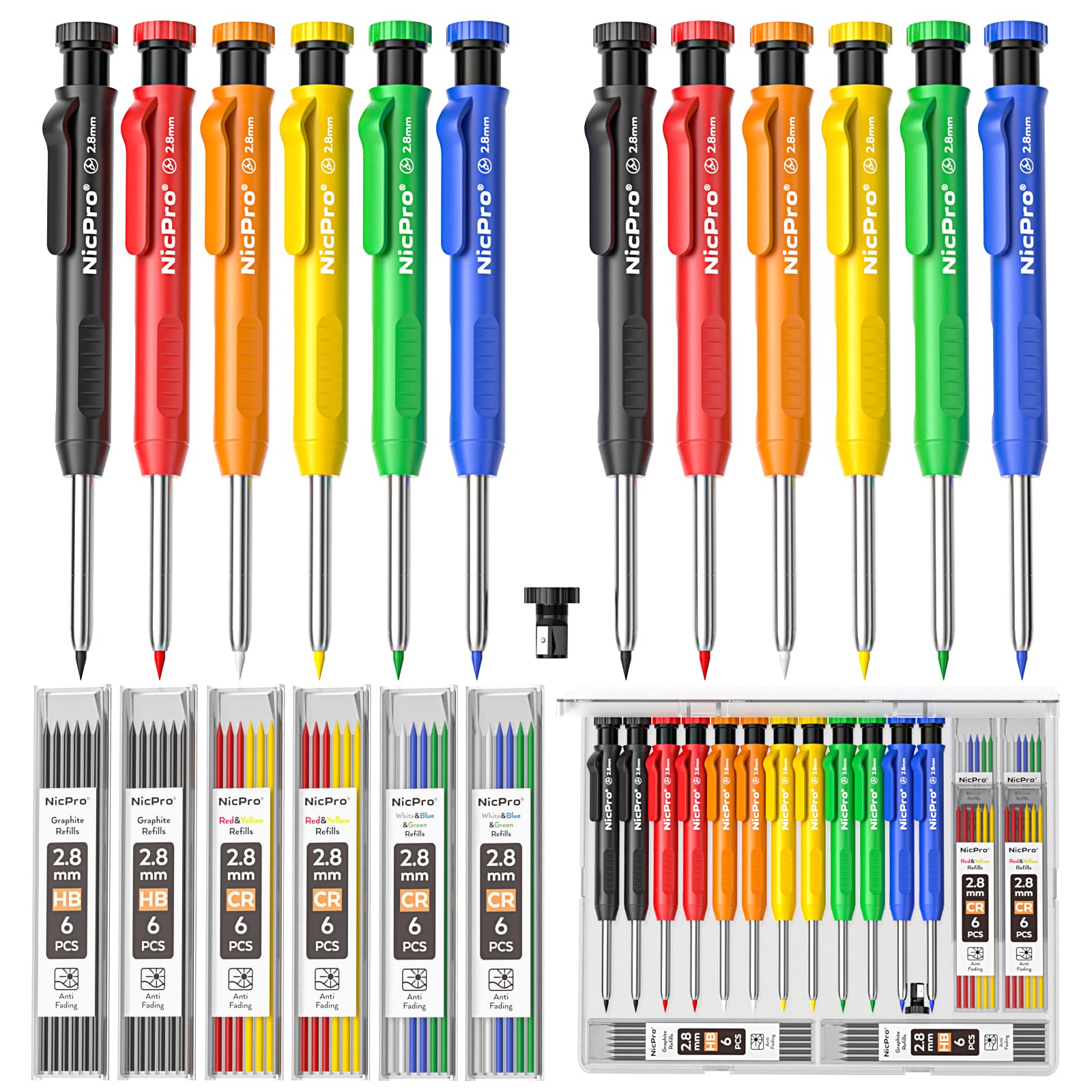
Twelve pencils and 52 refills in one box is more marking tool than most people need, and that is the pitch: this is the set you buy once and split across a crew, a shop, and a truck. Every pencil carries a 45mm nib, so the lead reaches into a drilled hole or a tight corner where a flat carpenter pencil stops at the surface.

The mechanism is what sold us. The sharpener screws into the top of the pencil instead of pushing on, so it stays with the pencil in a pouch rather than dropping off in the first week, and the 2.8mm lead is thick enough that ordinary marking does not snap it.

Six lead colors is the sleeper feature. Black graphite is right for clean lumber; the colored leads hold a visible line on darker or smoother stock, and you can give each trade on a remodel its own color so nobody's layout gets cut away. The collar occasionally needs a quarter turn to grip a fresh lead again, which is a two-second fix rather than a fault.

We recommend this set to anyone marking more than one material or splitting tools with a crew. It is the most complete kit here, and the per-pencil arithmetic makes the outlay easier to justify than a single premium pencil. Work alone and mark only lumber, though, and you are paying for eleven pencils and five colors you will never finish.

Bottom line: The kit we recommend for a crew: 12 pencils, 52 refills, six lead colors, and a 45mm nib for holes.

Check Latest Price
#04

Best for Deep Holes

Tracer AMK1 6-Pack

93 /100
Kirk Score Outstanding
Pack Count
6 pencils
Body Material
Metal
Lead Hardness
2B
Marking Reach
Up to 5.7 inches
Check Details on Amazon

Pros

  • 5.7 inches of lead reach
  • Metal barrel takes site abuse
  • Holster keeps it on a belt
  • Sharpener built into the cap

Cons

  • Lead cap can be knocked off in a pouch

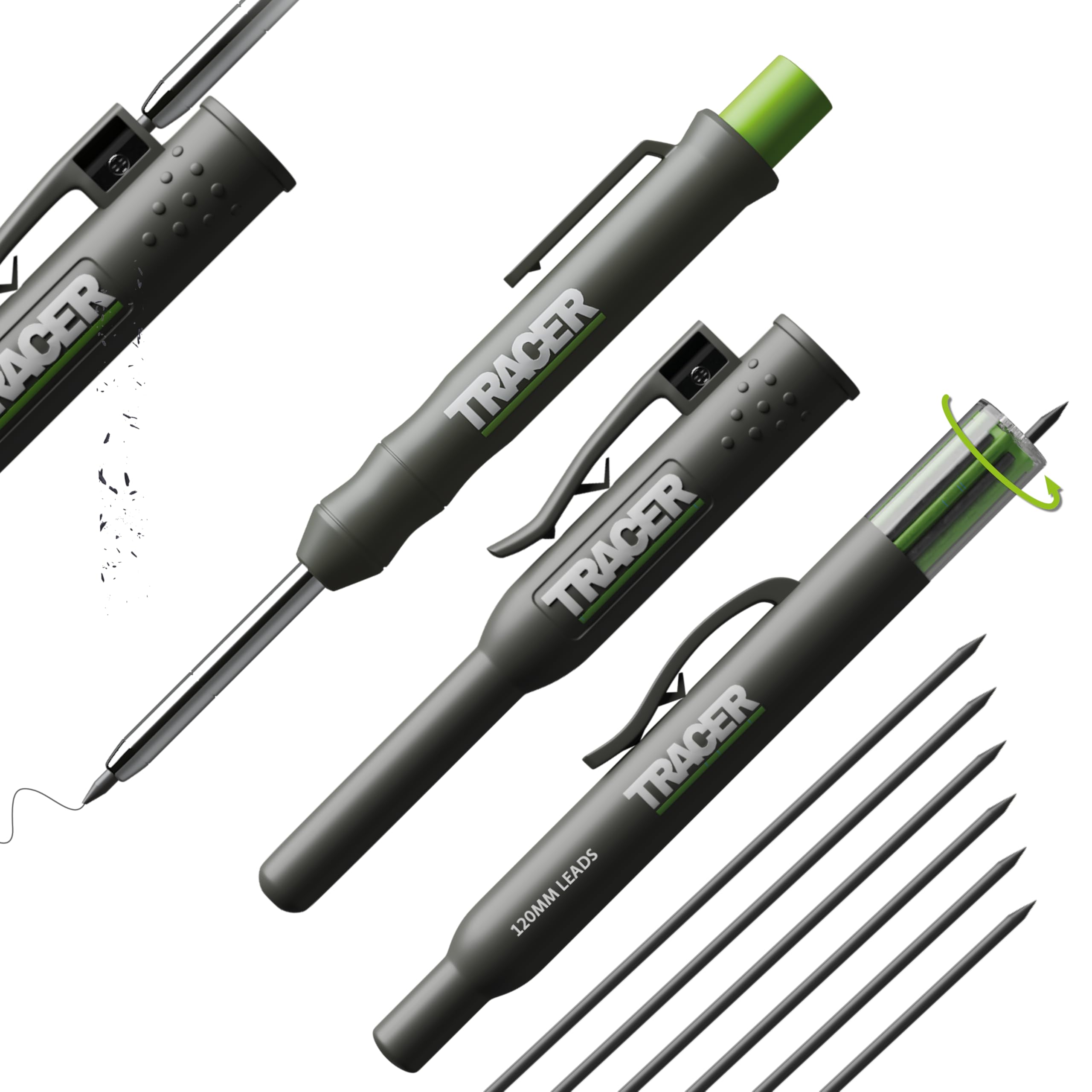
Most of the pencils here are plastic with a metal clip. This one is metal with a plastic clip, which tells you where Tracer put the money. The barrel is metal, the 2B lead extends out to 5.7 inches, and the point is blunt enough to survive being shoved back into a tool pouch.

Reach is what earns it a place. Marking through an existing hole — anchor points, bolt holes, a pilot drilled from the other side — is the job a flat pencil simply cannot do, and the Tracer's lead touches the bottom of a hole you cannot see into. If you hang cabinets, set anchors, or fit hardware all day, that is the feature that pays for the pencil.

The site holster is the second thing we appreciate. Clipped to a belt or a tool pouch, the pencil comes out and goes back with one hand, which is the difference between marking a board and setting it down to hunt. The sharpener sits in the cap, so a fresh point is a twist away at the top of a ladder. The holster clip itself is the part that ages fastest — treat it as a holder rather than permanent belt furniture.

Six pencils come in the set, which suits a tool this easy to set down and forget. It is not the pencil for finished trim or cabinet layout, where a bold 2B point leaves more line than a reveal wants. Where the marks land on framing, holes, and hardware, nothing else here reaches as far.

Bottom line: Our pick for deep-hole work: a metal barrel, 5.7 inches of lead reach, and a holster that keeps it on your belt.

Check Latest Price
#05

Best If You Hate Sharpening

Swanson AlwaysSharp CP216

92 /100
Kirk Score Outstanding
Tip
Chisel
Pack Count
2 pencils
Sharpening
None required
Refills Included
8 cartridges
Check Details on Amazon

Pros

  • Never needs sharpening
  • Body stays full length in use
  • Eight refill cartridges included
  • Quick to reload on the job

Cons

  • Tips can sit loose and wobble in the holder

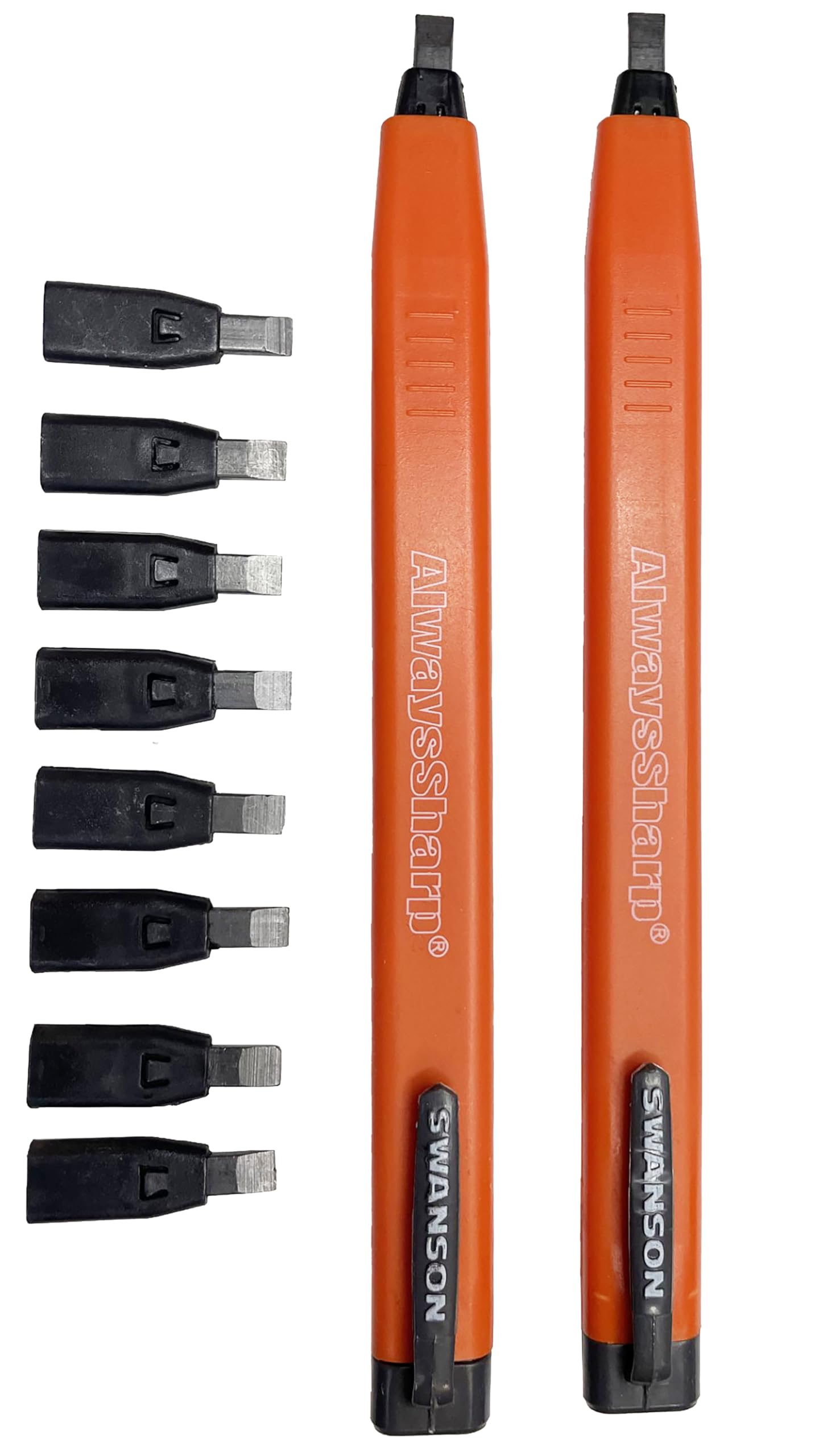
A carpenter pencil that never needs sharpening sounds like a gimmick until you have spent a morning on a roof with a dull point. Here the tip is a chisel-edged graphite cartridge, and when the edge flattens you pull it out and slide in a fresh one from the eight-cartridge tray. No knife, no shavings on the work.

Two things follow from that design. The body stays the length it shipped at, so the balance does not change as you work and it never shrinks into a stub that disappears in a pouch. And the line is a thin, consistent chisel edge — cleaner than a knife-sharpened carpenter pencil, and much faster to bring back.

The flat edge is also the limit. It will not trace around a grommet or drop a mark inside a drilled hole, and the tip that makes it so quick on a straight line is coarser than joinery layout wants. What it does is pull one reliable line along a square, board after board, without a single stop at the sharpener.

Bottom line: We reach for this one on rough cuts: a chisel graphite tip you never sharpen, and no knife to hunt for.

Check Latest Price
#06

Best All-in-One Set

STAGEEK 4-Pencil Set

94 /100
Kirk Score Outstanding
Lead Size
2.8 mm
Nib Length
45 mm
Storage Case
Included
Refills Included
52
Check Details on Amazon

Pros

  • Everything lives in one case
  • 52 refills in six lead colors
  • Three deep-hole markers for glass and plastic
  • 45mm nib reaches tight gaps

Cons

  • Sharpener cap works loose in a pouch

It arrives in a compartmented case, which sounds like packaging and is not: pencils on one side, refill tubes on the other, the marker pens clipped in the lid. On a shelf in a shop or loose in the back of a truck, that is the difference between a set you use and a pile of barrels rolling around.

The working end is a 45mm nib on a 2.8mm 2B lead, with the sharpener screwed into the cap. The grip is textured enough to hold with gloves on, and the pencils mark cleanly on wood, drywall, and metal — the three surfaces most of us actually face on a Saturday.

Coverage is where this set earns its spot. Four pencils, 52 refills in six colors, three deep-hole marker pens, and the case, all for roughly what one premium pencil costs, which makes it the set we recommend for a first toolbox or for a DIY-er who marks whatever is in front of them. Nothing in the box feels like the filler that usually pads these kits.

The marker pens are the part we did not expect to use. Graphite will not write on glass or smooth plastic; the three long-nib markers will, and they reach into the same tight gaps the pencils do. That saves carrying a separate marker in the pouch, which is the kind of small convenience that keeps a kit together.

Bottom line: The set we hand a new DIYer: four pencils, 52 refills, three deep-hole markers, and a case that keeps it all together.

Check Latest Price
#07

Rough layout

Pica Big Dry 6060

93 /100
Kirk Score Outstanding
Grip
Ribbed
Point
Wide
Refillable
Yes
Water Resistance
Water resistant
Check Details on Amazon

Pros

  • Broad nib for rough and wet stock
  • Click feed advances the lead
  • Water-resistant graphite
  • Refills for different applications

Cons

  • Graphite breaks if dropped or leaned on

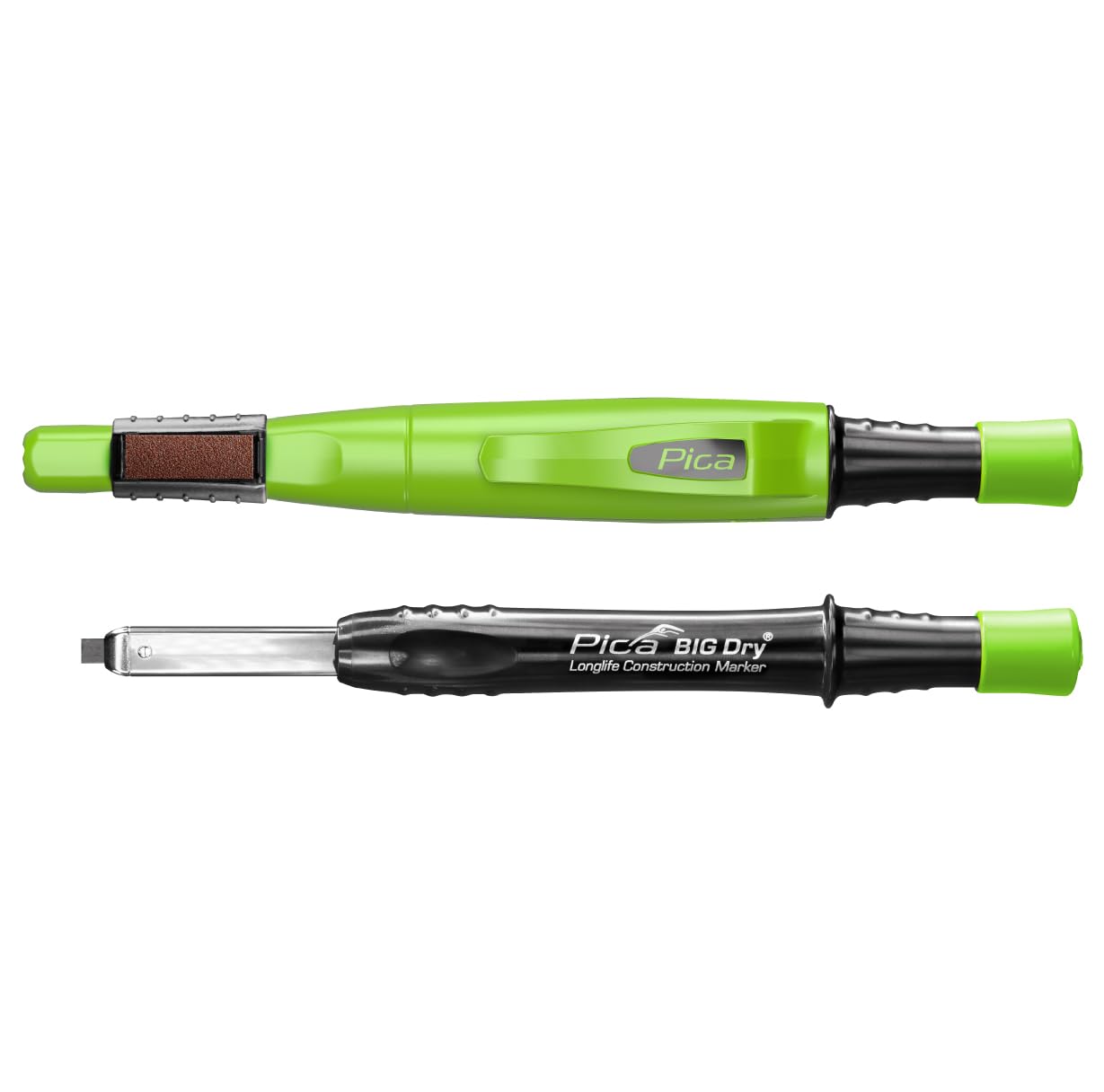
This is not a fine-line pencil, and it does not pretend to be. The Big Dry pushes out a broad graphite nib from a thick, ribbed body, and Pica built it for laying out stock you are about to cut rather than for a sixteenth-inch reveal on a cabinet door.

The design is about longevity. Marking performance runs long, and when the lead wears you click the button on the back and keep going instead of stopping to cut wood or find a sharpener. The graphite is listed as water resistant, which is the specification that matters on a damp morning or a stack of treated lumber that came off the truck wet.

We take it for exactly that work: rough-sawn, weathered, or wet stock where a 2.8mm lead skates or snaps. A broader nib leaves a mark you can still find after the saw has been through, and the fat barrel is easy to spot in a pile of offcuts. What it will not give you is a crisp edge for fine layout — that calls for a different tool.

At about eight inches and 50 grams, it is a toolbox pencil rather than a pocket pencil, and the refills come in various grades for different applications, which is the argument for buying into the system instead of a single disposable pencil.

Bottom line: Our pick for rough, wet stock: a broad refillable nib and a click feed that keeps the line going when a fine lead skates.

Check Latest Price
#08

Tight spaces

Hiboom 2-Pack

91 /100
Kirk Score Outstanding
Lead Size
2.8 mm
Sharpener
Built into the cap
Nib Length
45 mm
Pack Count
2 pencils
Check Details on Amazon

Pros

  • 45mm needle nose for deep holes
  • Two pencils plus refill boxes
  • Sharpener built into the cap
  • Slim enough for a shirt pocket

Cons

  • Cap and sharpener work loose

Forty-five millimetres of needle nose is a lot of reach for a budget pair, and it is what these are built around: the tip drops into a drilled hole or a tight corner and marks the bottom of it, where a flat pencil stops at the surface.

Both pencils arrive loaded, one black lead and one yellow, with two boxes of refills alongside. The black is the one to keep on lumber; the colored leads work better for flagging a cut than for the main line, since the yellow reads faint on pale wood. The built-in sharpener screws into the cap, so a point is never more than a twist away.

The barrel is slim, slimmer than the Pica or the Tracer, and it clips into a shirt pocket without a bulge. That cuts both ways: easy to carry, easy to forget, with the pocket clip doing most of the work of keeping it with you.

Where we land is that this is a good second pencil. It handles the reach, the sharpening, and the refills on a small outlay, and buying two means one can live in the shop and one in the pouch. It is not the pencil we expect to shrug off a season of hard site abuse, but as a cheap companion to a better one it earns its place.

Bottom line: We see this as a good second pencil: 45mm of reach at a budget price, with refills and a sharpener already in the box.

Check Latest Price

How We Tested These Construction Pencils

We started by rounding up about 40 pencils and mechanical marker sets from the brands that turn up in contractor forums and lumber-yard bins, then filtered by lead diameter, tip reach, refill availability, and price. Anything that required its own proprietary lead with no refill option got cut early, as did pencils whose listings never stated a lead size. That left 16 we could honestly compare against each other.

Those 16 spent three months in tool bags, apron pockets, and truck cupholders. We marked framing lumber, pressure-treated decking, plywood, concrete block, and metal studs, and dragged each pencil down a freshly sawn edge to see whether the line stayed crisp or smeared under a thumb. We sharpened each one repeatedly, counting how many usable points we got per lead and checking whether the built-in sharpeners clogged with graphite dust after a few turns. Deep-hole marks got their own trial, reaching through drilled studs and pilot holes to see whether the nib actually touched the surface behind.

The rest came down to handling. We marked overhead and on vertical walls in gloves to judge grip, set each pencil on a sloped bench to see if it rolled onto the floor, shook them hard to check the lead didn't slide, and threw them into a bag with screws and chisels to see whether caps cracked or clips gave out over a few weeks. Light-colored leads were tested on dark timber and gray concrete, where a black line simply disappears. And we priced refill packs against the pencil itself, since cheap lead that costs more than the tool isn't a bargain for long.

How to Choose a Construction Pencil

Wooden or mechanical: pick by how you lose pencils

A flat wooden carpenter pencil has no mechanism to fail. It marks wet, gritty, rough stock that ruins a fine lead, and it costs little enough that losing one is not a disaster. What you give up is speed: every point comes from a knife, a block plane, or a grinder, and the pencil shrinks as you work. A mechanical pencil keeps a point on board and feeds fresh lead, but caps, clips, and collars are all wear items.

Our rule of thumb: if you are marking rough stock all day and cutting to the line, buy wooden pencils by the box. If you mark a handful of boards between other jobs and want the pencil still in your pocket next week, buy mechanical.

The lead decides the line

Thickness and hardness do most of the work. A 2.8mm lead is the common size in mechanical carpenter pencils: thick enough not to snap under ordinary marking and long enough to reach into a hole. Harder H leads hold a point longer; 2B lays down a darker line and wants sharpening more often. Wooden carpenter pencils push the idea further with a broad flat lead that marks rough or damp timber where a fine lead skates.

If your marks get cut away or sanded off, favor visibility over precision. A dark 2B line you can see across a bay beats a fine point you have to squint at.

Sharpening should travel with the pencil

The most useful feature in this category is a sharpener in the cap. It removes the walk back to the truck, and on a mechanical pencil the shavings stay in the cap instead of on the workpiece. The trap is that the same cap is the piece you can lose: check whether it threads on or pushes on. A push-fit cap works loose in a pouch and takes the sharpener with it, while a threaded one stays put.

Skip all of it with wooden pencils if you already carry a knife or have a belt sander in the truck — but then budget for a dull point at the worst moment.

Reach, carry, and what survives a site

A 45mm nib is the difference between marking the surface of a hole and marking its bottom, which matters for anchors, hangers, and hardware. If you never mark inside a hole, you are carrying length you do not need, and a shorter pencil sits better in a pouch.

Carry matters as much as reach. A clip, a holster, or a bright body keeps the pencil with you; a loose one rides in a pocket until it falls out at the saw. Whichever you buy, buy two — every pencil in this guide is easy to set down and forget.

Frequently Asked Questions

Final Verdict

Start with the Pica-Dry 3030. The sharpener rides in the cap, the 2B lead reads across a framing bay, and the pencil sits in a shirt pocket without weighing you down — it solves the two daily annoyances, a dull point and a sharpener you cannot find.

If more than one person marks on your jobs, the Nicpro set covers a crew with 12 pencils and six lead colors. And if you want nothing that can jam, lose a cap, or stop feeding, a box of Irwin wooden pencils still marks rough stock for the least money here.