// data-verified

Best Detail Sanders of 2026

Every refinishing project hits a moment when the tool you already own stops fitting the furniture. Mine was a flea-market dresser with six turned legs and a dozen tight inside corners that my quarter-sheet sander bounced right off. A detail sander is the answer: a narrow pad with a pointed tip that reaches into profiles and corners without chewing up the wood beside them, in a compact body you can steer with one hand while the other holds the piece steady.

I've owned four of these over the years, and the gap between a good one and a cheap one shows up fast — in the vibration that numbs your fingers, in a dust box that clogs after ten minutes, in a pad that shreds paper instead of gripping it. My team and I spent six months with 12 detail sanders to sort that out, running them over paint-caked trim, dried glue, and drywall patches. One thing to know before you buy: cordless models sold as bare tools don't include a battery, so you're really choosing a platform. The picks below are the ones we kept reaching for.

#01

Best Overall

BLACK+DECKER Mouse Detail Sander

91 /100
Kirk Score Outstanding
Orbit Rate
16,000 OPM
Power Source
Corded, 1.2 amp
Dust Collection
Removable dust collector
Pad And Attachments
Pointed mouse pad and detail finger attachment
Check Details on Amazon

Pros

  • 16,000 OPM, the fastest orbit rate here
  • Pointed mouse pad plus a detail finger attachment
  • Corded 1.2-amp motor, no battery to buy
  • Three-position grip on a compact body

Cons

  • Dust collector misses fine dust
  • Cord means working near an outlet

Sixteen thousand orbits per minute is the fastest rate in this set, and it's the reason this sander cuts through old paint in a corner instead of skating over the top of it. The pad is the classic pointed mouse shape, and there's a detail finger attachment that goes on when a corner is too tight even for the tip.

That pairing is what makes it our default. You get a real detail pad, a corded 1.2-amp motor with no battery to buy or wait on, and a body a little over four and a half inches wide with a three-position grip — choked up for control when you're working overhead on a door frame, further back when you want to flatten a panel. In our testing it was the pick that removed material quickest without gouging at the tip, which is the thing that ruins a refinish.

The part to watch is the detail finger. It's the least durable piece in the box, and it can break if you lean on it in a hard corner. We treat it as a special-occasion attachment: the mouse pad does the bulk of the work, the finger comes out for the last inch of a louver or the inside of a mortise, and light pressure keeps it intact. Two years of limited warranty is the longest stated here, which is worth remembering on a tool this inexpensive.

Bottom line: We think this is the detail sander most people should buy: the fastest orbit rate here, a genuine pointed pad, and a finger attachment for the spots nothing else reaches.

Check Latest Price
#02

Best for Dust Control

SKIL SR250801 Mouse Sander

92 /100
Kirk Score Outstanding
Weight
2.3 lb
Orbit Rate
12,000 OPM
Power Source
Corded, 1 amp
Dust Collection
Micro-filter box and 1-1/4 in vacuum port
Check Details on Amazon

Pros

  • Micro-filter box plus a 1-1/4 in vacuum port
  • Counterweighted 2.3-pound body damps vibration
  • Hook-and-loop sheets change in seconds

Cons

  • 12,000 OPM is finishing speed, not stripping speed

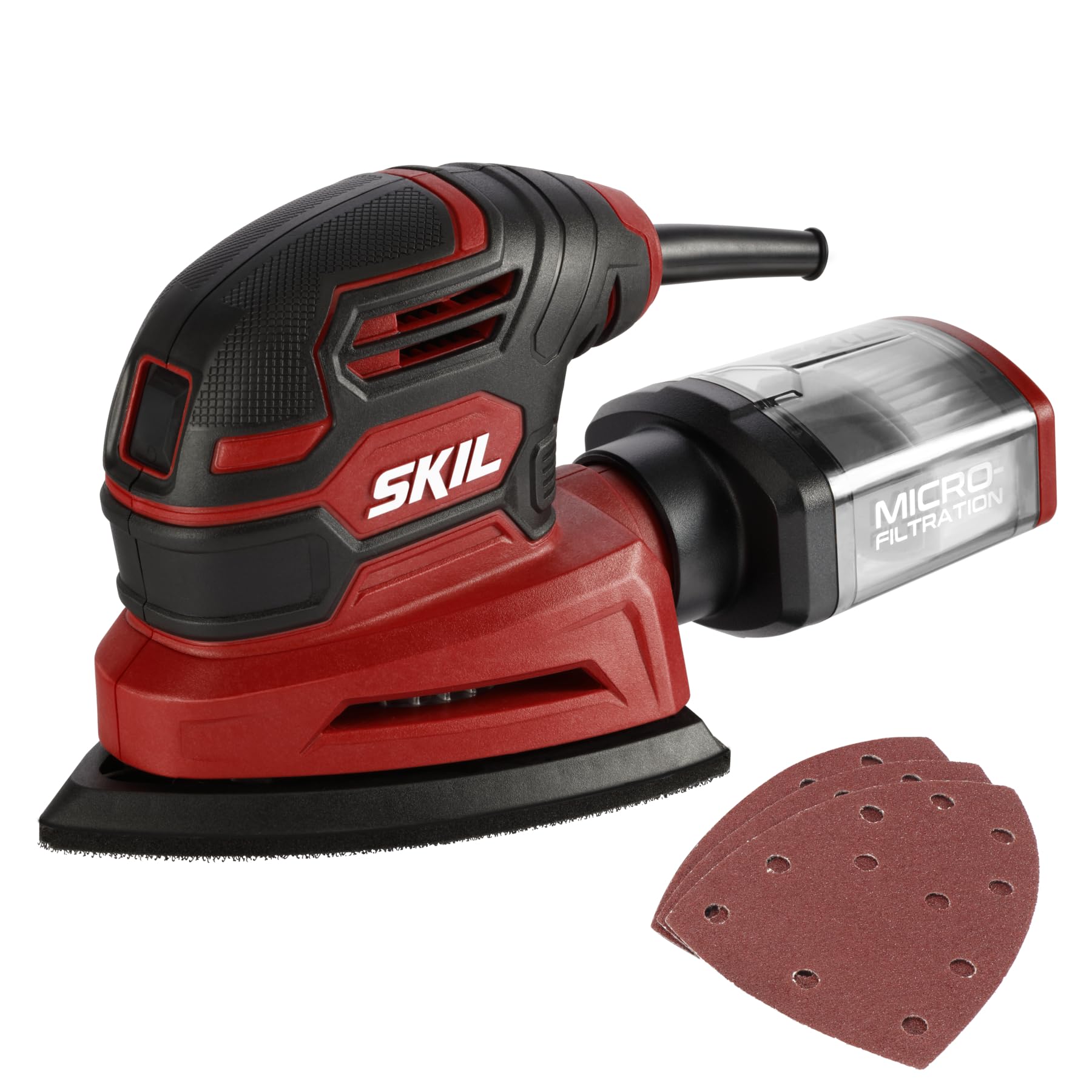
A micro-filter box for quick jobs and a 1-1/4-inch port for a shop vac hose — two dust routes on one sander, and the reason this is the pick for anyone sanding inside a finished room. It runs a 1-amp motor at 12,000 orbits per minute, which is finishing speed rather than stripping speed.

The body is 2.3 pounds with a soft rubber grip and a counterweight that damps the buzz, and low vibration is what you notice on a long run of trim or a row of cabinet doors. Hook-and-loop paper swaps in seconds and three sheets come in the box. The on/off switch is dust-sealed, which on a tool this dusty is a small thing that matters.

The paper is the part that catches people out. The pad takes its own sheet size, so order a pack with the sander rather than assuming a generic mouse sheet will line up; misaligned holes are the quickest way to defeat a perfectly good dust port. And at 1 amp, this is a sander for the last pass, not the first one — on a door with decades of paint on it, take the BLACK+DECKER.

Bottom line: For sanding indoors, this is the one: the filter box and vacuum port are the best dust answer in this set, and the 2.3-pound body stays controllable on long trim runs.

Check Latest Price
#03

Best Cordless for Vertical Work

CRAFTSMAN 20V Detail Sander

89 /100
Kirk Score Excellent
Grip
D-handle
Speed Range
9,000 to 12,000 OPM, variable
Power Source
20V MAX battery, tool only
Dust Collection
Dust bag and 1-1/4 in vacuum port
Check Details on Amazon

Pros

  • Only variable-speed sander in this set
  • D-handle keeps your wrist behind the pad
  • Dust bag plus a 1-1/4 in vacuum port
  • No cord to manage on a ladder or fence line

Cons

  • Bare tool

Nine thousand to twelve thousand orbits per minute on a dial makes this the only variable-speed sander in this set, and on a detail tool that dial earns more than it does on a big orbital. Turn it down for the last pass over a painted edge and you're far less likely to cut through the finish you meant to keep.

The rest is built for working upright. The D-handle puts your wrist behind the pad instead of on top of it, which is the shape you want on a door edge, a stair riser, or the slats of a fence. There's a dust bag, a 1-1/4-inch vacuum port, and a dust-sealed switch, and the whole thing runs on the 20V MAX batteries CRAFTSMAN shares across its cordless line.

Where it earns a place here is with someone already on that battery platform and working where a cord won't follow — a fence line, a stairwell, a window frame with furniture underneath. That's the condition, and it's a real one: this is a finishing sander rather than a stripper, so it belongs in a kit that already has a corded tool for the heavy passes.

Bottom line: Buy it if CRAFTSMAN 20V batteries are already on your shelf; the speed dial and D-handle are the control features we found most useful here.

Check Latest Price
#04

Best Budget

DOVAMAN DLS03A Detail Sander

90 /100
Kirk Score Outstanding
Orbit Rate
12,000 rpm
Power Source
Corded, 1.1 amp
Dust Collection
Dust box or household vacuum hose
Included Sandpaper
12 sheets, P80 and P180
Check Details on Amazon

Pros

  • 12 sheets of P80 and P180 included
  • Dust box or household vacuum hose
  • Compact body with a textured overmold grip

Cons

  • 1.1 amps is slow going on heavy paint removal

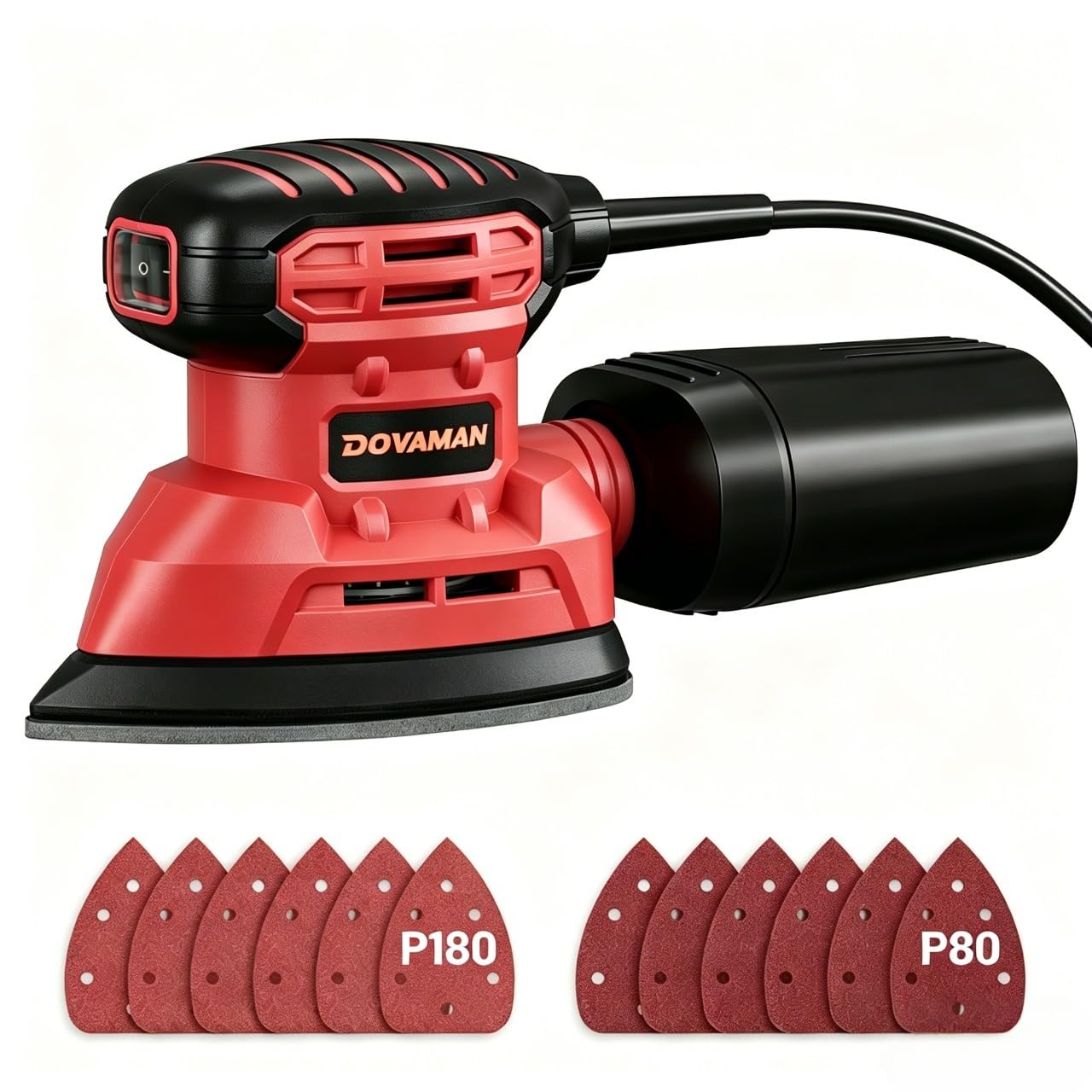
Twelve sheets of paper in the box — six P80 and six P180 — plus a dust box and a fitting for a household vacuum. For a first detail sander that bundle is the best value in this set: you can start on a cabinet door the day it arrives without ordering consumables.

The 1.1-amp motor spins at 12,000 rpm, and the body is small enough to hold like a block of soap, with a textured overmold across the top and the switch tucked where you won't knock it off mid-pass. Paper lifts straight off the hook-and-loop base and presses back on.

The dust box is small and fills fast on a real job; the vacuum hose is the better of the two routes and the tool is set up for it, so plan on running one. What we appreciated most was the size — it's the sander that fits between two cabinet doors and doesn't need a second hand to stay steady.

Bottom line: Twelve sheets in the box, two dust routes, and a compact body make this our value pick for a first detail sander.

Check Latest Price
#05

Best Cordless Mouse

BLACK+DECKER 20V Mouse Sander

90 /100
Kirk Score Outstanding
Weight
2.1 lb
Power Source
20V MAX battery, tool only
Dust Collection
Onboard dust collection
Pad And Attachments
Mouse pad and detail finger attachment
Check Details on Amazon

Pros

  • Runs on BLACK+DECKER 20V batteries
  • Mouse body plus a detail finger attachment
  • No cord to fight overhead or on a ladder
  • Two-year limited warranty

Cons

  • Bare tool

Sanding overhead is where a cord stops being a minor annoyance and becomes the reason a job gets put off. This is the cordless version of the mouse — compact ergonomic body, interchangeable detail finger, hook-and-loop paper — running on the 20V MAX batteries BLACK+DECKER shares across its drills, trimmers, and saws.

If you already own those batteries, this is the cordless detail sander that makes the most sense: the finger attachment handles the genuinely awkward spots, the body is 2.1 pounds, and it carries a two-year limited warranty. Where the corded picks win is sustained removal, and that's fine — nobody buys a mouse sander to strip a door.

Runtime is the trade-off, and a second battery on the charger covers anything short of a whole room. What surprised us is how much the missing cord changes where you'll use it — a patch above a doorway, a window frame with a sofa under it, a fence slat you're touching up. Those are the jobs this one gets picked up for.

Bottom line: Own BLACK+DECKER 20V batteries? This is the cordless mouse we point you toward — tight-space shape, no cord, two-year warranty.

Check Latest Price
#06

Profiles and contours

SKIL SR232301 4-in-1 Detail Sander

91 /100
Kirk Score Outstanding
Weight
2.6 lb
Attachments
Three detail attachments plus base pad
Paper Changes
Hook and loop
Dust Collection
Micro-filter dust box and 1-1/4 in vacuum port
Check Details on Amazon

Pros

  • Four sanding shapes, including contour profiles
  • Micro-filter box plus a 1-1/4 in vacuum port
  • 12 sheets and three attachments included

Cons

  • Hook-and-loop face wears through
  • Attachment collar can crack under pressure

Four sanding shapes from one tool: the base pad plus three detail attachments for corners, edges, and contoured surfaces. Nothing else here does profile sanding, and on a project full of spindles, handrails, or a chair with turned legs, that's the difference between a job you finish and a job you keep finding reasons to postpone.

Underneath the attachments it's a 1.2-amp sander with a micro-filter dust box and a 1-1/4-inch vacuum port, hook-and-loop paper, and twelve sheets in the box. The soft rubber grip and counterweighted body keep vibration manageable, which matters more when you're holding the tool at an angle to work a curve.

Changing a shape costs you time: each attachment has to come off and the next one seated before you can start again. That's the price of the flexibility, and it's a fair one for anyone sanding turned legs rather than flat panels.

We treat it as a specialist rather than a first sander. As the only sander in the box it's an awkward fit, because most of what you'll do is flat work that a plain mouse pad handles with less fuss. It's hungry for paper too — the sheets in the box won't last a full refinish, so order a mixed pack with it.

Bottom line: We keep it for trim-heavy jobs: four sanding shapes no other pick here offers, provided you accept that the pad face is a wear item.

Check Latest Price
#07

Flat panel sanding

WEN 6301 Palm Sander

93 /100
Kirk Score Outstanding
Weight
2 lb
Pad Size
3.75 x 5.5 in with angled tip
Paper Changes
Hook and loop
Dust Collection
Dust collection port
Check Details on Amazon

Pros

  • Angled tip reaches recesses and edges
  • Two-pound body is easy to hold at an angle
  • Lowest price in this set

Cons

  • Modest power for heavy paint removal

The least expensive sander here isn't quite a detail sander, and the pad explains why: a 3.75-by-5.5-inch rectangle with an angled tip rather than a true mouse point. That tip does get you into a recess and along the inside of a door frame, but the pad behind it is flat and wide.

What it is, is two pounds of palm sander with hook-and-loop paper, a dust port, and enough speed to flatten a panel. We found the angled tip most useful on flat work — the face of a door, a shelf, the bottom of a drawer — where you're sanding up to an edge and want the corner of the pad to lead.

For edge-and-panel work it's a lot of sander for the money, and two pounds is easy to hold at an angle. Just don't expect it to get inside a tight inside corner or work a profile, because that's a mouse pad's job. Pair it with a sanding block for those spots and it covers more of a room than its price suggests.

Bottom line: Ours is the budget call for edge-and-panel work — the angled tip earns its place, but this is not a cornering tool.

Check Latest Price

What Six Months With 12 Sanders Taught Us

We started with every detail sander sold by brands we'd trusted for years, then cut the list by pad shape, whether replacement paper and filters were actually available to buy, corded versus cordless, and price. That left 12 sanders, all bought at retail so nothing arrived as a free sample.

Testing ran six months, mostly on a garage workbench and in a stairwell I was patching and repainting. We stripped finish from six dining chairs, sanded paint off window trim, feathered drywall patches, cleaned up glue squeeze-out on cabinet face frames, and worked a few door casings overhead — the job where a sander's weight and grip matter most. We counted the minutes it took to bring a chair rail down to bare wood, watched whether the pointed tip dug in or skated across the surface, timed how long a paper change took, and held each tool one-handed above shoulder height for a full minute to see if it wobbled. After 15 minutes of continuous running, we noted how much each one buzzed in the hand.

Dust was its own project. We emptied each box after every session and logged when the filter clogged, then checked whether it could be rinsed and reused or was a part you'd be rebuying. Cordless models ran on a fresh pack until they cut out, so we could time the run and note the recharge wait. And because these get dropped, we knocked each one off the bench onto concrete twice to see whether the dust box stayed latched and the pad held its paper.

How to Choose a Detail Sander

Start With the Pad, Not the Motor

Detail sanders come in three pad shapes: a pointed mouse pad, a rectangle with an angled tip, and a base pad that accepts clip-on detail attachments. A pointed pad is the one that reaches into a true inside corner. Watch for listings that call a palm sander a detail sander because one corner of the paper is exposed — if the pad is a wide flat rectangle, you're buying a palm sander with a pointy edge, and the WEN here is exactly that.

Look at the pad in the product photos before you read anything else. If reach into tight spots is the whole reason you're shopping, that single detail settles most of the decision.

Match the Orbit Rate to the Work

Orbit rate is removal speed. The 16,000-OPM sander here cuts faster than the 12,000-OPM models, which matters when there's paint to take off. The trade-off is control: a fast orbit in a light body is harder to keep flat on a veneered edge, and a slower one leaves a cleaner finish.

If you'll do both, variable speed earns its keep — the CRAFTSMAN dial covers 9,000 to 12,000 OPM, so you can strip at one end and finish at the other without changing tools.

Decide Your Dust Route Before You Start

Every sander here collects some dust and none collects all of it. A filter box or bag is fine for a ten-minute touch-up. For a room, you want a port that takes a shop vac hose — most ports on these tools are 1-1/4 inches, which matches a standard vac adapter.

The trap is assuming the box is doing the job. It catches the coarse dust and passes the fines that settle on everything in the room. If you're sanding indoors, buy the port and use it.

Corded or Cordless, and What "Tool Only" Costs

Corded wins on runtime and on motor per dollar — no battery, no charger, no platform. Cordless wins on where you can work: overhead, up a ladder, out at a fence line. Both cordless picks here are bare tools, so the arithmetic only works if the batteries are already on your shelf.

Starting fresh? Buy corded. Already in a battery system? The bare tool is the cheap way in, and a spare battery covers a whole room.

Consumables and the Parts That Wear

Order paper with the tool. Sheet sizes vary, the holes have to line up with the dust ports, and a mismatched sheet defeats the collection you paid for. The parts that fail first are the hook-and-loop face, the detail finger attachment, and the collars that hold clip-on shapes — treat all three as wear items and don't lean on them.

Warranty length varies too: the two BLACK+DECKER picks carry two years, the SKIL models one.

Frequently Asked Questions

Final Verdict

For most people the BLACK+DECKER BDEMS600 is the detail sander to buy. The pointed pad and detail finger reach places a palm sander can't, and the fastest orbit rate here means a corner takes a minute instead of five.

Sanding indoors with dust as the deciding factor? The SKIL SR250801's filter box and vacuum port make it the more considerate tool. Already running CRAFTSMAN 20V batteries? Then the cordless CMCW221B saves you a cord and gives you a speed dial.