// data-verified

Best Drywall Sanders of 2026

Sanding drywall is really a dust problem wearing a sanding problem's clothes. Fine white powder gets into every corner of the room and drifts past the plastic sheeting you taped up so carefully, and it's the reason a lot of finished basements sit half-done for a year. A sander that genuinely holds onto the dust — best case, by plumbing into a shop vac — decides whether you spend the evening wiping down shelves or just vacuuming one drop cloth.

Weight is the thing nobody warns you about. Overhead work is a different job than running a head along a wall, and a sander that feels balanced at chest height will have your shoulders burning by the fourth pass across a ceiling. We've spent the past eight months with 12 sanders — compact radial models, corded units with long hoses, a cordless or two — on taped seams, patches, and a popcorn ceiling I was glad to see go.

The spec people overrate is the variable-speed dial. A sander that reaches the ceiling without a ladder and stays light in your hands saves more time than a wider RPM range ever will, which is roughly how the picks below sorted themselves out.

#01

Best Overall

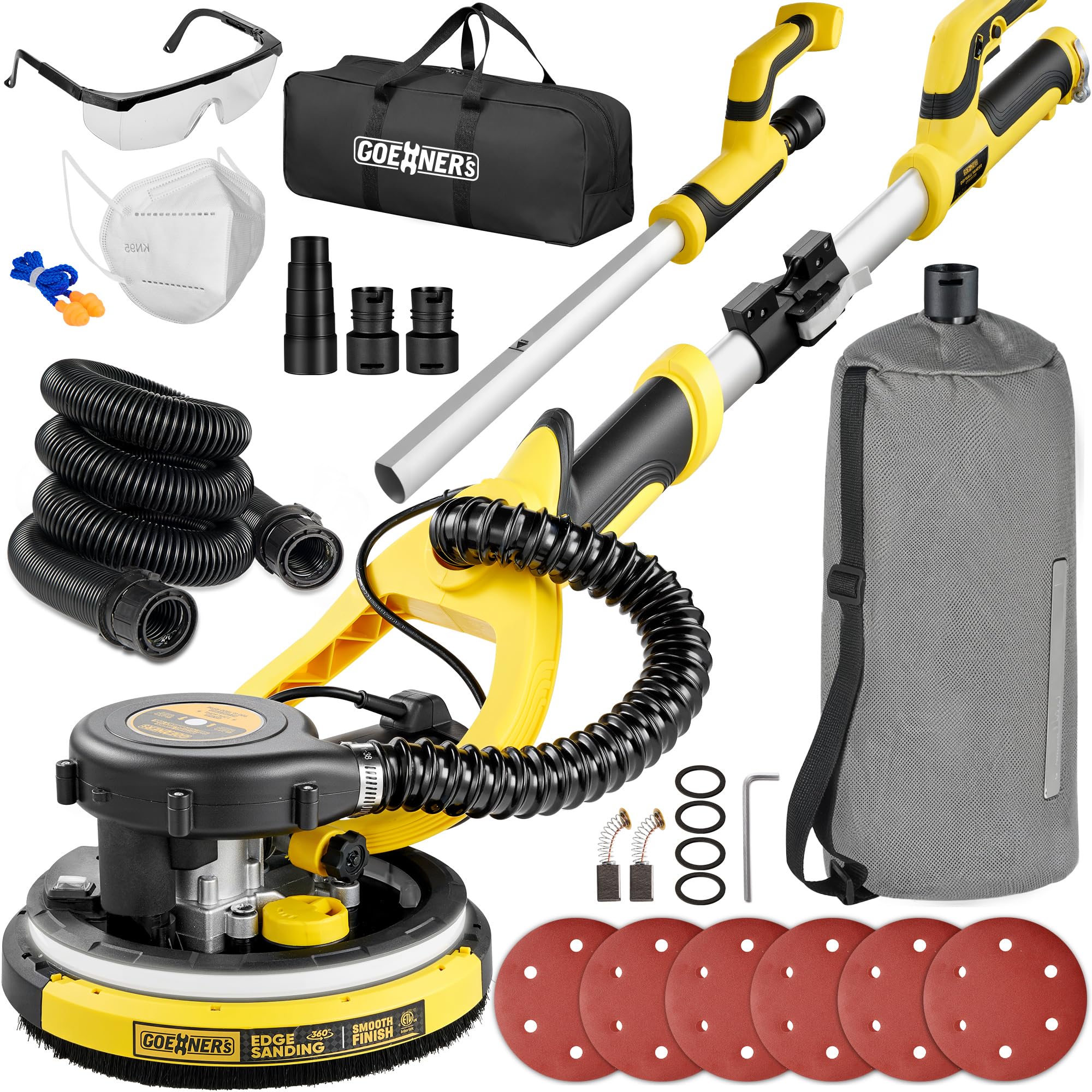
WEN 6369 Drywall Sander

89 /100
Kirk Score Excellent
Disc
9 inches
Hose
15 feet
Speed
600–1500 RPM
Weight
9.2 lb
Check Details on Amazon

Pros

  • Long 15-foot dust hose
  • Variable speed from 600 to 1500 rpm
  • 9-inch hook-and-loop disc
  • Strong value for whole-room work

Cons

  • Heavy for extended overhead work

Ceilings are where a pole sander stops being charming, and the WEN 6369 is the tool we reach for when the job is a whole room rather than a patch. A 5-amp head-mounted motor, 600–1500 rpm variable speed, and a 15-foot dust hose turn a miserable overhead job into a manageable one. It is not the most refined sander here, but it is the best overall here for whole-room drywall work.

The 15-foot hose is the practical hero. It lets you park a shop vac outside the room, which keeps the noise and some of the dust away from your work area. Hook-and-loop paper changes are quick, and the 9-inch disc covers ground. The onboard bag works as a backup, but it fills and the port can clog on heavy compound; plan on a shop vac with a HEPA filter if clean air matters.

At 9.2 pounds, it is not a featherweight. On walls, the weight helps keep the head flat; on ceilings, it is the trade-off you feel after a few passes. The variable speed is useful for dialing back the aggression around fresh compound, and the 9-inch head flattens a seam without endless passes. The 5-amp motor has enough torque to keep the disc moving under load.

The round head does not get into inside corners, so budget for a hand block or a detail sander. The dust bag is also better as a backup than as your only collection. If you own a shop vac and have a whole room to finish, those are easy compromises. That is why it earns the top spot: it does the big, unpleasant part of the job without asking you to buy into a premium battery platform.

Bottom line: The WEN 6369 is the best default for whole-room drywall and ceiling work: enough power, speed control, and hose length to make the job manageable, provided you can handle the overhead weight.

Check Latest Price
#02

Best Cordless

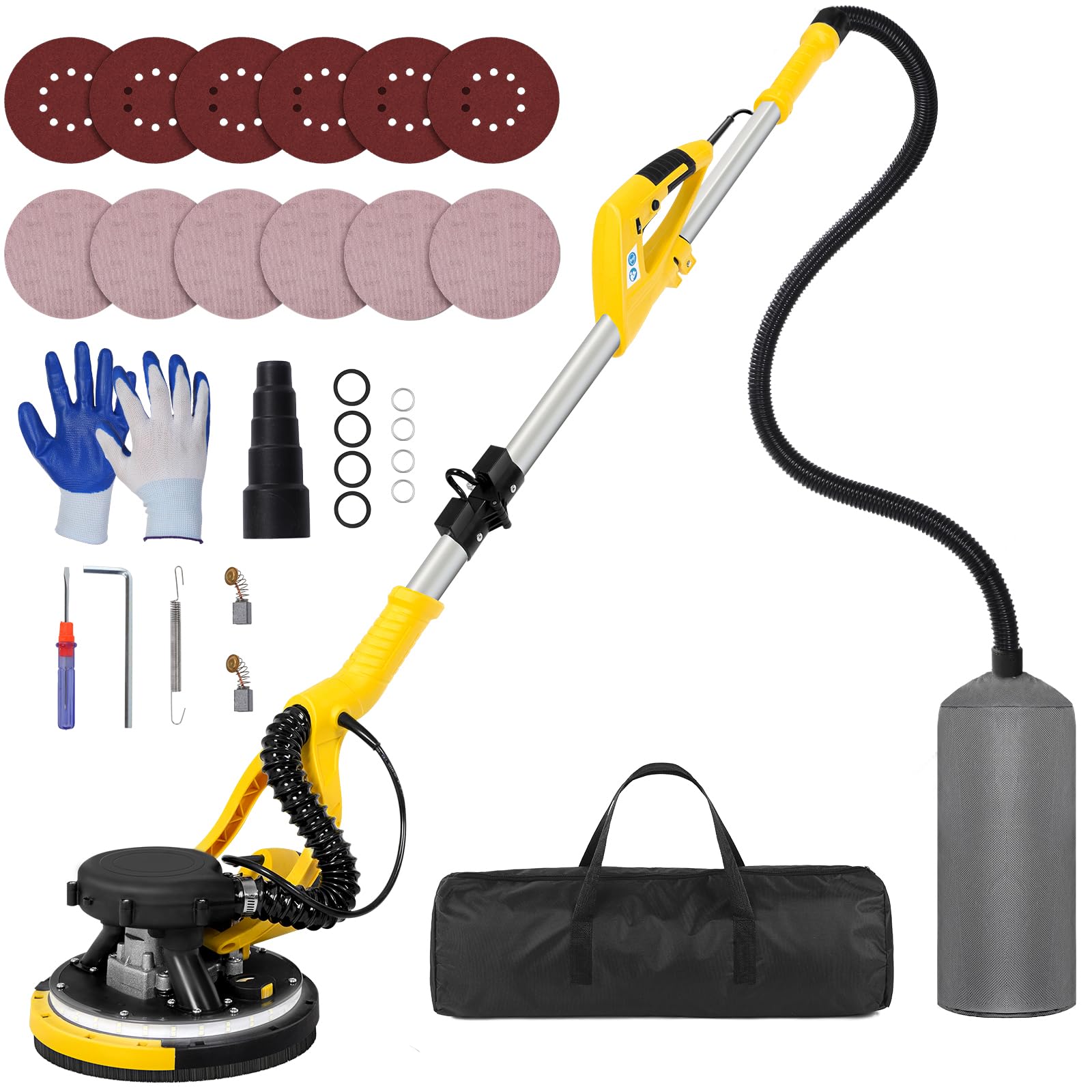
DEWALT DCE800B Drywall Sander

86 /100
Kirk Score Excellent
Disc
9 inches
Power
20V battery
Weight
8.6 lb
Dust Port
AirLock
Check Details on Amazon

Pros

  • Cordless 20V freedom
  • Telescoping shaft
  • AirLock extractor connection
  • Light for a long-reach sander

Cons

  • Sold without battery or charger

No cord sounds like a small thing until you are working a ceiling away from an outlet. The DEWALT DCE800B is the premium cordless answer: a 20V MAX brushless sander with an 8.6-pound body, telescoping shaft, and AirLock connection to DEWALT extractors. It feels built for a pro's truck rather than a homeowner's one-off.

The telescoping shaft is the feature we appreciate most. It collapses for storage and reaches into tight spots without a separate pole. Wireless Tool Control pairs with a compatible extractor, so the vacuum can start and stop with the tool. That is a genuine convenience on a remodel where you move between rooms.

Battery life is the catch. The tool is sold without a battery, and the 20V packs that fit are another investment if you are not already on the platform. Runtime is a job-site variable rather than a guarantee; a spare pack belongs in the plan for a full ceiling. The 8.6-pound body is light for its class, but overhead work still asks for breaks.

Dust collection is good when paired with a proper extractor, and the AirLock connection is tool-free. The 9-inch pad and variable-speed dial are familiar DEWALT ergonomics rather than a revelation. If you already own the batteries and extractor, the DCE800B is the cleanest cordless setup in this group. If you do not, the total cost is the reason to look at a corded model.

Bottom line: The DEWALT DCE800B is the cordless pick for pros already on the 20V platform: light enough to manage overhead and clean with an extractor, but the tool-only price and battery runtime are real commitments.

Check Latest Price
#03

Best for Ceilings

KUPERIA Drywall Sander

82 /100
Kirk Score Excellent
Dust
Dual-channel vacuum
Motor
8.5 A
Speed
800–1800 RPM
Weight
8.5 lb
Check Details on Amazon

Pros

  • Dual-channel dust collection
  • Seven speeds from 800 to 1800 rpm
  • LED light and detachable edge
  • Complete starter bundle

Cons

  • Top-heavy when fully extended
  • Starter sandpaper is limited

KUPERIA bundles the bits that usually cost extra: an 8.5-amp motor, seven speeds from 800 to 1800 rpm, a dual-channel vacuum, LED light, extension rod, carry bag, and a starter set of sandpaper. The package is aimed at homeowners who want one box to finish a room.

The dust control is the reason to consider it. The dual-channel head pulls dust toward the hose rather than letting it trail across the wall, and the LED strip helps you see the surface you are flattening. The 8.5-pound body is manageable on walls, though it becomes top-heavy when the handle is extended for a ceiling. The detachable edge is useful for getting closer to a corner without gouging.

The speed dial has enough range to slow down around fresh compound, and the 8.5-amp motor does not bog down easily. The extension rod reaches high ceilings, but the balance changes when it is fully extended; keep two hands on the tool and take breaks. The included sandpaper is a starter set, not a full project supply, so budget for more discs.

Storage is thoughtfully handled with the collapsible handle and carry bag. This is not the lightest or most refined sander here, but it is a sensible middle path between a bare-bones budget model and a premium cordless system. If your project is ceiling-heavy and you do not already own a battery platform, it is the one we point to first among the midrange corded models.

Bottom line: The KUPERIA is our ceiling-work pick: a bundled long-reach sander with strong dust control and useful lighting, as long as you respect its top-heavy balance when extended.

Check Latest Price
#04

Best Manual Pole Sander

Hyde 09977 Radial Sander

92 /100
Kirk Score Outstanding
Disc
9 inches
Head
Pivoting
Mount
Acme-thread pole
Paper
Hook-and-loop
Check Details on Amazon

Pros

  • Pivoting head resists flipping
  • 9-inch hook-and-loop paper
  • Mounts to standard Acme poles
  • Low-cost manual option

Cons

  • No dust collection
  • Pad and hinge can wear

There is no motor here, and that is the point. The Hyde 09977 is a 9-inch radial sanding head that mounts to an Acme-thread pole, and it costs little enough to keep as a backup even if you own a powered sander. We rate it the best manual pole sander here for ceilings and high walls because the pivoting hinge keeps the head flat instead of letting it flip and scar the wall.

The hook-and-loop system is the other practical detail. Paper changes take seconds, and the 9-inch discs are widely available. The head rides along the wall without twisting your wrist, which matters when you are reaching above your head. It is not a dust-control tool; you still need a vacuum, a drop cloth, or both. For a small ceiling or a few repaired seams, that is a fair trade.

Durability is the weak spot. The pad and hinge are the parts to watch; they can wear after a hard job. The head is simple enough that there is not much else to fail. Keep the pole tight and do not lean on the head; let the abrasive do the work.

The Hyde is not the tool for a whole-house drywall job unless you enjoy the exercise. It is the tool for a bathroom ceiling, a stairwell, or a quick leveling pass where dragging out a powered sander feels like overkill. That narrow role is exactly why it stays in the group.

Bottom line: The Hyde 09977 is the manual pole sander we recommend for small ceilings and repairs: simple, stable, and cheap to own, with no dust collection and a pad that can wear.

Check Latest Price
#05

Best Budget Kit

Goldblatt 9-Inch Radial Sander

90 /100
Kirk Score Outstanding
Disc
9 inches
Grits
80, 100, 180
Mount
Standard extension pole
Abrasive Discs
30
Check Details on Amazon

Pros

  • 30 discs in three grits
  • Pivoting head with bumpers
  • Accepts standard extension poles
  • Low-cost kit

Cons

  • Pole sold separately
  • Manual effort on large areas

Thirty discs is a blunt way to get attention, and it works. The Goldblatt 9-inch radial sander arrives with ten each of 80-, 100-, and 180-grit hook-and-loop discs, plus a pivoting head and protective rubber bumpers. For a first drywall sanding kit, that is a more useful package than a bare head and a trip to the store.

The head itself is similar to the Hyde: a 9-inch round pad on a free-spinning mount that takes a standard extension pole. The bumpers are the difference we noticed. They keep the edge of the head from digging into a door jamb or a corner bead, which is exactly where a manual sander can do expensive damage. The hook-and-loop surface holds paper tightly, and the discs are easy to change.

We rate it the best budget kit in this group because the included abrasives let you start work immediately, and the three grits cover coarse leveling through a finish pass. It is still a manual tool: on normal joint compound you have to push, and the 9-inch head does not reach into inside corners. The discs are not the longest-lasting we have used, but the low replacement cost softens that.

If you already own a pole, this is an easy add. If you do not, factor one into the purchase; the sander does not include it. The Goldblatt is not a substitute for a powered sander on a big ceiling, but it is a smart way to handle a small room without spending on a motor you will rarely use.

Bottom line: The Goldblatt 9-inch radial sander is the best budget kit here for manual wall and ceiling work, with a stable head and a useful starter set of discs, though it needs a pole and muscle.

Check Latest Price
#06

Best Budget Electric

ZENY 800W Drywall Sander

86 /100
Kirk Score Excellent
Disc
8.8 inches
Power
800W
Speed
1,000–2,000 RPM
Weight
12.6 lb
Check Details on Amazon

Pros

  • 800W motor removes compound quickly
  • Six speeds up to 2,000 rpm
  • Removable base for edges
  • Low-cost powered option

Cons

  • Heavy at 12.6 pounds

The ZENY 800W is the lowest-cost way into a powered drywall sander in this group, and it makes no secret of that. You get an 800-watt motor, six speeds from 1,000 to 2,000 rpm, an 8.8-inch head, a hose, and a set of sanding pads. For a homeowner with one room to finish, that is enough tool to matter.

The power is real. The 800-watt motor removes dried compound faster than any manual sander here, and the variable speed lets you slow down near a corner. The removable base helps at edges, and the rubberized handle is comfortable for wall work. It is not a precise finishing tool; the head is big and the machine wants a light hand.

Weight is the price. At 12.6 pounds, it is the heaviest sander in this group, and that shows up on ceilings faster than on walls. The dust setup is also inconsistent: the bag and ports can leak, especially if the joints are not sealed. Plan on a shop vac and tape the joints if you are working in a finished room.

We see it as a starter electric sander rather than a pro's daily tool. The 8.8-inch head and 2,000-rpm top speed are useful on walls, and the package is complete enough to begin. If your project is ceiling-heavy, the weight is hard to ignore; if it is a few walls and a closet, the ZENY gets the job done for a budget commitment.

Bottom line: The ZENY 800W is the budget electric pick for wall work: real power and useful speed control for the money, but it is heavy overhead and its dust control is not as clean as the price suggests.

Check Latest Price
#07

High-ceiling reach

Gioventù Electric Drywall Sander

82 /100
Kirk Score Excellent
Motor
780W
Reach
6.2-foot extension
Speed
900–1800 RPM
Weight
11.7 lb
Check Details on Amazon

Pros

  • 6.2-foot extension reaches ceilings
  • 26-foot power cord
  • Head lock holds the pad flat
  • Seven speeds from 900 to 1800 rpm

Cons

  • Dust leaks at bag and hose joints
  • Heavy at 11.7 pounds

The Gioventù is built around reach: a 780-watt motor, seven speeds from 900 to 1800 rpm, a 6.2-foot extension rod, and a 26-foot power cord. That combination is aimed at high ceilings and large rooms where moving the cord and repositioning a ladder eat time.

The patented head lock is the detail that makes overhead work less tiring. It holds the sanding head vertical so you are not fighting it to stay flat against the ceiling. The LED light helps, and the detachable handle makes storage easier. The long cord is genuinely useful; fewer trips to the outlet means fewer interruptions.

Dust collection is the weak point. The bag and hose joints can leak, and the suction is not strong enough to capture everything on a heavy sanding pass. A shop vac improves the result. The 11.7-pound body is also substantial overhead, though the long reach means you are not moving a ladder as often.

We rate it as a specialist for high-ceiling work rather than a default. The reach and head lock are real advantages, and the long cord is a thoughtful touch. But the dust control and overhead weight are real trade-offs, so it makes sense for a specific room with high ceilings, not a whole-house job where clean air matters most.

Bottom line: The Gioventù is a long-reach specialist for high ceilings, with a useful head lock and 26-foot cord, but its dust collection and overhead weight are less competitive than our top picks.

Check Latest Price

How We Tested 12 Drywall Sanders in Real Rooms

The shortlist started with research: every drywall sander we could find from established tool brands, then filtered by format — radial hand sanders, corded pole sanders with a vacuum port, and cordless units built for patch work. Anything with a fixed speed, a head that wouldn't angle flat against a ceiling, or a hose fitting that matched only one brand of vac was cut. Twelve made it into the test.

We then spent eight months using them, mostly on a basement remodel, a hallway ceiling, and a few bathroom patches in between. Each one got weighed on a kitchen scale and, more to the point, run along a 12-foot ceiling seam until our shoulders quit, which told us more about weight than the scale did. We timed how long a feathered edge took on a dried seam of joint compound, counted discs burned through per wall, noted whether the hook-and-loop pad held paper flat or let it creep, and checked whether a head-mounted light actually lit the seam or just bounced glare off the paper.

Dust got the white-cloth test: a wipe across a shelf three feet away after every session, plus a look inside the vac to see how much had actually made it down the hose. Corded models were run from a wall outlet with no extension cord to see whether the cord reached; the cordless got timed from full charge to shutdown. Every sander was knocked off a sawhorse at least once and hauled in a truck bed, and we tallied what came in the box against what the tool could do — the kits with usable discs and a real hose are worth more than the ones that nickel-and-dime you on abrasives.

How to Choose a Drywall Sander

Match the sander to the room

A manual pole sander is still the smart choice for a bathroom ceiling, a stairwell, or a few repaired seams; it is cheap, quiet, and simple, and the Hyde 09977 shows how well a pivoting 9-inch head can work on a pole. A corded electric sander earns its space when you have a whole room or a full ceiling, because it removes compound faster and keeps you off a ladder. Cordless models such as the DEWALT DCE800B make sense if you already own the batteries and want one less cord.

Treat dust control as a system

An onboard bag is not the same as clean air. The sander has to move dust through a hose, past a filter, and into a container that seals; a weak vacuum, a dirty filter, or a loose joint turns a dust-free tool into a dust spreader. The WEN 6369's 15-foot hose lets you park a shop vac outside the room, while the KUPERIA's dual-channel head is designed to pull dust into the hose rather than across the wall. Match the adapter to your vacuum, use a HEPA filter, and tape leaking joints before you start.

Weigh the overhead penalty

Weight matters more on a ceiling than on a wall. In this group, the 8.5- to 9.2-pound sanders are easier to keep flat overhead than the 11.7- to 12.6-pound models, and balance matters as much as the number on the spec sheet. A long extension rod moves the center of gravity away from your hands, which is why the KUPERIA and Gioventù need two hands when fully extended. If most of your work is overhead, choose the lighter tool or a manual pole; if it is walls, a heavier head can help.

Choose paper and corner control

Drywall sanding is mostly about flattening compound without digging into it. Start with 100- to 120-grit on heavy ridges, finish with 150- to 180-grit, and save finer paper for light scuffing between coats. Hook-and-loop discs are the easy choice for changes; the Goldblatt kit's 80/100/180 mix covers a small job. A pivoting head keeps the pad flat, but the round edge still cannot reach an inside corner. Slow the speed, use light pressure, and finish corners by hand with a block.

Frequently Asked Questions

Final Verdict

If you are finishing a whole room or a ceiling and want one tool to carry you through it, the WEN 6369 is our pick. The 15-foot hose, variable speed, and 9-inch head make the work faster and cleaner, and the weight is the trade-off you accept for that reach. For pros already on the DEWALT 20V platform, the DCE800B is the cordless alternative. For a small ceiling and a tight budget, the Hyde 09977 manual pole sander remains the simple fallback.