// data-verified

Best Electric Hand Planers of 2026

A hand planer earns its keep in the ten seconds after a door stops latching: you run it along the edge, watch the curls peel off, and the door swings free again. What struck me during testing is how differently two machines make the same 3-1/4-inch cut — glass-smooth on one, a splintered groove on the next — and how often that comes down to blade sharpness and a chip exit that can't keep up.

Over the past nine months we've put 12 planers through real trim work: fitting doors, chamfering stair stringers, shaving a sticking drawer, and planing salvaged boards that had no business being saved. Corded models won on raw power; brushless cordless ones closed the gap far enough that battery life, not torque, became my main worry. Two things I'd tell a first-time buyer: a bare tool only looks like better value until you price the batteries and charger, and nearly every one of these throws its chips mostly in one direction, so check the dust bag before you commit.

The picks below are the ones I kept reaching for, sorted by who they suit best.

#01

Best Overall

Makita XPK01Z 18V Planer

94 /100
Kirk Score Outstanding
Weight
7.4 lb
Cut Width
3-1/4 in.
Max Cut Depth
5/64 in.
No-load Speed
14,000 rpm
Check Details on Amazon

Pros

  • Clean, controlled 3-1/4-inch cuts
  • Click depth adjustment is easy to trust
  • Balanced 7.4-pound body
  • Runs on Makita 18V LXT batteries

Cons

  • Battery and charger are sold separately
  • No dust bag included

A cordless planer has to earn its keep against a corded one, and the Makita XPK01Z is the first one here we stopped thinking of as the convenient compromise. The 3-1/4-inch cut width and 5/64-inch maximum depth cover door bottoms, edge trimming, and light stock removal, while the 14,000 rpm two-blade cutter head leaves a finish that needed only a light sanding in our testing.

What settled it for us was control. The click depth knob has clear settings, the 7.4-pound body sits flat on the work, and the cut stays balanced enough that we could take a light pass and then another without fighting the tool. Plenty of planers remove wood; this one lets you decide how much and leave a surface that does not need much cleanup.

For a shop where the planer lives on a bench, a corded model still makes sense. The XPK01Z earns its place on installed doors and built-ins, where a cord dragging over a finished floor is the last thing you want. We kept choosing it for the last pass because the depth clicks and balance made it easier to stop exactly where we wanted.

Bottom line: The XPK01Z is the cordless planer we trust most here: it cuts cleanly, adjusts precisely, and frees you from a cord.

Check Latest Price
#02

Best for DeWalt 20V Owners

DEWALT DCP580B 20V Planer

94 /100
Kirk Score Outstanding
Motor
Brushless
Weight
7.4 lb
Max Cut Depth
2 mm
Cuts Per Minute
30,000
Check Details on Amazon

Pros

  • Very fast stock removal
  • Takes 2 mm in a single pass
  • Runs on existing DeWalt 20V batteries
  • Aluminum shoes support parallel cuts

Cons

  • Tool-only; battery and charger extra
  • Chip ejection can scatter shavings

The DCP580B's 30,000 cuts per minute tell you what DeWalt built it to do: remove material in a hurry. The 2 mm depth of cut and brushless motor make it a natural for sticking doors, easing framing, and cleaning up a rough edge when you do not want to spend the afternoon with a sander.

We like the calibrated depth knob and the aluminum front and back shoes, which give the tool a solid, flat reference on the workpiece. The cut is fast enough that the planer can feel aggressive, so light passes are still the way to a clean finish.

What keeps it behind the Makita for us is consistency at the finish end. The blade setup can produce a deeper cut on one side, so we check a scrap offcut before trusting it on a visible door edge. On painted trim that will be caulked and sanded, that speed is worth more than a glass-smooth off the blade.

Bottom line: For DeWalt 20V users who want fast stock removal, the DCP580B is our pick; check blade alignment before trusting a finish pass.

Check Latest Price
#03

Best Budget

WEN 6530 6-Amp Planer

91 /100
Kirk Score Outstanding
Weight
6.5 lb
Cut Width
3-1/4 in.
Depth Range
0 to 1/8 in.
Cuts Per Minute
34,000
Check Details on Amazon

Pros

  • Low cost for a 3-1/4-inch planer
  • 34,000 cuts per minute
  • 16 positive depth stops
  • Light enough for door work

Cons

  • Durability is the weak point
  • Fence can wobble

The WEN 6530 is the planer we hand to someone who is not ready to spend real money on a tool they may use twice a year. A 6-amp motor, 34,000 cuts per minute, and 16 positive depth stops give it more range than the price suggests, and the 3-1/4-inch cut width means it can handle the same door and board edges as the premium models.

We found the depth stops easy to click through, and the 6.5-pound body is light enough to run along a door bottom without wearing you out. The included dust bag fills quickly, but it keeps the worst of the chips off the floor. This is a rough-work tool: painted trim, deck boards, and framing are its lane, not a show-quality tabletop.

For occasional DIY work, painted trim, and rough boards, it does the job and leaves budget for blades. We don't choose it for a finish carpenter's daily work, but that is not the job it is built for.

Bottom line: We reach for the WEN on rough, painted, or occasional jobs; it is the value pick as long as you accept the long-term risk.

Check Latest Price
#04

Best Corded Value

Porter-Cable PC60THP Planer

92 /100
Kirk Score Outstanding
Weight
8.2 lb
Amperage
6 A
Max Cut Depth
5/64 in.
No-load Speed
16,500 rpm
Check Details on Amazon

Pros

  • Dust port mounts on either side
  • Three chamfering grooves
  • 10 positive depth steps
  • Strong 6-amp motor for hardwood

Cons

  • Durability is the question mark

The PC60THP's party trick is small but genuinely useful: the dust port can be mounted on either side of the tool. If you are planing a door with the waste falling toward a wall, or working left-handed, that means you can point the chips away from the cut instead of sweeping them out of your way.

We also like the three chamfering grooves, which turn a one-note trim planer into something you can use to break an edge or ease a corner. The 6-amp motor has enough grunt for oak door edges, and the 10-step depth knob is easy to read. It is not the finest depth adjustment here, but for door trimming and chamfering it is more than adequate.

Where it gives up ground is weight. At 8.2 pounds it is a two-hand tool, and overhead work will tell you so. Keep it for doors, shelves, and trim at bench height and the heft feels planted rather than tiresome. The included dust bag is a nice touch at this price, and the ability to swap the port side is the detail we kept using.

Bottom line: The PC60THP is our corded value choice for door trimming and chamfering, especially when you want the dust port on either side.

Check Latest Price
#05

Best Corded for Fine Work

Makita KP0800K Planer

92 /100
Kirk Score Outstanding
Weight
10.1 lb
Amperage
6.5 A
Cut Width
3-1/4 in.
Max Cut Depth
3/32 in.
Check Details on Amazon

Pros

  • Smooth 17,000 rpm finish
  • Spring-loaded stand protects blades
  • Tool case keeps kit together
  • 6.5-amp motor for continuous cuts

Cons

  • No dust bag or adapter included

There is still a case for a corded planer, and the KP0800K makes it plainly. The 6.5-amp motor and 17,000 rpm cutter head pull through stock without the sag that can creep in as a battery winds down, and the 3-1/4-inch width and 3/32-inch depth let it take a proper pass on a door or a rough board.

The spring-loaded stand is one of those details we appreciate more after using it: the base lifts the blades off the bench when you set the tool down, so you are not nicking a fresh edge or dulling the cutter on a stray screw. The case, blade gauge, and guide rule make it a kit rather than a bare tool, which suits a shop where the planer has a home.

In our testing, the cut was smooth and the depth settings were easy to repeat, which is what we want from a corded finish planer. It is not the tool for overhead work; the listed 4.6 kg weight is a lot to hold at shoulder height. But at a bench, with the cord trailing behind you, it is a calm, powerful planer that feels built for repeated passes.

Bottom line: We choose the KP0800K for bench and shop work where corded power, a smooth finish, and a case matter more than portability.

Check Latest Price
#06

Best for Ryobi One+ Owners

RYOBI P611 18V Planer

93 /100
Kirk Score Outstanding
Weight
5.6 lb
Cut Width
3-1/4 in.
Max Cut Depth
0.06 in.
No-load Speed
11,000 rpm
Check Details on Amazon

Pros

  • Runs on Ryobi One+ batteries
  • Light 5.6-pound body
  • Click depth knob is easy to control
  • Dust bag included

Cons

  • Battery and charger not included
  • Battery life varies

The P611 makes the most sense if you already own Ryobi One+ batteries. It is a 3-1/4-inch, 18V planer that weighs 5.6 pounds and tops out at 0.06 inch of cut depth, so it is a trim tool rather than a stock-removal monster. For a sticking door or a proud edge, that is exactly the size of job we want a cordless planer for.

We found the click depth knob easy to hold and adjust, and the light body makes it easy to run along a door bottom without a cord snagging on the floor. The dust bag is included, which is not true of every planer here, and the tool drops onto the same batteries as the rest of the One+ line.

It will not keep up with a corded 6-amp planer on a long run of deck boards, and the 11,000 rpm motor is happier with light passes. For homeowner trim work and quick fixes, that is a fair trade for the convenience. We keep it in the case for door adjustments and small scribes, not for a day of stock removal.

Bottom line: The P611 is our pick for Ryobi One+ users who want a light door-trimming planer without adding another battery platform.

Check Latest Price
#07

Best Compact Cordless

Bosch GHO12V-08N Planer

91 /100
Kirk Score Outstanding
Weight
3.3 lb
Cut Width
2.2 in.
Max Cut Depth
0.08 in.
No-load Speed
14,500 rpm
Check Details on Amazon

Pros

  • Compact 3.3-pound body
  • 2.2-inch width reaches tight edges
  • Brushless 14,500 rpm motor
  • Rated for 33 feet per amp-hour

Cons

  • Battery and charger sold separately

The GHO12V-08N is not trying to be a full-size planer. Its 2.2-inch cut width is narrower than the 3-1/4-inch tools here, which means more passes on a standard door edge. What you get for that trade is a 3.3-pound body that fits into places a full-size planer cannot reach.

The brushless 12V motor runs at 14,500 rpm and takes up to 0.08 inch in a single pass, and Bosch rates it for 33 feet of planing per battery amp-hour in hardwood at a 0.04-inch depth. That is a manufacturer's figure, not our measurement, but it gives you a way to think about runtime: a small battery is fine for trim, not for a whole house of doors.

We like the balance of the tool and the way the small body lets you keep two hands on the work instead of fighting a long sole around a corner. The kickstand and blade protection are welcome on a tool that will spend time in a trim bag.

For scribing a cabinet panel, easing a door in a finished room, or trimming a piece that is already installed, the compact size is the reason to choose it. If your work is mostly flat boards and door bottoms with room to run, the full-size Makita or DeWalt will get there faster; this Bosch is for the spots where access wins.

Bottom line: We pick the GHO12V-08N for trim and door work in tight spots; its 2.2-inch width is a trade-off we happily make.

Check Latest Price
#08

DIY deck repairs

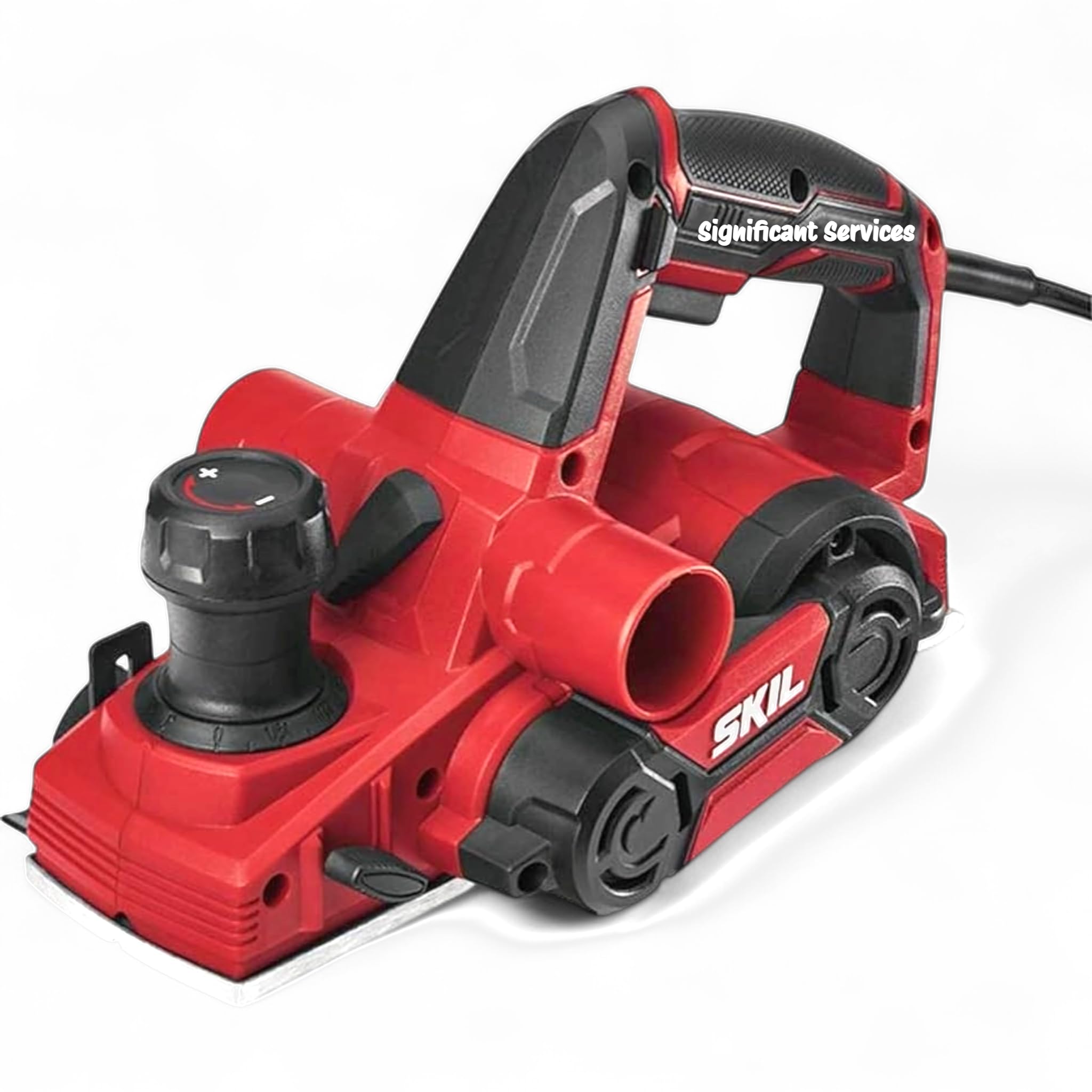
SKIL PL201201 Planer

88 /100
Kirk Score Excellent
Weight
6 lb
Amperage
6.5 A
Cut Width
3-1/4 in.
Max Cut Depth
2 mm
Check Details on Amazon

Pros

  • Dual chip exhaust keeps sightlines clear
  • 6.5-amp motor handles deck boards
  • Kickstand protects finished surfaces
  • Lock-off switch adds safety

Cons

  • Depth setting can drift
  • Blade life is inconsistent

The PL201201's dual chip exhaust is the feature we noticed first. You can throw chips to either side of the tool, which keeps the cut line visible when you are working along a deck board or a door edge and do not have a vacuum hooked up.

The 6.5-amp motor and 3-1/4-inch cut width put it in the same class as the corded Porter-Cable and Makita, and the 16,000 rpm cutter head has enough speed for painted trim and pressure-treated lumber. The kickstand keeps the blade off the work when you set it down, and the lock-off switch is a sensible safety detail.

We also appreciate the wrench storage and the included dust bag, parallel guide, and rebate fence. It is a more complete kit than the price tier suggests, and the grip works for left- or right-handed use.

That kit makes it a useful second planer for a homeowner who does not want to tie up a premium tool on a deck. The dual exhaust and kickstand are the details we use most, and the 6.5-amp motor has enough power for pressure-treated boards. It is not the planer for a finish carpenter's daily work, but it covers the rough side of door and deck repairs well.

Bottom line: What we like about the PL201201 is its dual chip exhaust and full kit for deck and door work.

Check Latest Price

How We Tested the Electric Hand Planers

We started by pulling every 3-1/4-inch planer we could find from brands we'd trust on a job site, then thinned the list with spec sheets: amperage or voltage, maximum depth of cut, drum width, weight, whether the depth adjustment had a positive stop, and whether the box included a dust bag, a case, or nothing at all. That left 12 machines — corded, cordless, bare tools, and kits. We bought them at retail and spent nine months using them.

Most of the testing happened during a renovation of an old house, which is where planers actually live: fitting doors that had swollen shut, chamfering stair stringers, and shaving a drawer that hadn't closed since the 1980s. On the bench, we ran each one down a 6-foot white-oak board and counted passes to a penciled line, checking the result with a combination square instead of trusting the depth scale. Blade quality showed up fastest on figured maple, where a dull set tears out and a sharp one leaves glass; we also tracked how blades held up after a stack of reclaimed lumber full of old staples.

Cordless models ran against a stopwatch — continuous passes on 2x4 edges until the tool quit, then recharge time — because battery life is the difference between finishing a door and hunting for a charger. We planed over a dark drop cloth to see where the chips actually went, and noted whether the dust bag stayed put and filled evenly or clogged at the port. Finally, we priced each one by what it cost to get cutting, since a bare tool only looks like better value until you add batteries and a charger.

How to Choose an Electric Hand Planer

Match Cut Width to the Work

A full-size hand planer cuts about 3-1/4 inches wide and takes 5/64 to 3/32 inch in a pass; compact models such as the Bosch GHO12V-08N cut around 2.2 inches. Wider is faster on door bottoms and board edges, but narrower gets into cabinet scribes and installed trim where a full-size sole will not fit. Decide which of those jobs you have more of, then choose the width. We prefer a tool that takes a controllable pass over one that advertises the deepest cut.

Choose Corded or Cordless by the Job

Corded planers such as the Makita KP0800K and Porter-Cable PC60THP run all day without a battery question and usually deliver more power for the money. Cordless models earn their place on installed doors, occupied rooms, and site work where a cord is a trip hazard. If you go cordless, the battery platform is part of the purchase: a bare tool only makes sense if you already own compatible packs and a charger. We treat the planer as a trim tool first, so a light 18V or 12V model with a fresh battery is often enough.

Check Depth Adjustment and Blade Alignment

A depth knob with positive clicks is easier to repeat than a friction dial, especially when you are creeping up on a door clearance. The scale can still be off, and a blade that sits proud on one side will cut a step across the width. We check a scrap offcut before every visible pass and confirm that both sides of the cutter are taking the same amount. If the cut is heavy on one side, reset or replace the blade rather than compensating with the depth knob.

Plan for Chips, Dust, and Control

A planer makes a lot of chips fast, and the bag or port is not an afterthought. A reversible exhaust or a port that swaps sides, as on the Porter-Cable and SKIL, keeps the stream away from your cut line; a vacuum adapter is better than a small bag for indoor work. Weight and balance matter just as much: a 3.3-pound compact is easier overhead, while a heavier full-size tool feels steadier on a bench. We choose the lightest tool that still has enough power for the pass, then let the dust collection decide the rest.

Frequently Asked Questions

Final Verdict

We recommend the Makita XPK01Z as the best default for most buyers. It has the width for door and board work, a depth adjustment we trust, and enough balance to keep a light pass under control. The fact that it runs on Makita's 18V LXT batteries makes it easier to live with if you are already on that platform.

If you are committed to DeWalt's 20V line and want faster stock removal, the DCP580B is the alternative we point to, with the caveat that blade alignment deserves a check before finish work. For tight trim and installed doors, the compact Bosch GHO12V-08N is the one that fits where a full-size planer will not. Start with the work you do most, and the choice becomes simpler.