// data-verified

Best Glass Cutters of 2026

A glass cutter doesn't cut glass — it scores a thin line into the surface, and the pane breaks along that line when you flex it. So everything comes down to whether the wheel leaves one clean, unbroken score, and whether the tool lets you press hard and stay straight while you do it. In years of scoring mirror, window glass, and stained glass, the cutters that fail are rarely the expensive ones — they're the ones that don't feed oil properly.

My team worked through 14 cutters over the past four months, from pistol grips and brass-handled straight cutters to kits that bundle in running pliers and breaker pliers. The oil reservoir was the real dividing line: too little and the wheel drags and skips, too much and it bleeds out the head and into the case. Grip matters more than you'd guess, too — once your fingers are slick, the score wanders.

We also weighed what each one delivers for the money, including the parts a kit bundles that you'd otherwise buy separately. The picks below are the cutters that scored cleanly, snapped true, and didn't leave a puddle in the toolbox.

#01

Best Overall

Toyo Custom-Grip Supercutter

90 /100
Kirk Score Outstanding
Wheel
Carbide steel
Handle
Molded plastic grip
Length
5.4 in
Check Details on Amazon

Pros

  • Swiveling head follows curves without fighting your wrist
  • Wide grip reduces hand strain
  • Scores with light pressure
  • Carbide wheel outlasts conventional cutters

Cons

  • Priciest single cutter here

Toyo builds this one around the hold rather than the barrel. The handle is a wide, patterned plastic grip you close your fist around instead of pinching like a pencil, and the head swivels, so the wheel goes where your wrist points rather than where the tool is aimed. On a curve, that is the difference between following a pattern and fighting it.

We noticed the change on the second or third score rather than the first. Because the grip fills your palm, the pressure comes from your arm instead of your fingertips, and the light touch that keeps a score clean stops feeling like a balancing act. Of everything here, this is the cutter we hand to someone who has never scored glass before, and it is the one most likely to produce a clean break in the first ten minutes.

It also costs more than the kits on this list and arrives as one tool with nothing else in the box — no pliers, no spare heads, no bottle of oil. Keep an eye on the wheel as you work: if it starts skating across the surface instead of biting, the reservoir has run dry, and a dry wheel polishes glass rather than scoring it.

Most of what you are paying for is the wheel. It is carbide steel, which Toyo rates to outlast conventional cutters, and it is the reason this one is still worth picking up after the budget sets have gone dull.

Bottom line: Our pick for most people: the Custom-Grip gives you the most control of anything here, on straight scores and curves alike.

Check Latest Price
#02

Best Pistol Grip

IMT Pistol Grip Glass Cutter

87 /100
Kirk Score Excellent
Wheel
Tungsten carbide
Handle
Pistol grip
Weight
3.2 oz
Cutting Ranges
2-6 mm and 6-12 mm
Check Details on Amazon

Pros

  • Palm-driven leverage from the pistol grip
  • Tungsten carbide wheel cuts with light pressure
  • Two heads cover 2-12mm glass

Cons

  • Heads stop at 12mm glass

Buy this one for the score, not the oil. The pistol grip puts the pressure in your palm, the tungsten carbide wheel bites with very little downward force, and the result is the kind of even, consistent line that lets a stained-glass piece break where you meant it to. It is the cutter we reach for when there is a long run of scores to get through. What it also does is seep: oil works past the cap between sessions and leaves a ring on whatever it is sitting on.

That is manageable rather than disqualifying. Fill the reservoir partway instead of full, wipe the head after the last cut, and stand the cutter nose-up in a cup rather than laying it on its side in a drawer. We keep a rag next to ours and empty it before it goes back in the toolbox. Two heads come in the box, one for 2-6mm glass and one for 6-12mm, which covers window glass, mirror and most craft stock.

The iron head adds weight at the front, which steadies a long straight score and takes a little adjusting to on a tight curve; if your work is mostly patterns and small pieces, the grip-style Toyo above tracks them more naturally. Past 12mm you are out of range here and into a cutter with a bigger head.

Bottom line: If your glass is under 12mm and your scoring sessions are long, the IMT's pistol grip and tungsten wheel deliver; just empty the reservoir before you store it.

Check Latest Price
#03

Best for Straight Cuts

Toyo TC17B Brass Supercutter

88 /100
Kirk Score Excellent
Body
Brass barrel
Wheel
Tungsten carbide
Wheel Angle
140°
Glass Thickness
3/32 in to 1/4 in (2-6 mm)
Check Details on Amazon

Pros

  • 140-degree wheel matched to 2-6mm glass
  • Brass barrel adds steadying heft
  • Hex end cap stops it rolling off the bench
  • Tungsten carbide scoring wheel

Cons

  • Fixed head cannot follow tight curves

The number that decides whether the TC17B suits you is 140 degrees: that is the angle Toyo grinds into the tungsten carbide wheel, and it is chosen for glass between 3/32 inch and 1/4 inch thick. Window glass, mirror and picture framing all sit in that band. The head is fixed and straight, so it tracks a steel rule without wandering the way a swiveling head can, and the hexagonal end cap stops it rolling off the bench between cuts.

What won us over is the brass barrel. It is dense enough that the cutter does more of the work than your hand does, and it has the solid, weighted feel of a tool built to be kept. It is also a specialist's purchase: one wheel, one fixed head, no pliers in the box, and no real way to follow a tight curve. If your work is stained-glass patterns rather than window panes, the Custom-Grip above is the better buy.

Bottom line: For straight scores in 2-6mm glass, the brass TC17B is the most satisfying cutter here; add a pair of running pliers to finish the break.

Check Latest Price
#04

Best Budget

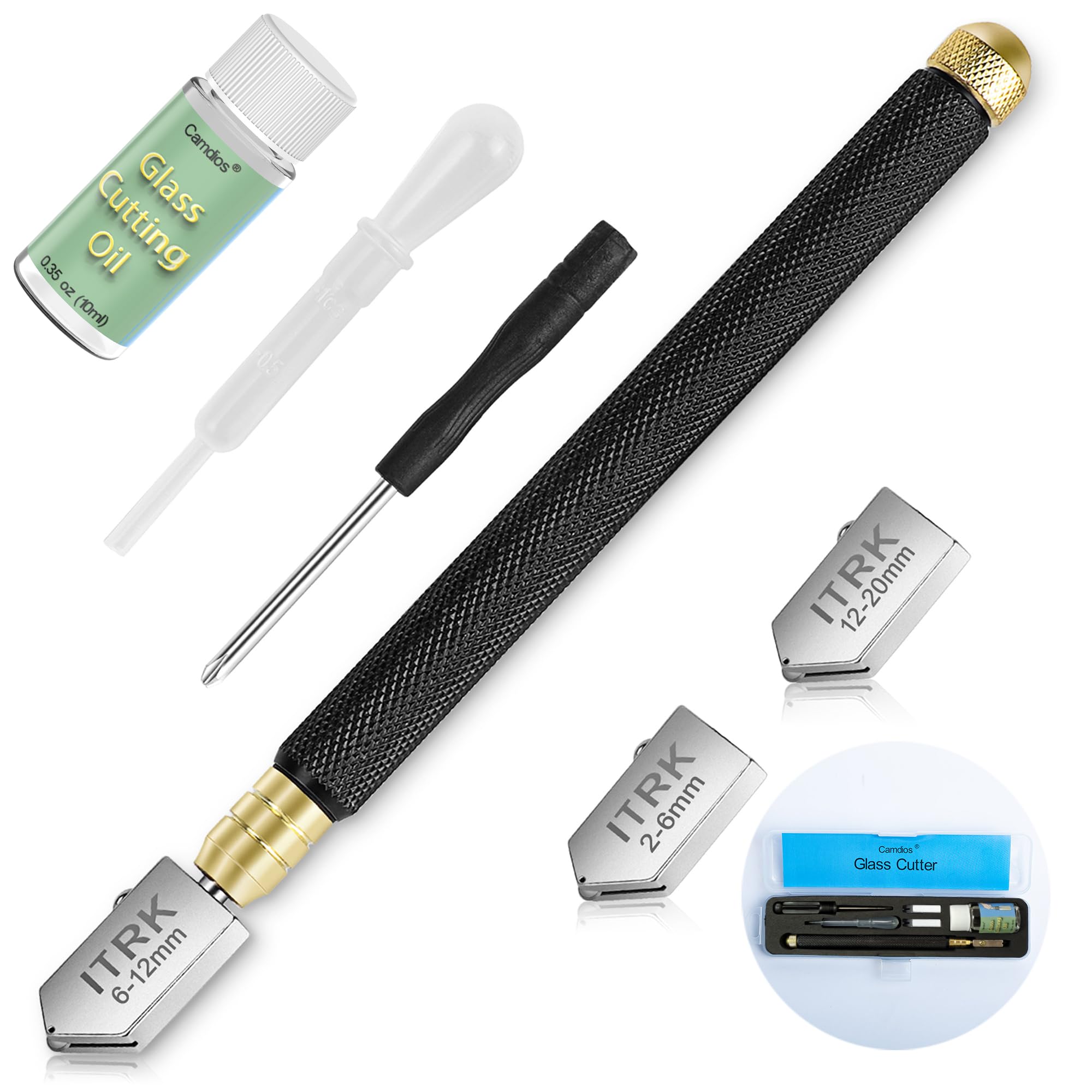
Camdios Glass Cutter Kit

86 /100
Kirk Score Excellent
Length
8.42 in
Oil Feed
Automatic
Included Oil
10 ml
Cutting Ranges
2-6 mm, 6-12 mm, 12-20 mm
Check Details on Amazon

Pros

  • Three heads cover 2-20mm glass
  • Cutting oil, dropper and screwdriver included
  • Storage case keeps the kit together

Cons

  • Small loose heads are easy to misplace

For the least money on this list you get a complete scoring setup: the pencil-style cutter, three heads covering 2-6mm, 6-12mm and 12-20mm glass, a 10ml bottle of cutting oil, a dropper, a screwdriver, and a case. That is the package we point people toward when they are not sure how much glass they will actually cut, because there is nothing else to buy before the first score — no separate oil, no second order for a thicker head.

The heads are the useful part and the fiddly part. Thin mirror and thick shelf glass genuinely need different wheels, and this kit hands you all three; they are small threaded parts, though, and the one you need is always the one that is not on the handle. Keep them in the case. The pencil handle runs 8.4 inches, long enough to keep your knuckles clear of the glass on a full-length score and a little unwieldy in a tight corner. Store it upright when you are done, because a reservoir cutter left on its side weeps.

Bottom line: The best value here: three heads, a bottle of oil, and a case for less than a single premium cutter, covering 2-20mm glass.

Check Latest Price
#05

Best Complete Kit

Rizom 13-Piece Glass Cutting Kit

89 /100
Kirk Score Excellent
Pieces
13
Weight
3.08 lb
Cutting Ranges
2-6 mm, 6-12 mm, 12-20 mm
Pliers Included
Tile nippers, running pliers, breaker grozer
Check Details on Amazon

Pros

  • Cutter plus pliers and nippers in one purchase
  • Canvas bag keeps the set together
  • Three cutter heads span 2-20mm

Cons

  • Nipper spring and jaws are the parts that wear first

Thirteen pieces is the pitch, and the count matters: a cutter with three heads for 2-6mm, 6-12mm and 12-20mm glass, 8-inch tile nippers, 8-inch running pliers with curved jaws, a 6-inch breaker grozer, spare rubber tips, and a canvas bag. For someone setting up a stained-glass bench from nothing, this is the shortest path to actually cutting — score, run the break, nip the shape, and put it all back in the bag.

The running pliers are the reason to buy the kit rather than a cutter. A score is only a scratch until something presses evenly on both sides of it, and doing that by hand is how a beginner breaks a pane in the wrong place. The bag earns its place too: tools that travel in a case get to class intact, and the curved jaws reach inside cuts that a straight plier struggles with.

Where we think it earns its price is having the second and third tool already in the bag — buy a cutter alone and the running pliers become a separate order the same week, which is exactly the step beginners skip. The trade is bulk: a bit over 3 pounds in the canvas roll, so it lives on a workshop shelf more happily than it rides in a tote.

Bottom line: Setting up for stained glass from scratch? The Rizom kit puts the cutter, running pliers and nippers in one bag and saves a second order.

Check Latest Price
#06

Best Starter Kit

Swpeet 3-Piece Glass Tool Kit

91 /100
Kirk Score Outstanding
Handle
Rubber pistol grip
Pieces
3
Storage
Carrying case
Tools Included
Running pliers, breaker grozer, oil-feed cutter
Check Details on Amazon

Pros

  • Scorer plus running and grozer pliers
  • Adjustable set screw controls breaking pressure
  • Case keeps the three tools together

Cons

  • Rubber jaw covers can split with use

Scoring glass is the easy half. The half that ruins panes is the break, and a starter kit with only a cutter in it leaves you to work that out with your thumbs. Swpeet's three-piece set pairs an oil-feed scorer with running pliers and a breaker grozer, which is why it is the set we suggest to someone who wants to try stained glass without buying a bench full of tools.

The running pliers carry an adjustable set screw, and that is the detail to understand: it sets how much squeeze the jaws apply, so you can start gentle on thin stock and add pressure for thicker pieces. The rubber covers on the jaws keep bare metal off the glass, and everything lives in the case, which matters more than it sounds when the alternative is a drawer of loose pliers.

Value is where this set makes sense: it is the least you spend and still get both halves of the job, and for a few pieces a month it holds up fine. Where it asks patience is consistency — the tools arrive ready to work but not evenly matched, so treat the pliers as the cheaper half of the pair and keep the scorer clean. That is a whole first project's worth of kit, and the pliers are the part you upgrade later.

Bottom line: A sensible first kit: scorer, running pliers and grozer in one case, with the set screw that lets a beginner control the break.

Check Latest Price
#07

Occasional cutting

Mudder 9-Piece Glass Cutter Set

86 /100
Kirk Score Excellent
Heads
5
Handle
Aluminum alloy
Pieces
9
Cutting Ranges
2-6 mm, 5-12 mm, 12-20 mm
Check Details on Amazon

Pros

  • Two cutters and five heads in one set
  • Rotating head helps on curves
  • Threaded aluminum handle grips well

Cons

  • Alloy steel wheels rather than carbide

Two cutters, five heads, a glove, a dropper and a screwdriver, for less than either Toyo here costs on its own. That arithmetic is the appeal: one cutter can hold a thin-glass head while the second keeps a big one loaded, so you are not swapping heads in the middle of a project.

The aluminum handle is threaded for grip, and the head rotates through a full turn, which helps when a curve needs the wheel to lead and the barrel to follow. Five heads across 2-6mm, 5-12mm and 12-20mm cover everything a household is likely to score, from a mirror to a shelf pane, and the glove is a sensible inclusion for handling fresh edges.

What we do not love is the hand feel. Aluminum is light, and a light cutter asks more of your hand over a long score. That is the trade for the price, and it is a fair one if you cut a pane every few weeks rather than working through a project.

The bigger point is the wheel. Five heads sounds generous until you notice they rotate around alloy steel wheels rather than carbide, and it is the wheel, not the head, that dulls; the extra heads buy convenience, not life. For occasional cutting that is fine. If you score glass most weekends, the carbide cutters above are worth the step up.

Bottom line: Lots of kit for the money — two cutters, five heads and a glove — and the right pick if you cut glass occasionally.

Check Latest Price

How We Put 14 Glass Cutters to the Test

We started by pulling specs and reviews for close to 40 cutters, then narrowed to 14 based on what actually changes a cut: carbide versus steel wheels, self-oiling reservoirs versus a separate dropper bottle, straight versus pistol grip, and whether a kit includes running pliers and breaker pliers. We bought every one ourselves rather than working from samples.

Testing ran four months, mostly at my garage workbench and on a bathroom mirror project that needed 30-odd tiles. We scored 3mm window glass, mirror, and stained glass against a steel straightedge, then snapped each line with running pliers and by hand to see whether the break followed the score or chewed the edge. Every couple of weeks we started a fresh sheet so we could count how many clean cuts a wheel made before it skipped.

Oil flow got its own checks, because that's where these tools go wrong. We filled each reservoir, cut a dozen lines, then stood the cutters head-down in a toolbox overnight over a paper towel to see what leaked and how fast. We scored with bare hands, then with deliberately oily fingers, to see how the grip held.

Durability came from ordinary abuse — a drop off the bench, a head swapped in and out, a month loose in a toolbox. Finally, we tallied what each kit's pliers and spare heads would cost separately, since a bundle isn't a bargain if you'll never use half of it.

How to Choose a Glass Cutter

Match the Head to the Glass Thickness

Glass thickness dictates the wheel. The Toyo TC17B is built around a 140-degree wheel ground for 2-6mm stock, which is where window glass, mirror and picture framing sit, and it scores that band beautifully. Multi-head kits, like the Camdios, Rizom and Mudder sets, ship 2-6mm, 6-12mm and 12-20mm heads and you swap to suit the pane in front of you.

The trap is the range printed on the box: a cutter sold as 2-20mm does not have one wheel that does all of it, it has three, and the wrong one on the wrong glass gives you a shallow score and a break in the wrong place. Measure before ordering — most household glass is thinner than people assume.

Pencil, Pistol, or Wide Grip

Pencil-style cutters are held like a pen and run along a straightedge on a bench, which makes them natural for panes and shelves. Pistol grips move the pressure into your palm, which buys leverage on a long score and gives up a little finesse on a tight radius. Wide grip-style cutters with swiveling heads are the stained-glass choice, because the head turns with the pattern instead of the whole tool.

If your work is mostly patterns, pay for the swivel. If it is mostly rectangles, a pencil or pistol body is steadier and cheaper, and the swivel only adds a joint to keep clean.

How the Oil Feed Behaves

An oil-fed cutter lubricates the wheel as it scores, which keeps the line clean and stops chips clinging to the wheel. That convenience has a cost: reservoirs seep between sessions, and a cutter left on its side in a toolbox leaves an oil ring and oily hands.

Fill partway rather than full, wipe the head after the last score, and stand the tool upright. If you prefer to skip the reservoir entirely, a dry cutter and a small squeeze bottle of oil do the same job with less to go wrong.

A Score Isn't a Cut: Budget for Pliers

The wheel scratches the surface, and something has to run the break. On thin glass a light snap over a dowel works, but running pliers press evenly on both sides of the score and breaker grozers nibble away at a curve, and those are the tools that stop a good score ending in the wrong place.

That is the argument for a kit over a single cutter: the Rizom and Swpeet sets include the pliers, and the Toyo cutters do not. If you plan to cut more than a pane or two, buy them together.

Frequently Asked Questions

Final Verdict

For most people, the Toyo Custom-Grip is the cutter to buy. It is the most controllable tool here on both straight scores and curves, and its carbide wheel is the part that keeps it useful long after a budget set has gone dull.

If cost decides it, the Camdios kit covers 2-20mm glass with oil and a case for the least money on this list. Setting up a stained-glass bench? Start with the Rizom kit and skip the separate plier order.