// data-verified

Best PVC Pipe Cutters of 2026

A PVC joint usually fails at the cut, not at the glue. A blade that crushes instead of slices leaves a burr and a hairline crack; a cut that wanders off square won't seat all the way into the fitting, and you find out a week later, on your knees, with a wet rag. I've made both mistakes on my own sprinkler lines. Over the past five months, my team and I worked through a dozen cutters, from compact ratchets to a battery-powered shear.

The capacity number on the package is a ceiling, not a promise — a cutter rated for two and a half inches will sail through thin-wall tubing and stall halfway into schedule 40. Ratchet action rescues you there: squeeze, release, squeeze, and the blade advances a few degrees at a time. Blade stability matters just as much; a flexing blade wanders off your mark no matter how strong the jaws are.

The picks below are the ones that stayed square, held an edge, and didn't shower the floor with shavings — how much pipe you cut and where you cut it will sort out the rest.

#01

Best Overall

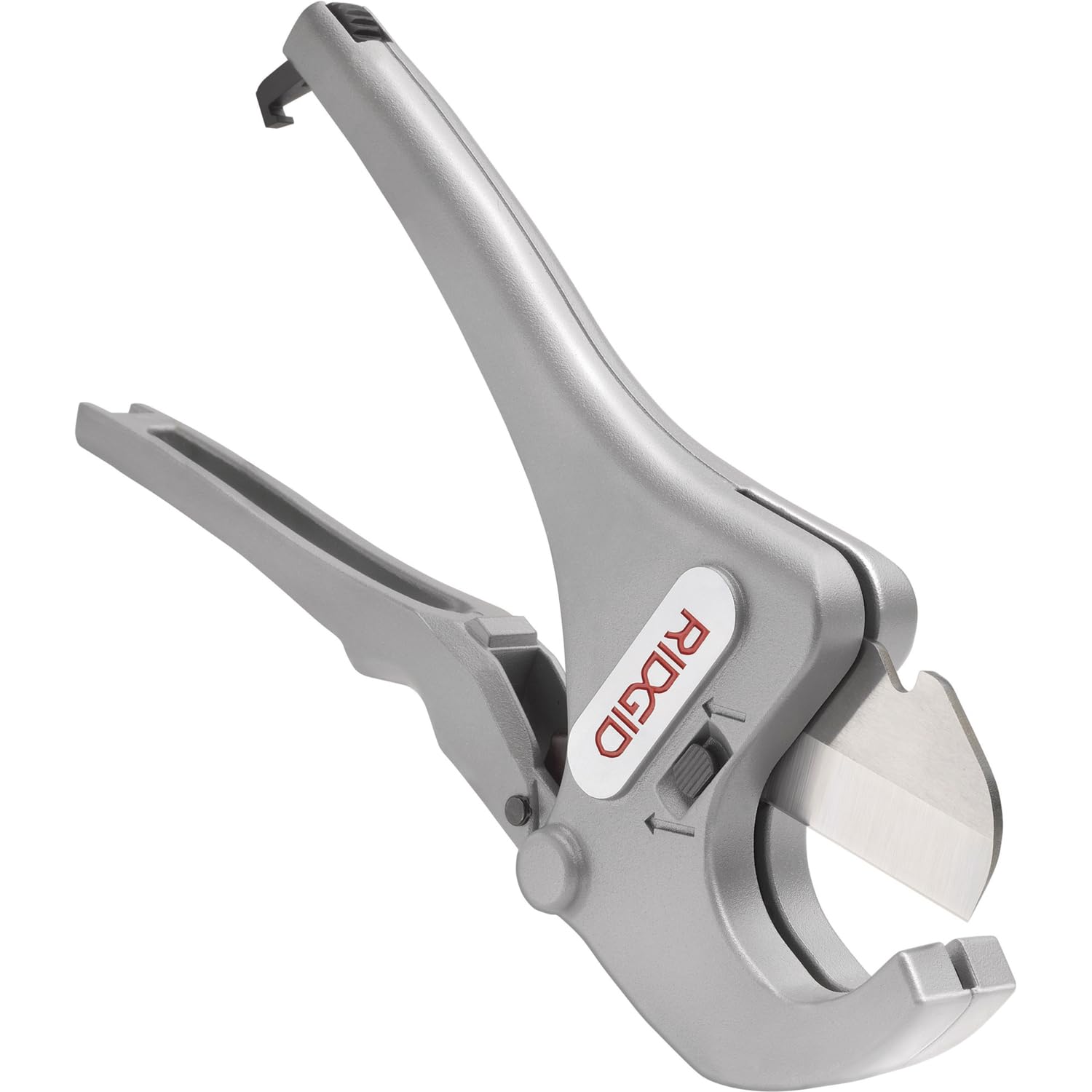
RIDGID RC-1625 Pipe Cutter

91 /100
Kirk Score Outstanding
Body
Aluminum
Blade
X-CEL quick-change
Warranty
Lifetime
Cutting Capacity
1/8 to 1-5/8 in. OD
Check Details on Amazon

Pros

  • Square, burr-free ends with little effort
  • Blade replaces in seconds, no tools
  • Handle markings work as a 1/2-inch scale
  • Lifetime warranty against defects

Cons

  • Capacity stops below 1-1/2-inch pipe
  • Priciest hand cutter in this set

The cut is what earns this one the top spot. We ran the RC-1625 through 1/2-inch and 3/4-inch schedule 40 and got square, burr-free ends that dry-fit into fittings without rocking — a lip so slight it wiped off with a thumb. Two or three short squeezes of the ratchet does it, because the jaws cradle the pipe instead of pinching it flat. A clean end with barely any effort is exactly the combination a homeowner should be shopping for.

The details hold up. The aluminum body has no flex in the handles, the X-CEL blade twists out for replacement, and the grips are marked in 1/2-inch increments so the tool doubles as a tape measure in a cramped joist bay. RIDGID backs it with a lifetime warranty against defects. At 1/8 inch to 1-5/8 inches of outside diameter it covers 1/2-, 3/4-, and 1-inch PVC, which is most of what a house throws at you.

Two things to know before you commit. It stops short of 1-1/2-inch pipe — that pipe measures 1.900 inches across, past this cutter's ceiling — so a bigger run means stepping up to the SHALL or the Milwaukee. And it is the most expensive hand cutter we are recommending. The blade and the squareness justify it for anyone who cuts pipe more than a couple of times a year; the SHALL covers occasional use for less.

Bottom line: The one we reach for first: it leaves a square, burr-free end in a couple of easy squeezes, and the blade swaps out in seconds when it dulls.

Check Latest Price
#02

Best Cordless

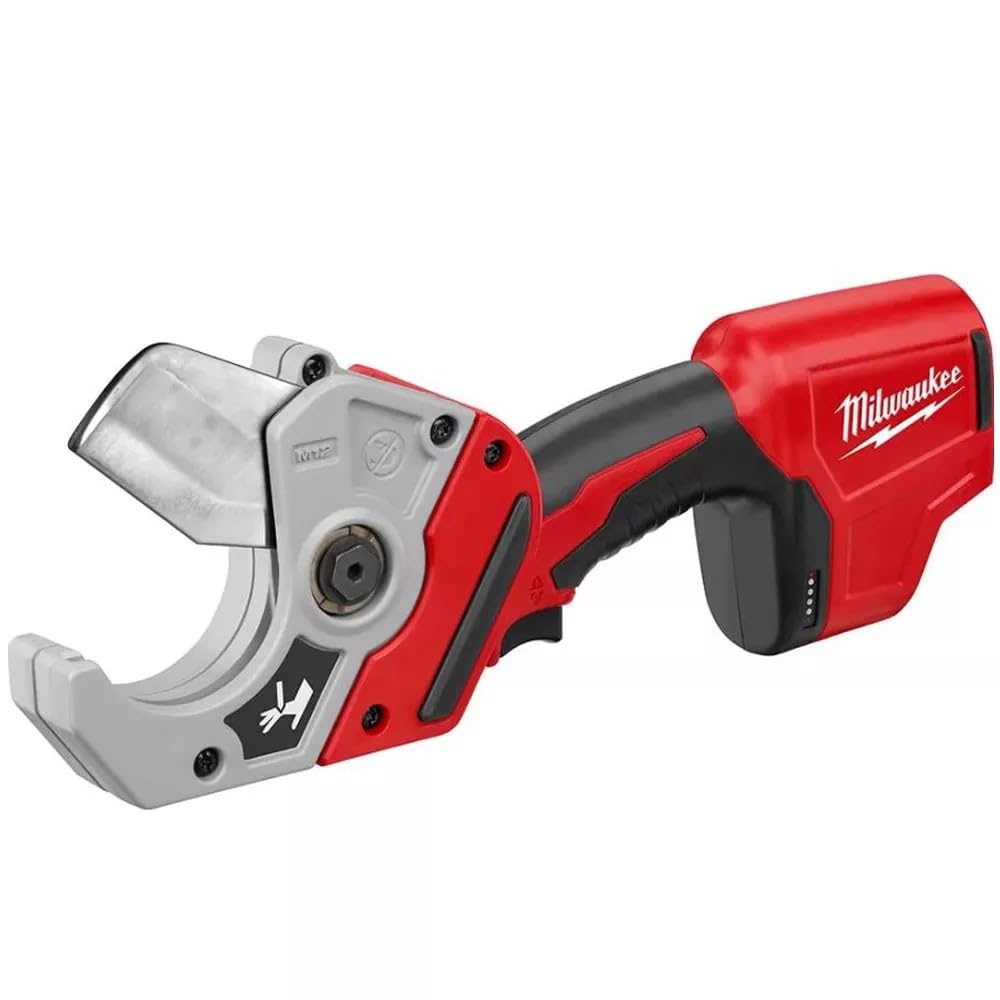
Milwaukee M12 PVC Shear

94 /100
Kirk Score Outstanding
Blade
Stainless steel
Power
M12 battery, tool only
Weight
4.71 lb
Max Capacity
2 in. Schedule 80
Check Details on Amazon

Pros

  • One-pass cuts through 2-inch schedule 80
  • Burr-free ends on PVC, CPVC, ABS, and conduit
  • Stainless blade and aluminum jaw resist water and rust
  • Quick blade return keeps repeat cuts moving

Cons

  • Bare tool
  • Close to five pounds before the battery

Milwaukee sells this as a bare tool, and that is the first thing to get straight about the cost: no battery, no charger in the box. On a service truck that is normal. In a garage where the cordless tools are a drill and a flashlight, it means committing to the M12 platform before the first cut.

What you get for that is a genuinely different experience from a hand cutter. The shear's jaws close on the pipe in one pass and leave a clean, square end on 2-inch schedule 80, and the quick blade return has the next cut ready before you have moved the pipe. We think it earns its keep for anyone cutting more than a handful of joints a week — a remodel, a pool rebuild, a long conduit run — and it is hard to justify for a single repair under the sink.

It is also close to five pounds before you add a battery, so overhead work gets old, and the pierce point starts the cut with a bite rather than a slice. On cold, brittle pipe that bite can chip the end, so leave an inch of waste and trim back to square. Neither is a dealbreaker for the jobs this tool is built to do.

Bottom line: We keep it for volume: one pass through 2-inch schedule 80, no forearm burn, as long as you are already on Milwaukee's M12 batteries.

Check Latest Price
#03

Best for Large Pipe

SHALL 2-1/2-Inch Pipe Cutter

87 /100
Kirk Score Excellent
Body
Die-cast aluminum
Blade
SK5, Teflon coated
Weight
1.3 lb
Max Capacity
2-1/2 in. OD
Check Details on Amazon

Pros

  • Reaches 2-1/2-inch outside diameter
  • Aluminum body at 1.3 pounds
  • Teflon-coated SK5 blade
  • Ratchet works one-handed overhead

Cons

Two and a half inches of outside diameter is the number that matters here. It is the widest of the hand cutters we are recommending, which puts 2-inch schedule 40 — the pipe on pool equipment, sump discharges, and main drains — within reach of a tool you squeeze by hand.

The build is more thoughtful than the price suggests. The die-cast aluminum body takes the flex out of the handles when you are leaning on 2-inch pipe, and at 1.3 pounds it is light enough to hold overhead with one hand while the other lines up the cut. The SK5 blade carries a Teflon coating that helps it slide through PVC and ABS rather than drag, and the safety lock buckles shut one-handed for storage.

Squareness is where it asks for patience. On the largest sizes the blade can drift off line, and a cut that runs out of square will not seat in a fitting no matter how much cement you use. Let the ratchet take small bites, keep the pipe seated against the back jaw, and resist forcing a full stroke. Do that and this is the best balance of capacity and money in this group.

Bottom line: The sensible buy when the pipe is bigger than 1 inch: 2-1/2 inches of capacity, a light aluminum body, and a ratchet you can work one-handed.

Check Latest Price
#04

Best Value

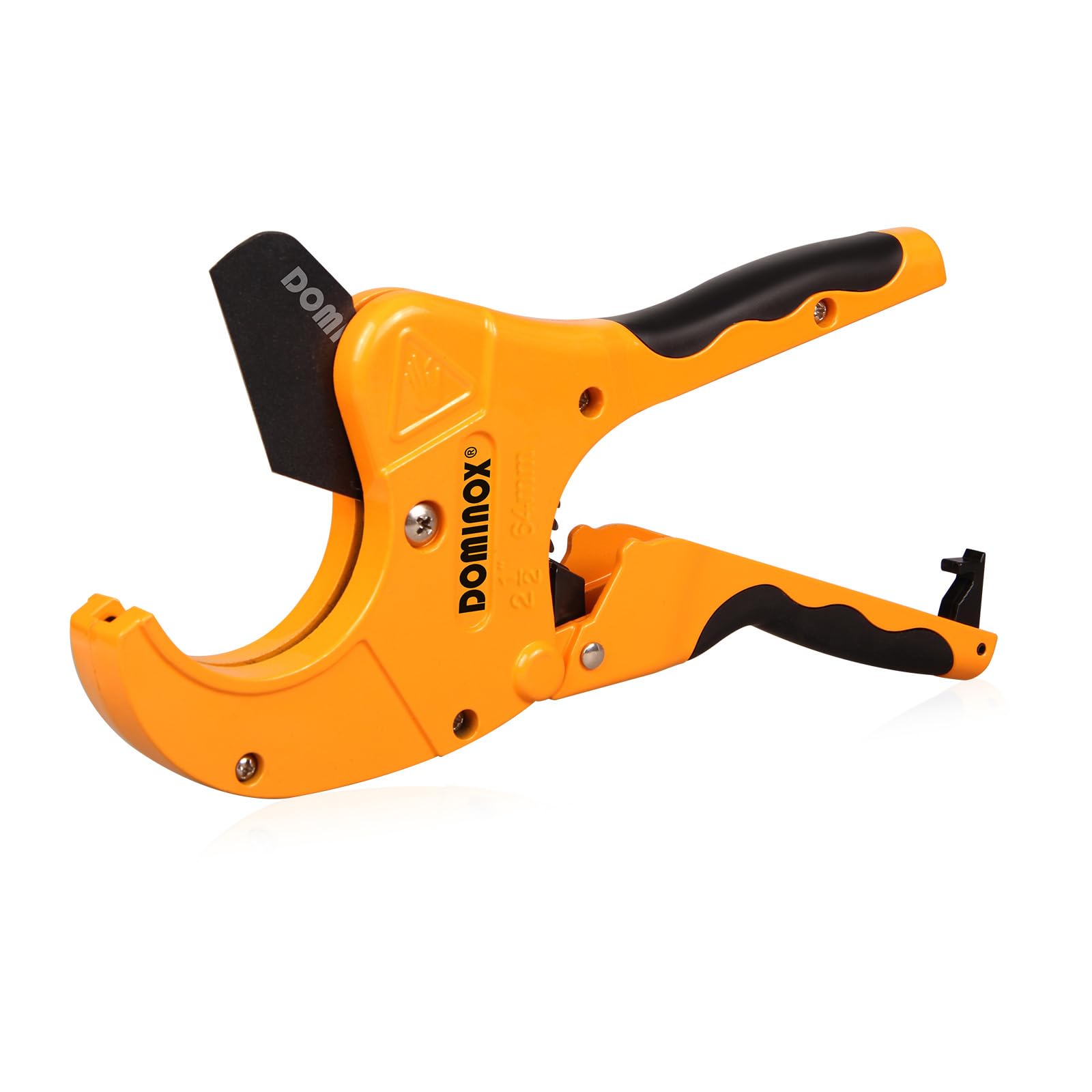
DOMINOX 2-1/2-Inch Pipe Cutter

87 /100
Kirk Score Excellent
Blade
SK5 steel
Handle
Aluminum with ABS
Max Capacity
2-1/2 in. OD
Check Details on Amazon

Pros

  • 2-1/2-inch capacity for the least money here
  • Die-cast aluminum handle with ABS grip
  • SK5 blade with rust-resistant coating

Cons

On paper the DOMINOX matches the big-capacity cutters for less: 2-1/2 inches of outside diameter, an SK5 steel blade the listing describes as resisting rust, bending, and breaking, and a die-cast aluminum handle encased in ABS. The ratchet drive is the same idea you will find on cutters costing more.

The handle is what separates it from the bare-metal cutters — the ABS shell is thicker in the palm, which is comfortable on a long run and slightly less so in a tight bay where every bit of jaw opening counts. Everything else about it follows the standard formula for this class: ratchet, hooked blade, cradle jaw.

Where it makes sense is a single afternoon of 2-inch work: a sump swap, a pool patch, a drain reroute. It gives up little to the SHALL on paper and asks less for it, and if the job is one and done, that is the whole calculation. If you will still be cutting pipe in five years, put the difference into the RIDGID, where the blade comes out when it dulls.

Bottom line: The cheapest way to reach 2-1/2 inches here, with an aluminum body and an SK5 blade — a sound bet for a one-off run of big pipe.

Check Latest Price
#05

Conduit and thin-wall

KNIPEX Bix Pipe Cutter

92 /100
Kirk Score Outstanding
Weight
2.47 oz
Pipe Range
20 to 50 mm OD
Spare Blades
2 included
Wall Thickness
Up to 2.4 mm
Check Details on Amazon

Pros

  • Cuts thin-wall plastic with no shavings
  • 2.47 ounces, short enough for tight cavities
  • Rotating knife block handles sealing sleeves
  • Two spare blades in the box

Cons

  • Unreinforced pipe only, up to 2.4 mm wall

The number to read first is 2.4 mm. That is the wall thickness this Knipex is rated for on unreinforced plastic pipe, rising to 3.5 mm on soft and foam-core material, which covers electrical conduit, thin-wall drain pipe, and irrigation line and stops well short of schedule 40 pressure pipe. Buy it for the first list and it is a lovely little tool; buy it for the second and it will let you down.

What we appreciate is how little room it needs. At 2.47 ounces it disappears into a tool pouch, and it opens in a cavity where a ratchet cutter's handles would never have space to swing. The cut leaves no shavings to blow out of a conduit run, which is the difference between a ten-minute job and a fish tape full of plastic curls. The knife block rotates so the blade sits outside the jaw for cutting sealing sleeves, and two spares come in the box.

It is a specialist, and it costs more than the SHALL while doing fewer jobs. As the thing that lives in the bag for conduit and DWV work, though, the spare blades and the two-position block make it two tools in one pocket — and the blade is the part that wears out.

Bottom line: We reach for this on conduit, thin-wall drain pipe, and sealing sleeves — a shavings-free slice in spaces no ratchet cutter fits — but it will not touch schedule 40.

Check Latest Price
#06

Flush inside cuts

DEWALT Impact Connect Cutter

90 /100
Kirk Score Outstanding
Shank
1/4 in. hex
Wheel
Diamond grit, fixed
Pipe Range
1-1/4 to 8 in. Sch. 40
Check Details on Amazon

Pros

  • Flush cuts from inside the pipe
  • Rated for 1-1/4- to 8-inch schedule 40
  • Fits any 1/4-inch hex impact driver or drill
  • Fixed wheel will not fall into the pipe

Cons

  • Requires a separate impact driver

It is not a cutter you carry; it is a bit. The DEWALT Impact Connect locks into a 1/4-inch hex chuck and the diamond-grit wheel works from inside the pipe, which is how you get a flush end where a stub comes through a floor, a wall, or a toilet flange. It is rated for 1-1/4- to 8-inch schedule 40, so it out-reaches every hand cutter on this page.

The wheel is permanently fixed — DEWALT's point is that it cannot drop into the pipe mid-cut — and the trade is that the wheel's life is the tool's life. It grinds rather than slices, so it slows as the wheel loads up, and you will want to wipe the end before you glue it.

Where it earns a place is the renovation where a riser has to come off flush and no ratchet will reach. Treat it as a problem-solver rather than your only cutter: it needs an impact driver you may not own, and it will not replace a hand cutter for bench work.

Bottom line: For the cut nothing else here can make — a flush end from inside the pipe — this hex-shank cutter works, if there is an impact driver in your kit.

Check Latest Price

How We Tested PVC Pipe Cutters

We started by pulling every cutter we could find that would handle at least one-inch pipe, then narrowed the field by blade material, whether spare blades were sold, how wide a capacity range each tool covered, and whether it could be locked shut for storage. Ratchet, shear, and wheeled designs all survived the cut, and we ended up with 12 cutters in hand for a five-month run. Every one of them faced the same pipes: half-inch, three-quarter, one-and-a-half, and two-inch schedule 40, plus a coil of PEX.

Most of the cutting happened at my basement bench, but the tools also went outside for a real irrigation manifold rebuild on a 45-degree morning — cold PVC is brittle, and that's when a dull blade does damage — and up a ladder, cutting overhead between joists with one hand while the other held a flashlight. We made every cut twice: once on a fresh length and once on pipe already in place with no room to maneuver.

At the bench we wrapped each pipe in tape, marked a line, and afterward held the offcut against a framing square to see how far the cut had drifted. We counted how many ratchet squeezes a full cut took, ran a thumb around the inside edge for burrs, and watched for blade wobble by pushing the blade sideways mid-cut. Locking mechanisms got opened and closed fifty times, and every cutter spent the test period riding loose in a toolbox to see what rattled. We tracked blade wear as we went — a couple of tools wanted a fresh blade inside a month, while others were still slicing clean at the end — and factored in what replacement blades cost, since that's where a budget cutter stops being a bargain.

How to Choose a Pvc Pipe Cutter

Match the Outside Diameter, Not the Label

Pipe is sold by nominal size and cutters by outside diameter, and the two do not line up. A 1-1/2-inch PVC pipe measures 1.900 inches across; 1-1/4-inch measures 1.660. Both are wider than the 1-5/8-inch ceiling on most ratchet cutters, so a tool advertised as cutting up to 1-5/8 inch realistically covers 1/2-, 3/4-, and 1-inch pipe. That is plenty for a bathroom remodel and not enough for a main drain.

Measure the pipe's outside diameter before you buy, and check the fitting you are gluing onto, because the cut end has to seat all the way into the socket. If 2-inch pipe is on the list, you need a 2-1/2-inch cutter like the SHALL or a powered shear.

The Blade Is Where the Money Goes

Every cutter here works the same way: a hook-shaped blade is drawn through plastic while a jaw holds the pipe. What separates a tool that keeps cutting square from one that starts beveling is the steel and, more importantly, how firmly the blade is held. A blade that shifts sideways under load cuts at an angle, and an angled end does not seal — solvent cement needs two square faces meeting.

That makes replaceability as important as sharpness. The RIDGID's X-CEL blade comes out with a twist, and the Knipex ships with two spares. A cutter whose blade you can change is a tool; one you throw away when it dulls is a consumable.

Four Designs, Four Jobs

A ratcheting hand cutter is the default, and it is what most people should buy. Short squeezes let the mechanism multiply your grip, so you can work one-handed overhead; the RIDGID, the SHALL, and the DOMINOX all work this way.

The other three designs solve narrower problems. A scissor-style cutter like the Knipex slices thin-wall pipe and conduit without shavings but will not touch pressure pipe. A cordless shear like the Milwaukee M12 takes 2-inch schedule 80 in a single pass and is the tool for volume, at the cost of a battery platform and roughly five pounds. A hex-shank bit like the DEWALT's cuts from inside the pipe, the only way to finish flush at a floor or wall.

Cold Pipe and Installed Runs

Temperature changes how plastic behaves under a blade. Warm PVC slices cleanly; cold PVC cracks, which is why a shear can chip the end of pipe that has spent the night in a garage. Bring the pipe indoors before cutting, or leave an inch of waste and trim back to a clean end.

Installed pipe is the other constraint. With two inches of stub between a fitting and the framing, no ratchet cutter has room to swing — that is the moment for the scissor cutter, or for cutting from the inside.

Frequently Asked Questions

Final Verdict

Start with the RIDGID RC-1625. It handles the pipe sizes most repairs actually involve — 1/2, 3/4, and 1 inch — and leaves a square, burr-free end in a couple of short squeezes. The replaceable blade and the lifetime warranty are what separate it from the cheaper ratchet cutters, and they are what you are paying for. If you cut pipe more than a couple of times a year, that is the right trade.

Two changes in requirement move the answer. If the run includes 1-1/2- or 2-inch pipe, the RIDGID will not fit it: the SHALL reaches 2-1/2 inches for a fraction of the money, and the Milwaukee M12 shear will cut 2-inch schedule 80 all day if you are already on that battery platform.