// data-verified

Best Infrared Thermometers of 2026

Point an infrared thermometer at a cast-iron skillet and you get a number in under a second — no probe, no steam, no waiting. The catch is that the number is only as good as where you stand and how shiny the surface is, which is why two guns aimed at the same pan can disagree by 40 degrees.

I've spent seven months living with 14 of these temp guns in the kitchen, the garage, and on the grill cart, and the best ones separated themselves on things you'd never guess from the box: distance-to-spot ratio, a second laser that shows the circle you're actually averaging, and an adjustable emissivity setting for shiny metal. Almost nobody touches emissivity out of the box, and it's the biggest source of wrong readings on a stainless pan.

The picks below are the ones quick enough to grab one-handed and sturdy enough to survive a drawer full of tongs — whether you're checking a pizza steel, a griddle, a vent, or an engine block.

#01

Best Overall

Etekcity Lasergrip 1080

93 /100
Kirk Score Outstanding
Emissivity
Adjustable, 0.1 to 1.0
Response Time
0.5 seconds
Temperature Range
-58° to 1130°F
Distance-to-spot Ratio
12:1
Check Details on Amazon

Pros

  • Adjustable emissivity from 0.1 to 1.0
  • 1130°F ceiling covers pizza stones and grates
  • Half-second readings with a backlit display
  • Two-year warranty backing

Cons

  • Battery bay in the grip is cramped to load

The specification we keep coming back to on the Lasergrip 1080 is one most cheap guns leave out: emissivity is adjustable from 0.1 to 1.0. Left at the 0.95 default, it reads food, cast iron, drywall, and painted metal correctly. Point it at a polished stainless pan or a chrome bumper and that same control is how you get a number that matches what a contact probe shows. Paying for a dial you touch a dozen times a year sounds fussy until a shiny surface hands you a reading that is plainly wrong.

The 1130°F ceiling is the other half of the case. That covers a pizza oven's stone, a flat-top griddle, grill grates, brake rotors, and exhaust manifolds, which is most of the list people buy one of these for. The 12:1 distance-to-spot ratio puts the measuring circle at about an inch across from a foot away and five inches across from five feet, so at grill distance you are reading the grate rather than the fire behind it.

Half-second updates make it a sweeping tool rather than a spot checker: drag the beam down a griddle and the hot end shows up before the first pancake goes on. The backlit LCD stays legible in a dim garage, Fahrenheit and Celsius swap from the buttons, and it runs on two AAA cells that come in the box. The two-year warranty is longer cover than the Klein IR10 offers.

What it cannot do is steady your hand. On a thin pipe or a single burner ring the circle is wider than the target, so the number is an average of what it swallowed; move closer and accept that the laser dot marks the middle of the circle, not its edge. Reflective metal needs the emissivity value set, and no infrared gun reads the middle of a steak.

For a house that cooks, heats, and occasionally fixes a car, this is the one we hand people first. The range clears every domestic cooking surface, the emissivity control rescues the pans that trip up cheaper guns, and the price stays in the middle of the group. Nothing else here does all three.

Bottom line: We recommend it as the default infrared gun for a mixed household, because adjustable emissivity and an 1130°F ceiling cover cooking, vents, and engine work without a premium price.

Check Latest Price
#02

Best for Professional Use

Fluke 62 MAX

93 /100
Kirk Score Outstanding
Accuracy
±1.5°C or ±1.5% of reading, 0 to 500°C
Temperature Range
-22° to 932°F
Sealing And Warranty
IP54, 3 years
Distance-to-spot Ratio
10:1
Check Details on Amazon

Pros

  • Stated accuracy of ±1.5°C or ±1.5%
  • IP54 sealing and a three-year warranty
  • Minimum, maximum, average, and difference modes
  • Solid, substantial feel in the hand

Cons

  • Instructions are drawings only, with no text

The 62 MAX is the most expensive tool on this page, and the money goes somewhere specific: a stated accuracy of plus or minus 1.5°C or 1.5% of the reading between 0 and 500°C, IP54 sealing against dust and splashes, and a three-year warranty. Those three lines are what a technician is paying for, and they are why the price holds up.

Repeat work is where we think it earns that. The same reading on the same bearing or the same supply vent a month apart is the entire job, and this is the instrument here that hands you minimum, maximum, average, and the difference between two spots on demand. The accuracy figure is concrete rather than decorative: 1.5% at 300°F works out to under five degrees either way.

Set two limits against it. The 10:1 ratio is the narrowest in this group, so from ten feet you are reading a circle about a foot across, which is fine for a wall or a vent grille and useless for a single pipe. And the 932°F ceiling sits below the budget guns. It suits someone measuring large, dull surfaces at close range, not a cook chasing a pizza stone.

Bottom line: We recommend it for anyone whose readings have to be repeatable, since the sealed body, stated accuracy band, and three-year warranty are what a professional is actually buying.

Check Latest Price
#03

Best for High Heat and Distance

Klein Tools IR10

91 /100
Kirk Score Outstanding
Probe
K-type probe included
Alarms
High and low, audible and visual
Temperature Range
-40° to 1200°F
Distance-to-spot Ratio
20:1
Check Details on Amazon

Pros

  • 20:1 ratio reads small targets from far off
  • 1200°F ceiling with a K-type probe included
  • High and low alarms, audible and visual
  • Adjustable emissivity and dual-laser targeting

Cons

  • One-year warranty on a premium instrument
  • Runs on a 9V rather than AAA cells

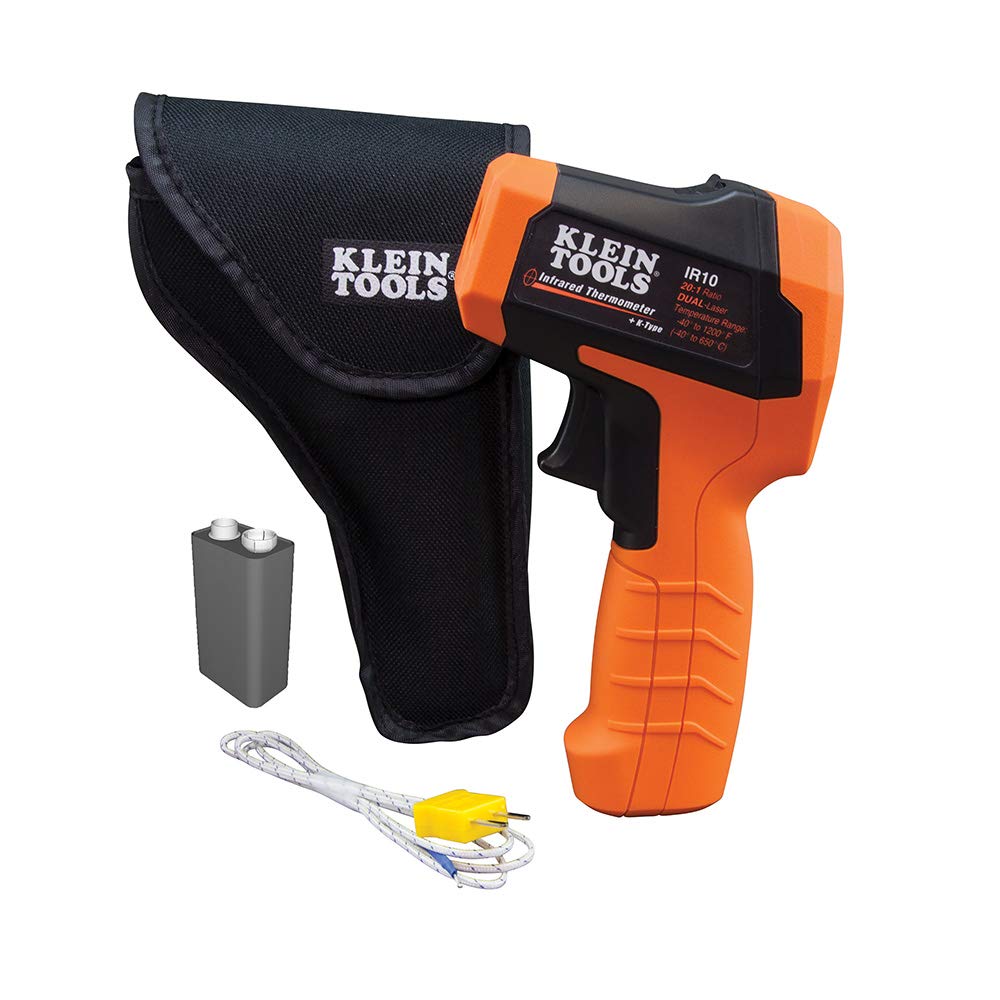
Twenty to one stops being a marketing number once you are standing on the floor. At 20:1 the measuring circle is about an inch across from 20 inches and roughly nine inches across from 15 feet, wide enough to average a stretch of duct and tight enough that the number still means something. That is the difference between reading a ceiling register from a ladder and reading it from the doorway.

The ceiling is 1200°F, the highest here, and a K-type probe comes in the box for air, gas, or liquid readings. That pairing makes it a service tool rather than a kitchen gadget: read the register face with the sensor, then the airstream with the probe, and compare the two without reaching for a second instrument.

Around that sit the features that separate a working gun from a consumer one: adjustable emissivity from 0.1 to 1.0, high and low alarms that sound and flash when a limit is crossed, max, min, average, and difference modes, and dual lasers that bracket the measuring spot instead of pointing at its middle.

What you are paying for is headroom, and it is worth being honest about how much of it most people need. If your work tops out around 900°F and six feet, this is more instrument than the job requires, and the Fluke is the better buy for repeatable readings close in. For rooftop units, manifolds, and anything hot and far away, the ratio and the probe are the whole argument.

Bottom line: We recommend it for technicians working at distance or near 1200°F, where 20:1 optics and the included K-type probe do jobs nothing else in this group can.

Check Latest Price
#04

Best for Aiming Precision

TempPro TempScan PLUS TP450

91 /100
Kirk Score Outstanding
Targeting
Two lasers
Emissivity
Adjustable, 0.1 to 1.0
Temperature Range
-58° to 1022°F
Distance-to-spot Ratio
16:1
Check Details on Amazon

Pros

  • Two lasers show when you are at working distance
  • 16:1 ratio for small, hot targets
  • Max, min, and average from one sweep
  • Adjustable emissivity from 0.1 to 1.0

Cons

  • No carry case in the box

Two laser dots on a temperature gun are not double the accuracy; they are a distance gauge. The beams are angled to meet where the measuring circle is tightest, so they spread apart as you back off and close up as you come in to the working distance. On a 16:1 gun that turns am I too far back into something you can see, and it is the detail we like most here.

The rest is a well-rounded midrange package: minus 58 to 1022°F, plus or minus 1.5% claimed accuracy, half-second response, adjustable emissivity from 0.1 to 1.0, and max, min, and average so a single pass across a flat-top reports the range instead of the last point under the dot. Two AAA batteries come in the box and the display reads easily at arm's length.

Readings drift a few degrees against a contact thermometer on some units, which is harmless for a griddle or an oven window and not good enough for anything you have to certify. The twin laser helps most at cooking distances; in a tight engine bay we found it busier than a single dot. For grills, ovens, and flat-tops it is the most useful aiming system in this group.

Bottom line: We recommend it for griddle and pizza-oven cooks who want to see their working distance, with two lasers bracketing the spot and a 16:1 ratio behind them.

Check Latest Price
#05

Best Budget

KNINE OUTDOORS TG-2024

92 /100
Kirk Score Outstanding
Emissivity
Adjustable, 0.1 to 1.0
Temperature Range
-58° to 1112°F
Display Resolution
0.1°C or 0.1°F
Distance-to-spot Ratio
12:1
Check Details on Amazon

Pros

  • 1112°F ceiling at the budget end
  • Adjustable emissivity from 0.1 to 1.0
  • Large, readable LCD

Cons

  • Hollow-feeling plastic body

If you want one gun that lives by the grill and gets grabbed for the truck, this is the one we point at. It reads minus 58 to 1112°F, adjusts emissivity from 0.1 to 1.0, and aims with a single laser that is good enough for grates, griddles, and tire sidewalls. Nothing about it is delicate, and nothing about it pretends to be a laboratory instrument.

The 1112°F ceiling is generous for the money: pizza oven domes, cast-iron searing, and brake rotors all fall inside it. The 12:1 ratio matches the Etekcity 1080 and the TempPro CORE, the LCD is large and easy to read, and the display resolves to 0.1°. That last figure is display precision rather than accuracy, since the optics set the limit, not the readout.

The limits are the usual 12:1 ones: hold steady on a small target, and dial in an emissivity value for polished metal instead of trusting the default. It is also a light, hollow-feeling tool that will not be the one you hand down. For the two jobs most people actually have, cooking and checking something that is running hot, it does the work without asking much.

Bottom line: We recommend it as the one gun to keep between the grill and the truck, with an 1112°F ceiling and adjustable emissivity at the budget end of the group.

Check Latest Price
#06

Kitchen and travel

Etekcity Lasergrip 774

93 /100
Kirk Score Outstanding
Weight
4 oz
Emissivity
Adjustable
Temperature Range
-58° to 842°F
Distance-to-spot Ratio
12:1
Check Details on Amazon

Pros

  • Adjustable emissivity at the low end
  • Two-year warranty
  • 4 ounces, easy to keep in a drawer
  • Half-second readings

Cons

  • No lanyard loop or case in the box

What you give up for the 774's place in the group is range. It tops out at 842°F, which covers fry oil, a griddle, AC vents, and tire temperatures but stops short of a pizza oven's stone on a hot bake. At 4 ounces and a little over six inches long, it also feels like a pocket tool next to the bigger guns here.

What it keeps is more than we expected at this end: adjustable emissivity, the same 12:1 ratio as the top pick, half-second readings, and Etekcity's two-year warranty. Finding an emissivity control on a gun this inexpensive is the surprise, and it is the reason we keep one in a kitchen drawer rather than treating it as a throwaway.

The shell is light plastic, and its quality is the least consistent of the two Etekcity guns here, so it belongs in the drawer-of-a-house category rather than the toolbox-that-rides-in-a-truck one. As a second thermometer, a camp kit, or a gift for someone who cooks, it is easy to justify.

Bottom line: We recommend it as a second gun for the kitchen drawer or a travel kit, where its light weight and adjustable emissivity outweigh an 842°F ceiling.

Check Latest Price
#07

Cooking and grills

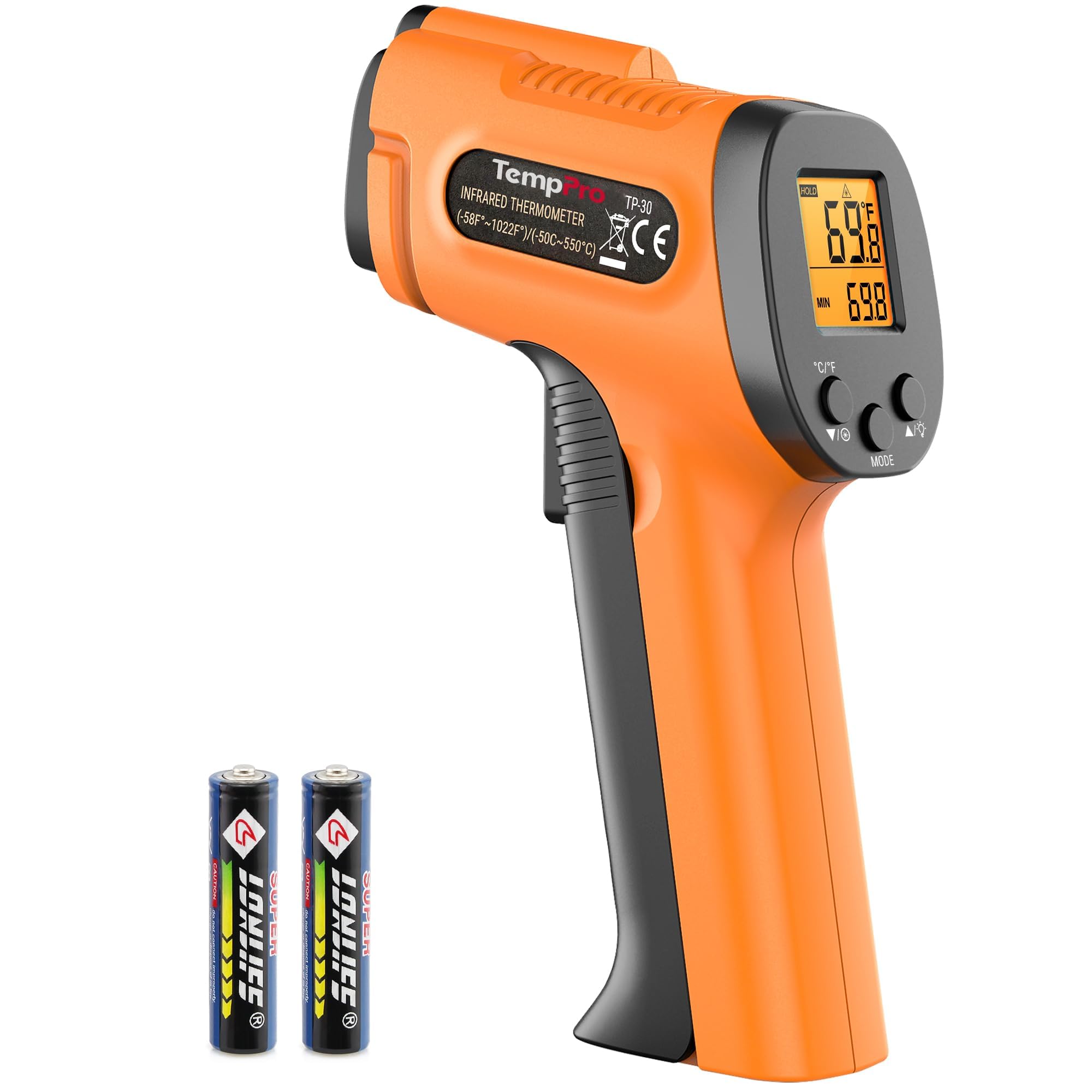
TempPro TempScan CORE TP30

93 /100
Kirk Score Outstanding
Emissivity
Adjustable
Display Modes
MAX, MIN, AVG
Temperature Range
-58° to 1022°F
Distance-to-spot Ratio
12:1
Check Details on Amazon

Pros

  • Max, min, and average from a single sweep
  • 1022°F ceiling covers pizza ovens
  • Adjustable emissivity and 12:1 optics
  • Half-second response

Cons

  • Laser can fail early; readings can drift over time

Sweeping a flat-top with a temperature gun is the quickest way to find the cool corner that is why one pancake browns late. The TP30 is built for that pass: one sweep, release the trigger, and the MAX/MIN/AVG display reports the range you crossed instead of the last number under the dot.

The rest of the specification holds up: minus 58 to 1022°F, a 12:1 ratio, adjustable emissivity, plus or minus 1.5% claimed accuracy, and a half-second response, with two AAA cells in the box. That is the same working envelope as the top pick, a step behind only at the very top of the range, and the readout is easy to see over a hot pan.

For cooking, that is the whole job: it finds the hot end of a griddle, the cool spot on a pizza steel, and the vent blowing warm instead of cold. What it is not is a tool to buy for a decade. The laser can stop working early and the accuracy does not always hold over months, so treat it as a good instrument with a limited lifespan and keep the receipt.

Bottom line: We recommend it for anyone who cooks on a flat surface, since max, min, and average turn one pass into a temperature map of the whole griddle.

Check Latest Price
#08

Vents and walls

Klein Tools IR1

92 /100
Kirk Score Outstanding
Battery
One 9V
Emissivity
Fixed at 0.95
Temperature Range
-4° to 752°F
Distance-to-spot Ratio
10:1
Check Details on Amazon

Pros

  • Fixed 0.95 suits ducts, walls, and painted surfaces
  • Auto-hold keeps the reading on screen
  • Pouch and a solid, weighty body
  • Simple one-handed operation

Cons

  • Included 9V can arrive flat

Compared with the Etekcity and TempPro guns here, the IR1 gives up range: 752°F against 1022 or 1130, and 10:1 optics instead of 12:1. What it keeps is the part that matters indoors, a fixed 0.95 emissivity that is right for drywall, ducts, painted doors, and most household surfaces, plus a targeting laser and auto-hold so the number stays on screen after you release the trigger.

Vent temperatures, wall temperatures, and the cold corner of a room are its jobs, and it does them without fuss. There is a pouch for a belt, the body has a solid, weighty feel the inexpensive guns lack, and one trigger pull gives you something you can write down.

Our hesitation is the ceiling and the cell. At 752°F, pizza ovens and exhaust manifolds are out of reach, which makes this a building-diagnostics tool rather than a cooking one. The 9V is also the wrong battery for a kitchen drawer, being the pricier cell and the one nobody has spare. For HVAC checks, doors, windows, and hunting a cold corner, it is tidy and well made.

Bottom line: We recommend it for vents, walls, and insulation checks indoors, where a fixed 0.95 emissivity and a solid body matter more than a high ceiling.

Check Latest Price
#09

Occasional light duty

Soonkoda GM50

93 /100
Kirk Score Outstanding
Battery
Two AAA
Emissivity
Fixed at 0.95
Temperature Range
-58° to 932°F
Display Resolution
0.1°C or 0.1°F
Check Details on Amazon

Pros

  • Point-and-read, with no settings to learn
  • Backlit display and hold function
  • 932°F ceiling at the low end
  • Two AAA batteries included

Cons

  • Thin plastic body

The GM50 has no emissivity control. What it has is a preset 0.95, which is right for oil, water, cast iron, drywall, and painted metal, and wrong for anything shiny. It also publishes no distance-to-spot ratio at all, so there is no way to work out how wide the measuring circle gets with distance; the practical answer is to hold it close and accept a looser reading.

Operation is as plain as it gets: pull the trigger to scan, let go for hold, backlight for a dark garage, and an eight-second auto-off that saves the cells. Two AAA batteries come in the box, the display resolves to 0.1°, and the same unit switches between Fahrenheit and Celsius.

The ceiling is 932°F, which covers frying oil, a griddle, and most engine checks, and the backlit display stays legible. What you accept at this end is inconsistent accuracy and uneven durability, with some units stopping inside the first week. For occasional use that is a risk worth knowing about rather than a reason to avoid the tool entirely.

It does the beginner's job well: point, hold, read, with no settings to learn. If you want an inexpensive way to find the hot end of a griddle, confirm the freezer is actually freezing, or settle an argument about the thermostat, this is enough gun. If a wrong number costs you money, put the money into the top pick instead.

Bottom line: We recommend it as a first gun for occasional checks, where point-and-read simplicity matters more than emissivity control or a long service life.

Check Latest Price

How We Tested These Temperature Guns

We built the shortlist from a running list of about 40 temp guns pulled from retailer listings and from threads where pizza obsessives and HVAC techs compare notes. Anything that didn't publish a distance-to-spot ratio and a temperature range up front got cut, as did near-duplicate listings from the same family of models. That left 14 to test.

Over seven months, those 14 went everywhere a thermometer actually goes: beside a pizza steel running near 550°F on Saturday nights, into a cast-iron skillet mid-sear, across a griddle of pancakes, onto grill grates and the surface of a pork shoulder, into the fridge and freezer, at HVAC registers and window frames on cold mornings, and under the hood of a car that had just come off the highway. Each reading got taken three times, with the distance and the surface written down alongside the number.

Accuracy was the hard part to judge honestly, so we cross-read the same target with a leave-in probe thermometer resting on the surface, then ran every gun over one matte-black pan back to back and flagged the outliers that disagreed by more than a few degrees. We timed how long it took to find and change the emissivity setting, noted how much of the manual we needed to get there, and watched for auto-off killing a reading mid-scan. Battery swaps got logged from the first day. Durability meant counter-height drops, a week rattling around in a toolbox, and wiping off grease and flour to see whether the laser still landed where it should. The units that stayed in rotation got re-checked months later to see whether their readings had drifted.

How to Choose an Infrared Thermometer

Match the distance-to-spot ratio to your target

The ratio on the box tells you how wide the measuring circle grows with distance: divide the distance by the ratio and you get the circle. A 12:1 gun reads a one-inch circle from a foot away and a five-inch circle from five feet. That is why two guns with similar accuracy give different answers when you lean back.

If you read ductwork overhead or a manifold from outside the engine bay, the 20:1 Klein IR10 shrinks the circle enough to matter. If you are hovering over a griddle, 10:1 or 12:1 is plenty. Measure the smallest thing you plan to point at, then work back to the ratio that covers it.

Decide whether you need adjustable emissivity

Emissivity is how readily a surface gives off heat, and a shiny one gives off less than it is holding. A fixed 0.95 preset, which is what the Klein IR1 and the Soonkoda GM50 use, is right for food, cast iron, drywall, and painted surfaces. Stainless steel, chrome, and bare aluminum need a lower setting, which the top pick and most midrange guns let you dial in.

If the gun cannot be adjusted, the workaround is simple: lay a strip of matte tape on the metal, let it come up to temperature, and read the tape. It is also the fastest way to check a reading you do not trust.

Pick a ceiling above your hottest target

Most home cooking sits under 700°F, with pizza stones and searing grates pushing higher; brakes and exhaust manifolds run 500 to 900°F. Six of the nine guns here reach 900°F or better and three pass 1100°F, so headroom is cheap.

Too little headroom is the one mistake you cannot fix later. A 752°F limit takes pizza ovens and manifolds off the table entirely, which is why the smallest contractor-style guns are a poor fit for a household that cooks.

Weigh the aiming aids and the modes you will use

A single laser confirms what you are pointed at; it says nothing about how wide the circle is. Dual lasers are a distance gauge: the beams are angled to meet where the spot is tightest, so they spread as you back off and close as you come in. On a hot griddle that is genuinely useful, and the reason the TempPro TP450 earns its place.

MAX, MIN, and AVG recording is the other feature worth paying for. One sweep across a flat-top then reports the range you crossed, which is the question a cook is actually asking. High and low alarms on the Klein IR10 do the same job for a technician scanning a panel.

Check the small things: cells, case, and cover

Two AAA cells are the easy case; a 9V costs more to replace and is rarely the spare rolling around a kitchen drawer, which is a nuisance both Kleins here share. A pouch or case matters more than it sounds if the gun rides in a truck instead of a drawer.

Warranty coverage varies sharply across this group: three years on the Fluke, two on the Etekcitys, one on the Klein IR10. That difference is part of what a premium price is buying, so weigh it alongside the specifications.

Frequently Asked Questions

Final Verdict

The Etekcity Lasergrip 1080 is our pick for a house that cooks, heats, and occasionally fixes a car. Adjustable emissivity handles the shiny pans and polished metal that fool cheaper guns, the 1130°F ceiling clears every domestic cooking surface, and the two-year warranty beats the Klein IR10's single year at a midrange price.

Change the requirement and the answer changes. Reading bearings and ductwork for a living makes the Fluke 62 MAX the better buy, on the strength of its stated accuracy band, IP54 sealing, and three-year cover. Rooftop units, manifolds, and anything near 1200°F call for the Klein IR10, whose 20:1 optics and included probe do jobs none of the others here can.