// data-verified

Best Laser Levels of 2026

A gallery wall looks easy until you're three frames in, standing back, and realizing the whole row tilts half an inch to the right. A laser level replaces the pencil-and-squint method with a line you can actually follow, and once one lives in the house you keep finding work for it — shelving, tile, outlet cutouts, a fence rail. The category splits, though: green beams read clearly in a bright room but drain the battery faster, while red beams run longer and wash out in daylight.

My team and I spent eight months with 12 of them, hanging, framing, and setting cabinets, and the differences came down to things the box doesn't advertise — how quickly the pendulum settles, whether the magnet holds on a ladder rung, and whether the line is still crisp at 30 feet.

Worth knowing before you buy: nearly every self-leveling model only corrects within a few degrees, so you still have to get the unit roughly straight before the pendulum takes over. That's normal, not a defect. The picks below all clear that bar; what separates them is everything that happens after.

#01

Best Overall

DEWALT DW088K Cross Line Laser

95 /100
Kirk Score Outstanding
Range
165 ft with detector
Beam Color
Red
Durability
IP54, 1 m drop rating
Laser Lines
1 horizontal, 1 vertical
Check Details on Amazon

Pros

  • Accurate cross line straight out of the box
  • IP54 housing with a 1 m drop rating
  • Strong magnets hold on studs and corner bead
  • Three-year warranty backs the build

Cons

  • 165-ft range figure requires a sold-separately detector
  • Two lines only, with no 360-degree planes

A one-meter drop rating and a three-year warranty are the two specifications that explain the DW088K. This is a cross-line built to ride in a tool bag, perch on a ladder, get knocked off it, and keep shooting a straight line — the housing is overmolded, and IP54 covers dust and splashes along the way.

For indoor layout it's the pick we reach for first, and not because of a feature list. The horizontal and vertical lines cross exactly where you set them, the self-leveling settles in a second or two, and the beam flashes instead of pretending when the unit is too far out of level to correct. Checked against a long spirit level, the line came back true, which is the only test that really matters on a tool like this.

The compromise is the beam color. Red reads clearly on drywall in ordinary room light, fades in a bright sunroom, and is gone entirely in daylight, so exterior work or a wall of windows calls for one of the green units below. Inside, in the light most of us actually work in, we never found it limiting.

What settles it is the combination of sealing and that flashing warning: on a paid job, a laser that survives a fall and refuses to lie about being out of level is worth more than an extra plane. It travels in a hard case with the bracket attached, so it comes out of the bag ready to hang on a stud.

Bottom line: If your layout work happens indoors and you want a laser that survives being dropped in a bag, this is the one we hand people first.

Check Latest Price
#02

Best for Whole-Room Layout

CIGMAN CM-701 3x360 Laser Level

93 /100
Kirk Score Outstanding
Battery
4,000 mAh, USB-C
Includes
Remote, mini tripod, L-bracket
Beam Color
Green
Laser Lines
3 x 360°
Check Details on Amazon

Pros

  • Three 360-degree green planes
  • Remote control for switching planes
  • Rechargeable 4,000 mAh battery over USB-C
  • Mini tripod and magnetic base included

Cons

  • Line fades fast in direct daylight
  • Ships with a soft bag, not a hard case

Whole-room work is where the CM-701 earns its place. One horizontal ring and two vertical rings mean you can square a room, set a ceiling grid, and mark both sides of a doorway without moving the unit, and it's the pick here for anyone whose jobs run past a single wall.

The kit is unusually complete. There's a 4,000 mAh battery charged over USB-C, a remote so you can kill a plane from across the room instead of walking back to the tool, a magnetic L-bracket, a mini tripod base, a target plate, and a soft bag that fits all of it. We found the remote more useful than it sounds — with three planes running, switching one off without disturbing the setup saves real time.

Two things to know before you buy. The body is smaller than most 3x360 units, which helps when you're perching it on the end of a shelf but makes it easy to lose in a crowded bag. Self-leveling corrects within ±4 degrees, which is normal for the class. And the line fades fast in direct daylight — a few feet of bright sun and it's gone. Plan on this as an indoor tool and it will cover a room from a single position.

Bottom line: Buy this if the job is a whole room: three green 360-degree planes, a remote, and a tripod in the box for about what a plain cross-line costs.

Check Latest Price
#03

Best Warranty and Support

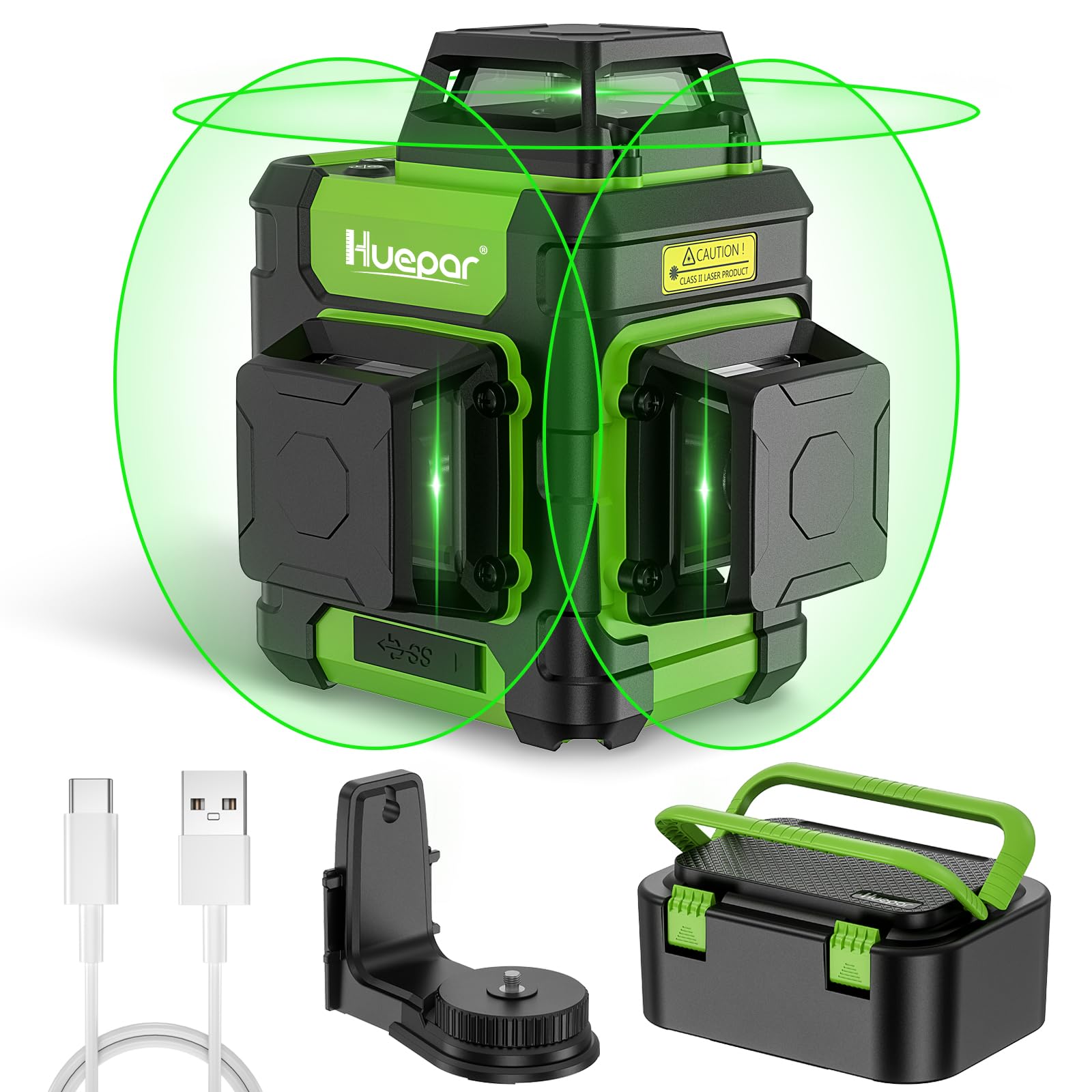
Huepar HM03CG 3x360 Laser Level

92 /100
Kirk Score Outstanding
Battery
Up to 8 hours, USB-C
Warranty
5 years
Beam Color
Green
Laser Lines
3 x 360°
Check Details on Amazon

Pros

  • Five-year warranty, the longest in this set
  • Three green 360-degree planes
  • About eight hours per charge over USB-C
  • Rigid hard case protects the unit

Cons

  • Line washes out in direct sunlight
  • No remote or mini tripod included

Five years is the longest warranty in this group, and on a tool that rides in a bag and gets set down hard, that cover is worth more than an extra laser plane. Huepar backs the HM03CG for five years and pairs it with lifetime technical support.

It's also the easiest 3x360 here to live with. A short row of buttons switches each plane on and off, the magnetic bracket clamps to a steel stud and rotates to fine-tune the line, and the first setup took nothing more than unlocking the pendulum and pressing a button. The rigid case is the part we appreciated most after a few trips in the back of a truck.

Power comes from a built-in battery quoted at eight hours of continuous use, charged over USB-C, which covers a day of cabinet or trim work without a second thought. This is a three-plane set, so there's no floor line, and the manual mode is there for when you deliberately want a line that isn't level. For the money, the balance of coverage, simplicity, and five years of backup is the strongest in this group.

Bottom line: A green 3x360 with a five-year warranty and an eight-hour battery — the sensible buy if you want coverage without paying premium money.

Check Latest Price
#04

Best for Jobsite Crews

DEWALT DW089LG 3x360 Green Laser

92 /100
Kirk Score Outstanding
Power
DEWALT 12V MAX battery
Sealing
IP65
Accuracy
±3 mm at 10 m
Laser Lines
3 x 360°
Check Details on Amazon

Pros

  • Runs on DEWALT 12V MAX batteries
  • IP65 sealing and overmolded housing
  • Three green 360-degree planes at ±3 mm per 10 m
  • 1/4-inch and 5/8-inch mounting threads

Cons

  • Value depends on already owning DEWALT 12V packs
  • Detector for extended range is not included

It runs on the same 12V MAX packs as DEWALT's drills and impact drivers, so the laser and the tools share a charger in the truck. If those batteries are already in your kit, that single fact changes the arithmetic on a laser that otherwise reads as expensive.

What's in the case is a three-plane green laser rated to ±3 mm at 10 m, sealed to IP65 in an overmolded housing, with an extended ceiling bracket, a target card, a battery, a charger, and a hard case. The bracket carries both 1/4-inch and 5/8-inch threads, so it goes on a camera tripod or a survey tripod without an adapter.

We found it the most plainly jobsite-ready of the group. IP65 is a step past the IP54 most of these carry, the stated 100-foot range comes with full-time pulse mode for use with DEWALT's DW0892G detector — not included — to stretch it further, and the whole kit feels like it was designed to be thrown in a gang box.

Where it loses ground is value outside the DEWALT ecosystem. The premium buys a battery platform you may not own, and green light is still light: on a sunlit slab the line fades like every other laser here. For a crew already on the platform, the sealing and the shared batteries justify the money; for a homeowner with a shelf project, the CIGMAN does the same work for a fraction of it.

Bottom line: The one to buy if you already run DEWALT 12V packs and need a sealed three-plane green laser that takes jobsite punishment.

Check Latest Price
#05

Best Compact Pick

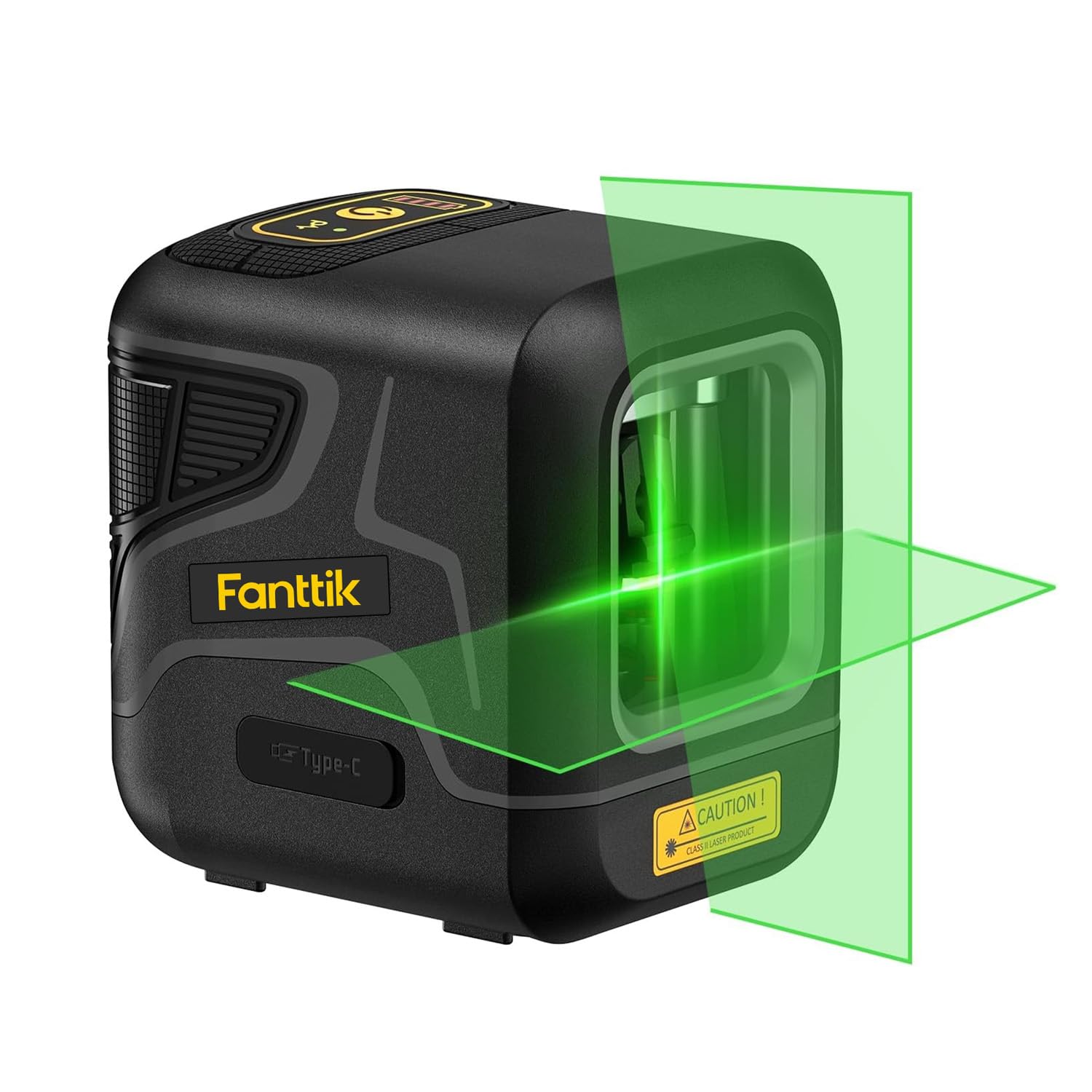
Fanttik D2 Pocket Laser Level

89 /100
Kirk Score Excellent
Range
100 ft
Runtime
Up to 10 hours
Beam Color
Green
Laser Lines
1 horizontal, 1 vertical
Check Details on Amazon

Pros

  • Palm-size body that stores anywhere
  • Up to ten hours per charge
  • Green cross line with pulse mode
  • Magnetic bracket rotates a full 360 degrees

Cons

  • Drawstring pouch instead of a hard case

Roughly three inches square and shaped like a fat phone, the D2 is the laser that lives in a kitchen drawer instead of a tool bag. That sounds like a small thing until you've hung four frames in a hallway and the big unit is out in the garage.

It throws a green cross, self-levels once the pendulum is unlocked, and flashes when it's tilted too far to correct. The 2,200 mAh battery is quoted at ten hours and charges over USB-C — more runtime than a weekend of picture hanging will use — and the bracket combines magnets with a 360-degree rotation, so you can dial the line in without repositioning the tool.

For the small jobs that make up most of a home's list, this is the sensible pick: a level line across a wall in the time it takes to find a pencil. It does want a surface that's close to level to start from — on a noticeably sloped floor the self-leveling can hunt, so set it on something solid rather than a sagging shelf. If you're squaring a room or running crown, spend up to a 3x360; a cross line at picture height is what this one is for.

Bottom line: For picture hanging and small repairs, this palm-size green cross-line is the one that actually comes out of the drawer.

Check Latest Price
#06

Budget room coverage

IKOVWUK B1-12 3x360 Laser Level

92 /100
Kirk Score Outstanding
Battery
5,200 mAh, up to 8 hours
Warranty
18 months
Beam Color
Green
Laser Lines
3 x 360°
Check Details on Amazon

Pros

  • Three 360-degree planes with a remote
  • 5,200 mAh battery quoted at eight hours
  • Bracket, mounting plate, and charger included
  • 18-month warranty

Cons

  • Vertical lines dimmer than the horizontal
  • Fades within a few feet in daylight

The box is fuller than the price suggests: a remote control, a 5,200 mAh battery and charger, an L-shaped magnetic bracket, a metal sheet for mounting the bracket to a wall, and a green laser that throws three 360-degree planes at once.

Coverage is the point. One horizontal and two vertical rings wrap a room, the pendulum self-levels within about three degrees, and the battery is quoted at up to eight hours — enough for a day of tile or trim. Pulse mode drops the beam to a weaker output for use with a detector, and the warranty runs 18 months.

Where it gives ground is beam quality: the vertical lines are noticeably dimmer than the horizontal one. Inside, in a normally lit room, all three read cleanly, and the remote saves a walk across the room every time you want to kill a plane.

For a first 3x360, or a second one for a helper, it does the job for very little money, and the accessory bundle is the reason to choose it over the cheapest two-line units. If beam quality matters for long runs and bright rooms, the Huepar HM03CG is the better spend — the same coverage, a cleaner line, and five years of cover instead of 18 months.

Bottom line: A full 3x360 kit with a remote and a big battery at the budget end — good value if you can live with a dimmer line.

Check Latest Price
#07

Lighting layout

Klein Tools 93LCLS Cross Line Laser

90 /100
Kirk Score Outstanding
Range
150 ft indoor
Mounting
Magnetic bracket, ceiling clamp
Beam Color
Red
Laser Lines
Cross line plus plumb spot
Check Details on Amazon

Pros

  • Plumb spot transfers points between ceiling and floor
  • Ceiling clamp for grid and lighting layout
  • 150-foot indoor working range
  • Rugged hard case included

Cons

  • Red beam is hard to read in bright rooms
  • One-year warranty is the shortest here

The plumb spot and ceiling clamp are why this one exists: the 93LCLS projects a single dot straight down, so you can transfer a point from ceiling to floor, or floor to ceiling, without a helper and a tape measure. For lighting layout and ceiling-grid work, that's a capability none of the other picks here offer.

Around it is a solid red cross-line: 150 feet of indoor range, IP54 sealing, a Class II laser, and a 360-degree magnetic bracket with 1/4-inch and 5/8-inch threads plus a hang hole for a nail or a hook. The controls sit on top of the body where you can reach them without pulling the unit off its mount, the ceiling clamp is what makes the plumb spot practical on a commercial grid, and the hard case is genuinely rugged.

The magnets are the weak part of the design. On vertical steel the bracket can slide, so for anything overhead plan on the clamp or the thread rather than trusting the magnet. Set against that, the plumb spot and the ceiling clamp are capabilities you can't add to a cheaper cross-line later.

Bottom line: The plumb spot and ceiling clamp make this the tool for recessed lighting and grid work — nothing else here transfers a point floor to ceiling.

Check Latest Price
#08

Floor-to-ceiling layout

Huepar LS04CG 4x360 Laser Level

92 /100
Kirk Score Outstanding
Accuracy
±1/9 in at 33 ft
Batteries
2 rechargeable
Beam Color
Green
Laser Lines
4 x 360°
Check Details on Amazon

Pros

  • Four 360-degree planes including top and floor lines
  • Two rechargeable batteries included
  • ±1/9 inch accuracy at 33 feet
  • Five-year warranty

Cons

  • 4.8 pounds with batteries fitted
  • More planes and buttons than most jobs need

Four 360-degree planes is the reason this one exists: a horizontal ring, two verticals, and a top line plus a floor line so you can mark a reference above and below the unit. For floor layout and recessed ceiling work, that's a capability the 3x360 units here simply don't have.

Around those planes are practical details: two rechargeable batteries so one can charge while the other works, a magnetic bracket with 1/4-inch-20 and 5/8-inch-11 threads, a lifting base, a target plate, and a hard case. Stated accuracy is ±1/9 inch at 33 feet, which is where a laser earns its keep on long cabinet runs.

It's also the heaviest thing in this group at 4.8 pounds with batteries fitted, and the keypad has more buttons than a two-line cross. Neither bothered us when the job needed all four planes; on a picture-hanging afternoon, both are more tool than you want to carry up a ladder.

So it's a specialist rather than a default. If your work is floor layouts, ceiling grids, or plumbing a wall from above and below, nothing else here does what it does, and the five-year warranty covers the outlay. If you mostly run cabinet lines and trim at eye height, the HM03CG gives you the three useful planes in a lighter body with the same cover.

Bottom line: The pick when you need a line on the floor and the ceiling as well as the walls: four planes, two batteries, five-year cover.

Check Latest Price

How We Tested the Best Laser Levels

We started with every laser level we could find that claimed 360-degree coverage, then cut the field by the things that actually separate one from another: green versus red beam, how many planes it projects, whether it runs on a rechargeable pack or AA batteries, and whether a magnetic bracket and a case come in the box. Price and the volume of durability complaints in reviews did the rest. That left 12 units, which we used over eight months in real rooms rather than on a bench.

Each one hung a 12-frame gallery wall, set a course of tile, and ran baseboard in a garage, and I rechecked every line against a spirit level at both ends of the throw. Accuracy got judged at distance, not up close: I walked each line out to 30 feet in a sunlit room and in a dim basement and noted where it stopped being readable. For self-leveling, I deliberately set each unit a few degrees off plumb to see whether it flashed a warning or quietly handed me a tilted line — that second failure is the one that ruins a wall.

Magnet strength was tested the same way every time: clipped to a steel stud, a ladder rail, and the side of a fridge, then tugged. Ease of use meant handing a unit to someone who had never touched one and timing how long it took to go from bag to first line. For durability, they rode loose in a toolbox and got knocked off a step stool onto concrete; we ran each on a full charge until the beam visibly dimmed, and weighed what came in the box against what the price asked.

How to Choose a Laser Level

Match the beam color to the room

A green beam reads more clearly to the eye than a red one in the same light, and that's the difference between spotting a line on a pale wall and hunting for it. Red still earns its place: it costs less, and in a stripped-out renovation with the windows covered it's perfectly readable. The rule we use is simple — if the work happens in finished, well-lit rooms, or anywhere near daylight, pay for green.

Neither color survives direct sun, which makes beam color an indoor decision first. Judge it against the lighting you'll actually be standing in, not a showroom floor.

Decide how much of the room you need to wrap

A single cross-line throws one horizontal and one vertical line, which covers trim, tile, and cabinet runs one wall at a time and is the simplest thing to operate. A 3x360 unit adds rings — one horizontal, two vertical — so a whole room squares up from one position, and that's the better choice if you're marking several walls or a ceiling. A 4x360 goes further with a top line and a floor line for ceiling and floor layout.

Sort out the mount before the height

Most of these ship with a magnetic bracket that grabs steel studs, corner bead, and steel door frames, plus a thread for a tripod. The trap is drywall and wood framing: there's nothing for a magnet to hold, and the tool ends up balanced on a stack of offcuts that isn't level. Before you start, decide what the laser will attach to in that room — a tripod with a 1/4-inch stud, a clamp, or a screw-fixed bracket.

Then set the unit at a height that puts the line within reach of the marks you're making, and measure from the line rather than from the tool.

Understand the self-leveling window

Self-leveling corrects a few degrees of tilt and no more; the units here that publish a figure quote ±3 or ±4 degrees. Outside that window the beam flashes rather than settling, and a flashing line means do not mark. In practice the surface you set the laser on has to be roughly level to begin with, which is harder on a ladder or an unfinished subfloor than it sounds. Set it on something solid, wait for the flashing to stop, and lock the pendulum before you carry it to the next room.

Weigh power, sealing, and warranty

Rechargeable lithium over USB-C is now the norm in this band, with quoted runtimes in the eight-to-ten-hour range. The alternative is a tool-brand battery platform that shares chargers with your drills — better or worse depending on what's already in your truck.

Sealing matters more than buyers expect: IP54 handles dust and splashes, IP65 handles a wet saw and a hose-down. And check the warranty — cover across these picks runs from one year to five, which on a tool that gets dropped off a ladder is worth real money.

Frequently Asked Questions

Final Verdict

Start with the DEWALT DW088K if your layout happens indoors and you want a laser that survives the back of a truck. It's the most trustworthy two-line tool in this group, and the drop rating and three-year warranty are the reasons.

If you need a whole room covered from one position, the CIGMAN CM-701 gives you three green planes, a remote, and a tripod for about the same money, while the Huepar HM03CG matches the coverage with five years of cover behind it. Choose by whether you need the room, not by the range figure on the box.