// data-verified

Best Laser Measures of 2026

The first time I measured a room with a laser instead of a tape, I felt faintly ridiculous — I pointed a small box at the far wall, pressed a button, and had the number before I'd found the end of the tape. What it actually fixes is narrower and more useful than that: you can measure ceiling height, closet depth, or the diagonal of a rug alone, one-handed, without bribing someone to hold the hook.

The catch is that nearly every model quotes the same accuracy on the box, and that number is not what separates them. What separates them is whether you can see the dot on a sunlit wall, whether the display is legible at an angle, and whether unit switching and the indirect-measurement modes are quick enough that you'll actually use them. I've spent the past six months with 12 of these — around my own house, on a friend's deck rebuild, and in a basement lit by exactly one bulb — and the good ones all got the boring parts right.

None of these are lab instruments; they're tools that end up in a kitchen drawer or a tool bag. The picks below lean toward people measuring rooms, hanging shelves, and estimating materials, with a couple built for rougher job-site use.

#01

Best Overall

Bosch GLM 50 C

95 /100
Kirk Score Outstanding
Weight
3.5 oz
Display
Backlit color
Accuracy
±1/16 in
Measuring Range
165 ft
Check Details on Amazon

Pros

  • Backlit color display reads clearly in dim rooms
  • 165 ft range at ±1/16 in accuracy
  • Real-time measurement updates as you move
  • 3.5 oz body with an IP54 rating

Cons

  • Companion app is the weakest part

The screen settles it. Bosch's backlit color display is the clearest of the ones we tested, and it stays readable at arm's length in a hallway with the light off and a notepad in your other hand. Point, press, and the number is simply there — no tilting the unit toward a window, no second look. Of everything in this group, this is the one we reach for first when a room needs measuring.

Behind that screen sits 165 feet of range at ±1/16 inch, in a body that weighs 3.5 ounces and slides into a shirt pocket between rooms. The IP54 rating covers dust and splashes; rain and drops are still on you. Real-time measurement is the quiet win: the reading updates as you slide the unit toward a target, which turns hunting for a stud bay or the true edge of a stairwell into a two-second adjustment instead of a guess.

Length, area, and volume are all here, and the MeasureOn app adds photos, notes, and floor plans if you are pricing a whole job. The app is the part we trust least — the floor-plan side is the shakiest piece of an otherwise strong package, and it is the one place this unit gives ground to a plain screen and a pencil. Buy the tool for the tool.

In the box you get a pouch, a hand strap, two AAA batteries, and five target cards. The cards matter more than they sound: a sheet of white card taped to a glossy surface is the difference between an error message and a reading, and having them in the case means you actually use them.

Bottom line: The one we hand people first: 165 feet, ±1/16 inch, and a backlit color screen that stays legible in a dim hallway, with only the companion app keeping it from a clean sweep.

Check Latest Price
#02

Best for Long Distances

MILESEEY D5

91 /100
Kirk Score Outstanding
Accuracy
±1/16 in
Level Accuracy
±0.3°
Measuring Range
229 ft
Stored Readings
30
Check Details on Amazon

Pros

  • 229 ft range at ±1/16 in accuracy
  • Angle sensor and Pythagorean mode find height indirectly
  • Stores 30 readings with full unit switching
  • Batteries, pouch, and 24-month warranty included

Cons

  • Red dot is hard to see in bright sun
  • 180 g is heavy next to the pocket models

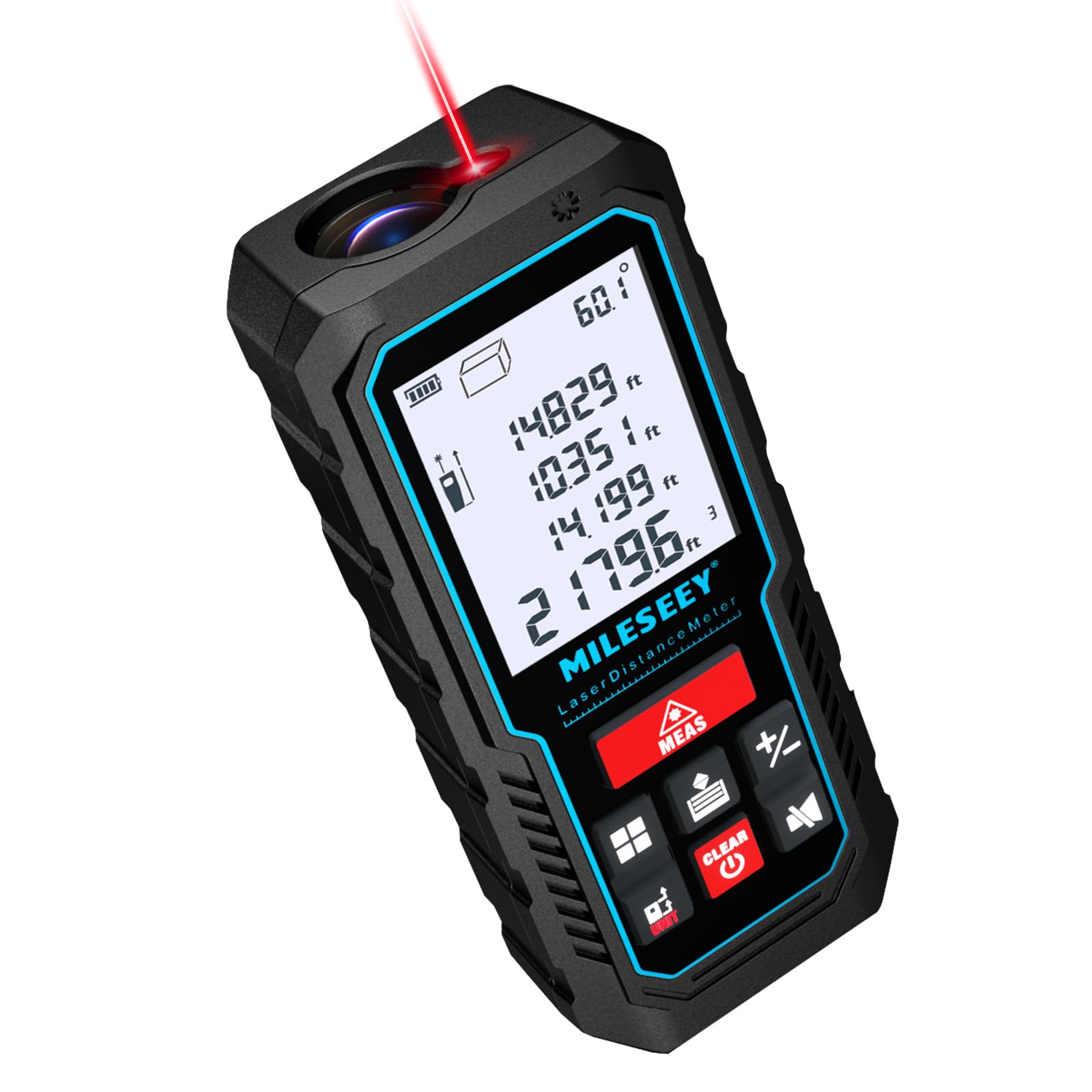
The measurement that earns the D5 its place is one you cannot walk to. Stand at a wall, take the diagonal up to the far corner of the ceiling, then the horizontal distance below it, and the Pythagorean mode works out the height for you. The electronic level reads to ±0.3° so you know the unit is sitting straight, range runs to 229 feet, and accuracy is ±1/16 inch.

None of that is unique on its own; the combination at this price is. The D5 has the longest reach here, matched only by the ACEGMET, plus thirty stored readings and switching between meters, feet, inches, and feet-plus-inches — handy when a plan arrives in one system and your tape is in another. Batteries, a pouch, and a wrist strap are included, and the warranty runs 24 months, longer than most of the budget units. It is our pick for whole rooms, ceilings, and long exterior runs.

The catch is the dot. Red laser light washes out in direct sun, and at 229 feet the usable range outdoors shrinks badly — treat this as an indoor tool that can come outside on an overcast day. At 180 grams it is roughly twice the weight of the pocket models, and IPX4 means a splash is survivable but a puddle is not.

Bottom line: We recommend it to anyone measuring ceiling heights and long runs: 229 feet, an angle sensor, and a 30-reading memory for noticeably less than the Bosch.

Check Latest Price
#03

Best for Bright Sunlight

Bosch GLM165-25G

91 /100
Kirk Score Outstanding
Laser
Green beam
Weight
10.9 oz
Measuring Range
5 to 165 ft
Ingress Protection
IP65
Check Details on Amazon

Pros

  • Green beam is up to 4x brighter than red
  • IP65 housing with rubber overmold at impact points
  • 165 ft range at ±1/16 in with a color display

Cons

  • Batteries drain quickly, even switched off
  • You pay a premium for visibility, not range

Aim a red-beam measure at a wall forty feet away in July and you spend longer hunting for the dot than taking the measurement. The green beam here is rated up to four times brighter than a standard red one, and it changes the job: you can see where the unit is pointing without shading the target with your body or waiting for a cloud.

Around that dot is a tool built to ride in a truck. The housing carries rubber overmold at the corners in the style of a roll cage, the rating is IP65, and the color display holds up in low light. Range is 165 feet at ±1/16 inch, and you can set the reference to the front or the back of the unit depending on what you are butted against — the difference between a right number and one that is an inch and a half long.

The battery is where it gives ground. It runs on two AAs, cells go flat quickly, and some units drain them while the tool sits switched off, so carry spares or pull the batteries between jobs. The rest of the package is the most job-site-ready thing here, and the premium you pay buys visibility rather than extra range — if your measuring happens indoors, that money buys you very little.

Bottom line: For outdoor work it is the one we trust in daylight: a green dot up to four times brighter than red, sealed to IP65, and priced accordingly.

Check Latest Price
#04

Best for Pocket Carry

Klein 93LDM100C

89 /100
Kirk Score Excellent
Weight
2.29 oz
Display
Reverse-contrast LCD
Accuracy
±1/16 in to 30 ft
Measuring Range
2 in to 100 ft
Check Details on Amazon

Pros

  • 65 g with a pocket clip for everyday carry
  • Reverse-contrast LCD reads clearly in dim rooms
  • 2 in to 100 ft range, ±1/16 in to 30 ft

Cons

  • Single button makes settings fiddly
  • Display washes out in daylight

Klein's measure is 4.7 inches long, weighs 65 grams, and clips to a shirt pocket the way a pen does. We stopped noticing it between measurements, which is the whole argument for a small unit: the tool you have on you beats the one in the truck.

For indoor work it is the one we grab when we need a number, not a project. The reverse-contrast LCD is easier to read in a dim room than a standard backlit screen, one press fires a reading with no menu in the way, and the memory holds three results so you are not hunting for a pencil mid-task. It measures from 2 inches out to 100 feet, which covers trim, blinds, and room dimensions.

Two limits decide whether it is your tool. Accuracy loosens with distance: ±1/16 inch to 30 feet, then ±1/8 inch out to 100, fine for a room and not fine for anything that has to be exact across a whole floor. And the single button that makes measuring simple makes the settings fiddly — press too quickly and you are in the settings menu instead of measuring. Point it at a bright window and the display washes out, so keep it indoors.

Bottom line: Built to be carried: 65 grams, a pocket clip, and a reverse-contrast screen that is easy on the eyes indoors, provided 100 feet of range is enough.

Check Latest Price
#05

Best Budget

RockSeed S2

89 /100
Kirk Score Excellent
Levels
Two bubble levels
Accuracy
±1/16 in
Warranty
Two years
Measuring Range
165 ft
Check Details on Amazon

Pros

  • 165 ft and ±1/16 in at a budget price
  • Two bubble levels built into the body
  • Mute setting and 20-reading memory
  • Two-year warranty

Cons

  • No pouch in the box
  • Top-mounted button makes one-handed shots awkward

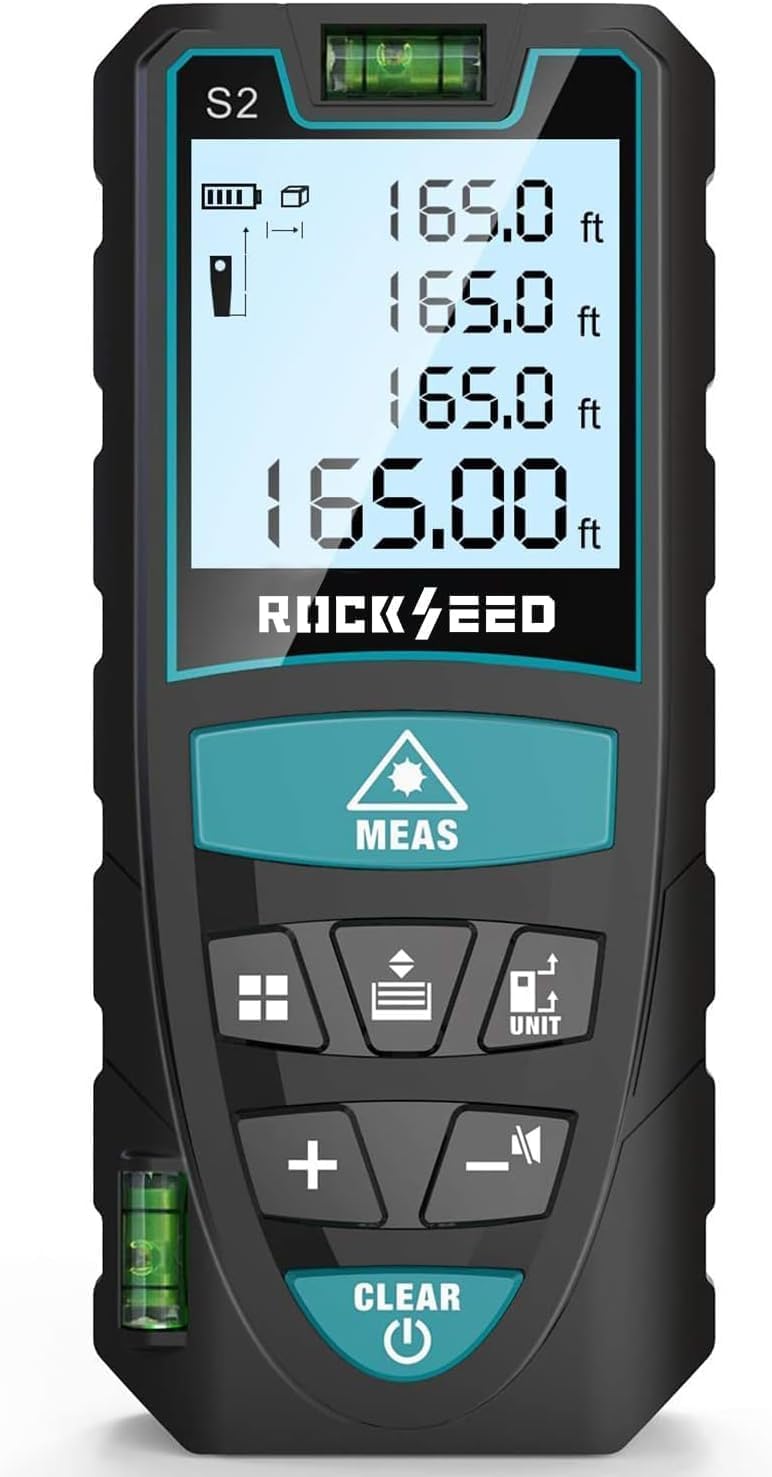
A budget laser measure buys more than it used to. The S2 covers 165 feet to ±1/16 inch, puts two bubble levels in the body, and carries area, volume, continuous measurement, and a three-point Pythagorean calculation — the same shortlist of modes the mid-priced units have. For a first laser, or a second one that lives in a kitchen drawer, this is the one we point people to.

The bubble levels are the detail we ended up using more than expected: with the unit already in your hand and pointed at a wall, you can check whether a shelf, a picture rail, or a run of cabinets is level without putting it down and finding another tool. The mute setting earns its keep too — the confirmation beep is useful on a job site and unwelcome in a quiet house.

Two things to know before you order. The measure button sits on top of the body, which makes a clean one-handed shot awkward; brace the unit against a wall or set it down and use the rear reference instead. And a budget laser is a bet on how long it keeps reading — the two-year warranty is what turns that bet into a reasonable one, so keep the receipt and register the purchase.

Bottom line: Our budget pick: 165 feet, ±1/16 inch, two bubble levels, and a mute setting, at one of the lowest prices in this group.

Check Latest Price
#06

Light tool bags

ACEGMET S9

90 /100
Kirk Score Outstanding
Levels
Two bubble levels
Weight
1.76 oz
Warranty
18 months
Measuring Range
229 ft
Check Details on Amazon

Pros

  • 229 ft range in a 50 g body
  • Two bubble levels and 30-reading memory
  • 0.5-second readings with IP54 protection

Cons

  • 18-month warranty is the shortest of the budget picks

Fifty grams is light enough that the S9 disappears into a tool bag, and 229 feet is more reach than most indoor work will ever use. It gets there in about half a second, stores thirty readings, and carries two bubble levels plus an IP54 rating.

Weight and range together matter in awkward places: under a sink, above a drop ceiling, halfway up a ladder with one hand on a rail. A tool that weighs nothing and reaches far is easier to aim one-handed than a heavier unit, and the price keeps it in the category of things you can leave in the van without worrying.

Where we hesitate is precision. The ±1/16-inch figure is the same one everyone prints, but accuracy is the least settled part of this unit's case, and the readings worth double-checking are the long ones. Treat the S9 as an estimating tool — square footage, wall runs, ceiling heights for paint — and keep a tape for anything that has to land within a fraction. The warranty is 18 months, shorter than the other budget picks here.

Bottom line: The lightest long-range option here: 229 feet and two bubble levels in a 50-gram body, best treated as an estimating tool.

Check Latest Price
#07

Budget mode set

DTAPE DT50

91 /100
Kirk Score Outstanding
Warranty
Two years
Battery Life
5,000+ measurements
Measuring Range
165 ft
Measurement Time
0.4 s
Check Details on Amazon

Pros

  • Eight modes including double Pythagoras
  • 0.4-second readings and 5,000 measurements per battery set
  • Front/rear reference switch and 2-inch backlit display
  • Two-year warranty

Cons

  • Dot is hard to see in sunlight

The DT50's selling point is the stack of modes behind one button: distance, area, volume, single and double Pythagoras, addition and subtraction, continuous measurement, and a front/rear reference toggle. That is more arithmetic than most home projects need, and it is genuinely useful when a job involves an angled ceiling or a run you cannot walk.

Speed is the other half of the pitch. Readings land in about 0.4 seconds, a set of batteries is rated for more than 5,000 measurements, and the 2-inch backlit screen is big enough to read at arm's length. It is IP54, so dust and splashes are covered.

Two habits make it behave. Set the reference point before you measure, or every reading will be off by the length of the body, and tape a sheet of white paper to anything shiny or transparent — glass, polished stone, a glossy cabinet door — because those surfaces send the beam somewhere unhelpful.

So where does it land? It is the least expensive route here to a full mode set, and if you want one inexpensive tool that can do Pythagoras, this is it. Accuracy is the part to verify: it carries the same ±1/16-inch rating as the rest, but measure a known distance against a tape the day it arrives, and send it back if the number is off or an error code greets you out of the box. The two-year warranty makes that an easy call.

Bottom line: The mode-heavy budget option: eight functions, 0.4-second readings, and 5,000 measurements per set of batteries, provided you read the sheet once and check its accuracy early.

Check Latest Price

How We Tested Laser Measures

We started with roughly 30 models sold at hardware stores and online, then filtered by range, advertised accuracy, display type, and price so we weren't comparing a keychain unit to a 400-foot site tool. Twelve made the cut, and each one lived with us for six months — through a bathroom renovation, a deck rebuild, and the ordinary run of measuring rooms for flooring and rugs.

Accuracy got checked the boring way: marked distances of 3, 12, and 25 feet on a concrete floor, measured against a steel tape, every reading repeated three times. A few wandered by a sixteenth of an inch between presses. Outdoors, I re-measured the same fence line at noon, because a faint dot in sunlight is where a laser measure quietly stops being trustworthy.

Every unit did the same real jobs — room dimensions, ceiling height from the floor without a ladder using the indirect modes, and the inside of a closet where there's nowhere to stand back. I counted button presses to switch between feet-inches and decimal feet, watched how long the backlight stayed on, and read the display in direct sun, at dusk, and at an angle with the tool lying flat. Measurements went onto paper as I went, so I could compare what each screen actually showed.

Durability happened on its own: two units slid off a ladder, one bounced across a basement floor, and all of them rode loose in a canvas tool bag. We tracked battery swaps across the six months and noted which ones auto-off fast enough to still work when you grab them, and since these run standalone, we judged each one on its own display and history rather than on any phone app. Value came down to the unglamorous stuff — a reading you trust, a screen you can read in the light you're actually in, and a battery that isn't dead.

How to Choose a Laser Measure

Range: buy for where you actually point it

Range figures assume a cooperative target and decent light. Indoors, a 100-foot unit covers any room in a house with room to spare, so the extra reach on a 165- or 229-foot model is really about driveways, yards, and commercial spaces. Accuracy is quoted at the target, which is why a shorter-range unit with a readable screen beats a long-range one you have to squint at.

If most of your measuring happens outside, spend the money on the beam rather than the number. If it happens in kitchens and basements, a 100- to 165-foot tool is the sensible ceiling.

Accuracy, and the surfaces that beat it

Nearly everything here claims ±1/16 inch, but the fine print matters: one of our picks holds that only to 30 feet and loosens to ±1/8 inch out to 100. Glass, polished stone, water, and dark matte walls either swallow the beam or bounce it back wrong, which is why the better kits ship target cards — a strip of white paper taped to the surface solves most of it.

Check a new unit once against a tape over a known distance. Five minutes tells you whether you can trust everything after it.

Red dot or green beam

Red is the default and it is fine for walls and ceilings indoors. Green costs more and reads up to four times brighter, which is the difference between working and squinting on a sunny porch; it also draws more power, so green units tend to eat batteries faster.

Neither color is immune to direct sun — even the green-beam Bosch has its limits — but if a good share of your measuring happens outdoors, the green premium pays for itself.

Which modes earn their buttons

Distance and area are the baseline; volume and addition/subtraction cover paint, flooring, and concrete. The Pythagorean modes are the ones people underestimate: two readings and the unit gives you a height you cannot reach, which saves a ladder trip. Beyond that, a pile of modes nobody uses is a menu to scroll past.

We also treat 2-in-1 combos with care. The laser half usually works fine; the retracting blade is the part that fails first, so buy a combo for the convenience and keep a real tape for the jobs that need one.

Power, protection, and where it lives

Most of these run on AAA cells, which is fine if you keep spares and annoying if the unit drains them while switched off. IP54 covers dust and splashes; IP65 adds water jets and is worth having on a tool that rides in a truck bed.

Then there is carry. A pocket clip on a 65-gram unit means it is with you; a heavier unit with a pouch stays in the bag. Front and back reference settings matter too — that is the difference between a measurement and a measurement plus the length of the tool.

Frequently Asked Questions

Final Verdict

Start with the Bosch GLM 50 C. It reaches 165 feet to within a sixteenth of an inch, its backlit color screen is the easiest to read in this group, and it pockets like a phone — which is why it is the measure we recommend without asking what the job is.

Two situations call for something else. If your measuring happens outdoors in daylight, the green beam on the Bosch GLM165-25G is worth the premium. If you want the most reach for the least money, the MILESEEY D5 adds 229 feet and an angle sensor for finding heights indirectly, and it stays our pick for anyone working through a whole house.