// data-verified

Best Level Tools of 2026

A level that lies to you is worse than no level at all. You'll chase a bubble that reads true, tighten a shelf bracket, step back, and see the slope. I learned that hanging a gallery wall in an old apartment where every wall leaned a little differently, and now I check a level against a known straightedge before trusting it on trim or a door frame. The right level tool makes the truth easy to see, whether you're checking a pipe or setting a laser line across a room.

The category is wider than the bubble level in a junk drawer. Small torpedo levels live in a tool belt and need a strong magnet, clear vials, and a frame that doesn't flex against steel studding; digital angle gauges earn their place on odd corners, and laser levels handle layout work only if the line stays crisp across a room. We spent six months with 14 level tools, comparing construction quality, accuracy, magnetic hold, visibility, ease of use, functionality, and value. The picks below are the ones I stopped second-guessing.

#01

Best Overall

Franklin Sensors Light Level

95 /100
Kirk Score Outstanding
Power
1 AA battery, not included
Vials
Two, at 90 and 180 degrees
Level Signal
Red, amber, and green light display
Overall Length
12 inches
Check Details on Amazon

Pros

  • Green light readable from across a room
  • Two vials plus the light, so you can work either way
  • 12-inch body spans more than a torpedo
  • Readable in dim light and at odd angles

Cons

  • Runs on an AA battery that isn't included
  • No 45-degree vial for trim and miters

A light strip does the job a bubble can't. It shifts from red through amber to green as you tilt the tool, and green only shows when the work is level or plumb. That sounds like a gimmick until you're alone with a shelf bracket in one hand, and then it's the difference between getting the board set and putting it down again to crouch at vial height. The display reads from above, below, and a few feet back, which is why it became the level we reached for without thinking.

At 12 inches it's longer than the 9-inch torpedoes most people start with, and that span earns its keep: it covers a cabinet door, a shelf bracket, or a picture frame with room at both ends. Two conventional vials at 90 and 180 degrees are there when you want a bubble instead, and a magnetic edge lets it hang on a steel frame or the side of a toolbox.

The magnet is the part we're least enthusiastic about. It holds the tool on vertical steel, but it doesn't have the bite of the rare-earth models here, and on anything overhead, keep a hand on it. Otherwise the design is consistent about one idea: fewer trips back to eye level.

It's at its best on the awkward job — leveling a fridge or a camper, hanging a cabinet alone, checking a rail in a dim hallway where the bubble is a dark smudge. For saw blades and conduit bends, the Klein digital gauge is the better tool. For a house full of small jobs, this is the one that gets picked up.

Bottom line: The level we hand most people: it turns green when you're there, so you can hold a shelf with both hands and read the result from across the room.

Check Latest Price
#02

Best Value

Craftsman 9-Inch Torpedo Level

96 /100
Kirk Score Outstanding
Body
Extruded aluminum
End Caps
Shock absorbing
Center Vial
Magnified block vial
Overall Length
9 inches
Check Details on Amazon

Pros

  • Extruded aluminum body takes knocks
  • Magnified center vial is easy to read
  • Fits an apron pocket at 9 inches
  • Budget price for a daily-use tool

Cons

  • Magnet grip is weak on smooth steel

You can spend a lot more on a torpedo level and get a lot less tool. This is the budget pick of the set, and it doesn't feel like one: an extruded aluminum body rather than plastic, rubber end caps to take a drop, and 9 inches of length that disappears into an apron pocket.

What we like most is the center vial. It's magnified, so the bubble sits bigger and the lines are easier to line up than the plain vials on the cheaper levels here, which is the difference between a quick check and a squint. The body is also stiff enough that it doesn't flex when you press it against a wall, something the plastic frames can't claim.

For hanging shelves, leveling an appliance, and setting trim, it's the level most people should start with: cheap enough to own two and solid enough to keep. If you work alone and want the readout somewhere you can see it rather than at eye level, the Franklin answers that for a bit more.

Bottom line: A sensible first level: aluminum, easy to read, and cheap enough to keep one in the kitchen drawer and one in the toolbox.

Check Latest Price
#03

Best Magnetic Grip

Klein 935RB 8-Inch Torpedo Level

95 /100
Kirk Score Outstanding
Body
Billet aluminum
Vials
Four, including 30 degrees
Magnet
Rare-earth magnet track
Overall Length
8 inches
Check Details on Amazon

Pros

  • Rare-earth magnets hold on pipe and duct
  • V-groove and tapered nose seat on conduit
  • Four vials including 30 degrees
  • Billet aluminum body with top-read windows

Cons

  • Premium price against the other spirit levels here

Pick this up and the weight tells you what it is — 7.4 ounces of billet aluminum with a tapered nose, closer to a machined block than the stamped frames of the budget picks. On a pipe that heft is the point: the tool sits where you put it instead of pivoting on the curve while you line up a mark.

The magnets are the real reason to buy it. They're rare-earth, set into a track that keeps them from working loose, which is the failure that track exists to prevent. Add a V-groove that seats on conduit and four vials at level, 90, 45, and 30 degrees, and it covers offsets and saddle bends as well as plain level and plumb. The top windows let you read from above when the tool is on the underside of a run.

It's one of the heaviest spirit levels here, and that's the trade for a body that won't skate on steel. For pipe, duct, and steel framing, nothing else in this set holds like it, and the tapered nose gets into a corner a square-bodied level can't reach.

Bottom line: The one for metal: rare-earth magnets that hold on pipe and duct, a V-groove that won't rock, and four vials in a body that survives a drop.

Check Latest Price
#04

Best for Angles

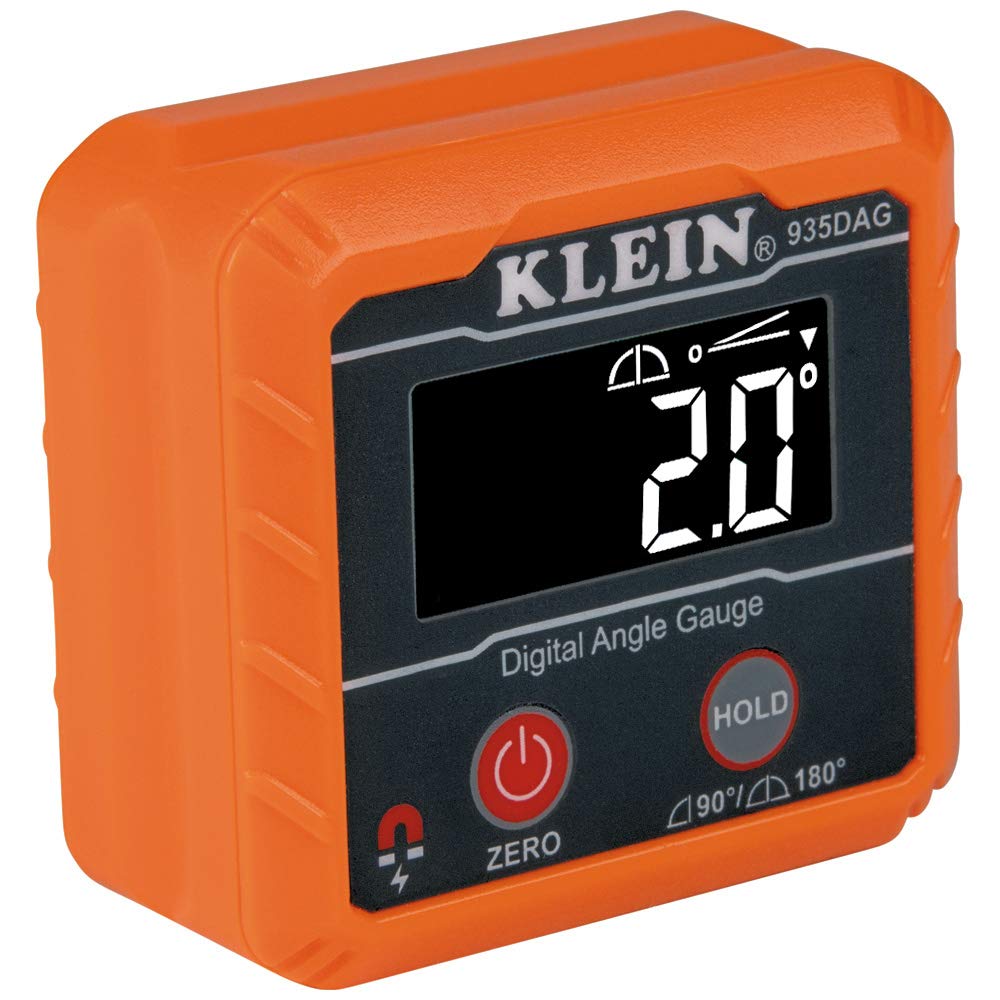
Klein 935DAG Digital Angle Gauge

96 /100
Kirk Score Outstanding
Base
Magnetic, with V-groove edges
Weight
3.5 oz
Display
Auto-rotating, reverse contrast
Angle Range
0-90 and 0-180 degrees
Check Details on Amazon

Pros

  • Reads and sets angles from 0 to 180 degrees
  • Zero calibration measures relative angles
  • Magnetic V-groove base sticks to pipe and blades

Cons

  • Angle readings can drift about half a degree

This isn't the level you carry to hang a picture. It's the tool for jobs where you need the number, not just a yes: dialing in a miter saw or table saw blade, setting a bend in conduit, matching a slope. It reads 0 to 90 and 0 to 180 degrees on a reverse-contrast display, and the zero-calibration function lets you treat any surface as your reference and measure everything else relative to it, which is the most useful thing about it and the reason it earns a slot here.

The magnetic base and V-groove edges are what make it practical rather than clever. It sticks to a saw blade or wraps a length of conduit, so you can set the tool, read the number, and keep both hands on the work. The display rotates when the tool is upside down, which sounds minor until the only place the gauge fits is under what you're measuring.

At 3.5 ounces, with a soft case and batteries in the box, it disappears into a tool bag. It isn't a flatness tool, though — it won't tell you whether a six-foot shelf is straight, only what angle the pad under it is sitting at.

Bottom line: Buy it if you set angles rather than check them: saw blades, conduit offsets, and anything that needs a number instead of a bubble.

Check Latest Price
#05

Best for Slope

WORKPRO 12-Inch Torpedo Level

93 /100
Kirk Score Outstanding
Frame
Aluminum-reinforced
Vials
Four, including multi-pitch
Weight
7.37 oz
Overall Length
12 inches
Check Details on Amazon

Pros

  • Pitch vial for drains and gutters
  • 12-inch body spans more of the work
  • Aluminum-reinforced frame at a budget price
  • Top-view windows read from above

Cons

  • Magnet grip is lighter than the Klein's

Most torpedoes in this set are 9 inches. This one is 12, and the extra length is the reason to pick it: it spans a gutter bracket, a drain run, or a shelf with more of the work under the tool, so a slope shows up instead of hiding between two short readings.

The fourth vial is the other draw. It's a multi-pitch vial, so you can set and check the fall on a drain or gutter instead of guessing, and the top-view holes let you read the bubble from above when the level is tucked under a run. The frame is aluminum-reinforced with shock-absorbing ends, which is a lot of level for the money, and the V-groove and hanging holes keep it on a pipe or on a hook.

Twelve inches is also the limit. Inside a cabinet, behind a toilet, or under a sink, the body runs out of room and a 9-inch torpedo does the job better. For drainage, decking, and shelving out in the open, the length and the pitch vial make this the most useful level here for the money.

Bottom line: A pitch vial, a 12-inch body, and an aluminum-reinforced frame at a budget price — this is the one for drains, gutters, and long shelves.

Check Latest Price
#06

Best Laser Level

DeWalt DW089LG 360 Laser Level

92 /100
Kirk Score Outstanding
Lines
Three 360-degree green lines
Power
12V MAX battery and charger
Range
100 feet
Accuracy
±3 mm at 10 m
Check Details on Amazon

Pros

  • Three 360-degree lines cover a whole room
  • Runs on DeWalt 12V batteries with charger included
  • IP65 housing and a hard case for jobsite use
  • Pulse mode works with an external detector

Cons

  • Beam washes out in direct sun
  • Costs many times what the spirit levels here do

Three 360-degree lines — one horizontal, two vertical — do something no bubble level here can: they put a reference on every wall in the room at once. Set it up once and cabinet heights, outlet boxes, tile courses, and ceiling lines can all be marked against the same line without moving the tool. That's the difference between layout and guesswork.

The hardware is built for a jobsite. It runs on DeWalt's 12V MAX battery platform with a charger in the kit, the housing is IP65-rated against dust and water, and the magnetic bracket takes 1/4-inch and 5/8-inch threads for a tripod or a steel stud. Range is 100 feet, stated accuracy is plus or minus 3 mm at 10 meters, and a pulse mode lets it work with an external detector sold separately.

For interior remodeling, tile, casework, and ceilings, this beats any torpedo in the set, because it removes the helper problem: one person can mark a whole room against a single setup. It doesn't replace a hand level, though. For one bracket you still want something you can hold.

It's the one tool here that only makes sense if it comes out regularly. For a single bathroom remodel followed by a quiet year on a shelf, borrow or rent one; if layout is a regular part of your work, it changes the shape of the day.

Bottom line: If the job is a whole room rather than one shelf, this projects three 360-degree lines and lets one person do layout that used to take two.

Check Latest Price
#07

Repeat angles

DeWalt 9-Inch Extruded Torpedo Level

95 /100
Kirk Score Outstanding
Weight
6.35 oz
Angle Vial
Rotating, marked in degrees
Overall Length
9 inches
Check Details on Amazon

Pros

  • Rotating vial sets repeatable angles
  • Magnetic strip holds on steel without sliding
  • Sturdy 9-inch body for a tool bag

Cons

  • Costs more than the plain 9-inch levels here

The rotating vial is the whole reason to look at this one. Instead of a fixed 45-degree bubble, the vial turns so you can set it to the angle you need — degrees on one side, pitch on the other — then hold the level against the work and match it. For repeat angles that's faster than a digital readout, and it doesn't need a battery.

The rest is a well-made 9-inch torpedo: 0.18 kg, a magnetic strip that holds on a steel bracket without sliding, and the kind of build that shrugs off being carried loose in a bag. Level and plumb read as plainly as anything else here.

Where it earns its place is repeat work — stringers, handrail, a specific roof pitch. If you set the same angle over and over, the rotating vial is a neat trick in a small tool. If you mostly hang pictures, the feature sits unused and a plain torpedo covers the same ground.

Bottom line: A 9-inch torpedo with a rotating vial that sets an angle instead of just checking one, for buyers who repeat the same pitch all day.

Check Latest Price
#08

Light-duty spare

Amazon Basics 9-Inch Torpedo Level

95 /100
Kirk Score Outstanding
Vials
Three, at level, plumb, and 45 degrees
Weight
4.84 oz
Accuracy
1.0 mm/m
Overall Length
9 inches
Check Details on Amazon

Pros

  • Three vials and a printed ruler edge
  • Light and pocket-sized for a drawer
  • Rubberized coating and a hanging hole

Cons

  • Magnet is weak on vertical steel

The cheapest 9-inch level here is also the one whose accuracy needs proving first. The tool itself is well put together: three vials, a printed ruler along the edge, a magnetic side, and a rubberized coating that survives being tossed in a drawer.

Light and pocket-sized, it's the one that ends up in the kitchen drawer for hanging a picture or setting a small shelf, and for that it's fine. The vial is easy enough to read, the ruler markings are handy when you're spacing hangers, and the hole at the end lets it hang rather than rattle around a toolbox.

The readings are the part to watch. On the same surface this level can disagree with a longer one, so check it against a known-good level — or flip it end for end and see whether the bubble repeats — before you trust it with a cabinet or a door. For a picture hook or a closet shelf, that margin doesn't matter.

None of that rules it out as a second level. Having one in the kitchen and one in the garage, with no hunting for either, is worth more than the accuracy gap costs on a picture hook. Buy it for light-duty work and keep a proven level for the jobs that matter.

Bottom line: Fine as a spare and fine for pictures, but check it against a longer level before you trust it with anything that has to be straight.

Check Latest Price

How We Tested Level Tools for Real Work

We built the shortlist by reading specs and owner reviews, then filtering for size, price, and the features that separate a useful level from a novelty: readable vials, a sturdy frame, a magnet that holds, and—on laser and digital models—controls that don't require a manual every time. In the end we tested 14 level tools over six months, from compact torpedo levels to a 360-degree laser level and a digital angle gauge.

The testing happened where the tools actually get used: on a basement framing project, hanging cabinets and shelves, trimming out two doorways, bending and installing conduit, and setting posts for a small deck. I kept a machined square and a known plumb line nearby, checked each bubble against them, and then pressed the middle of every torpedo level to see whether the frame flexed and the bubble drifted. Magnetic grip got tested on steel studs and conduit: I stuck each level on, tilted it, gave it a light shake, and checked whether the V-groove sat squarely instead of rocking. Visibility was judged in a dim garage and near a bright window, because a vial you can't read is just a green tube.

For laser and digital tools, I set up on a tripod and on a wall bracket, checked the line at close range and across a room, and repeated the same angle several times to see whether the reading came back the same. I also carried each level in a tool bag between projects, noted whether the edges stayed true after a few weeks, and weighed that against what it cost. The tools that scored best were not always the most feature-heavy—they were the ones whose bubbles, magnets, and lines I stopped second-guessing.

How to Choose a Level

Length decides what you can actually check

A 9-inch torpedo sitting on a six-foot counter can read perfect while the counter slopes end to end, because the tool knows nothing about what happens outside its own length. That's why the picks here run from 8-inch pocket levels through 12-inch torpedoes to a laser that references a whole room. We favor the longest level you're willing to carry: 9 inches covers brackets and trim, 12 inches handles shelves and gutters, and anything much longer is a different tool for a different job.

The trap is buying compact and expecting room-scale answers. If a cabinet run or a deck rail has to come out right, the torpedo only confirms the section under it. Bridge the span with the longest straightedge you own and check the gap at each end.

Bubble, light, or projected line

Three ways to read a level, and they suit different work. A bubble vial is cheap, needs no battery, and reads best with your eye at the vial. A light display turns green when the tool is level or plumb and can be seen from across a room, which matters when both hands are full. A laser puts the reference on the wall itself, so dozens of marks come off one setup.

The light's limit is that it answers yes or no; it doesn't say how far off you are, so fine adjustment still happens on the vial. We take the light for solo appliance and cabinet work, a plain bubble for the toolbox, and the laser when the job is a room rather than a shelf.

Check a new level before you trust it

Any level can arrive out of true, and the check takes ten seconds: set it on a flat surface, note where the bubble sits, turn it end for end, and read again. If the bubble moves to the other side of the lines, the vial is off and the tool goes back. Repeat against a door frame for the vertical vial.

Stated accuracy figures are worth having, because a number tells you the tolerance the maker claims, but no figure survives a drop. Re-run the flip test after the tool takes a fall, especially before a job where half a degree shows.

Magnets and V-grooves: hands-free where it holds

A magnetic edge is the difference between one hand and two on steel studs, conduit, duct, and saw blades, and the strength varies widely across this set. The Klein levels use rare-earth magnets set into a track; the budget picks have enough grip to hang on a toolbox and not much more. If hands-free work is the reason you're buying, pay for the magnet.

A V-groove matters just as much on pipe, because a flat-backed level rocks on a curve and a rocking level reads whatever you tilt it to. Check that the groove runs the length of the body, and remember magnets do nothing on aluminum, stainless, or painted steel.

Frequently Asked Questions

Final Verdict

The Franklin Sensors Light Level is the one to buy for a house. It turns green when you're there, it reads from across the room, and it costs less than the digital and laser tools that solve narrower problems. Put a Craftsman 9-inch in the drawer as the inexpensive second level, and step up to the DeWalt laser only when the job is a whole room rather than a single shelf.