// data-verified

Best Moisture Meters of 2026

A pin-type moisture meter gives you a number you can trust and leaves a neat row of tiny holes in the drywall to prove it. A pinless one slides across the surface without a mark but only sees the first inch or so of material. That trade-off is the real decision, and it's why I own three of these now — the first one came home with me the night a slow leak turned a ceiling stain into a bucket situation.

Here's what nobody tells a first-time buyer: the number matters less than the direction it's moving. A wall reading that falls over a week is drying; the same wall holding steady is a problem worth calling someone about. So what you actually want is a meter that repeats itself in the same spot, not one that shows the most decimal places. Over three months my team ran 14 meters — pin, pinless, 2-in-1 combos, and a couple of battery-free soil probes — through real damp problems instead of demo boards.

Some of them were great for firewood and hopeless on a painted wall; some soil probes read beautifully in a pot and have no business near a floor joist. The picks below are grouped by the job you're actually doing, so start there rather than at the top.

#01

Best Overall

Tavool MT270

91 /100
Kirk Score Outstanding
Wood Range
6%–60%
Measurement Type
Pin, two points
Wood Calibrations
8
Building Materials
0%–40%
Check Details on Amazon

Pros

  • Eight wood-species calibrations for real lumber
  • Wide 6%–60% wood range covers wet firewood
  • Backlit display stays readable in dim basements
  • Hold function freezes a reading in tight spots

Cons

  • Pin contact leaves two marks on finished surfaces

Eight settings for different wood species is more than most buyers will ever use, but they are the reason this is the meter we hand to anyone heading out to the lumber pile. Density changes how current moves through a board, so a meter without a species correction can sit several points away from the true figure on dense stock. The list here covers the furniture and firewood species most of us actually handle, and a second mode handles drywall and plaster.

The ranges are generous for the money: 6% to 60% on wood, which runs from kiln-dried boards to green firewood that still sizzles, and 0% to 40% on building materials. Having both on one dial means the tool follows the job — checking a new two-by-four before you paint one weekend, then testing the woodpile before the first cold snap.

The screen is the friendlier half of the design. Big digits, a backlight for dim basements, and a hold button so you can push the pins into a spot behind a pipe and read the number after your hand comes back out. It runs on the battery that comes in the box, shuts itself off when you forget about it, and the manual actually explains the species list instead of assuming you already know it.

Accuracy is where inexpensive meters fall apart, and it is the last thing a spec sheet tells you. We watched for repeatability — the same spot reading the same way twice — and this one held steadier than anything else in this set at the price. That is the whole case for it: eight species settings, two modes, and a number worth acting on. It is the one we reach for first when a reading has to hold up.

Bottom line: For firewood, lumber, and the drywall around a stain, this is the meter we recommend: the species settings make its readings worth acting on.

Check Latest Price
#02

Best for Finished Walls

Klein Tools ET140

91 /100
Kirk Score Outstanding
Weight
7 oz
Calibrated For
Drywall, masonry, hardwood, softwood
Detection Depth
Up to 3/4 inch
Measurement Type
Pinless, EMF
Check Details on Amazon

Pros

  • Reads through paint without damage
  • Nine-bar display plus an audible alert
  • Calibrated for drywall, masonry, and both woods
  • Light 7-ounce body for overhead work

Cons

  • Non-destructive read stops at 3/4 inch
  • Included 9V battery can arrive flat

Three-quarters of an inch is the whole story with a pinless meter. The ET140 reads that deep and no deeper, so it tells you whether the face of a wall, a floorboard, or a chunk of masonry is damp — not whether the cavity behind it is full of water. For a homeowner chasing a stain on the ceiling, that is usually enough to decide where to cut.

What makes it worth owning is the freedom to sweep. Pins leave two holes every time you probe, which is why nobody drags a pin meter along a painted hallway. We worked a stretch of finished wall with this one and left nothing behind but fingerprints. Held flat against the surface, the nine-bar graph climbs as you close in on a wet section, and the audible alert means you do not have to watch the display while balanced on a ladder. At seven ounces it is light enough to hold overhead.

Klein calibrates it for drywall, masonry, hardwood, and softwood only, and it reads a relative scale rather than a species-corrected percentage — expect the bars to jump near metal corner bead, conduit, or a foil-faced substrate. Power it up the day it arrives: the 9-volt in the box is a stopgap, and a unit that will not stay on once you release the button is one to exchange while you still can.

Bottom line: Buy this if you need to check finished walls without leaving holes behind; it is the pinless meter we reach for when the paint has to stay intact.

Check Latest Price
#03

Best 2-in-1

RDINSCOS MT69

91 /100
Kirk Score Outstanding
Alarm
Adjustable threshold
Power
Rechargeable lithium polymer
Weight
1.21 lb
Measurement Type
Pin probe plus pinless plate
Check Details on Amazon

Pros

  • Pinless sweep plus detachable pin probe
  • Recharges over USB, no 9-volt supply
  • Adjustable alarm threshold for sweeps
  • Probe reaches behind cabinets and sills

Cons

  • Heaviest meter here at 1.21 pounds

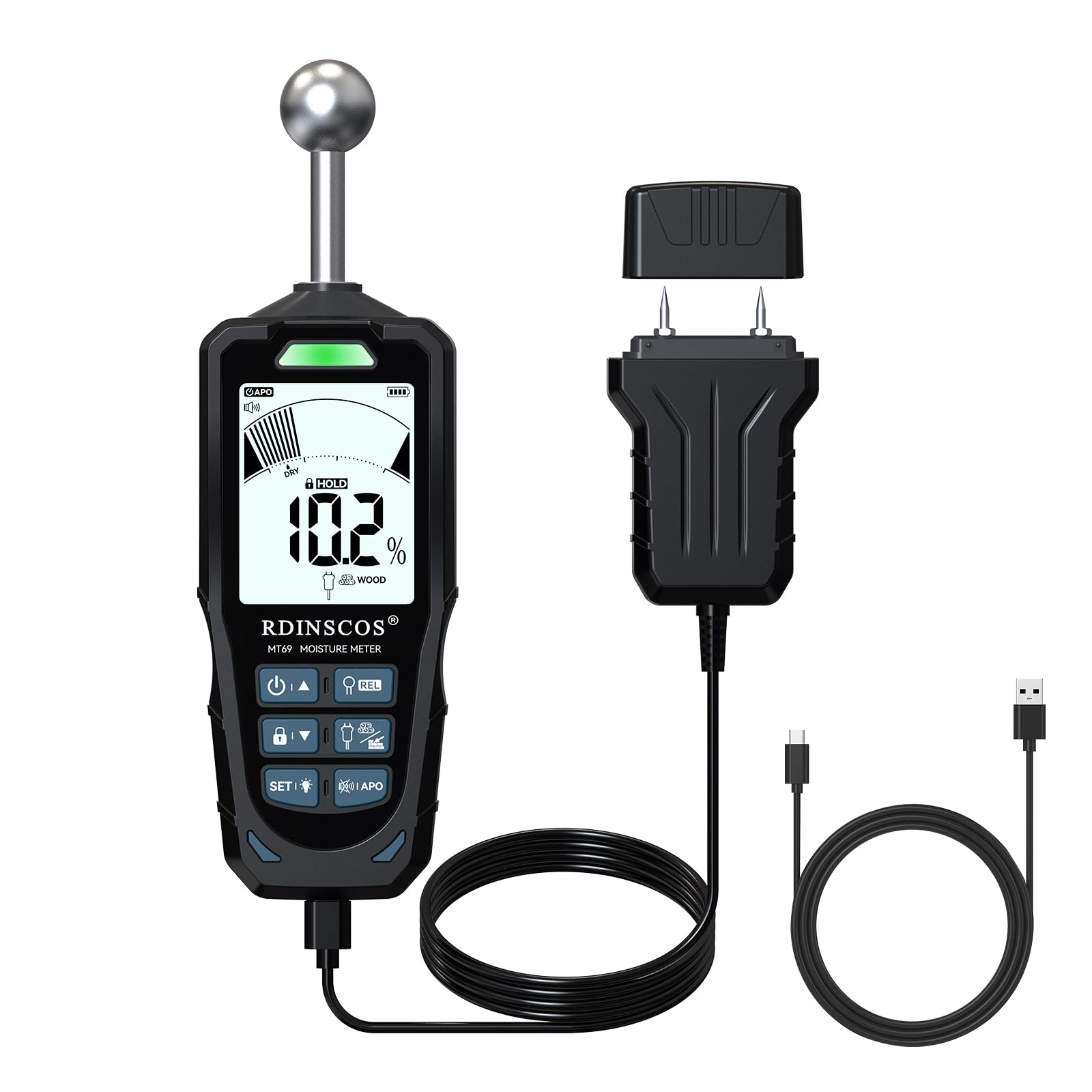
If your moisture problems live in two places at once — a wall that has been leaking and a woodpile that has not dried — a tool that does both is worth the extra outlay. The MT69 puts a pinless sensing plate on the back and a detachable pin probe on a cable, so you sweep a surface first and confirm the spot second.

That order matters in practice. Sweeping covers ground quickly and marks nothing; then the pin probe takes a contact reading exactly where the bars peaked, without drilling a test hole to find out. The detachable probe is the detail we appreciate most, because it reaches into a corner, behind a cabinet, or along the underside of a sill where the body of a meter simply will not fit.

It charges over USB, which ends the hunt for a 9-volt, and the alarm threshold is adjustable — set it and the meter tells you when a spot crosses your line instead of making you stare at a number. The cost is bulk and money: at 1.21 pounds it is the heaviest thing here, better hung on a ladder hook than carried in a pocket, and it only makes sense if both modes will earn their keep.

Bottom line: Worth it if you will genuinely use both modes: sweep a wall without damage, then pin the wet spot, all with one rechargeable tool.

Check Latest Price
#04

Best for Dark Crawl Spaces

RDINSCOS MT28

91 /100
Kirk Score Outstanding
Weight
5.2 oz
Flashlight
Built-in LED
Stated Accuracy
±5%
Measurement Type
Pinless
Check Details on Amazon

Pros

  • Built-in LED for cabinets and crawl spaces
  • Rubber side grips keep the plate flat
  • Alarm and hold for wall sweeps

Cons

  • No pin mode for a direct contact reading

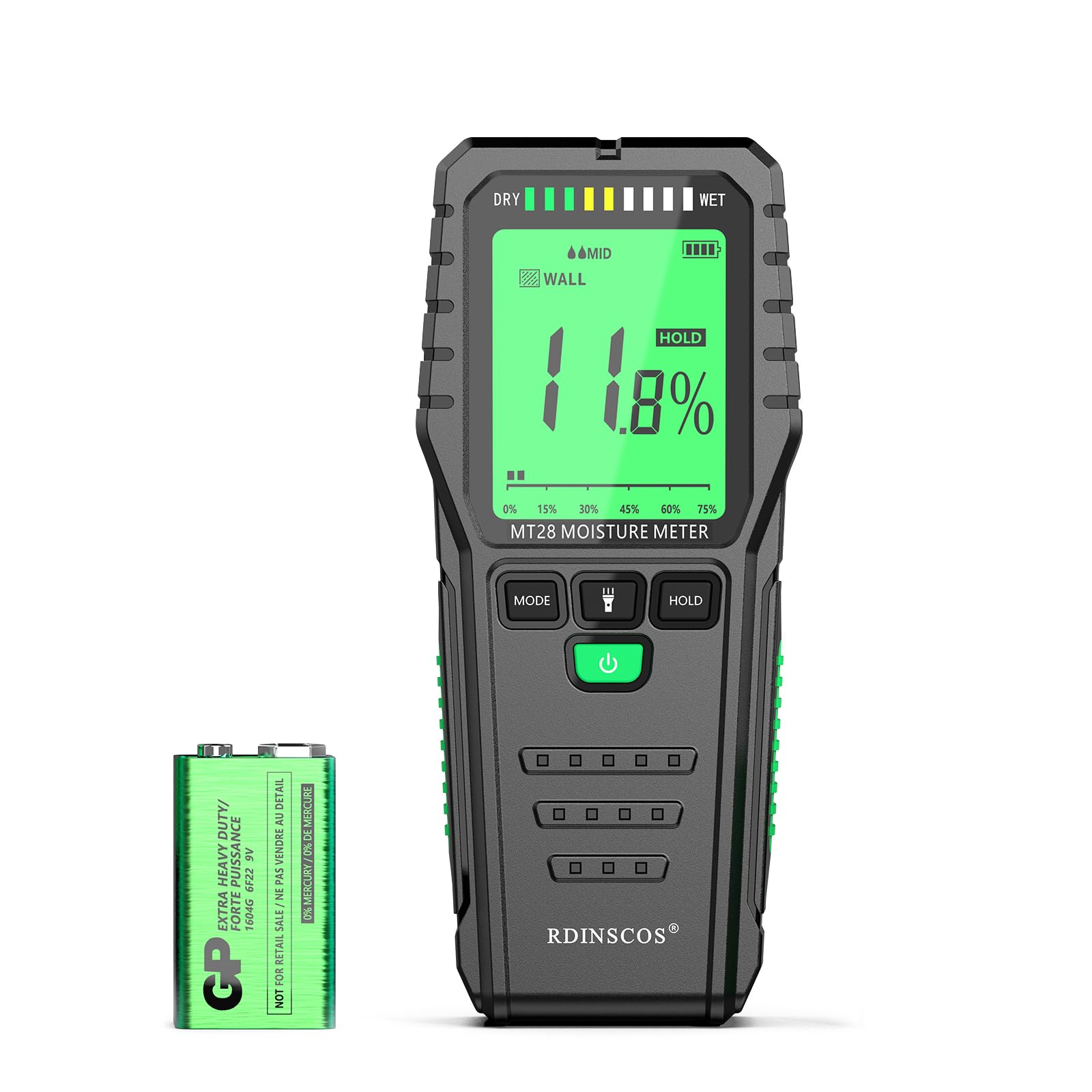
The flashlight is the feature that sells this one, and it is not a gimmick. Moisture hides where there is no light — under a sink, behind a water heater, at the back of a crawl space — and a meter you can actually see in those places gets used more often than one you have to aim by phone light.

The rest is sensible. Rubber grips on the sides keep the sensing plate flat against the surface, which matters because a pinless meter reads low if you rock it. There is a hold button and an audible alarm for sweeping along a wall, and no pins means no marks on anything you have already painted — the reason we keep reaching for it in finished rooms.

We treat the stated ±5% as triage accuracy. That is plenty to find where water is getting in and to track whether a patch is drying, and not enough to sign off a flooring installation or argue with a contractor's meter. Buy it for locating a problem, then bring in a pin meter if you need a figure you can defend.

Bottom line: A pinless scanner with a light on the front: the one we grab for dark cabinets and crawl spaces, and it does not cost much.

Check Latest Price
#05

Best Budget Pin Meter

coczow PM6811A

89 /100
Kirk Score Excellent
Wood Range
2.0%–75.0%
Measurement Type
Pin, two points
Wood Calibrations
6
Building Materials
1.5%–30%
Check Details on Amazon

Pros

  • Wood range runs 2% to 75%
  • Color-coded backlight reads at a glance
  • Spare pins and spanner included
  • Six wood-species settings

Cons

  • Six species settings, not the full set

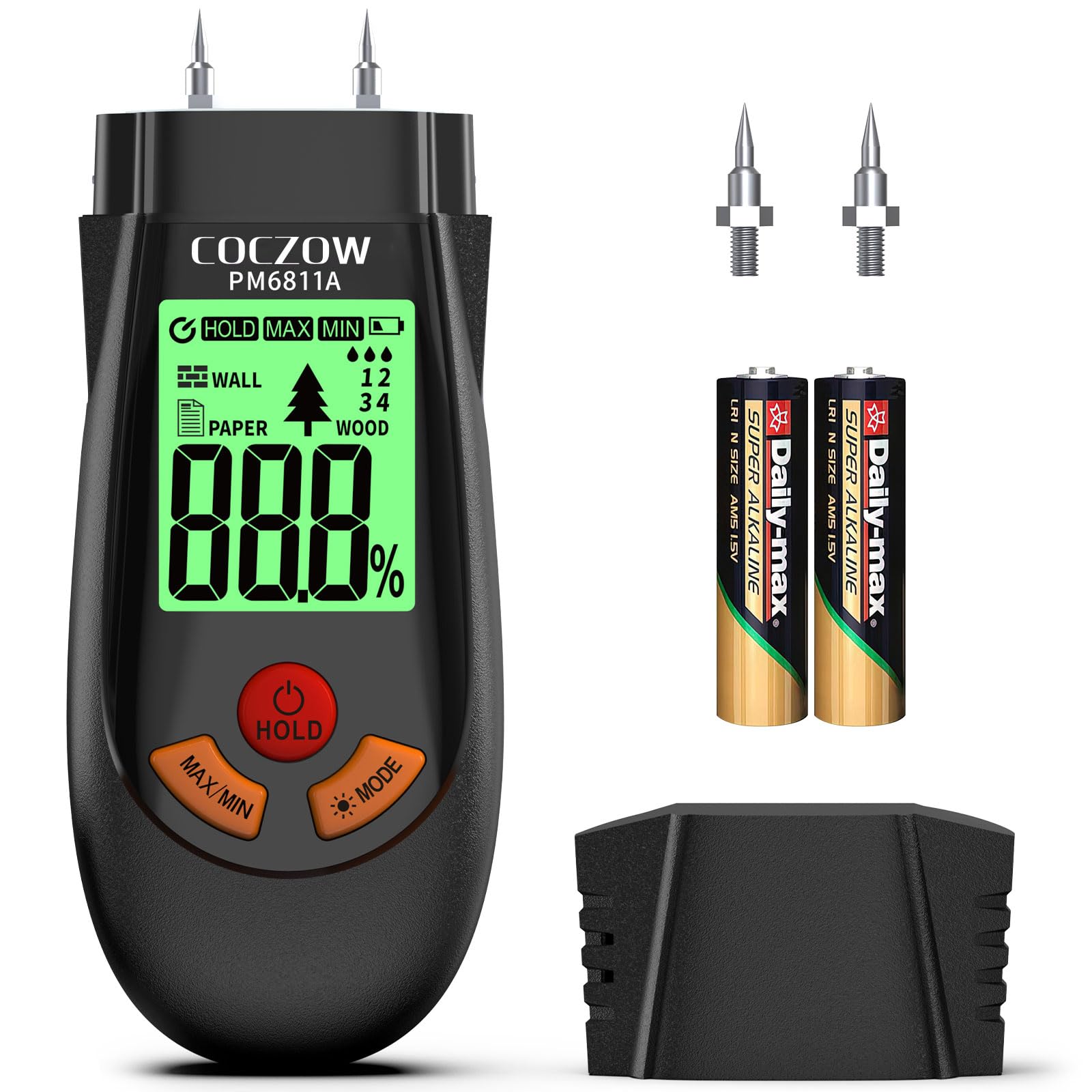
Two percent is the bottom of this meter's wood range, and that is unusual at the budget end. Most inexpensive pin meters stop around 5% or 6%, which is fine for firewood and useless for a furniture project where you are trying to prove a board is genuinely dry. The top of the range, 75%, is wetter than any lumber worth planing.

Six species calibrations, an LCD that shifts from green to yellow to red as the reading climbs, and a hold button. We ended up liking the color band more than expected: reading wet from across a workshop without parsing a number is quicker when you are working through a stack of boards. The box includes spare pins and a small spanner for changing them, which is exactly what a tool with fragile pins should ship with.

Against the other pin meters here you give up two species settings and a little polish, and you spend less. For a homeowner checking firewood and the occasional wall stain that is an easy trade. For anyone matching a species chart every working day, the Tavool earns its extra cost.

Bottom line: The pin meter to buy if you want a wide wood range and spare pins without spending much; ideal for firewood and the odd wall check.

Check Latest Price
#06

Best for Deep Pots

XLUX Long Probe Soil Meter

89 /100
Kirk Score Excellent
Dial
Three zones, ten scales
Pack
2 meters
Power
Battery-free
Measurement Type
Single-probe soil
Check Details on Amazon

Pros

  • Long stem reaches root level in big pots
  • No batteries, instant reading
  • Single probe disturbs less soil

Cons

  • Long stem is more than small pots need

Your finger only ever reaches the top inch of a pot, and in anything bigger than a windowsill planter that is the least informative part of the root ball. The long stem on this XLUX probe goes down to where the roots actually drink, and it does it without batteries, an app, or a wait.

The dial is deliberately vague — three zones across ten scales, reading from dry through wet rather than handing you a percentage. For deciding whether to water, that is the right resolution; a precise figure would only start an argument with yourself. The single probe slides in with less disturbance than a two-prong design and comes back out with less soil attached to it.

The two-pack is the practical answer we landed on for a probe that spends its life in wet dirt: keep one by the kitchen window and one in the garage. It is a soil tool and nothing else — no wood, no drywall, no concrete — and the steel is happiest in ground that has already been loosened. If a pot is bone dry and hard, water it, wait an hour, then measure.

Bottom line: For big pots and deep roots this is the soil meter we recommend: no batteries, two in the pack, and a stem that actually reaches.

Check Latest Price
#07

Houseplants

Dr.meter S10

89 /100
Kirk Score Excellent
Power
No batteries required
Scale
Ten color-coded zones
Weight
2.72 oz
Measurement Type
Single-probe soil
Check Details on Amazon

Pros

  • No batteries or setup
  • Ten color-coded scales
  • Instant reading at the pot

Cons

  • Probe can be damaged by rocks or hard soil

Ten scales, a color-coded needle, no batteries, and a probe you push into the pot. There is nothing to learn here, which is the point. This is the meter for someone who has killed a plant by watering on a schedule and wants a second opinion before filling the watering can again.

It gives you a zone rather than a percentage, which is the honest resolution for houseplants: dry, moist, wet, with colors that make the answer obvious from standing height. Read it in two or three spots around the pot rather than trusting the first — we got different answers from the top inch and the bottom of the same planter.

Where it gives ground to the long-stem XLUX is reach and the feel of the plastic; this is a light, houseplant-sized tool rather than a garden workhorse. Where it wins is simplicity, and the fact that trying one costs almost nothing. For a first soil meter on a windowsill of pots, that is most of the decision.

Bottom line: The simplest way to stop guessing about watering: battery-free, ten color-coded scales, and best kept to houseplant-sized pots.

Check Latest Price

How We Tested the Best Moisture Meters

We built the shortlist from spec sheets and customer reviews, then narrowed it by measurement type, probe design, depth of detection, alarm and hold features, and whether the meter needed a battery at all. Fourteen made the cut, and we lived with them for three months.

Testing happened where moisture actually shows up: a stained ceiling after a storm, a basement wall that stays cool all summer, a stacked cord of firewood, a scrap of 2x4 that we soaked and then let dry on the porch, and a windowsill of houseplants. On wood we took five readings in the same square inch to see whether the meter gave the same answer twice. We read the same board with a pin meter and a pinless one back to back, then re-read it daily for a week to track the drying curve. For depth, we stacked offcuts of drywall and noted how many layers down a pinless meter still registered.

Ease of use got settled the honest way: we handed each meter to someone who had never picked one up and said nothing. We also logged the puncture marks each pin left in painted drywall, dropped every unit from waist height onto concrete, left a few switched on overnight to see what the battery did, and checked the battery-free soil probes against the old finger-in-the-pot test and the weight of a watered pot.

The soil meters earned their place over weeks, not minutes — we watched whether the plants that got watered on the meter's say-so actually looked better. Durability showed up in small ways: bent pins, a cracked case, one display that faded in cold weather. Every meter that made the list repeated its readings; the ones that drifted are not here.

How to Choose a Moisture Meter

Start With the Material

A pin meter drives two steel points into the material and measures resistance between them, which is how you get a reading from inside a board. A pinless meter pushes an electromagnetic field a short way into the surface and reads what comes back, so it never marks paint or wallpaper. A soil probe is a single stem that reads relative moisture in a root zone and gives you zones rather than percentages.

Choose by the job you actually have. Firewood, lumber, and the drywall around a ceiling stain all suit a pin meter, and a building-materials mode covers the wall half of that — our top pick switches between the two. Painted walls and finished floors are pinless territory, because the alternative is filling holes afterward.

Species Settings and Honest Numbers

Wood density changes how current travels through it, so a meter without a species correction can sit several points away from the true figure on dense stock. Six to eight calibrations is typical, and the ones that matter are the species you actually buy; no list covers everything a yard sells.

The habit matters more than the setting. Take three readings in the same board and see whether they agree. A meter that repeats itself is useful even if the absolute number drifts a little; one that wanders is not, whatever the display says.

Depth and Access

A pinless plate reads the top three-quarters of an inch or so, which flags a damp skim coat and misses a saturated cavity behind it. Pins go deeper, but only as deep as the steel is long. That is the trade: reach inside the material, or leave the surface intact.

Then think about where you will be standing. A hold button saves a second trip up a ladder, a backlight matters in a basement, and a built-in light is the difference between checking under a sink and skipping it. The RDINSCOS MT28 earns its place on that light alone.

Buy for the Second Year

Pins are the part that fails, so check whether replacements exist and whether spares come in the box — the coczow ships with a spare set and a small spanner. A detachable probe, like the one on the RDINSCOS MT69, reaches awkward corners and can be changed out without retiring the whole tool.

Power is a smaller decision than it looks. Disposable batteries are fine if you keep spares, USB charging ends the hunt for a 9-volt, and a battery-free soil probe never needs either. What matters is that the meter works on the day you need it, which is usually the day after a storm.

Frequently Asked Questions

Final Verdict

Buy the Tavool MT270 if you want one meter for lumber, firewood, and the drywall around a stain. Its species settings and dual range are why it is our default: the number it gives you is worth making a decision on, whether that decision is lighting a fire or opening up a wall.

If the wall is already painted and you would rather not fill pin holes, the Klein ET140 is the pinless alternative that earns the extra outlay. And if your moisture problem is a houseplant rather than a house, skip both — the long-stem XLUX pair is the tool that matches that job.