// data-verified

Best Small Lathes of 2026

A benchtop lathe promises a whole turning shop on a shelf you already own, then hands you the bill in vibration. Shrink a lathe and everything shrinks with it — the cast iron that soaks up a roughing cut, the bed length behind the tool rest, the mass that keeps an out-of-round blank from walking across the bench. What a good small lathe fixes is the reason most people never start turning: the space, the wiring, the commitment of a floor-standing machine.

I've turned pens, table legs, and one stubborn bowl on machines that cost less than a good chisel set. Over the past eight months, our team ran 11 small lathes through that kind of work. The number that decides what you can actually make isn't horsepower — it's swing over the bed and distance between centers. Speed control comes next; three pulley steps will fight you every time you move from a pen blank to a bowl. And read the box carefully, since a lathe shipped without a live center costs more than it looks. The picks below earned their bench space.

#01

Best Overall

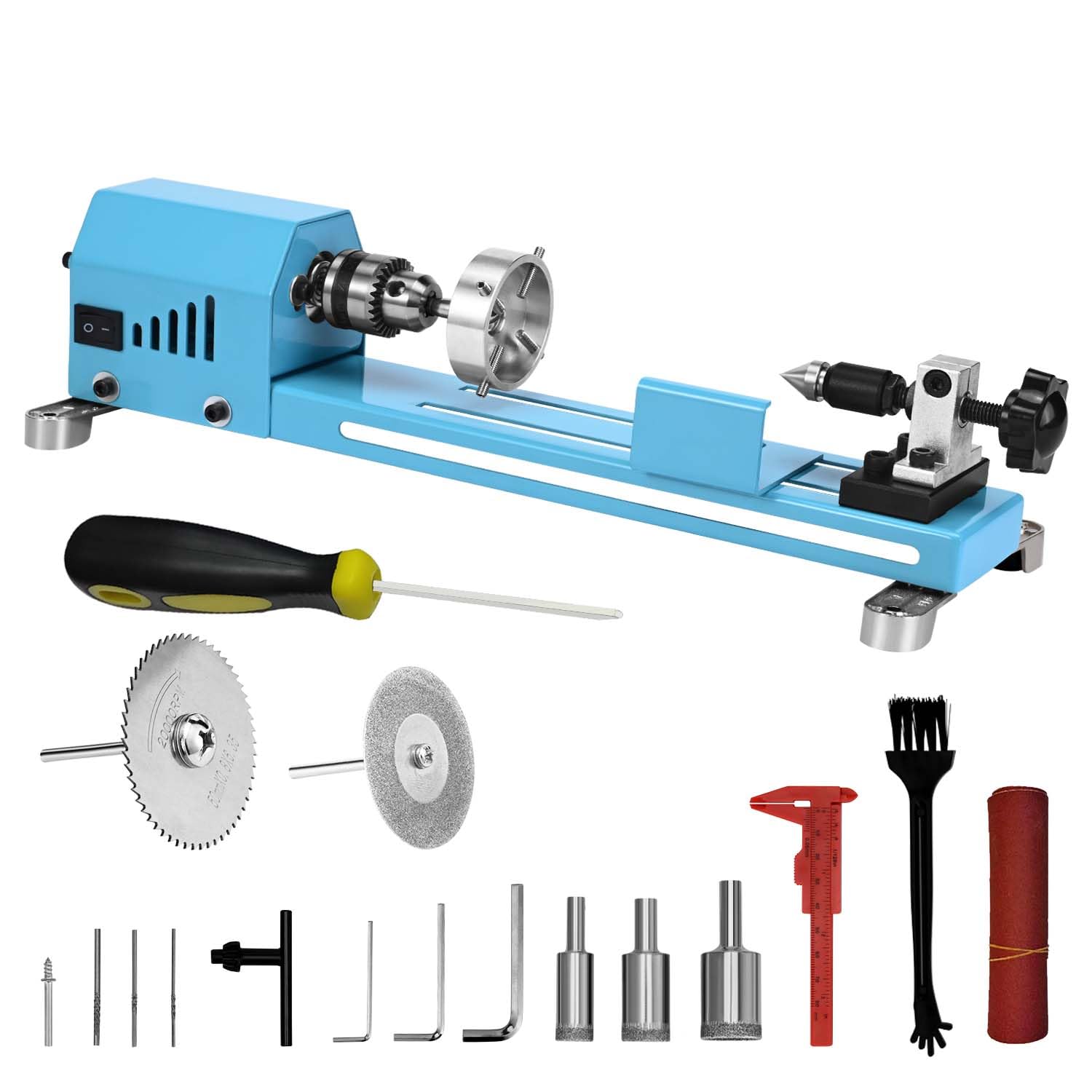
WEN LA3424 12-Inch Lathe

87 /100
Kirk Score Excellent
Motor
4.5 A
Weight
70.3 lb
Speed Range
520-3400 RPM
Swing And Centers
12 in x 18 in
Check Details on Amazon

Pros

  • 12-inch swing handles small bowls
  • Five speeds from 520 to 3,400 rpm
  • MT2 tapers and 3-1/8-inch faceplate
  • 70.3 pounds sits steadily

Cons

  • Belt changes slow speed selection

A 12-inch swing is what separates this WEN from the 8- and 10-inch minis here. That number is the maximum diameter the lathe can clear over the bed, and it is the difference between pens and small bowls. The 18-inch between-centers capacity gives you room for longer spindles, too. The 4.5-amp motor and five speeds from 520 to 3,400 rpm are sensible for a bench that turns a mix of stock rather than only pen blanks. The MT2 tapers and 3-1/8-inch faceplate also mean standard accessories are easy to find.

This is the small lathe we recommend first for most woodturners. It gives up the compactness of a true mini, but the extra swing is the thing you notice when a bowl blank will not fit on a smaller machine. The 70.3-pound body is heavy enough to sit still on a bench, and the 4.5-amp motor has enough grunt for the kind of small bowls and utensil handles that make a mini feel limiting.

Where it asks for a little planning is the bench. It is not a machine you tuck into a cabinet after each session; at 70 pounds, it wants a dedicated spot with room for the blank to spin and for you to move the tool rest. The reward is a lathe that handles more than pens without stepping into full-size floor-model territory. For a garage shop that turns a bit of everything, that is the right trade.

Bottom line: We recommend this WEN for most hobby turners because the 12-inch swing and 4.5-amp motor handle small bowls and spindles without a full-size footprint.

Check Latest Price
#02

Best for Pen Turning

RIKON 70-105 Mini Lathe

87 /100
Kirk Score Excellent
Motor
1/2 hp
Speeds
5
Weight
74 lb
Swing And Centers
10 in x 18 in
Check Details on Amazon

Pros

  • 10-inch swing and 18-inch centers
  • 1/2-hp motor
  • Five-year warranty
  • Includes live center and spur center

Cons

  • No electronic variable-speed dial

Two inches less swing than our top pick buys a noticeably more compact mini, and that is the case for the RIKON 70-105. The 10-inch swing and 18-inch between-centers capacity still cover pens, bottle stoppers, tool handles, and small bowls, while the 1/2-hp motor and five-speed range give it more authority than the tiny high-speed units here. We like that it feels like a compact machine rather than a toy.

The RIKON feels like a dedicated pen lathe. Its footprint is easier to live with than the 12-inch WEN, and the controls are simple enough to learn on. The compromise is capacity: a 10-inch swing is fine for small bowls but will not take the wider blanks that the WEN can. If you know your work is mostly pen blanks and small spindles, that is a trade worth making.

We also appreciate the five-year warranty and the included live center, spur center, and 6-inch tool rest. Those are the bits that let you start turning without a second order. For a bench where pens are the main event, this is the more focused machine.

Bottom line: For pen turners and small-spindle work, the RIKON is the better fit: compact, smooth, and backed by a five-year warranty.

Check Latest Price
#03

Best Compact Wood Lathe Kit

ArtyMaster WM101A-Plus Mini Lathe

84 /100
Kirk Score Excellent
Chuck
2 in
Power
96 W
Speed
Variable
Weight
17 lb
Check Details on Amazon

Pros

  • 2-inch chuck and tool kit included
  • Infinitely variable speed
  • 17.03 pounds is easy to move
  • UL-certified 24-volt supply

Cons

  • Limited to pen-and-stopper-sized work
  • Low-speed whine can be noticeable

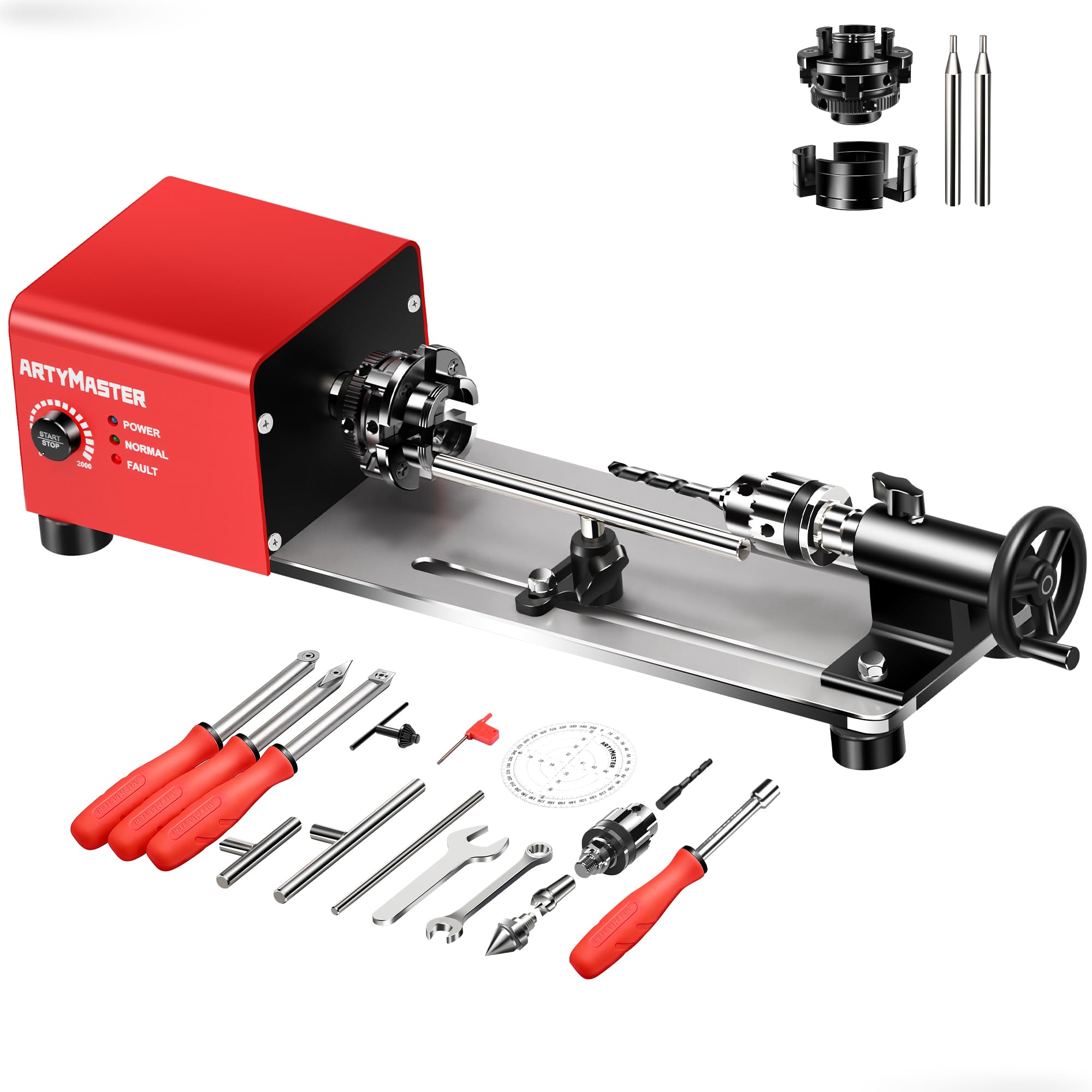
The 2-inch chuck is the first thing we look at on a kit this small, and the ArtyMaster's is usefully wide for pens, bottle stoppers, and little handles. The box also includes a drive center, live center, drill chuck, three turning tools, and the wrenches, so it is closer to a ready-to-turn package than most minis here. The 96-watt motor runs on a 24-volt supply, and the spindle has an MT1 taper and a 0.4-inch through-hole.

At 17 pounds, it is easy to move from a shelf to a bench and back, which is the point of a compact wood lathe for a spare room or apartment. The infinitely variable speed control is a real convenience on small work; you can slow it down for a delicate cut without stopping to move a belt. The UL-certified supply is a sensible detail on a machine that lives indoors.

This is a kit for pen turners, stopper makers, and anyone who wants a complete little setup without hunting for a chuck. The included centers and tools make it easy to start on small work, and the 17-pound body is easy to store. We recommend it when the blank is already small and the bench is short on space.

Bottom line: For pens, stoppers, and other small blanks, this is the most complete compact kit here, with the chuck and tools included.

Check Latest Price
#04

Best for Miniatures

Proxxon DB 250 Micro Lathe

80 /100
Kirk Score Excellent
Power
100 W
Weight
5.74 lb
Dimensions
21.65 x 6.1 x 3.94 in
Spindle Bore
13/32 in
Check Details on Amazon

Pros

  • 13/32-inch through-bore
  • Adjustable tool rest swings 360 degrees
  • 5.74 pounds
  • Two-year warranty

Cons

  • Small tool rest limits aggressive cuts

The 13/32-inch through-bore is the detail that makes the Proxxon DB 250 a micro lathe rather than a scaled-down pen lathe. It lets you feed small stock through the spindle, which is handy for repeat work and for holding slender pieces that would be awkward in a chuck. At 5.74 pounds, the whole machine is light enough to lift with one hand, but the aluminum-profile bed and adjustable tool rest give it a more planted feel than the cheapest high-speed minis. We recommend it for miniature turnings, rings, and tiny parts where precision matters more than capacity.

The 100-watt motor is not a bowl motor, and the work envelope is tiny even by mini-lathe standards. What it does have is a quiet, smooth-running spindle and a tool rest that adjusts in height and swings through 360 degrees, so you can get the support close to small work. The included collets, drive center, live center, and faceplate are the right starting set for micro turning.

This is a specialist's lathe. We like it for miniatures and short batches of little parts, not for a beginner who wants to turn a salad bowl. The two-year warranty is a reasonable safety net for a machine in this class. If your work fits through a 13/32-inch bore and you value a small, quiet footprint, it earns its place.

Bottom line: For miniature turnings and tiny parts, the Proxxon's through-bore, adjustable tool rest, and small footprint make it the specialist choice here.

Check Latest Price
#05

Best Small Metal Lathe

VEVOR 7 x 14 Metal Lathe

78 /100
Kirk Score Very Good
Chuck
4 in
Power
550 W
Weight
103 lb
Swing And Centers
7.09 in x 13.78 in
Check Details on Amazon

Pros

  • 550-watt motor
  • 7.09-inch swing and 13.78-inch centers
  • 4-inch three-jaw chuck
  • Digital speed display and power-off switch

Cons

  • Tool post has no height adjustment

This is the only machine in the group that is built to cut metal, and that changes the shopping question. The VEVOR has a 7.09-inch swing over the bed, 13.78 inches between centers, a 4-inch three-jaw chuck, and a 550-watt motor. For small metal parts, bushings, and light facing and turning, that is a useful benchtop package. The digital speed display and automatic power-off switch are practical touches on a machine that can do real damage if a workpiece comes loose.

We treat the VEVOR as a lathe to check and tune on arrival, not a turnkey precision instrument. The headstock and ways can arrive out of alignment, and the machine rewards someone with a dial indicator and patience. Those are fixable setup issues, but they are not what a first-time machinist wants to discover mid-project. The motor and capacity are the reason it earns a place; the setup is the price of buying metal capacity at this end of the market.

If your work is wood, stop here and choose a wood lathe. If you need to turn small metal parts and you are willing to do the setup, the VEVOR is the only real option here. It is also the heaviest machine in the group at 103 pounds, so plan a permanent bench.

Bottom line: For small metal turning on a benchtop, the VEVOR is the only real option here, provided you check alignment and tool height before trusting a tolerance.

Check Latest Price
#06

Best Budget High-Speed Mini

Winbomgo Mini Lathe

82 /100
Kirk Score Excellent
Chuck
4-jaw
Power
100 W
Weight
4.18 lb
Speed Range
3500-10000 RPM
Check Details on Amazon

Pros

  • 100 watts and seven speeds
  • 3,500-10,000 rpm range
  • 4.18 pounds stores easily
  • Four-jaw chuck and tools included

Cons

  • High minimum speed limits larger blanks

A top speed of 10,000 rpm tells you what kind of machine this is. The Winbomgo is a tiny high-speed lathe for beads, pen blanks, and small craft pieces. Its 100-watt motor and seven speeds from 3,500 to 10,000 rpm are set up for light cuts and polishing, and the four-jaw chuck and included tools let you start on small work without a separate kit. At 4.18 pounds, it takes up almost no bench space.

That light weight is convenient, but it also means you need to clamp or mount the base before you turn anything. The high spindle speeds are great for small diameters, and the included saw blade and turning tool add some versatility for craft work. The machine's footprint is tiny, so it stores easily.

We see this as a budget entry into tiny turning. The seven speeds give you enough control for beads and pen blanks, and the small body is easy to store. If your projects fit in the palm of your hand, it is a low-cost way to start; if you need more capacity, the WEN is the better buy.

Bottom line: For beads, pen blanks, and tiny craft pieces, this high-speed mini is a practical budget start.

Check Latest Price
#07

Tiny craft projects

Jinegelela Mini Lathe

78 /100
Kirk Score Very Good
Base
Aluminum
Weight
3.98 lb
Dimensions
14.33 x 4.53 x 4.49 in
Speed Levels
7
Check Details on Amazon

Pros

  • 3.98 pounds is easy to store
  • Seven power levels
  • Aluminum base
  • Compact 14.33-inch body

Cons

  • Not intended for production work

The limit of what this lathe can turn is also the clearest description of who it is for. The Jinegelela is a 3.98-pound mini for beads, small wooden parts, and soft craft materials, with a seven-level power adapter instead of a full speed dial. The aluminum base and compact 14.33-inch body make it easy to set on a desk or workbench, and the low weight means you can move it out of the way when the project is done.

It comes with an adapter, power cord, Allen wrenches, and ball fixing pins, but the included kit is basic. The machine is intended for light passes on small pieces. The seven power levels give you some control over speed, though the range is not the same as a variable-speed wood lathe with a low-speed torque band.

The appeal is the entry point. For a craft hobbyist who wants to turn a few beads or small handles without dedicating a bench to a 70-pound machine, it is small enough to store and simple enough to try. The aluminum base and compact footprint also make it less intimidating than a full wood lathe.

We recommend it only for genuinely tiny work. If you want to turn pens or stoppers with a proper chuck and centers, the ArtyMaster is a more complete kit. If you want bowls, neither of these is the right purchase. The Jinegelela earns its place as an ultra-compact craft lathe, not as a general-purpose small lathe.

Bottom line: For beads and tiny craft pieces, this ultra-light lathe is an affordable way to try turning without giving up bench space.

Check Latest Price

How We Tested Small Lathes

We built the shortlist by reading listings and owner reviews, then filtering hard on three things: swing over the bed and distance between centers, whether speed could be changed without dismantling anything, and what actually came in the box beyond the lathe itself. That narrowed roughly thirty machines to 11, which we mounted to a plywood-topped bench in a garage shop and kept there for eight months.

Most of that time looked like ordinary shop work — roughing square blanks down to spindles, turning pen blanks, hollowing a couple of small bowls, and drilling with the tailstock. On the machines built for metal, we took light facing and turning cuts in aluminum. Alignment got its own check: we slid the tailstock up to a dead center in the headstock and looked for daylight at the joint, then turned a cylinder between centers and calipered both ends, since a lathe that tapers will fight you on every long piece.

For stability, we mounted a 2-inch square blank and ran it at the highest speed the machine allowed, watching whether the feet crept across the bench and whether the bed rang. We moved tool rests, changed belt positions, and counted how often we needed a wrench instead of a lever. Assembly was timed out of the box, and we noted whether the manual explained a speed change plainly. Over the months we ran 45-minute sessions, checked headstock warmth and belt stretch, and watched how beds and finishes held up under chips and oil — that's where reliability and durability show themselves. Every box got inventoried, chisels and centers included, and we kept a running list of what had to be bought separately, because that's where value lives. Footprint and weight were measured too, and each machine was lifted onto a shelf to see whether one person could put it away.

How to Choose a Small Lathe

Start With Swing and Between-Centers Capacity

Swing is the largest diameter a lathe can clear over the bed; between-centers capacity is the longest piece it can hold. An 8-inch lathe is pen-and-small-bowl territory, a 10-inch mini covers most hobby spindles, and a 12-inch benchtop opens up small bowls and platters. Do not confuse either figure with a tiny chuck's clamping range. We start by asking what the largest blank will be, then add a couple of inches of clearance for the tool rest and your knuckles. If bowls are the goal, choose the larger swing.

Match Motor Power to the Blank

Small lathes live or die on low-speed torque, not top rpm. A 96- or 100-watt micro lathe can spin a pen blank or a bead, but it will feel out of its depth on a bowl blank. A 4.5-amp or 1/2-hp benchtop model has the reserve for intermittent bowl work, and a 550-watt metal lathe is a different tool entirely. We pay more attention to the low end of the speed range than the highest number on the dial. If your work is mostly small, a modest motor is fine; if you want to remove material from a wider blank, buy the power.

Decide How You Want to Change Speed

Five-speed lathes usually change speed by moving a belt between pulleys; electronic variable-speed models let you dial the rpm without stopping. The belt is simple and gives useful torque ranges, but it interrupts the work every time you move from drilling to roughing to finishing. Electronic control is nicer for small, delicate pieces and for beginners who adjust often. We accept a belt change on a budget benchtop, but we want the pulleys to be easy to reach and the tensioner to feel solid. Try the change routine before you commit.

Plan the Bench and the Mounting

Small does not mean weightless. The micro lathes here run from about 4 to 17 pounds, while the benchtop wood and metal models run from 70 to 103 pounds. A light unit needs clamping or bolting so it does not walk; a heavy one needs a stable table and enough room around the bed for the blank and the tool rest. A 70-pound lathe does not belong on a folding table. Measure the bench depth, leave clearance at the headstock and tailstock, and plan where the chips will land.

Check Spindle, Chuck, and Tooling

The spindle taper, through-bore, and chuck range decide what accessories fit and what stock you can hold. MT1 is common on small wood lathes; MT2 appears on larger benchtops and gives you more accessory choices. A through-bore lets you feed thin stock through the headstock, which is useful for repeated small parts. Check the included chuck range and centers before you order a separate kit. We prefer a lathe that comes with the centers and a faceplate, because those are the pieces you need on day one.

Frequently Asked Questions

Final Verdict

For most hobby woodturners, the WEN LA3424 is the small lathe to buy. Its 12-inch swing and 4.5-amp motor cover pens, spindles, and small bowls, and the MT2 tapers keep accessories easy to find. If your work is almost all pens and you want a more compact 10-inch machine, the RIKON is the better fit. For metal, the VEVOR is the only real choice here, provided you check alignment and tool height before trusting a close tolerance.