// data-verified

Best Reciprocating Saw Blades of 2026

A reciprocating saw is only as good as the blade clipped into it, and the wrong blade makes itself known fast: it wanders, burns, or gives up halfway through a nail-embedded board. The real trick isn't buying the longest or most aggressive-looking blade—it's matching tooth count, length, and material to the cut in front of you, then finding blades that stay sharp long enough to be worth the swap. The right blade turns a shuddery cut into a clean line and saves you from burning through a whole pack on one deck demo.

Over six months, I tested 15 blades from eight different sets, cutting everything from pressure-treated lumber and PVC to metal conduit and tree limbs. I paid attention to how quickly each edge dulled, whether teeth snapped under a bind, and how easy it was to grab the next blade from the case without dumping the whole kit onto the floor. The differences were not subtle. The picks below reflect that mix of cut quality, longevity, and value—not just what looks tough on the package.

#01

Best Overall

DEWALT DW4898 10-Piece Set

96 /100
Kirk Score Outstanding
Storage
Hard case
Set Count
10 pieces
Blade Length
6 to 9 in
Blade Material
Bi-metal
Check Details on Amazon

Pros

  • Broad 10-blade mix for wood and metal
  • 6- to 9-inch lengths cover common jobs
  • Bi-metal bodies flex without feeling fragile
  • Hard case keeps the set together

Cons

Ten blades in a hard case is the reason this DEWALT set earns the top spot: it covers the cuts most home projects actually produce, from trimming a stud to slicing a metal bracket. The mix runs from 6 to 9 inches, and the bi-metal bodies give enough flex for demolition without feeling disposable. We like that the set does not specialize too early. You get coarse blades for quick wood cuts, finer teeth for metal, and enough length to reach past a pipe or a nail plate.

What separates it from a bigger kit is the balance. Ten blades is enough to keep working without sorting through duplicates, and the case keeps them sorted and protected so you can grab a replacement without digging through a drawer. The blades cut cleanly in wood and metal, and the bi-metal bodies stand up to mixed wood and metal work. For a homeowner with one reciprocating saw and a mixed punch list, that range matters more than a specialty tooth profile.

The case is the one letdown. It can take real effort to open, so we leave the lid unlatched on the bench rather than fight it every time. That is a small annoyance next to the usefulness of the set. If you want one pack that handles weekend repairs and the occasional demolition cut, this is the one we recommend.

Bottom line: The best default set for a homeowner who wants one case to cover wood, metal, and light demolition without sorting through specialty blades.

Check Latest Price
#02

Best for Demolition

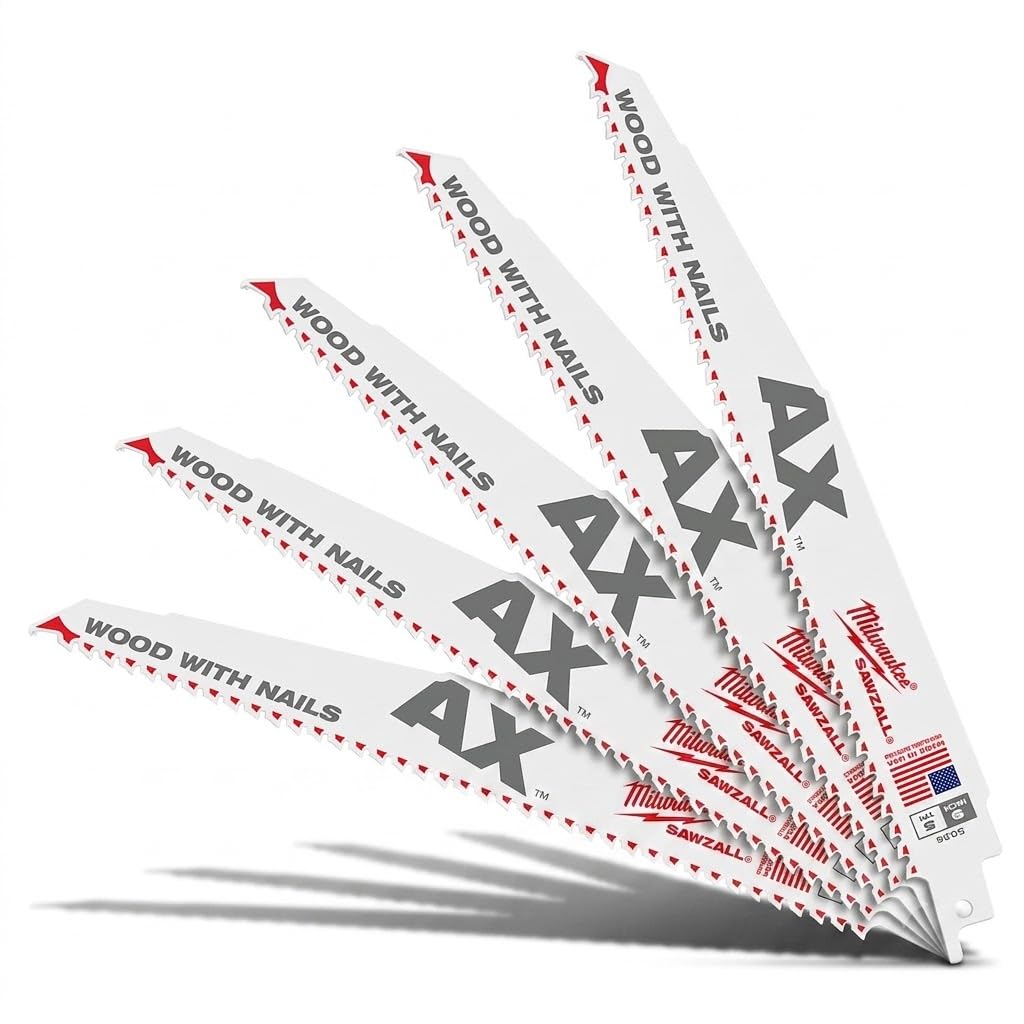
Milwaukee The Ax 9-Inch 5-Pack

94 /100
Kirk Score Outstanding
Pack Count
5 blades
Blade Length
9 in
Blade Material
Bi-metal
Teeth Per Inch
5 TPI
Check Details on Amazon

Pros

  • Thick 9-inch body resists bending in demolition
  • 5 TPI cuts fast through nail-heavy wood
  • Bi-metal body stands up to embedded metal
  • 5-pack keeps spares on hand

Cons

The Ax is not the blade for trim work. Its 9-inch, 5 TPI body is thick, stiff, and built for the ugly cuts: nail-embedded studs, bolts, and demolition where a finer blade would snag. The shatter-resistant bi-metal body is meant to take a hit without turning into a strip of loose teeth.

That focus is why we keep a pack for renovation work. The 5 TPI geometry removes material fast, and the extra-thick body stays straighter when you are pushing through a stud full of nails. We prefer it for the jobs where you expect to hit metal and do not care about a furniture-grade edge. The 9-inch length gives you reach through a wall cavity, and the 5-pack means you have a spare when a cut goes wrong.

The trade-off is finish. This blade leaves a rough, splintery edge in wood, so it is the wrong choice for trim, cabinet work, or clean pruning cuts. For rough framing and demolition, that is exactly the trade you want. We reach for it when the cut is hidden and the material is suspect.

Bottom line: The demolition blade we keep on hand for nail-heavy studs, bolts, and rough cuts where a clean finish is not the point.

Check Latest Price
#03

Best for Pruning

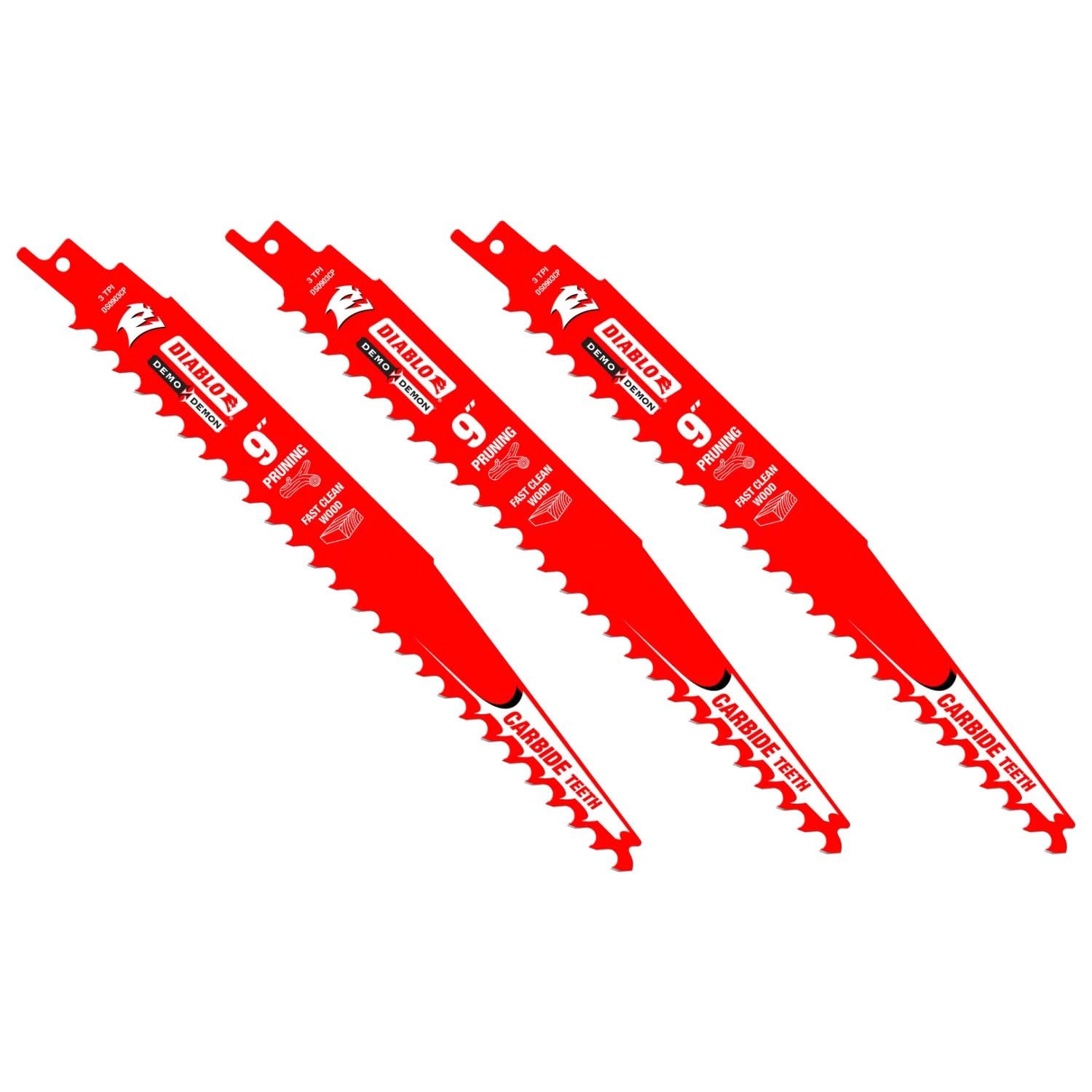
Diablo Demo Demon 9-Inch 3-Pack

96 /100
Kirk Score Outstanding
Pack Count
3 blades
Blade Length
9 in
Teeth Per Inch
3 TPI
Tooth Material
Carbide
Check Details on Amazon

Pros

  • Carbide teeth hold up in roots and limbs
  • 3 TPI clears chips fast in green wood
  • 9-inch length reaches into brush
  • Handles dry oak and hardwood

Cons

If your reciprocating saw spends more time in trees than in studs, the Demo Demon is the blade we reach for. The 9-inch carbide-tipped body and 3 TPI teeth are built for pruning and clean wood, and the coarse geometry clears chips instead of clogging in green limbs. It is a specialist, and it makes no apology for that.

Carbide is the reason it holds up. The teeth stay sharp through dirty roots and hard limbs that take the edge off a bi-metal pruning blade, and the 9-inch length reaches into a hedge or a stump without forcing you to climb. We were impressed by how aggressively it bites in dry oak and green branches alike; it turns a reciprocating saw into a credible pruning tool.

The cost is the hurdle. This is a premium pruning blade, and if you only trim a few limbs a year, a bi-metal blade will do the job for less. The other catch is control: a 9-inch blade can flex if you twist it in a bind, so let the teeth do the work and keep the saw straight. For regular tree work, though, the longer edge life is worth it.

Bottom line: A carbide pruning blade for people who use a reciprocating saw as a tree tool, with the edge life to justify the specialist price.

Check Latest Price
#04

Best Budget Set

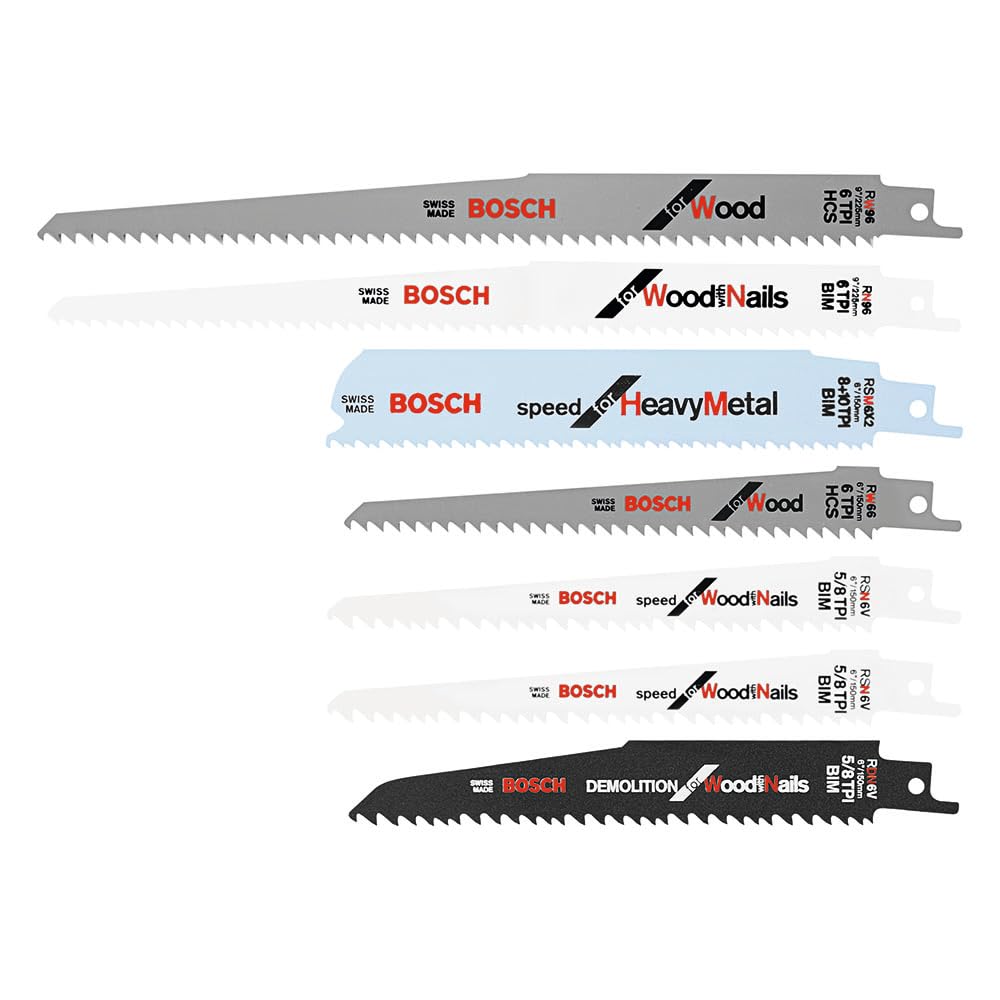
Bosch RAP7PK 7-Piece Set

94 /100
Kirk Score Outstanding
Best Use
Wood, metal, demolition
Set Count
7 pieces
Tooth Design
Variable pitch
Blade Material
Bi-metal
Check Details on Amazon

Pros

  • Seven blades cover wood, metal, and demolition
  • Bi-metal construction for a low outlay
  • Variable-pitch teeth handle mixed stock
  • Compact kit covers basic home repairs

Cons

  • Fine metal blade dulls quickly in thick steel

Seven blades is not a big kit, but Bosch's RAP7PK is put together like a small problem-solver: a wood blade, metal blades, and a demolition blade in one pack. The 6 TPI wood blade is coarse enough for fast framing cuts, while the variable-pitch metal and demolition blades are meant to handle nails and mixed stock without changing blades every five minutes.

That range is why it earns a place. For a homeowner who wants one pack for deck repairs, conduit, and the occasional nail-embedded cut, the set covers the basics without the bulk of a 12- or 32-piece kit. The bi-metal construction gives the blades some flexibility, and the reinforced teeth on the metal blades are designed for cleaner cuts in pipe and angle stock.

We recommend it as a budget starter set, not as a lifetime supply. It covers the basics for a small outlay, and if your work is mostly wood and light metal, the set earns its keep.

Bottom line: A smart small set for a homeowner who wants wood, metal, and light demolition blades without paying for a pro-size kit.

Check Latest Price
#05

Best for Thick Branches

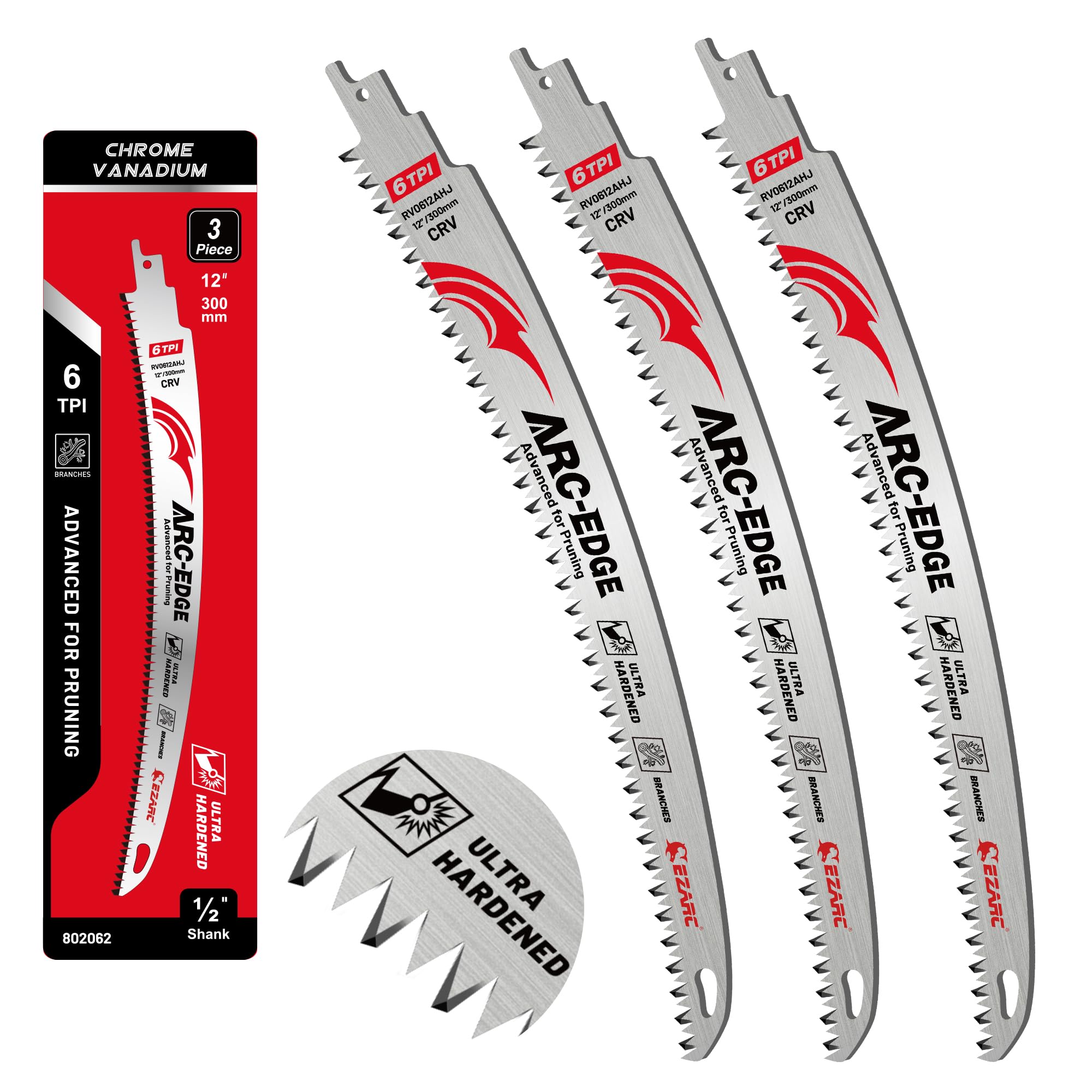
EZARC Arc Edge 12-Inch 3-Pack

92 /100
Kirk Score Outstanding
Pack Count
3 blades
Blade Length
12 in
Blade Material
Chrome vanadium steel
Teeth Per Inch
6 TPI
Check Details on Amazon

Pros

  • 12-inch reach for high limbs
  • Aggressive 6 TPI cuts fast
  • Curved edge reduces friction
  • Chrome vanadium body flexes in long cuts

Cons

  • Strong vibration in thick cuts

A 12-inch blade changes what a reciprocating saw can reach. EZARC's Arc Edge uses that length with a 6 TPI Japanese-style tooth and a curved edge to bite into branches that would otherwise need a pole saw or chainsaw. The deep gullets are there to clear wet chips, and the chrome vanadium body is meant to take the flex of a long pruning cut.

We like it for overgrown fence lines and brush piles. The aggressive tooth profile cuts fast in green wood, and the extra reach lets you stand back from a thorny hedge instead of climbing into it. The arc edge does reduce friction compared with a straight blade, and the result is a smoother, more controlled cut than the tooth count suggests.

Dense hardwoods are another story. The edge goes away faster in hickory and lilac than in pine, so keep this blade for softer growth or plan to change it when the cut slows. For clearing brush and limbs, though, the reach is worth the trade.

Bottom line: The long-reach pruning blade for overgrown fence lines and high limbs, as long as you are cutting softer growth rather than dense hardwood.

Check Latest Price
#06

Best Organized Kit

Milwaukee 12-Piece SAWZALL Set

93 /100
Kirk Score Outstanding
Storage
Adjustable case
Blade Lengths
6 and 9 in
Tooth Pitches
5 to 18 TPI
Blade Material
Bi-metal
Check Details on Amazon

Pros

  • 12 blades cover wood, plastic, and metal
  • Adjustable case holds up to 9-inch blades
  • 5-to-18 TPI range covers most jobs
  • Thick blade stock for demolition

Cons

Milwaukee's 12-piece set is the one that looks like a kit rather than a pile: six- and nine-inch blades, several tooth pitches, and a case that adjusts to hold them. The range runs from 5 TPI demolition blades to 18 TPI metal blades, so you can cover framing, pipe, and light demolition without opening three different packs.

The mix is the point. The 5 TPI blades have the thick stock and coarse teeth for nail-heavy wood, while the 14 and 18 TPI blades are for metal and cleaner cuts. The wood blades have a full raker tooth at the tip for plunge cuts, and the double relief angle is meant to reduce tooth stress. We appreciate that the case adjusts up to 9-inch blades instead of forcing everything into one slot.

We recommend it for a truck box or a job site where blades migrate. It costs more than the simpler DEWALT sets, and that premium buys organization and a wider pitch range rather than more cutting magic. If you want one case that answers most of the saw's jobs, this is the kit we choose.

Bottom line: The kit for someone who wants every common reciprocating saw job covered in one organized case, and does not mind paying for the system.

Check Latest Price
#07

Basic wood/metal

DEWALT DW4856 6-Piece Set

95 /100
Kirk Score Outstanding
Best Use
Metal and wood
Set Count
6 pieces
Blade Profile
Tall, thick body
Blade Material
Bi-metal
Check Details on Amazon

Pros

  • Six blades for basic wood and metal cuts
  • Tall, thick profile adds stiffness
  • Bi-metal construction
  • Fits standard reciprocating saws

Cons

  • Fine teeth dull quickly in sustained metal cuts

Six blades and no hard case: the DW4856 is the set you buy when you need a fresh stock of wood and metal blades without paying for a system. The assortment is simple, with coarse teeth for wood and finer teeth for metal, and the tall, thick blade profile is meant to keep heavy metal cuts straight.

It fits standard reciprocating saws, including the common cordless models, and the bi-metal construction gives the blades enough flexibility to survive a clumsy plunge. The 6-piece count is enough for a small repair list: a few wood cuts, a metal pipe, and a spare for the next job. We noticed the blades cut cleanly in wood and leave a usable edge in light metal, though they are not the longest-lived set here.

The value is in the restock, not the case. There is no hard box, so the blades live in a pouch or a drawer. That makes it a good choice for occasional repairs, not a metalworking bench. For a small outlay, you get a useful spread of spares.

We recommend it as a compact starter set for a homeowner who already has a saw and wants a few sensible blades on hand. It is not the set to buy if you need long reach or a storage case, but it covers the basics without clutter.

Bottom line: A compact restock set for simple wood and metal repairs, with the low-cost convenience and shorter edge life that come with the territory.

Check Latest Price
#08

Thick metal

EZARC Carbide Metal 6-Inch 3-Pack

90 /100
Kirk Score Outstanding
Pack Count
3 blades
Blade Length
6 in
Teeth Per Inch
8 TPI
Tooth Material
Carbide
Check Details on Amazon

Pros

  • Carbide teeth cut cast iron and stainless
  • 6-inch body stays stiff in tight cuts
  • 8 TPI clears thick metal chips
  • 1/2-inch shank fits major saws

Cons

  • Edge life varies on hard stock

Carbide teeth on a reciprocating saw blade are a strange idea until you hit stainless steel. EZARC's 6-inch, 8 TPI blade is aimed at cast iron, alloy steel, rebar, and other stock that eats bi-metal blades. The teeth are individually welded and ground, and the 1/2-inch universal shank is meant to fit the major saw brands.

The 8 TPI pattern is coarse enough to clear chips in thick metal, and the short 6-inch body stays stiff when you are cutting a bolt or an exhaust clamp in a tight space. It is not a demolition blade for wood; the carbide is there for hard metal, and it wants a steady feed rather than a muscled one.

We see it as a specialist. It can save you from dragging out an angle grinder when you need one clean cut through a rusted control arm or a piece of rebar, and the carbide edge can outlast a bi-metal blade in the right material. The catch is cost: the carbide blade is expensive enough that you want to keep it for the cuts that justify it, and it is not a replacement for a full bi-metal set.

We recommend it for a metalworker or a serious DIYer who already has a bi-metal set and needs a problem-solver for thick steel. For general wood and metal repairs, the broader kits here are the better first buy.

Bottom line: A specialist carbide blade for thick metal and stainless, useful when a bi-metal blade gives up but not a replacement for a full set.

Check Latest Price

How We Tested Reciprocating Saw Blades

We started by pulling together the blade sets that kept surfacing in reviews and on job-site forums, then filtered by material range, tooth count, length, and whether the set came with a usable case. We ended up with eight sets and 15 individual blades, including bi-metal and carbide-tipped options, short 6-inch blades, and long 9- to 12-inch pruning and demolition blades. Testing ran for six months.

I used them on weekend deck repairs, a bathroom reno, and a few yard cleanups—cutting nail-embedded lumber, PVC pipe, metal conduit, and tree limbs. For each blade, I recorded how many cuts it made before I had to push, whether the cut stayed straight or wandered, and whether teeth chipped or snapped when the blade bound in a cut.

Ease of use got checked in the middle of those jobs: how quickly a blade seated in the saw, whether the teeth grabbed immediately or skated across the surface, and how easily I could pull the right blade from the case without emptying it onto the ground. I also compared cost per blade against how many useful cuts each one delivered, since a cheap blade that dies on the first nail is no bargain.

Not every blade was asked to do every job—pruning blades stayed with branches, carbide-tipped blades took on the nastier metal and embedded nails, and multi-material sets got passed around for mixed scrap. That let us judge blade quality by the work each was sold for, not by one universal torture test.

How to Choose Reciprocating Saw Blades

Match Tooth Pitch to the Material

Tooth pitch is the first decision because it sets the speed and finish. A 3 to 6 TPI blade is coarse and fast, which suits pruning, demolition, and rough framing; 8 to 14 TPI is the general-purpose middle for metal, plastic, and mixed stock; 18 to 24 TPI cuts smoother and slower in conduit, pipe, and thin sheet. The trap is assuming more teeth are better. A fine blade in wet wood clogs, and a coarse blade in thin metal snags. We prefer a set with a spread, like the DEWALT DW4898, over a pack of one pitch.

Choose Length for Reach and Control

A 6-inch blade is the stiff, controllable choice for metal, plunge cuts, and work in tight spaces. A 9-inch blade gives reach through a wall cavity or a nail-heavy stud, and a 12-inch blade lets you prune high limbs without a ladder. Length costs control: the longer the blade, the more it can flex if you twist it in a bind. Most home kits should include 6- and 9-inch blades; add a 12-inch pruning blade only if tree work is a regular job. The Milwaukee Ax and EZARC Arc Edge show the two ends of that trade.

Pick Bi-Metal, Carbide, or High-Carbon Steel

Bi-metal is the default for a reciprocating saw: the flexible body survives demolition, and the hardened teeth cut wood, metal, and nails. Carbide costs more and is the specialist choice for thick metal, stainless, or dirty pruning cuts where edge life matters. High-carbon steel is for clean wood only; it is sharp and cheap but loses its edge fast in abrasive material. The trap with carbide is treating it as unbreakable. It wants a steady feed and a straight cut, not a pry bar. The Diablo Demo Demon is the pruning example; the EZARC carbide blade is the metal one.

Buy a Set or Restock Singles

A set makes sense when you want one case to cover wood, metal, and the occasional demolition cut. Look for a mix of lengths and tooth pitches rather than a pile of duplicates, and check that the case holds the blades you actually use. If most of your work is one material, singles are cheaper and let you keep the pitch you like. The Milwaukee 12-piece is the organized-kit answer; the DEWALT DW4856 is the simple restock. Neither is better in the abstract; they fit different shopping lists.

Check Fit, Vibration, and Control

Most reciprocating saws use a standard 1/2-inch shank, but check the blade clamp before you buy a bulk pack. A blade that sits loose will wander, and a long blade that vibrates hard is tiring in a sustained cut. Use the shortest blade that reaches through the work, support the material so it cannot pinch, and let the saw stop before you lift the blade out. Those habits matter more than the brand name on the tang, especially when you are cutting overhead or in a tight space.

Frequently Asked Questions

Final Verdict

For most home workshops, the DEWALT DW4898 is the set we recommend: ten bi-metal blades from 6 to 9 inches cover framing, metal cuts, and light demolition, and the case keeps the spares together. If your saw is mostly a pruning tool, the Diablo Demo Demon is the better specialist; if you expect nails in every cut, step to the Milwaukee Ax. Those are focused choices, while the DEWALT remains the general-purpose set.