// data-verified

Best Paint Brushes for Trim of 2026

Trim is where a paint job gets judged — the line where wall meets casing, the edge of a baseboard. It's also where a brush either helps or fights you: too wide and you're wiping drips off the floor, too narrow and you're making four passes at a two-inch band. A good one holds enough paint to finish a doorway without reloading and doesn't leave a bristle standing in the finish.

I've repainted the trim in two apartments and one very long hallway, and the gap between a cheap brush and a good one shows up in the first ten minutes. My team and I spent five months with 15 trim brushes — angled sash styles, short-handled detail brushes, a couple of sets — on casings, door slabs, cabinet frames, and shelf edges. Synthetic filaments have mostly won for water-based paint, and the angled tip matters more than width for most of this work.

Softness is the spec people underrate: a stiff brush leaves lap marks in semi-gloss, and a shedding brush is a flaw no amount of skill covers up. The picks below are the ones that earned their spot.

#01

Best Overall

Wooster Q3211-2 Shortcut

96 /100
Kirk Score Outstanding
Handle
2-inch Shergrip
Filament
White nylon and gold polyester blend
Brush Width
2 inches
Bristle Type
Angle sash
Check Details on Amazon

Pros

  • Two-inch angled head cuts a clean line along trim
  • Short Shergrip handle keeps control in tight spaces
  • Rubber grip stays comfortable through a room of casing
  • Rinses clean enough to reuse

Cons

  • Short handle gives up reach overhead

Two inches of handle is all this brush gives you, and that is the whole argument for it. Your fingertips sit almost on the ferrule, so the head goes where your hand goes — along the top of a baseboard, down the edge of a casing, into the inside corner of a window reveal. A full-length sash brush steers from six inches back. This one steers from the paint.

The head is a 2-inch angled sash in a white nylon and gold polyester blend, versatile enough to take latex, primer and an oil-based trim enamel without you owning two brushes. The filaments are soft enough to lay a line without dragging and firm enough that the tip doesn't splay when you press it into a corner. Brass-plated ferrule, rubberized Shergrip handle, and a head that washes out clean enough to put away and use again next weekend.

After a room of casing, the detail that stood out is the grip. The rubber overmold is easy on the hand through hundreds of small strokes, and the balance keeps the brush from fighting you at the end of a long reach. The price makes it easy to keep two — one for primer, one for finish — which is the simplest way to keep a finish brush clean.

Bottom line: If you want one brush for baseboards, casings and cut-in, start here: a 2-inch angled head on a 2-inch handle that goes exactly where you steer it.

Check Latest Price
#02

Best Splurge

Purdy XL Glide 2-Inch

95 /100
Kirk Score Outstanding
Handle
Fluted hardwood
Filament
Nylon and polyester blend
Brush Width
2 inches
Bristle Type
Flagged bristle
Check Details on Amazon

Pros

  • Flagged nylon-polyester tips lay paint without lap marks
  • Thin head slides into raised panel recesses
  • Holds its shape through repeated washing
  • Comfortable fluted hardwood handle

Cons

  • Pricier than the other single brushes here

This is the priciest single brush on the page, and the money goes into the bristles rather than the badge. Purdy blends nylon and polyester, flags the tips, and builds the head slightly thinner through the body than a standard 2-inch brush, which is what lets it slide into the recess of a raised door panel without mashing the edge of the molding.

We reach for it when the finish has to be right the first time: enamel on a door casing, a dark color against white trim, anywhere a lap mark would show. The flagged tips release paint evenly, the head keeps a straight edge as the load runs down, and the whole thing holds its shape through repeated washing. That last part is the difference between a brush you replace every season and one that lives in its sleeve for years.

The fluted hardwood handle is comfortable without being fussy, and soap and water takes latex off it cleanly. What it doesn't do is turn in a tight inside corner the way a short-handled brush does, and it costs more than the other single brushes here. For a house full of flat casings, we think that trade is worth making.

Bottom line: Worth the premium on visible trim — enamel on door casings, dark colors against white — but it's more brush than a first repaint needs.

Check Latest Price
#03

Best for Crisp Lines

Purdy Clearcut Dale 1.5-Inch

94 /100
Kirk Score Outstanding
Handle
Rattail alderwood
Ferrule
Stainless steel
Filament
Stiff nylon and polyester
Brush Width
1.5 inches
Check Details on Amazon

Pros

  • Stiff filaments hold a defined line
  • 1.5-inch head fits molding and muntins
  • Rinses out clean and keeps its shape
  • Stainless ferrule and sealed alderwood handle

Cons

  • Narrow head slows wide flat casings

An inch and a half is narrow for a trim brush, and that is the point. The Clearcut Dale is the most precise brush in this set — the one we pick when the job is a defined line rather than coverage: window muntins, the return on a door casing, the meeting of wall and ceiling that's easier to brush than to tape.

The filaments are stiff, a Tynex nylon and Orel polyester blend, and that stiffness is what produces the edge. A soft brush lays paint down and lets it find its own line; a stiff one holds the line you set. That's why this head works for cutting in around molding, and why it stays crisp as the brush wears in instead of blooming into an oval. Stainless ferrule, sealed alderwood handle, and a rattail grip that keeps the brush balanced in the hand.

It also rinses out fully, which matters more than it sounds: a brush that comes clean keeps its shape, and this one goes back into the sleeve looking like it did last time. On a six-panel door, this is the brush that does the panels while a wider one does the stiles.

Bottom line: Buy it for the lines that show: muntins, panel returns, cut-in that's easier to brush than to tape. Wide flat casings want a wider brush.

Check Latest Price
#04

Best for Long Runs

Wooster Silver Tip 2.5-Inch

94 /100
Kirk Score Outstanding
Handle
Hardwood
Ferrule
Stainless steel
Filament
100% CT polyester
Brush Width
2.5 inches
Check Details on Amazon

Pros

  • 2.5-inch angle head covers baseboard fast
  • Soft polyester levels enamel and oil paint
  • Holds a heavy load without dripping
  • Fits a quart can for trim work

Cons

  • Soft filament can leave marks in fast-drying latex

Two and a half inches is a lot of brush, and on a long run of baseboard that's a gift. One pass covers roughly what two passes with a narrower brush cover, the angle keeps the top edge tight to the wall, and the width lets paint flow out behind the head instead of sitting up in ridges.

The filaments are 100% polyester and soft, noticeably softer than the Purdy brushes here. That softness suits enamel and oil-based trim paint, because the brush levels the coating as it goes and marks flatten out behind you. It loads heavily too: a 2.5-inch angle head sits nicely in a quart can, and a single dip gives you a long stroke down a casing.

Long, straight, visible trim is where it earns its place in this set — baseboards, chair rail, door stiles. We didn't find it the brush for a tight inside corner; with that much width and that much softness, control lives at the opposite end of the scale from the Shortcut.

One thing we kept an eye on is shedding. With this much filament there's more to lose, and the occasional bristle works loose, so check the head against the can lip before you start a run anyone will look at.

Bottom line: For long, straight, visible runs — baseboard, chair rail, door stiles — the extra width and soft filament do the work; keep a shorter brush for the corners.

Check Latest Price
#05

Best for Corners

Zibra Triangle 1.25-Inch

95 /100
Kirk Score Outstanding
Handle
Hourglass
Brush Width
1.25 inches
Paint Types
All paints and stains
Bristle Type
Flagged filament
Check Details on Amazon

Pros

  • Triangle point reaches into corners
  • Flat side lays a wide line on panels
  • Dense filament carries paint into tight spots
  • Hourglass handle sits comfortably

Cons

  • Point traps paint when rinsing

The head is a triangle, and after one paneled door you'll wonder why more brushes aren't shaped this way. A point goes into the corner, the opposite flat edge lays a wide line across the panel, and you stop swapping tools between the field and the recess.

Detailed molding is where it earns its keep. The filament is packed densely enough that the brush carries a real load into a corner instead of arriving dry, and the hourglass handle lets you choke up for the last inch. We found ourselves choosing it over a standard angle sash whenever the trim was decorative rather than long.

Where it pays for itself is the fiddly work: stair spindles, furniture, the inside of a window casing, the corner where two moldings meet. A standard angle sash has to be worked in from two directions to fill a corner; the point gets there in one.

Bottom line: The one to buy for paneled doors, detailed molding and furniture, where reaching a corner without changing brushes is most of the job.

Check Latest Price
#06

Best Budget Set

Pro Grade 5-Piece Set

93 /100
Kirk Score Outstanding
Handle
Solid wood
Paint Types
Latex and oil-based
Bristle Type
SRT filament
Set Contents
5 brushes, 1 to 2.5 inches
Check Details on Amazon

Pros

  • Five sizes cover a full trim repaint
  • Includes a 2-inch angle stubby most sets omit
  • Soft filaments lay paint flat with little drag
  • Inexpensive enough to treat as semi-disposable

Cons

  • Bristles can shed into a wet finish

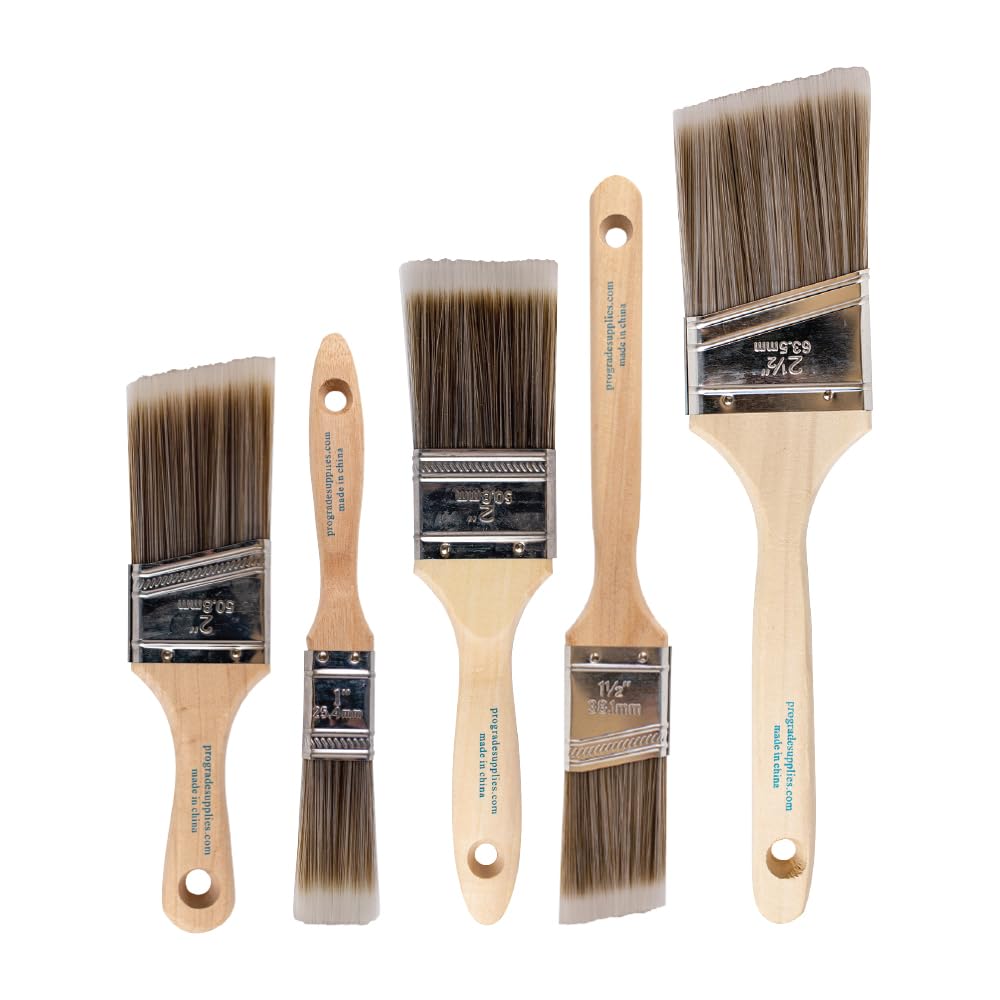
Five brushes, and one of them is the reason to look: a 2-inch angle stubby that most sets leave out. Short handle, angled head, sized for cabinet interiors, window sashes and the inside of a built-in — the places where a full-length brush gets in its own way.

The range covers a whole trim repaint: 1-inch flat for tight spots, 1.5-inch angle for the average casing, 2-inch flat and 2-inch angle for door faces, 2.5-inch angle for a long baseboard run. The filaments are soft, the handles are solid wood, and the whole set is light enough to carry in one hand while you climb a step stool.

This is the set we hand someone starting a whole-house trim job. Nothing in it is the best brush on this page at any single task, but you can put one in each room's color, sacrifice one to a forgotten roller tray, and not feel it. For a first repaint, before you know whether you're a 2-inch-angle person or a small-brush person, that breadth is worth more than one excellent brush.

Where the set gives ground to the Purdys is at the very edge of the work. The filaments are soft, so a hard, long line on a window sash takes more care, and the 1-inch flat is more of a tight-space tool than a cutting-in brush. On standard profiles and standard trim paint, none of that slows the job down.

Bottom line: The set to buy when the job is a whole house rather than one door: five sizes, a stubby most sets skip, and a price that makes using one up painless.

Check Latest Price
#07

Window trim

Zibra Square 1-Inch

94 /100
Kirk Score Outstanding
Handle
Hourglass
Brush Width
1 inch
Paint Types
All paints and stains
Bristle Type
Flagged filament
Check Details on Amazon

Pros

  • Square tip holds a hard edge on narrow trim
  • One-inch head stays inside the profile
  • Dense filament carries plenty of paint
  • Hourglass handle comfortable for detail work

Cons

  • Too narrow for long baseboard runs

A square head looks like a gimmick until you run it along a window sill. The squared tip holds a straight edge against a narrow band of trim, and because the head is only an inch wide you can keep the whole brush inside the profile instead of hanging it over the wall.

One inch suits sashes, muntins, narrow casing and the edges of a furniture panel. What we liked is how much paint a head that small carries: the filament is packed denser than a standard brush of the same width, so a dip goes further than the size suggests and you aren't reloading at every corner.

The bristles hold their shape through repeated washing, the hourglass handle is comfortable enough for a long session of small work, and the brush weighs next to nothing in the hand. It's the sort of thing that stays in the kit rather than getting thrown out with the tray liner.

Where it belongs is the finishing end of a job: the sash you didn't take off the window, the narrow molding around a built-in, the edge beside a painted panel. If you already own the triangle, the square is the second Zibra worth adding to the bag. If you want one small detail brush and no more, the triangle covers more shapes.

Bottom line: For window trim and narrow profiles, the square tip is the reason to buy: it holds a hard line where a 2-inch brush can't fit.

Check Latest Price

How We Tested Trim Brushes (and What We Looked For)

We started by gathering angled trim brushes in the budget-to-mid range, reading filament specs and handle shapes and looking closely at whether the angle was actually cut into the brush or just trimmed flat at the ferrule. We kept a few sets in the running too, since that's how a lot of people buy their first trim brush. That left 15 brushes, which my team and I used over five months.

Every brush went through the same rotation: cutting a line along a ceiling and casing in a hallway, painting door slabs laid across sawhorses, and edging cabinet frames and shelf fronts where a wide brush won't fit. We loaded each one with the same water-based semi-gloss and counted how many feet of trim a single dip covered before the paint ran thin, then checked the line in raking light for waviness, lap marks, and any spot where the tip had smeared paint onto the adjoining wall.

Shedding got its own tally. We counted loose bristles in the paint after every coat and noted which brushes were still dropping filaments into the third and fourth coat. We also felt how each brush loaded — soft enough to lay off without leaving tracks, stiff enough not to flop — and checked whether the angled tip stayed sharp enough to reach into a corner after washing.

By month five we set the most-used brushes side by side to compare tips that had splayed, filaments that had gone mushy, and handles that had swollen from soaking. Then we weighed what each brush cost against how its tip looked at the end, because a cheap brush that dies in a season isn't the bargain it seems.

How to Choose a Paint Brush for Trim

Pick the head shape first

Almost every trim job starts with an angled sash head, and for good reason: the angle puts the longest filaments where the line is, so you can steer the tip along a casing while the rest of the brush rides the wall. Flat heads suit wide, flat trim and door faces. Shaped heads — the Zibra triangle and square, or a short stubby — exist for corners, raised panels and multi-pane windows, where a straight brush has to be worked in from two directions.

Start with one 2-inch angle, then add a shape only if your house has detail worth reaching for.

Match the width to the run

Width is a speed-versus-control decision. A 1.5-inch brush is nimble on a door casing and a window sash; a 2-inch angle is the all-purpose size most trim gets painted with; a 2.5-inch angle eats a long baseboard in fewer passes and sits neatly in a quart can.

The trap is buying the widest brush for speed and then fighting it at every inside corner. A wide head has to be tipped up on its edge to make a tight turn, which is exactly where a soft filament smears. Wide for the runs, narrow for the turns.

Let filament stiffness decide the line

Synthetic nylon and polyester blends handle latex, primer and most trim enamels; natural bristle belongs with oil-based finishes and their thinners. Beyond that, stiffness is the choice you're making. Stiff filaments — the Purdy Clearcut is the stiffest brush here — hold the line you set and stay crisp as they wear in. Soft filaments lay paint flatter and level out brush marks, which is why they suit enamel on a door face.

The trap with soft: on fast-drying latex, overworking pulls marks back into a film that has already started to set. Lay it down once and leave it.

Handle length and grip

A short handle, like the 2-inch Shergrip on our top pick, puts your fingers near the ferrule and gives the finest control — the reason cabinet painters keep stubby brushes in the bag. A standard sash handle gives reach for high walls, ceilings and long strokes down a door. Neither is better; they answer different reaches.

For long sessions, a rubber overmold matters more than it sounds, because trim work is thousands of small strokes rather than a few big ones.

Shedding, cleaning, and what you're really paying for

Any filament brush can lose a bristle now and then, and a loose filament in a wet finish is the most irritating thing in this category. Rinse and comb a new brush before its first coat, and glance at the head as you load it.

After the job, wash latex out with warm soapy water before it sets, spin the brush dry and store it in its sleeve. That care, more than the price on the tag, is what separates a brush you keep for years from one you throw out at the end of the week.

Frequently Asked Questions

Final Verdict

Buy the Wooster Q3211-2 Shortcut, and buy two — one for primer, one for finish. A 2-inch angled head on a stubby handle is the most controllable combination on this page for baseboards, casings and cut-in, and it's the least expensive brush here, which makes the second one an easy call.

Add a specialist only if your trim asks for it: the Purdy Clearcut Dale for muntins and panel returns, the Zibra Triangle for detailed molding and furniture, the Wooster Silver Tip when most of your trim is long, flat baseboard. Starting from nothing, the Pro Grade set covers every profile in one go.