// data-verified

Best Paint Scrapers of 2026

A paint scraper has one job, and there's a fine line running straight through the middle of it: sharp enough to lift forty years of paint off a sill, dull enough not to gouge the wood underneath. Miss in one direction and you're sanding out divots; miss in the other and the paint is still there an hour later. My team and I spent four months working through 15 scrapers — carbide, razor-blade, and stiff-bladed — on window frames, doors, and a railing that needed three coats stripped.

What I learned is that shoppers agonize over handle shape, and that isn't wrong, because you feel it around hour three. But the blade does the actual work. A scraper is only as good as the clamp or screw holding its edge, and I've had cheap ones walk loose mid-stroke and start skating sideways across a window. Replaceable blades matter too: the tool costs almost nothing next to the edges you'll feed it over a few seasons.

The picks below run the whole range — razor scrapers for glass and oven doors, stiff carbide for floors and siding, and a couple of multi-tools that live in a back pocket. Each one earned its spot on a real job, not on a spec sheet, so start with the surface you're attacking and work from there.

#01

Best Overall

Bahco 665 Carbide Scraper

96 /100
Kirk Score Outstanding
Blade
2-1/2 in. carbide
Handle
Two-hand, two-component
Warranty
Limited lifetime
Blade Options
Four carbide styles
Check Details on Amazon

Pros

  • Carbide edge keeps cutting on cured paint
  • Two-hand grip puts weight behind the blade
  • Wide 2-1/2 in. head still reaches corners
  • Blades replace and swap profiles

Cons

  • Costs more than any other scraper here

Carbide is the reason we reach for this one first. A 2-1/2 inch carbide edge shaves paint that cured decades ago — the kind that makes a steel blade skate — and it keeps cutting past the point where anything else in the box needs attention. The head accepts four different Bahco carbide profiles, so a job that wants a narrower or a shaped edge does not need a second tool.

The handle does as much work as the blade. There is room for both hands on the two-component grip, and the ball-shaped swell at the butt gives your lower hand something to pull against, so the force goes into the edge rather than into your forearms. Of everything here, it is the scraper we were least tired of holding after a long run along a door frame, and the one that holds a shallow angle without you thinking about it.

Wide blade, slim head — which sounds contradictory until you are on your knees with it. The 2-1/2 inch edge clears a floorboard or a door stile in a couple of passes, and because the head itself is narrow, the corners reach into the recesses where paint pools. We took less wood with the paint than we expected, because the blade shaves at a low angle instead of digging in.

The objection is cost: this is the most expensive scraper on this list, and if you are doing two sash windows every few years a steel blade will do the job. The carbide earns its keep on a whole-house repaint, a Victorian door, or a furniture stripping habit. Keep it flat to the surface, though — carbide is an edge, not a chisel, and levering it against a nail head or a ridge of paint is exactly how you chip it.

Bottom line: Our default for old, hardened paint: a carbide edge that keeps cutting long after steel needs resharpening, and a two-hand handle you can lean on.

Check Latest Price
#02

Best Multi-Tool

DEWALT 9-in-1 Painter's Tool

95 /100
Kirk Score Outstanding
Blade
Hardened high-carbon steel
Handle
Riveted nylon, soft grip
Length
9.5 in.
Functions
9
Check Details on Amazon

Pros

  • Nine functions cover a painting day
  • Riveted blade resists flex under pressure
  • Soft-grip nylon handle comfortable over hours

Cons

  • One-year limited warranty

The most important note on this tool is the dull one: hardened high-carbon steel corrodes if it is stored wet. We wiped it down after every session and it stayed bright. Skip that step and the edge goes orange, which is a maintenance habit rather than a reason to avoid the tool.

Everything else earns its place. Nine functions, and the ones we actually reached for were the straight scraper, the curved edge that pulls paint out of a moulding profile, the nail puller, and the hammer end when a can lid needed persuading shut. The blade is riveted to the handle rather than tacked on, so it does not flex under a hard push the way a cheap stamped five-in-one does, and the edge arrived sharp enough that we dressed it once all season.

The nylon handle is the part we did not expect to notice: solvent resistant enough to shrug off thinners, and shaped so the heel of your hand is not riding a rivet head after an hour. At 9.5 inches it is a big tool that wants to live in the bucket rather than a pouch — and it is the one we grab to scrape, pry, pull and tap without a trip back to the toolbox.

Bottom line: Buy it as the tool that lives in the paint bucket: nine jobs, one handle, and an edge you can dress yourself, provided you dry it before it goes away.

Check Latest Price
#03

Best for Walls and High Reach

Amazon Basics Bent Scraper

93 /100
Kirk Score Outstanding
Blade
3 in. chisel-edge carbon steel
Handle
Soft grip with pole socket
Profile
Bent
Hammer End
Screw-out
Check Details on Amazon

Pros

  • Pole socket turns walls into standing work
  • Bent shank keeps knuckles off the wall
  • 3-inch chisel edge lifts paper in sheets
  • Light enough to work overhead

Cons

  • 3-inch blade is too wide for trim and glazing

A socket on the butt of a scraper is a small feature that changes which jobs you are willing to start. Thread this onto an extension pole and the wallpaper behind a radiator, the paint above a door head and the high line on a stairwell stop being ladder work. None of the other scrapers on this list takes a pole.

The cranked shank is the other practical detail. The bend lifts the handle away from the wall so your knuckles clear the plaster, and it holds the blade at a shallower angle — which is what you want on drywall paper and wallpaper, where a flat scraper tends to dig and tear. The 3-inch chisel edge is heat-treated cutlery steel with a proper bevel on it, and we were lifting paper in sheets rather than shreds.

The screw-out hammer end is handy for seating a lifted edge, and at just under eight ounces the tool is light enough to work overhead without your shoulder complaining. What settled it for us is the combination — pole socket, bent profile, three inches of steel — for less money than anything else here that is built for walls.

Bottom line: The one to buy for wallpaper and overhead work: a bent 3-inch blade that keeps your knuckles clear of the plaster and a socket that takes an extension pole.

Check Latest Price
#04

Best for Glass and Cooktops

MulWark Razor Blade Scraper Set

93 /100
Kirk Score Outstanding
Blade
SK5 hardened steel
Reach
Extendable handle
Weight
10.2 oz
Handles
Full-size and mini
Check Details on Amazon

Pros

  • Two handles cover full-size and tight work
  • Screw clamp keeps the blade flat
  • Extendable handle adds reach
  • Blades store in the tool

Cons

  • Thin blades can snap on a hard paint ridge

Two handles in one box is why this set beat the single-handle razor scrapers we tried. One is a full-length handle that takes a standard razor blade; the other is a stubby version you can choke up on for the inside of an oven door or the corner of a shower screen. They share blades, so one purchase covers both jobs.

The clamp is what we watched, because a razor that creeps out of its holder is how a cooktop gets gouged. This one holds: the screw pulls the blade flat, the TPR rubber over the handle stops the tool skating when you lean on it, and the angle of the head keeps the edge against the glass instead of standing a corner up to scratch it.

Reach is the other half of the design. The long handle extends for the top of a window or the far side of a windshield, and the mini handle slips into a tool pocket with blades stored inside it. Each blade also arrives individually wrapped, which matters less for safety than for the fact that you can carry spares without them rattling loose in a bag.

Above shoulder height the weight tells — this is the heaviest tool in the group at just over ten ounces, and it is the one place the set gives ground. At counter and floor level that weight is an advantage: it keeps the blade flat and the pressure even. Compared with the Lisle, which disappears into a glovebox, the MulWark is the one that stays in the kitchen.

Bottom line: Our pick for glass and cooktops: two handle sizes, a clamp that keeps the razor flat, and spare blades stowed in the tool.

Check Latest Price
#05

Best for Stickers and Decals

Lisle 52000 Razor Scraper

95 /100
Kirk Score Outstanding
Blades
5 carbon steel, 1 plastic
Weight
2.56 oz
Storage
Blades store in handle
Blade Change
Spring release
Check Details on Amazon

Pros

  • Five steel blades plus a plastic blade
  • Blades store inside the handle
  • Tool-free spring-release blade changes
  • Pocketable at 2.56 ounces

Cons

  • No retraction or blade cover

This is the scraper we hand someone who is fighting a registration sticker off a windshield. The razor takes the decal and the glue beneath it in one or two passes, the spring release swaps blades without tools, and the plastic blade in the box is the right call for laminated safety glass, where a steel edge can leave a scratch you will see every sunny morning.

The hollow handle swallows all six blades, which is why it lives in a glovebox rather than a drawer. At 2.56 ounces it is small enough to forget about, and the spares travel with the tool instead of sitting in a workshop. For stickers, inspection decals, adhesive film and the crust on a glass cooktop, that is a complete kit in one hand.

It is not a paint scraper in the way the Bahco or the Amazon Basics are. There is no wide edge and no leverage, and the holder is the part of the design under the most strain when you press hard. We treat it as a glass-and-trim tool and pick up something heavier for a door.

Bottom line: A dedicated sticker-and-glass scraper: five steel blades plus a plastic one for laminated glass, and a handle that holds the spares.

Check Latest Price
#06

Best Budget

Bates 2-Pack Paint Scraper

95 /100
Kirk Score Outstanding
Pack
2 scrapers
Width
3 in.
Blades
Straight-ground stainless steel
Handle
Wood
Check Details on Amazon

Pros

  • Two scrapers for less than most single tools
  • Stiff stainless blade handles prying and scraping
  • Wood handles resist flex under pressure

Cons

  • Fixed blade; you resharpen rather than replace

Two full-size scrapers, straight-ground stainless blades, wood handles — and the pair comes in cheaper than most single tools on this list. The blade is stiff rather than springy, which is the right choice for scraping paint off trim and sliding under a stuck can lid. A flexible putty knife just bends away from the work, and the wood handle gives you something solid to push against.

Where the value stops is heavy, built-up paint. A stiff 3-inch blade with no carbide and no razor edge will lift flaking paint, caulk beads, gaskets and labels all day; on a cured shell it skates. That is the job for the Bahco. For everything else — two scrapers you can leave in different rooms without thinking about it — this is the best value in the group.

Bottom line: The budget answer for scraping and prying: two stiff stainless blades on wood handles, inexpensive enough to keep one in the garage and one in the house.

Check Latest Price
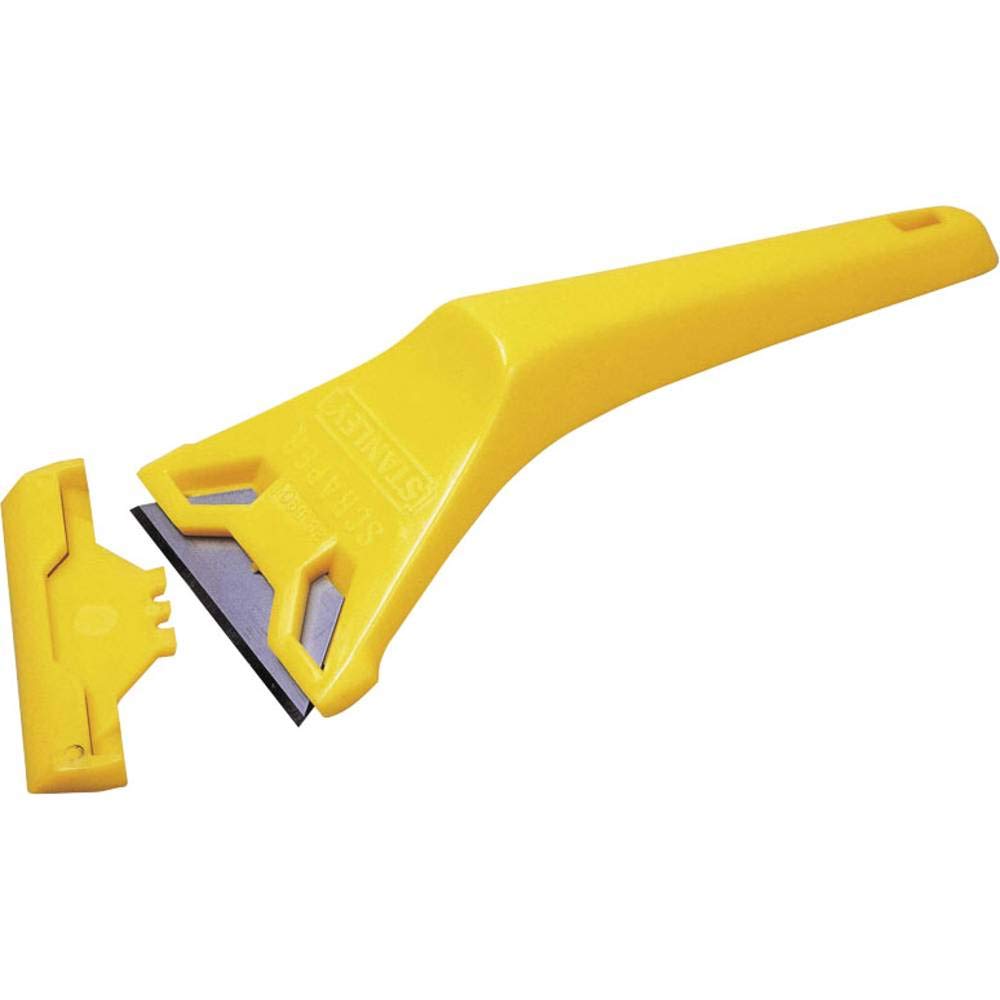
#07

Windows and glass

Stanley Window Scraper

93 /100
Kirk Score Outstanding
Size
65 x 40 x 170 mm
Blade
Heavy-duty steel
Handle
Plastic
Blade Width
6.5 cm
Check Details on Amazon

Pros

  • Compact body is easy to control on glass
  • Blade changes without tools
  • Effective on windows, cooktops and walls

Cons

  • Small blade is slow across a big pane

Not every scraper needs to be a system. This one is a 6.5-centimeter blade in a compact plastic body, 170 millimeters end to end, and the job it is built for is glass: overspray on a window, the adhesive ring a sticker leaves behind, the film on a shower door. On that job it is quick and controllable, and the blade changes without tools.

Everything else is a stretch. The plastic body has no weight to lean on, so it is the wrong tool for a painted door frame, and there is nothing on it to grip with a second hand.

For what it costs, a dedicated glass scraper is easy to justify in a house with windows, a glass cooktop or a car, and its small size is why it is the one that stays within reach instead of migrating to the bottom of a toolbox. We keep ours with the cleaning supplies, which tells you where it earns its place.

Bottom line: The glass specialist: a compact 6.5 cm blade that lifts paint and adhesive off windows and cooktops, and costs little enough to keep one at home.

Check Latest Price

How We Tested Paint Scrapers, and What Separated Them

I started by pulling listings and spec sheets for close to 40 scrapers and narrowing that to 15 to actually use — carbide, razor-blade, stiff steel, and a few multi-tools. Then they went into four months of real work rather than a bench test: stripping paint from window frames with intact glazing, working around the curves of a paneled door, taking adhesive off a concrete floor, and cleaning baked-on grease off an oven door.

Each one got the same jobs. On flat work I noted whether the edge bit in or skated, and how much pressure it took to keep it cutting. On curves I watched for chatter and whether the blade followed the molding or chewed into it. The scrapers with extendable handles or a pole socket went overhead on a porch ceiling, where reach matters more than finesse.

Blade retention got its own check: twenty minutes of continuous scraping, then a look at whether the screw or clamp had loosened and the blade had started to wander. I timed blade changes, checked how much edge had rolled after a full afternoon, and dropped each tool onto concrete from waist height to see what cracked. The plastic guards on razor scrapers got watched too — a missing cap means a bare blade loose in a drawer.

Handles were judged at the end of a long session: blisters, hot spots, whether a two-handed grip was even possible, and whether the multi-tools' can openers and nail pullers actually worked. I also tracked value — how many spare blades came in the box, whether they're a standard size you can buy anywhere, and how much cutting edge you get per dollar across a season.

How to Choose a Paint Scraper

Carbide, Steel or Razor: Match the Edge to the Coating

Carbide is the hardest of the three and keeps a usable edge against paint that cured to a shell; it costs the most and it chips if you pry with it, which is why it earns its keep on a whole-house repaint rather than a single sash window. Hardened steel sits in the middle: a stiff steel blade lifts flaking paint, caulk and wallpaper happily but skates across cured oil paint. A razor is the sharpest and the most disposable — unbeatable on glass and adhesive, hopeless on thick paint, where the thin edge folds or snaps.

The Clamp Fails Before the Blade Does

The blade holder, not the blade, is where these tools give out. A razor that creeps in its holder under pressure will score whatever you are scraping, and a wide scraper with a loose head wobbles instead of cutting. Look for a screw or spring clamp that pulls the blade flat against the body, and a handle that is riveted or moulded through to the head rather than spot-attached.

The trap with cheap razor multipacks is that you get a generous pile of blades and a holder that will not keep them straight. Blades are the cheap part; the clamp is what you are paying for.

Handle, Weight and Reach

One hand or two is a real choice. A long two-hand handle lets you put your weight behind the edge on flat work and keeps your wrists straight; a compact handle gets into a window rebate or a drawer front where a long tool will not fit, and a razor scraper of two or three ounces is the one that ends up living in a glovebox.

If the paint is overhead or behind furniture, reach is worth more than any other feature. A pole socket or an extendable handle solves a different job from a sharp edge, and the Amazon Basics and the MulWark are the two picks here that address it — one with a socket, one with a sliding handle.

Protect the Surface Under the Paint

The same edge that shaves paint will gouge pine, tear drywall paper and dull a coated cooktop. Keep the blade close to flat rather than stood up on its corner, and let the edge shave; the moment you start levering, the tool is doing the wrong job in the wrong direction. A wide, stiff blade on wood does less damage than a narrow sharp one because it spreads the pressure over more grain. On glass and a glass cooktop, a razor held genuinely flat is safe and fast.

Upkeep: Rust, Edges and the Cost of Blades

Plain carbon steel needs drying. Wipe it, dry it, and put it away with a film of oil on the bevel, or the next time you pick it up the edge will be orange. Carbide lasts far longer but chips against nails and staples. Razor blades are consumables — buy them by the pack and change one the moment a job needs pressure to cut.

That running cost is why a cheap razor set and a carbide scraper end up in the same toolbox. They cover different halves of the same job, and neither one replaces the other.

Frequently Asked Questions

Final Verdict

For most people stripping paint, the Bahco 665 is the answer. The carbide edge keeps cutting where steel gives up, and the two-hand handle lets you put your weight into the blade instead of your wrists — that combination is worth the step up in price on any job bigger than a couple of windows.

Buy the Amazon Basics instead if the paint is on a wall or a ceiling: a pole socket and a cranked shank matter more there than a carbide edge. And if the paint is on glass or a sticker is on the windshield, skip both and start with the Stanley or the Lisle.