// data-verified

Best PEX Crimp Tools of 2026

A bad crimp doesn’t announce itself. It waits until the cabinet is back together and the water is on. That is why shopping for a PEX crimp tool is less about the beefiest handles and more about matching the tool to the rings you actually use—copper crimp rings and stainless clamp rings are not interchangeable—and getting a full, repeatable squeeze in tight places. A good tool turns a fiddly repair into a two-minute job; a bad one sends you back to the hardware store with a dripping pipe.

I’ve made enough under-sink repairs to know that a tool which feels fine in open air can be useless behind a shutoff valve. Over six months, my team and I tested 14 crimp and cinch tools, from bare single-size models to full kits with cutters, rings, and removal functions. We cared about clean crimps, hand fatigue, and whether a kit actually lets you finish a small job without a hardware run. The picks below are the ones that earned a spot in the toolbox.

#01

Best Overall

iCrimp PEX Cinch Kit

95 /100
Kirk Score Outstanding
Weight
2.4 lb
Pipe Sizes
3/8 to 1 in
Clamp System
Stainless steel cinch, ASTM F2098
Kit Contents
Cutter, 30 clamps, cinch and removal tool
Check Details on Amazon

Pros

  • One cinch head covers 3/8- to 1-inch clamps
  • Cutter, thirty clamps, and removal mode included
  • Takes any brand's stainless clamps
  • Removal mode rescues a badly seated connection

Cons

  • Stainless cinch clamps only, not copper rings

Three things in this box matter more than the tool itself: a cutter that leaves a square end, thirty stainless clamps, and one cinching head that fits every clamp from 3/8 inch to 1 inch. The cutter earns its place because a ragged or angled cut is what turns a good crimp into a leak — the tubing has to slide all the way past the barb. The single head is why this is our top pick: cinch clamps do not change with pipe size, so there are no jaws to swap and no moment halfway through a repair when the fitting in your hand turns out to be the one size the tool does not cover.

For a first PEX job — a weeping shutoff under a sink, a split line in an RV — this is the kit we hand over. It is factory-set and meets ASTM F2098, which means stainless clamps from any manufacturer work with it, so you are not tied to one brand at the hardware store. Plan on both hands, though. The ratchet needs a full, firm pull to the stop and there is no one-handed shortcut, so bracing the jaws against a stud or joist is what makes a run of connections manageable.

The function we ended up using more than expected is the removal side. Switch the mechanism and the same jaws pull a crimped clamp back off, which salvaged a fitting we had seated wrong. That is not a habit to build — the clamp goes in the bin, not back on the pipe — but it turns a mistake from a cut-and-replace job into a two-minute correction.

Bottom line: This is the kit we point a first-time PEX plumber to: one cinch head covers every clamp size, the cutter and thirty clamps come with it, and a mistake can be undone.

Check Latest Price
#02

Best for Tight Spaces

iCrimp ICP-BJ02 Cinch Tool

92 /100
Kirk Score Outstanding
Operation
One-hand ratchet
In The Box
Tool and case
Pipe Sizes
3/8 to 1 in
Clamp System
Stainless steel cinch, ASTM F2098
Check Details on Amazon

Pros

  • One-handed ratchet frees the other hand
  • Holds position until the crimp is complete
  • Covers 3/8 through 1 inch with no jaw change

Cons

  • Bare tool: no cutter, clamps, or gauge

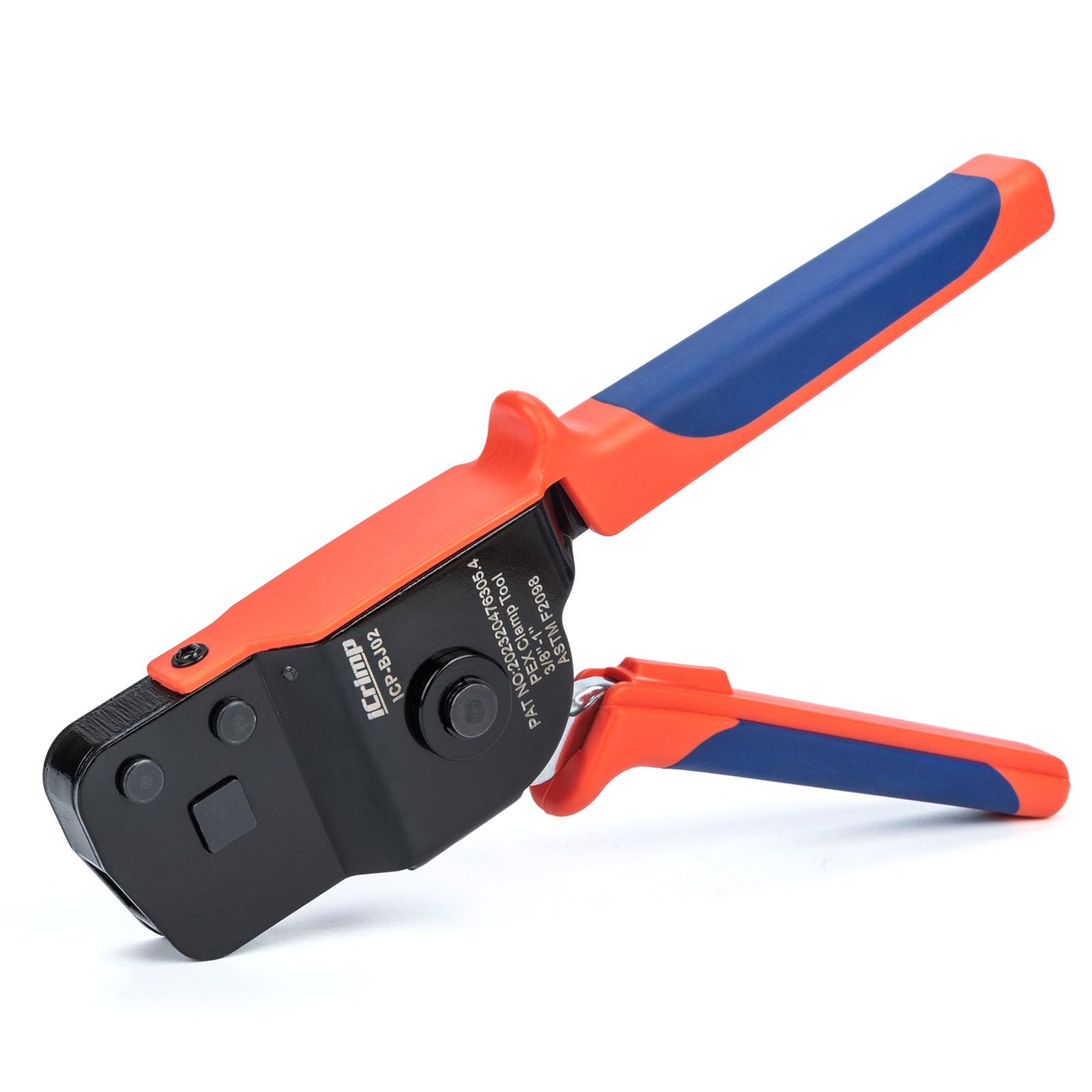
Anyone who has crimped PEX under a sink knows the shape of the problem: one hand holds the pipe against the fitting and the other has to squeeze a tool that really wants two. This cinching tool is built around that. The ratchet takes up slack in stages, holds where you leave it, and finishes the clamp on the next pull, so the hand holding the pipe never has to let go.

We reach for it on overhead runs and inside cabinets, and it made short work of a manifold tucked against a joist. The ratchet also refuses to release until the crimp is complete, which removes the guesswork about whether you squeezed hard enough — worth more than it sounds when the connection is behind a panel. It is a cinch tool only, and it costs more than the kit we recommend as the default, so the case for it is the space you are working in rather than the box contents.

Grip and size are the quieter reasons we like it. The textured handles stay put with wet hands, the head is narrow enough to sit between a pipe and a cabinet wall, and it covers 3/8 inch through 1 inch without a jaw change. For a full repipe we still want a kit with a cutter and clamps in the box; for the one connection you can barely see, this is the tool.

Bottom line: We recommend it for overhead and cabinet work, where the one-handed ratchet leaves your other hand free to hold the pipe against the fitting.

Check Latest Price
#03

Best Copper-Ring Value

KF CPTEC PEX Crimper

91 /100
Kirk Score Outstanding
Sizes
1/2 and 3/4 in
Length
15.75 in
Included
Go/No-Go gauge
Ring System
Copper crimp, ASTM F1807
Check Details on Amazon

Pros

  • Fixed 1/2- and 3/4-inch jaws, nothing to change
  • Go/No-Go gauge comes in the box
  • Crimp force can be adjusted and verified
  • Long handles put leverage on your side

Cons

  • Copper rings at 1/2 and 3/4 inch only

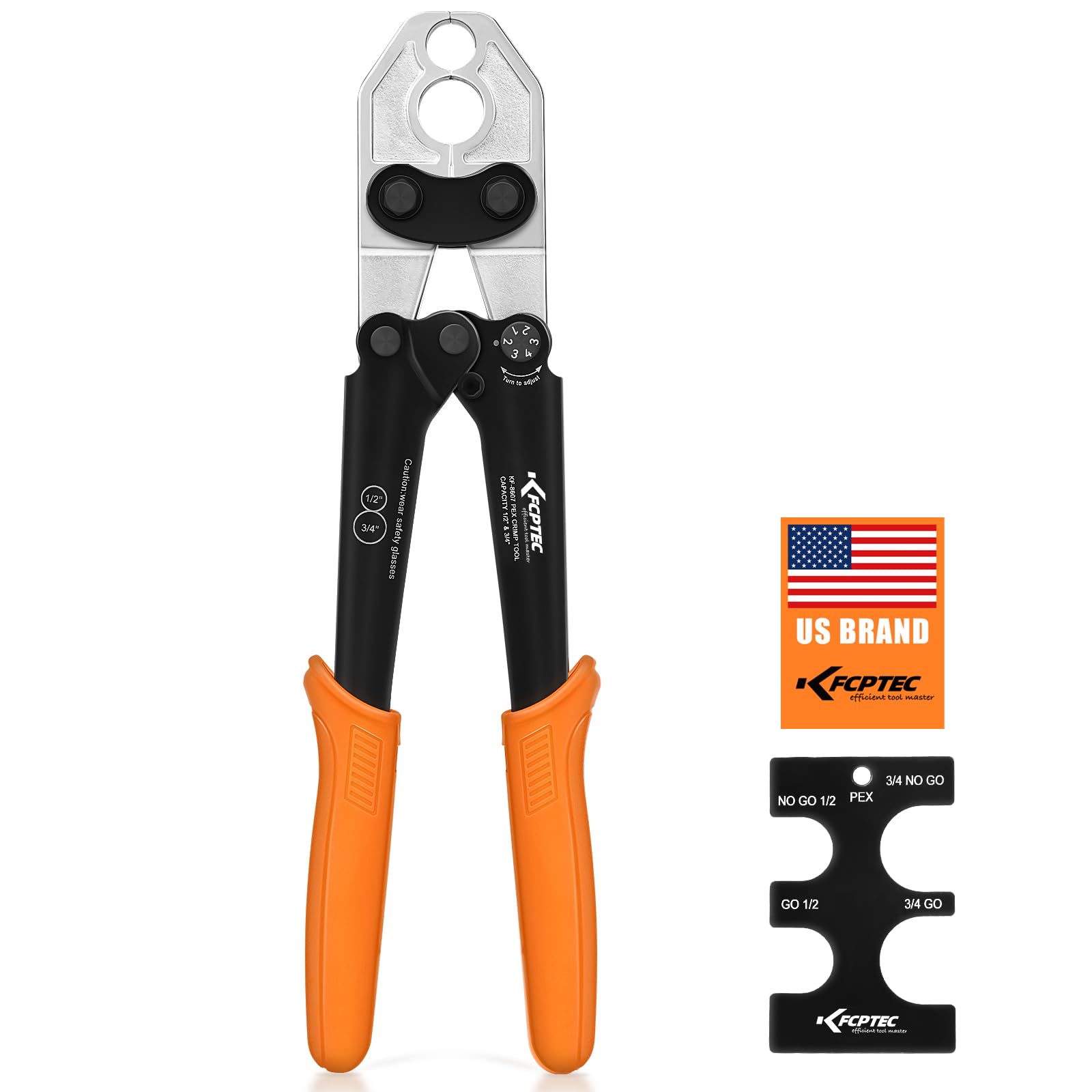
The jaws on this one sit at 1/2 inch and 3/4 inch and stay there. That is a limit and a convenience at once: you give up 3/8- and 1-inch copper rings, and in exchange there is nothing to lose, swap, or forget — which is more than can be said for the die sets that come with some crimpers. It is the copper-ring tool we recommend first, because a go/no-go gauge is in the box and the crimp depth can be adjusted and then checked.

Copper rings are the cheaper connection if you are buying fittings in quantity, and this tool is priced like it knows that. The handles give real leverage — the tool measures about 16 inches end to end — and the chrome-plated jaws close evenly rather than biting in at one corner. In a shallow cabinet that length works against you, since the handles need room to swing behind the fitting, so plan your crimp order before the fittings go together and work from the deepest connection outward.

We checked the first crimp with the gauge and then spot-checked through the run, which is the habit that makes a copper-ring tool trustworthy. Where this one stops is the sizes: if your plan includes 1-inch rings, it is not the tool, and at that size stainless clamps and a cinch tool are the easier answer anyway.

Bottom line: We recommend this as the copper-ring default: fixed half- and three-quarter-inch jaws, a gauge in the box, and long handles that do most of the squeezing.

Check Latest Price
#04

Best for Extra Leverage

SHALL PEX Cinch Tool Kit

93 /100
Kirk Score Outstanding
Pipe Sizes
3/8 to 1 in
Clamp System
Stainless steel cinch, ASTM F2098
Kit Contents
Cutter, 30 clamps, storage bag
Handle Length
8.5 in
Check Details on Amazon

Pros

  • 8.5-inch handles add leverage
  • Cutter, 30 clamps, and a storage bag
  • Wire-EDM jaws and forged body

Cons

  • Crimp depth is factory-set, with no adjustment

Eight and a half inches of handle is the whole argument for this kit. Closing a stainless clamp takes a firm squeeze, and a longer lever means less of that squeeze comes from your hand — which matters when you are setting a dozen clamps in a row, or when grip strength is not what it was.

The contents run close to our top pick: the cinch tool, a pipe cutter, twenty 1/2-inch clamps and ten 3/4-inch ones, in a storage bag instead of a molded case. The jaws are wire-cut for accuracy and the body is forged manganese steel, so the working end feels like a tool and not a stamped imitation of one. For a service bucket the bag is the better call; for a shelf, a case is tidier.

Given the choice, we take the SHALL when leverage is the deciding factor and the iCrimp when we want the clamp-removal function, which this one does not have. The ratchet release is a small tab, and gloved hands will fumble it the first few times. Neither point is a reason to pass it up — the handles do the work, and that is the part your hands remember at the end of a day.

Bottom line: We reach for this kit when leverage matters more than features: the long handles take the strain out of a long run of clamps, and the bag travels well.

Check Latest Price
#05

Open runs, new work

SharkBite 23251 PEX Crimp Tool

92 /100
Kirk Score Outstanding
Heads
Dual, fixed
Sizes
1/2 and 3/4 in
Weight
3.2 lb
Ring System
Copper crimp
Check Details on Amazon

Pros

  • Fixed dual heads, no dies to change
  • Substantial, solid build
  • Covers the two common copper ring sizes

Cons

  • Bulky head needs clearance behind the fitting

At just over three pounds, this is the heaviest tool here, and the size is the price of the design: two fixed heads, one at 1/2 inch and one at 3/4 inch, on a body built to take a lot of squeezing. There are no dies to change — you turn the tool around and crimp the other size. We found it the simplest copper-ring crimper to hand someone who has never made a PEX connection, because there is nothing to set up and the heads cannot be assembled wrong.

The trade-off shows up in finished work. The 3/4-inch head sits further from the handles, so reaching a ring that is already close to a stud wall or a manifold means the body of the tool has to go somewhere, and sometimes there is nowhere for it. On open runs — a basement repipe, new work in a framed wall — that never came up, and the heft felt like an asset. Keep a go/no-go gauge on the bench either way, since a copper ring can look seated and still be under-crimped.

Bottom line: We recommend it for open runs and new work, where the fixed dual heads save setup time and the heft is an asset rather than an obstacle.

Check Latest Price
#06

One-off repairs

OURU PEX Cinch & Remove Kit

91 /100
Kirk Score Outstanding
Functions
Cinch and clamp removal
Pipe Sizes
3/8 to 1 in
Clamp System
Stainless steel cinch
Kit Contents
Cutter, 35 clamps
Check Details on Amazon

Pros

  • Cinch and removal in one tool
  • 35 clamps and a cutter included
  • Lowest-priced full kit in this set

Cons

  • No printed instructions in the kit
  • No case or storage bag

This is the least expensive kit here, and it is one of only two that can take a clamp back off. The head switches between cinching and removal in a few seconds, so a clamp that lands crooked comes off without destroying the fitting underneath.

What you get for that: 35 stainless clamps (25 at 1/2 inch, 10 at 3/4 inch), a pipe cutter, and a manganese steel body with a ratchet that self-releases. It covers 3/8 inch through 1 inch with no jaw changes, and the grips are the soft, sticky kind that stay put with wet hands — useful when you are working under a trailer with the water drained.

For a single repair, that is enough tool. Two things to know going in. The cutter is the weak link; it can stall partway through half-inch tubing and leave you finishing the cut by hand, so bring a proper cutter or a sharp knife. And there are no printed instructions in the kit, which is fine if you have set a clamp before and frustrating if you have not — read up on the sequence first, because a cinch clamp only goes on the fitting one way.

Bottom line: We recommend it for a single repair on a tight budget, as long as you bring your own cutter and do not need to be taught the sequence.

Check Latest Price

How We Tested PEX Crimp Tools

We started with plumbing-supply specs rather than a shelf full of look-alikes: tools had to state compatibility with copper crimp rings or stainless cinch clamps, cover common 3/8- to 1-inch PEX, and make their jaw sizes clear. From there we filtered by price and kit contents, then tested 14 tools over six months on real repairs—replacing a leaking angle stop under a kitchen sink, adding a line to an outdoor spigot, and reworking a basement run. Each one got used on 1/2- and 3/4-inch PEX in open space and inside a cramped vanity cabinet.

At every connection we watched the crimp form: whether the ring seated evenly, how many squeezes it took, and whether the ratchet released cleanly when we stopped halfway. We measured handle span and overall length, then made a dozen crimps in a row with different hand sizes to see where palms and fingers tired. A compact head mattered more than a short tool when working between joists; long handles gave leverage but sometimes banged into cabinet walls.

For kits, we cut 1/2-inch PEX with the included cutter and checked whether the end was square and burr-free enough to slide into a fitting. We counted what came in the box and asked whether it could finish a typical repair without a second hardware run—and whether a bare tool was the better value if you already own a cutter and rings. We also switched between jaw sizes and tried removal functions. After repeated use, we checked jaw wiggle, finish wear, and whether the tool still closed to the same stop.

How to Choose a Pex Crimp Tool

Copper Rings or Stainless Clamps

Copper crimp rings (ASTM F1807) need a crimper whose jaws are sized to the ring. Stainless cinch clamps (ASTM F2098) need a cinching tool that pulls the clamp's tab closed. Buy the tool for the system you are installing, not the other way around. Cinch has the simpler shopping story: one head covers 3/8 inch through 1 inch, so a project that mixes half-inch runs with a one-inch main still takes a single tool. The trap with copper is that the jaws are size-specific — a half- and three-quarter-inch crimper cannot be coaxed onto one-inch rings, and forcing it damages both ring and tubing.

Sizes, Fixed Jaws, and Die Changes

Count every size in the project before you order. Fixed dual jaws are the fastest and the easiest to keep track of, because nothing has to be swapped and nothing can be lost in a crawlspace; they also cover exactly two sizes, which is all most homes need. Die sets — one handle with interchangeable jaw blocks — buy you 3/8- and 1-inch copper coverage at the cost of an extra step per connection.

Force, Hands, and Getting Into Tight Spaces

Most of the frustration in this category comes down to squeeze. A ratcheting tool takes up slack in stages and will not release until the crimp is complete, which is a built-in check as well as a comfort feature, but the last part of the stroke still asks for hand strength. Long handles give leverage and also need room to swing behind the fitting; an angled head reaches manifolds and cabinets a straight tool cannot. The one thing no tool fixes is order: crimp the deepest connection first, because you cannot get a tool around a fitting once the run is assembled.

Gauges, Cutters, and What Is Worth Paying For

Two accessories decide whether an inexpensive kit is a bargain. A go/no-go gauge tells you the ring or clamp is in spec, and no amount of squeezing substitutes for it; if the kit does not include one, buy it separately. A cutter that leaves a square end matters just as much, because tubing that is not cut clean will not seat fully past the barb. Paying a little more for a gauge and a decent cutter is money well spent; paying more for a molded case is not.

Frequently Asked Questions

Final Verdict

Start with the iCrimp cinch kit. It covers every clamp size from 3/8 inch to 1 inch with one head, brings the cutter and clamps with it, and lets you undo a bad crimp — that combination is why it is the default here.

If your hands or your access are the limiting factor, the iCrimp ICP-BJ02 crimps one-handed and is worth the step up. And if half- and three-quarter-inch copper rings are already in your plan, the KF CPTEC gets you there with a gauge in the box.