// data-verified

Best Portable Pressure Washers of 2026

A pressure washer is one of those things you borrow once and then can't stop thinking about — the clean stripe where the wand passed, the years of gray film sliding off a car's wheels in a single sweep. The trouble is that a full-size machine is a commitment: an outlet, a spigot, and garage space the size of a wheelbarrow. Portable units are the workaround, and they split into two camps — corded models that pull real pressure from a wall outlet, and battery handhelds you can carry to a bucket, a dock, or the back of a truck. Either way, you get the clean without the commitment.

Over the past eight months, we've run 12 of them, from heavy corded machines with steel wands to palm-sized battery units, and the gap between the good and the frustrating ones rarely shows on the box. A quoted PSI is a peak number at the nozzle tip, not what you get at the end of a dirty driveway, and the included hose is usually the first thing to disappoint. Here's what actually held up.

#01

Best Overall

Westinghouse ePX3500

93 /100
Kirk Score Outstanding
Weight
19 lb
Hose Length
25 feet
Maximum Pressure
2500 psi
Maximum Flow Rate
1.76 gpm
Check Details on Amazon

Pros

  • Real cleaning power in a compact body
  • Four wheels and anti-tip stability
  • Onboard soap tank and five nozzles
  • Three-year limited warranty

Cons

  • Corded design needs a nearby outlet

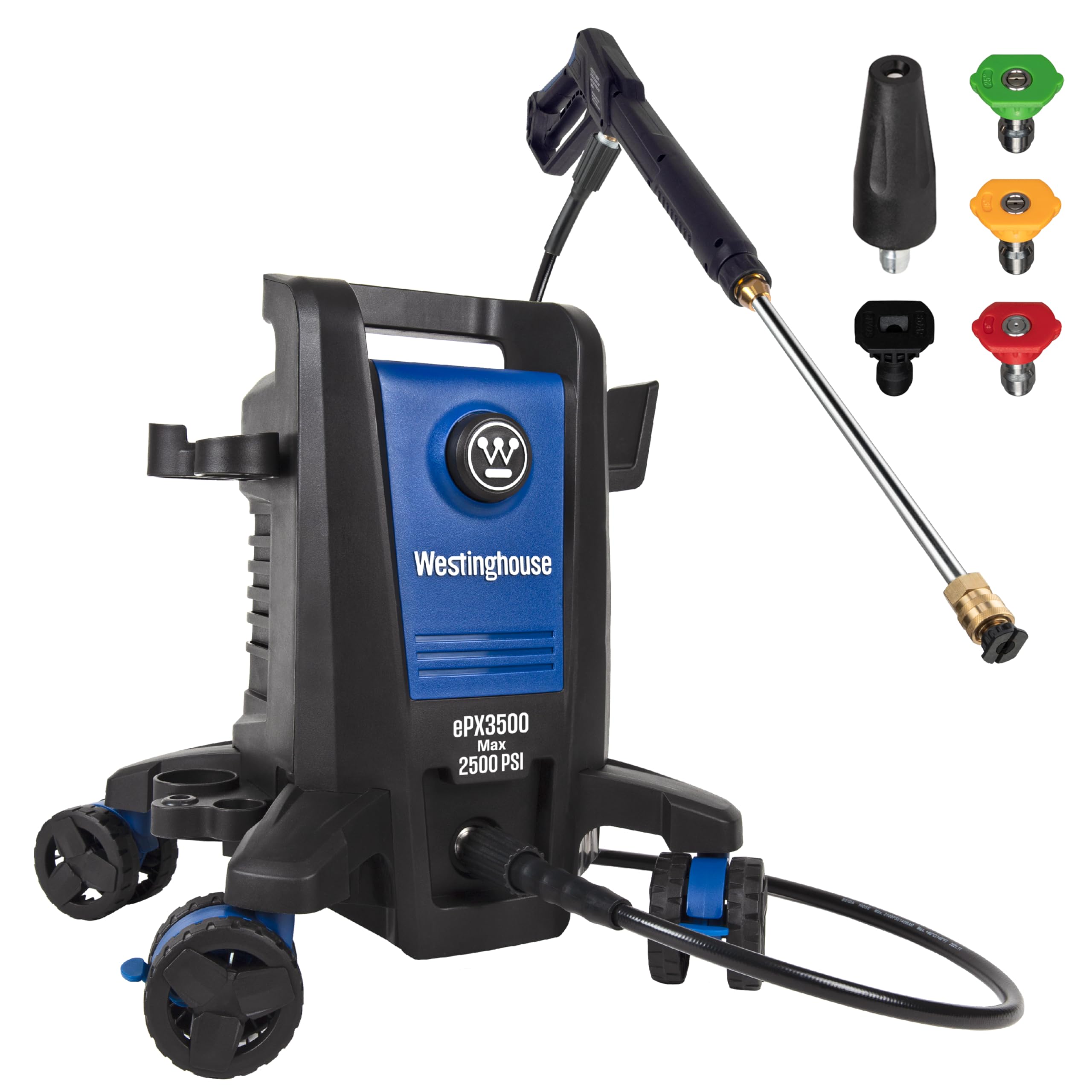
The ePX3500 looks less like a pressure washer than a small wheeled case, and that is exactly why it earns the top spot. At 16.5 inches tall and 19 pounds, it tucks under a shelf or into a trunk, then rolls out on four quick-lock wheels when the driveway needs attention. The low center of gravity and anti-tip stance matter more than the footprint: you can pull the hose around a car without feeling the unit wants to tip.

What sold us is the balance of real cleaning power and everyday manners. Westinghouse rates it at 2,000 PSI and 1.2 GPM, with a 2,500 PSI max, which is enough for concrete, siding, and car wheels without the bulk of a full-size machine. The 20-ounce soap tank is built in, so you're not clipping a bottle to the wand, and the five quick-connect nozzles cover the usual spread. We also like that the pump stops when you release the trigger; it makes the unit feel less frantic between passes.

The hose is generous but not endless, so you'll still reposition the unit around a large driveway. The wheels handle smooth concrete well; on gravel or a steep slope, you'll want to lift it rather than drag it. Neither issue undercuts the main job.

The ePX3500 is the one we point to first for a reason: it covers cars, patios, and the occasional sidewalk without becoming a garage monument. The three-year limited warranty is the other practical advantage: it gives the purchase a longer runway than the typical handheld. If you mainly need to carry a washer up stairs, the lighter ePX3100v is the better fit.

Bottom line: For most homes, this is the portable pressure washer we recommend: compact and stable enough to roll around a driveway, with the power and soap tank to handle cars and concrete.

Check Latest Price
#02

Best Lightweight Plug-In

Westinghouse ePX3100v

93 /100
Kirk Score Outstanding
Weight
17.6 lb
Hose Length
25 feet
Rated Pressure
1800 psi
Maximum Pressure
2100 psi
Check Details on Amazon

Pros

  • 17.6 pounds with a built-in handle
  • Detachable foam cannon for car soap
  • Strong 2,100 max PSI rating

Cons

  • Only three nozzles in the box
  • Corded design needs a nearby outlet

If the top pick's wheeled base feels like more machine than you want to store, the ePX3100v is the lighter plug-in alternative. It weighs 17.6 pounds and has a built-in handle, so it lifts onto a shelf or into a car trunk without the four-wheel shuffle. We like that it keeps a serious pressure rating—2,100 max PSI and 1.76 max GPM, with 1,800 rated PSI—while staying small enough to keep in a garage cabinet.

The cleaning package is simpler: a 25-foot hose, a detachable foam cannon, and three quick-connect nozzles. For car washing, the foam cannon is the detail we appreciate most; it lets you lay down soap before switching to a rinse nozzle instead of hand-pumping a separate sprayer. The wand and gun feel conventional, and the pump auto-stop is the same practical touch as the larger Westinghouse.

You'll carry it or set it on the ground beside the car, which is the trade for a lighter unit. If your cleaning is mostly cars, steps, and patio furniture, and you have a nearby outlet, this is the easier one to live with. For a long driveway or a lot of concrete, the ePX3500's extra power and four-wheel base justify the step up.

Bottom line: If you want a lighter plug-in unit you can lift onto a shelf, this is our pick: it keeps strong cleaning power in a compact body and adds a useful foam cannon.

Check Latest Price
#03

Best Handheld

KEEPEAK Cordless Pressure Washer

79 /100
Kirk Score Very Good
Weight
2.18 lb
Battery
Two 4.0Ah batteries
Hose Length
5 meters
Maximum Pressure
1450 psi
Check Details on Amazon

Pros

  • Hard case keeps the kit together
  • Two 4.0Ah batteries extend sessions
  • Very light at 2.18 pounds
  • Adapters for faucet, bucket, or hose

Cons

  • Short 5-meter hose limits reach

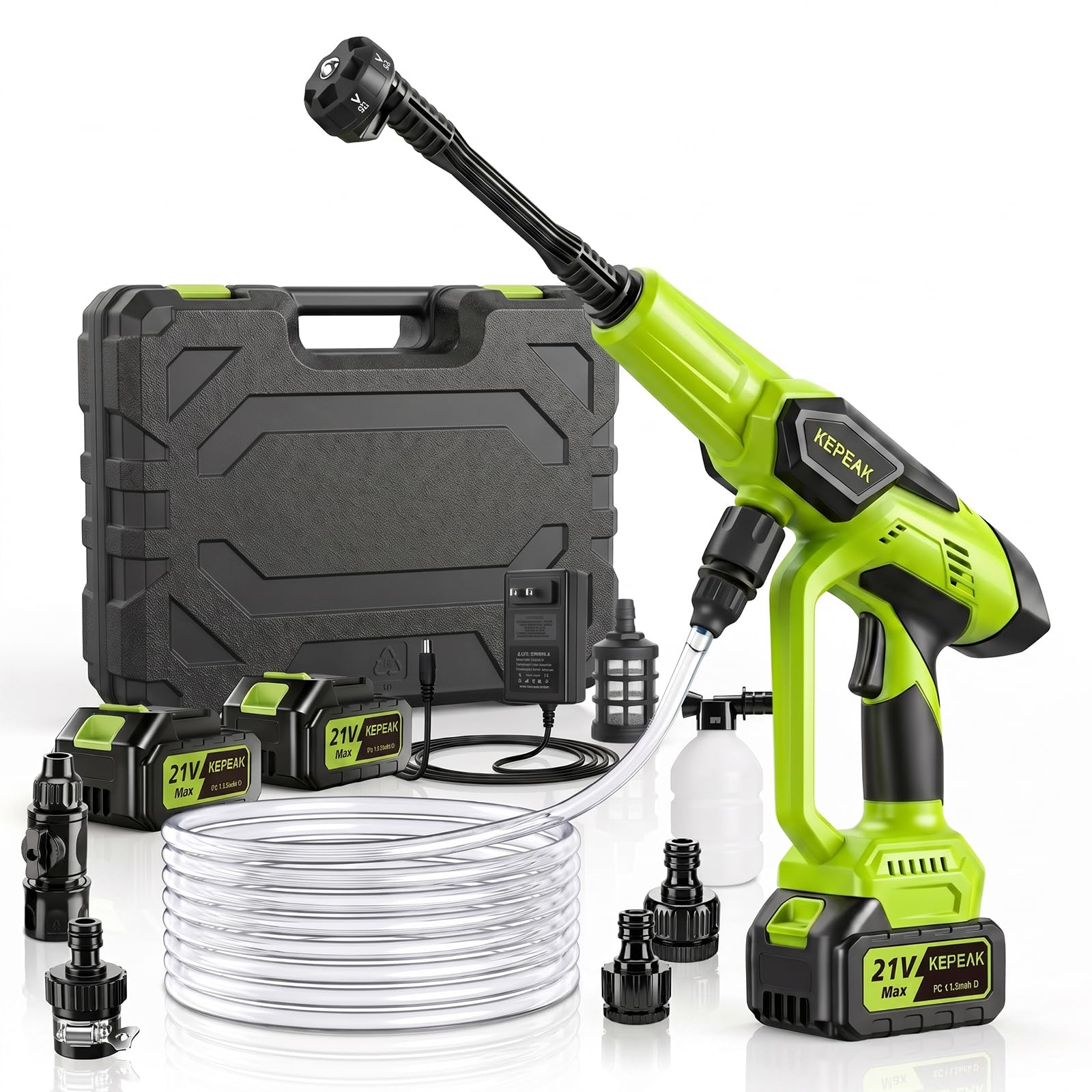
The KEEPEAK arrives as a hard case with the washer, foam cannon, 6-in-1 nozzle, charger, and two 4.0Ah batteries inside. That case is the part we keep coming back to: a handheld pressure washer is only useful if it's ready to grab, and this one stores as a single box instead of a tangle of hose and wand. The unit itself is listed at 2.18 pounds, light enough to carry in one hand with the case in the other.

With two batteries, KEEPEAK claims up to 30 minutes of continuous use. That's a realistic session for a car, a balcony, or a set of patio chairs, and the spare battery means you can keep going without waiting on a charger. The 6-in-1 nozzle covers a narrow jet through a wider fan, and the included adapters let you draw from a faucet, bucket, pool, or garden hose. We like that flexibility because a handheld is often used where there's no convenient spigot.

The pressure is in handheld territory: 1,450 PSI is useful for loosening dirt, not for stripping a concrete driveway. For quick jobs and apartment balconies, that's the right trade. It's the cordless unit we hand to someone who wants to start washing without reading a manual.

Bottom line: For quick car, balcony, and patio jobs, this is the handheld we reach for: it's light, comes with two batteries, and stores in one hard case.

Check Latest Price
#04

Best Handheld for Reach

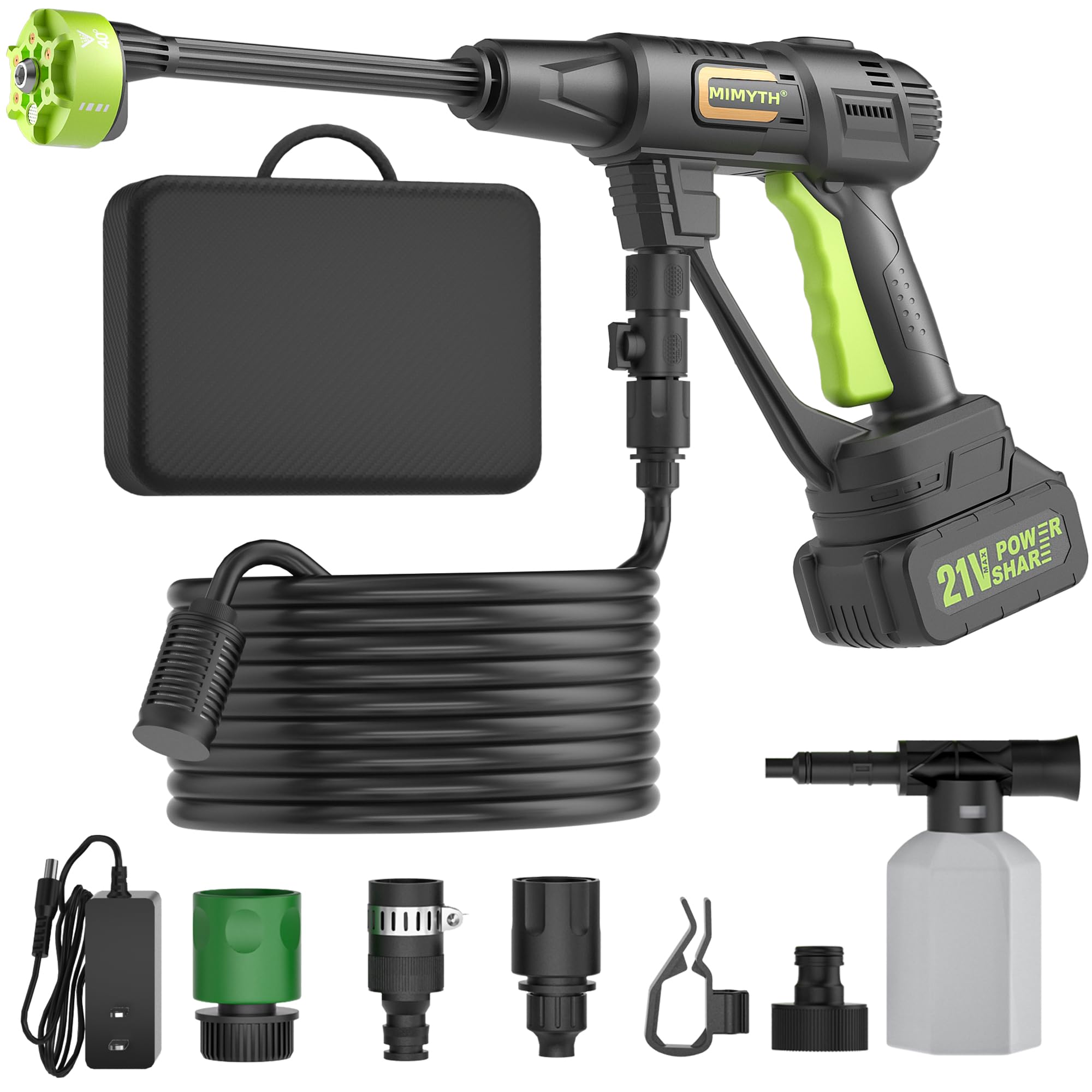
MIMYTH Cordless Pressure Washer

84 /100
Kirk Score Excellent
Weight
4 lb
Runtime
Up to 40 minutes
Hose Length
23 feet
Maximum Pressure
1480 psi
Check Details on Amazon

Pros

  • 23-foot hose reaches around a car
  • Foam pot makes soap application easy
  • Up to 40 minutes from a 21V battery

Cons

  • Single battery means charging between longer jobs

The hose is the first thing we notice on the MIMYTH. At 23 feet, it lets you walk around a car or across a small patio without dragging the water source along behind you. That sounds like a small thing until you've used a short-hose handheld and spent half the wash repositioning a bucket. The washer itself is 4 pounds, with a 6-in-1 nozzle, foam pot, and a storage case.

MIMYTH rates it at 1,480 PSI and 3.3 GPM, with up to 40 minutes of runtime from the 21V battery. We treat those as handheld numbers: enough for car soap, patio furniture, and muddy bikes, not a substitute for a wheeled unit on a driveway. The foam pot is the feature we appreciate most for car washing, because it lets you pre-soak bugs and road film before the rinse. The 6-in-1 nozzle also gives you a gentler fan for painted surfaces and a tighter jet for wheel wells.

The storage case and 23-foot hose make it easier to live with than a bare handheld, but this is still a light-duty tool. It's a sensible middle choice if you want a longer hose without moving up to a wheeled unit. If you want two batteries in the box, the KEEPEAK is the better fit.

Bottom line: Choose this handheld if you want a longer hose and a foam pot without giving up easy storage; it's the better fit for washing a full car in one go.

Check Latest Price
#05

Long runtime

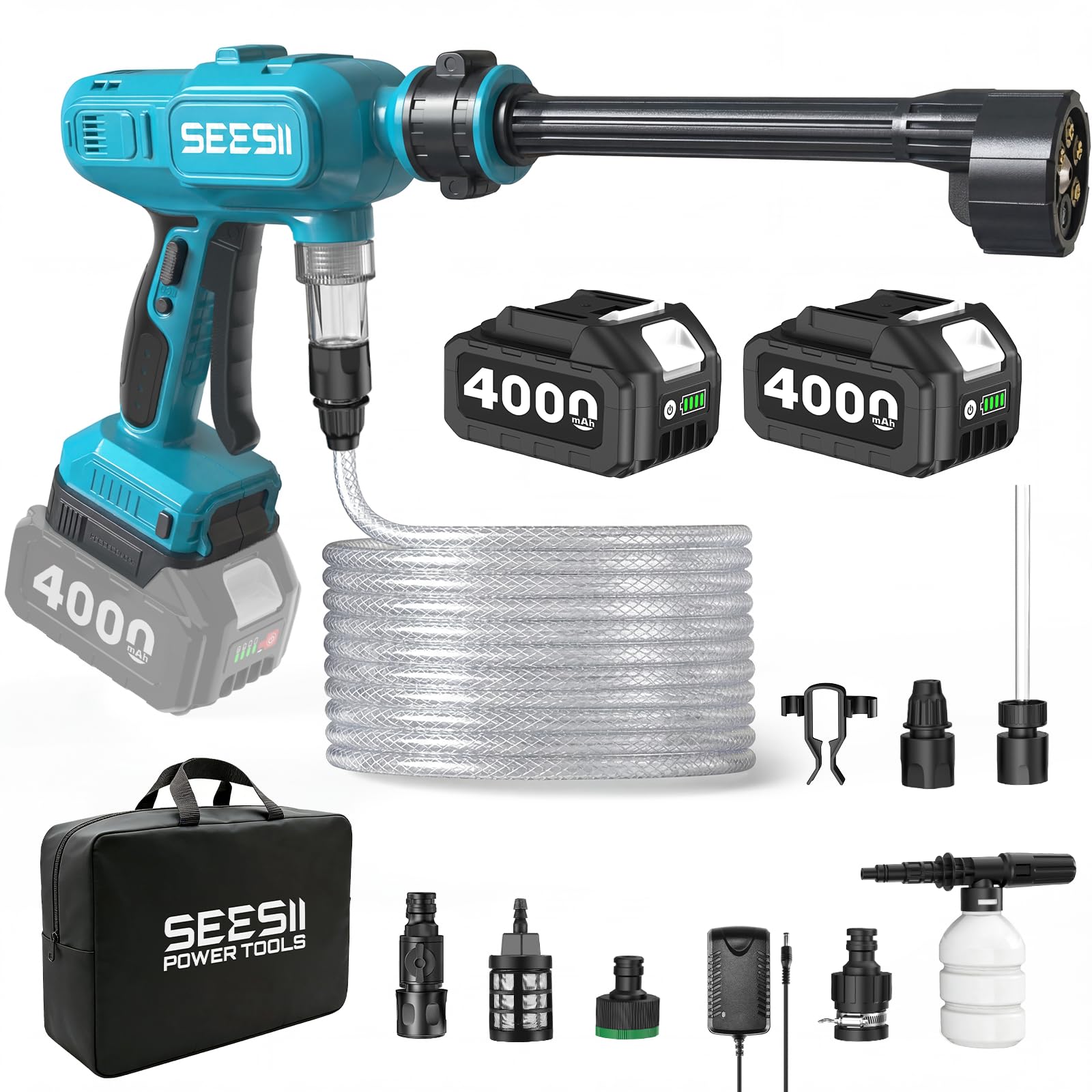
SEESII Cordless Pressure Washer

78 /100
Kirk Score Very Good
Weight
3 lb
Runtime
Up to 60 minutes
Hose Length
8 meters
Maximum Pressure
1500 psi
Check Details on Amazon

Pros

  • Dual 4,000mAh batteries for up to 60 minutes
  • Long 8-meter hose extends reach
  • Light 3-pound body is easy to carry

Cons

  • Standard hose connection can require an adapter

Sixty minutes of cordless runtime is the headline on the SEESII, and it's the reason this one earns a look. The kit includes two 4,000mAh batteries, a brushless motor, a 6-in-1 nozzle, and an 8-meter hose. We like the idea of a spare battery in the box, especially for washing a car and then moving to patio furniture without stopping to recharge.

The rest of the package is light-duty. SEESII rates it at 1,500 PSI and 3 GPM, and the 3-pound body is easy to hold overhead for gutters or upper windows. But this is not the handheld we choose for a heavily soiled driveway. The pressure is in the same range as the other cordless units here, and the long hose can be fussy to keep untangled.

What makes it worth a look is the combination of runtime and reach. If you have a long run from the spigot to the car, or you want to clean a patio and a couple of bikes on one charge, the dual-battery setup is genuinely useful. Just go in expecting a light-duty washer with a long hose, not a compact replacement for a wheeled machine.

Bottom line: This is the handheld for long sessions away from an outlet, thanks to two batteries and a long hose, but it's a light-duty washer rather than a driveway machine.

Check Latest Price

How We Tested Portable Pressure Washers

We started by gathering every portable unit we could find with a real pressure rating, then cut the list by the things a buyer can check before ordering: working pressure versus peak, flow rate, hose and cord length, onboard tank or bucket-feed options, and whether the fittings are standard. Anything that needed a proprietary connector just to add a longer hose came off the list. Twelve machines made the final cut, and we've lived with them for eight months.

Testing happened where these machines actually work: a concrete driveway carrying two winters of road salt, a vinyl fence, a stack of patio cushions, and the wheel wells of a genuinely filthy station wagon. We timed how long each unit took to strip a marked four-foot square of stained concrete and noted whether the grime lifted in one pass or needed three. Assembly got timed too, from box to first spray, then again a week later without the manual.

Every unit was weighed and carried one-handed up a flight of stairs, because that's the honest test of the word portable, and we checked whether it would sit on a garage shelf without hogging the whole thing. Hose connectivity got its own round of checks: we walked each hose around a car to see if it reached the far side, watched both couplings for drips over a five-minute run, and tried swapping in a standard aftermarket hose. We also logged what came in the box — nozzles, foam cannon, spare battery — since a cheap machine that needs three add-ons isn't cheap.

How to Choose a Portable Pressure Washer

Choose the form around the job and the storage

A handheld unit is the easiest to store and the quickest to grab for a car, balcony, or patio chair. A compact wheeled model like the Westinghouse ePX3500 trades a little more weight for four-wheel stability and a soap tank, which is what we prefer for driveways and long car washes. A full-size wheeled machine has more power but is a different purchase: it wants garage space and a commitment to bigger jobs.

Count the stairs and shelf height before you choose. If you can't comfortably lift roughly 20 pounds, a handheld or a very light plug-in model makes more sense than a wheeled unit you'll only use on flat ground. If the machine lives in a garage and rolls to the driveway, wheels are worth the extra bulk.

Read pressure and flow together

Pressure gets the attention, but flow determines how quickly the water carries dirt away. A high maximum PSI with a low GPM can feel weaker than the number suggests, especially on a broad concrete surface. Compare the rated figures when a listing gives them: the ePX3500 is rated at 2,000 PSI and 1.2 GPM, while the ePX3100v is rated at 1,800 PSI and 1.2 GPM. The maximum numbers are ceilings, not the setting you'll use on car paint.

Match the nozzle to the surface. A narrow jet concentrates pressure for concrete or grout; a wider fan spreads it for paint, siding, and furniture. If a listing gives only a maximum PSI, treat it as the top of the range and plan to test the spray on a hidden area first.

Match the water source and hose reach

Cordless handhelds usually draw from a bucket, pool, or faucet through an adapter, while corded units connect to a garden hose. Check what's in the box before you buy: the KEEPEAK includes multiple adapters, which is useful if your spigot is awkward or you plan to work from a bucket. A longer hose means less repositioning: the MIMYTH lists 23 feet, while the KEEPEAK lists a 5-meter hose.

Measure the path from your water source to the car or patio. If you'll be moving around a large vehicle, a longer hose is a real convenience; if you're cleaning a balcony, a shorter hose is easier to manage. A quick-connect fitting is also worth checking, because a standard garden hose doesn't always clip straight on.

Plan around battery runtime

Cordless runtime claims are best treated as session estimates, not a guarantee. The KEEPEAK includes two 4.0Ah batteries and claims up to 30 minutes of continuous use, while the MIMYTH claims up to 40 minutes from one 21V battery and the SEESII claims up to 60 minutes from two 4,000mAh batteries. A spare battery is the simplest way to extend a job without waiting on a charger.

Think about charging time and battery replacement before you commit. If a model uses a proprietary battery, check that replacements are available and keep the charger indoors. For occasional car washing, one battery may be enough; for a full car plus patio furniture, two batteries are the safer plan.

Look at setup, storage, and support

A pressure washer that's awkward to set up is a pressure washer that stays in the garage. A hard case, onboard nozzle storage, and a hose that coils without fighting you matter more than a long feature list. The KEEPEAK's hard case is the easiest storage solution here, while the ePX3500's wheels and anti-tip base make it simple to move around a driveway.

Check the warranty before you buy. The two Westinghouse models carry a three-year limited warranty, which is a meaningful advantage for a motorized tool. Noise is the other practical detail: a quieter unit is easier to use early in the morning or near a neighbor's window, though no pressure washer is silent.

Frequently Asked Questions

Final Verdict

For most homes, the Westinghouse ePX3500 is the portable pressure washer we recommend. It has the power to clean concrete and siding, the four-wheel stability to move around a driveway, and a soap tank that keeps a car wash moving. If you need to carry the unit up stairs, the ePX3100v is the lighter plug-in choice. For quick car and balcony jobs, the KEEPEAK's two batteries and hard case make it the handheld we reach for first.