// data-verified

Best Putty Knives of 2026

The wrong putty knife doesn't announce itself. It digs a shallow gouge in the drywall, or leaves a rust-colored streak in fresh spackle, and you only find out once the paint dries. I've patched holes with whatever was in the drawer — a credit card, a scraper too stiff for the job, a blade that flexed when I wanted it to pry — and the difference between a repair you can't see and one you can is mostly the steel in your hand.

Over the past three months, my team and I worked through 16 putty knives, from plastic sets to stainless flex blades, filling nail holes, lifting wallpaper, and scraping paint off trim. The surprise was how little the brand on the handle mattered next to the width range in a set: a 1-inch blade gets into corners, and a 6- or 8-inch flex blade is what makes a taped seam lie flat.

Flex is the spec most shoppers miss. A flexible blade bends with the wall to feather compound thin; a stiff one is for scraping and prying, and using it to smooth mud leaves ridges. Sharp corners save cleanup time and will also tear paper-faced drywall if you lean on them, which is why the picks below split the two jobs instead of pretending one knife does both — plus small extras, like a hammer end for resetting a popped nail, that make one worth reaching for.

#01

Best Overall

Rerdeim 5-Piece Putty Knife Set

93 /100
Kirk Score Outstanding
Handle
Rubber and plastic
Blade Widths
1, 2, 3, 4, 5 inches
Blade Material
Stainless steel
Check Details on Amazon

Pros

  • Five widths cover pinholes through small patches
  • Stainless blades wipe clean and resist rust
  • Rubber-over-plastic handle stays grippy when wet

Cons

  • Blades feel light for heavy scraping

Five knives, one inch apart, from 1 inch to 5. That spacing is the reason this set beat every single knife we handled: each step up covers a job the size below it can't. The 1-inch pushes compound into nail holes and hairline cracks, the 2-inch handles a doorknob ding, the 3-inch takes the filled patch itself, and the 4- and 5-inch feather the edges out far enough that the repair disappears under a coat of paint.

Stainless is the other half of the appeal. Compound wipes off with a paper towel before it sets, and these blades come out of a damp bucket without a spot on them, which we noticed most on the evenings we didn't get around to cleaning up. The handles are rubber over plastic and stay grippy with wet hands, and that matters more than it sounds when you're holding a knife in one hand and a mud pan in the other.

One thing to fix before you start: the side edges arrive sharp enough to catch a thumb when you run a rag down them, and on soft or freshly painted drywall they can dig a line where you're trying to smooth. Two minutes with 220-grit along the two sides, leaving the working edge alone, takes that off, and after that the knives behave.

Five sizes, stainless blades, and a handle that stays comfortable through a long skim, which is why this is the set we name first when someone asks what to buy. The one job it can't do is tape a long seam; that takes a 6- or 8-inch blade, and the DEKEones set on this list has them.

Bottom line: The set we tell most people to buy: five stainless widths from 1 to 5 inches, a grip that survives wet hands, and no rust to chase afterward.

Check Latest Price
#02

Best Budget

Red Devil 4718 3-Piece Plastic Set

93 /100
Kirk Score Outstanding
Handle
Plastic and metal
Blade Widths
1 1/2, 3, 6 inches
Blade Material
Plastic
Check Details on Amazon

Pros

  • Won't rust or scar a painted wall
  • Three widths handle spot patching and skimming
  • Low cost makes replacement painless

Cons

  • Plastic blades flex and lose their edge

If you're patching a rental before you hand the keys back, this is the set that keeps the job cheap and low-risk. Three plastic knives, 1 1/2, 3, and 6 inches, and not one of them will rust, leave a stain on the wall, or gouge a finish the way a burred steel corner can. On a wall you have to look at every day until the deposit comes back, that counts for something.

The 6-inch is the surprise. It's wide enough to drag a thin skim across a whole patch in a couple of passes, which is the difference between a repair you can see and one you can't, and the 1 1/2-inch gets into corners and along trim where nothing wider fits. The 3-inch does the ordinary work in between. They rinse clean in the sink and go back in the drawer.

Treat them as tools you won't mourn. They're light, they don't mind being dropped, and nothing about them asks for maintenance beyond a rinse. That's the trade this set is making, and for patching and skimming around the house it's a fair one.

Bottom line: Nothing here will rust or scar a finished wall, which makes this the low-risk way to learn on drywall, and the price asks very little of you.

Check Latest Price
#03

Best for Spreading and Scraping

WORKPRO 4-Piece Stainless Set

93 /100
Kirk Score Outstanding
Handle
PP and TPR
Blade Types
Three flexible, one stiff
Blade Widths
1.5, 3, 4, 6 inches
Blade Material
Stainless steel
Check Details on Amazon

Pros

  • Includes a rare stiff, sharpened scraper
  • TPR grip with a finger rail for hard pushing
  • Mirror-polished blades release compound easily

Cons

  • No 2-inch blade in the set

Three of the four knives in this set flex: 1.5, 4, and 6 inches of stainless that bend into a wall and feather compound out flat. The fourth, a 3-inch blade with a sharpened edge, is stiff, and that odd one out is the reason to buy the set. It's what you reach for to lift a chunk of failed patch, scrape dried compound off a floor, or get under the edge of something stuck, jobs where a flex blade skates over the top and does nothing.

The other three do the smoothing. Six inches pulls a seam or a wide patch flat, 4 inches handles most everything else, and 1.5 inches gets into corners. The handles are PP with a rubbery TPR patch and a finger rail along each side, which kept our thumb from creeping forward onto the blade during a hard push. Small thing, but it's the difference between a callus and a cut.

What we didn't expect is how much knife the 6-inch is: stiff enough to pull compound tight without the blade curling, and comfortable enough for a long pull. The caveat is water at the handle joint. Rinse one and stand it blade-down in a bucket and moisture sits in the seam, so wipe it and store it handle-up. Do that and the polished finish holds.

Bottom line: One set that spreads and scrapes: the stiff 3-inch blade does what the flexible knives can't, and the other three are comfortable for long pulls.

Check Latest Price
#04

Best Pro-Grade Knife

LEVEL5 2-Inch Joint Knife

93 /100
Kirk Score Outstanding
Grind
Hollow ground
Handle
Glass-reinforced nylon
Blade Width
2 inches
Blade Material
Stainless steel
Check Details on Amazon

Pros

  • Hollow grind flexes midway for even pressure
  • Eased blade corners won't scratch beside a patch
  • Metal hammer end and soft grip for daily use

Cons

  • One 2-inch blade only; no taping width

Most putty knives bend near the handle, which is fine until you're feathering a patch and the blade hinges where you don't want it to. LEVEL5 grinds this 2-inch stainless blade hollow, so it flexes about midway up and stays flat behind the edge. On a pull that reads as a smoother transfer of pressure: the blade lies down on the compound instead of digging a shoulder in at the start of the stroke.

Handle it and the difference shows before it touches a wall. The blade arrives with its corners eased and a polish that sheds compound, so it doesn't leave two parallel scratches alongside a patch the way a stamped blade with square corners can. The grip is glass-reinforced nylon with a soft outer layer, and the metal butt end means a proud drywall nail gets tapped home without a trip to the toolbox.

It's built to be used hard, rinsed, and used again. Stainless, hollow-ground, and feeling like someone already broke it in straight out of the package, it asks for nothing beyond a wipe and somewhere dry to live.

Bottom line: The single knife we hand to anyone who patches drywall often: hollow-ground stainless that flexes where it should, with a hammer end that earns its keep.

Check Latest Price
#05

Best for Wide Taping

DEKEones 4-Piece Putty Knife Set

94 /100
Kirk Score Outstanding
Handle
PP and TPR
Blade Widths
2, 4, 6, 8 inches
Blade Material
3CR13 stainless steel
Blade Thickness
0.8 mm full flex
Check Details on Amazon

Pros

  • Six- and eight-inch blades cover taping widths
  • Thin full-flex steel follows the wall
  • Comfortable PP and TPR handles with finger rails

Cons

  • Full-flex blades are too soft for scraping

Eight inches of blade is a lot of putty knife, and that's the point. This set jumps 2, 4, 6, 8, so it covers the sizes that actually move compound across a seam instead of stopping at patching widths. The 6- and 8-inch blades are the ones worth paying for: they carry a bead of mud down a joint and feather it wide enough that the hump disappears under paint, which we think is the job most cheap sets skip entirely.

The blades are 3CR13 stainless at 0.8 mm, sold as full flex, and they live up to it: thin enough to bend into a curve and keep contact with the wall across a wide stroke. That's what separates a taping knife from a wide scraper, because the blade has to follow the wall rather than fight it. The mirror polish helps, since compound releases instead of setting up on the steel.

Handles are PP with a TPR overlay and a finger rail down each side, comfortable enough that a long taping session doesn't leave a crease in your palm. The gap is at the small end, where 2 inches is as narrow as the set goes, so keep a 1-inch knife around for hairline cracks. Everything from a doorknob ding up to a full seam, it handles.

Bottom line: The taping set: 6- and 8-inch full-flex blades feather a seam wide enough to vanish under paint, with a 4-inch for everything before that.

Check Latest Price
#06

Messy resin work

Bates 10-Pack Plastic Putty Knives

92 /100
Kirk Score Outstanding
Handle
Plastic
Pack Size
10 knives
Blade Width
1.5 inches
Blade Material
Plastic
Check Details on Amazon

Pros

  • Ten identical blades for jobs that ruin a knife
  • Plastic won't rust and cleans up fast
  • Flexible enough for spreading, cheap enough to lose

Cons

  • One 1.5-inch size only

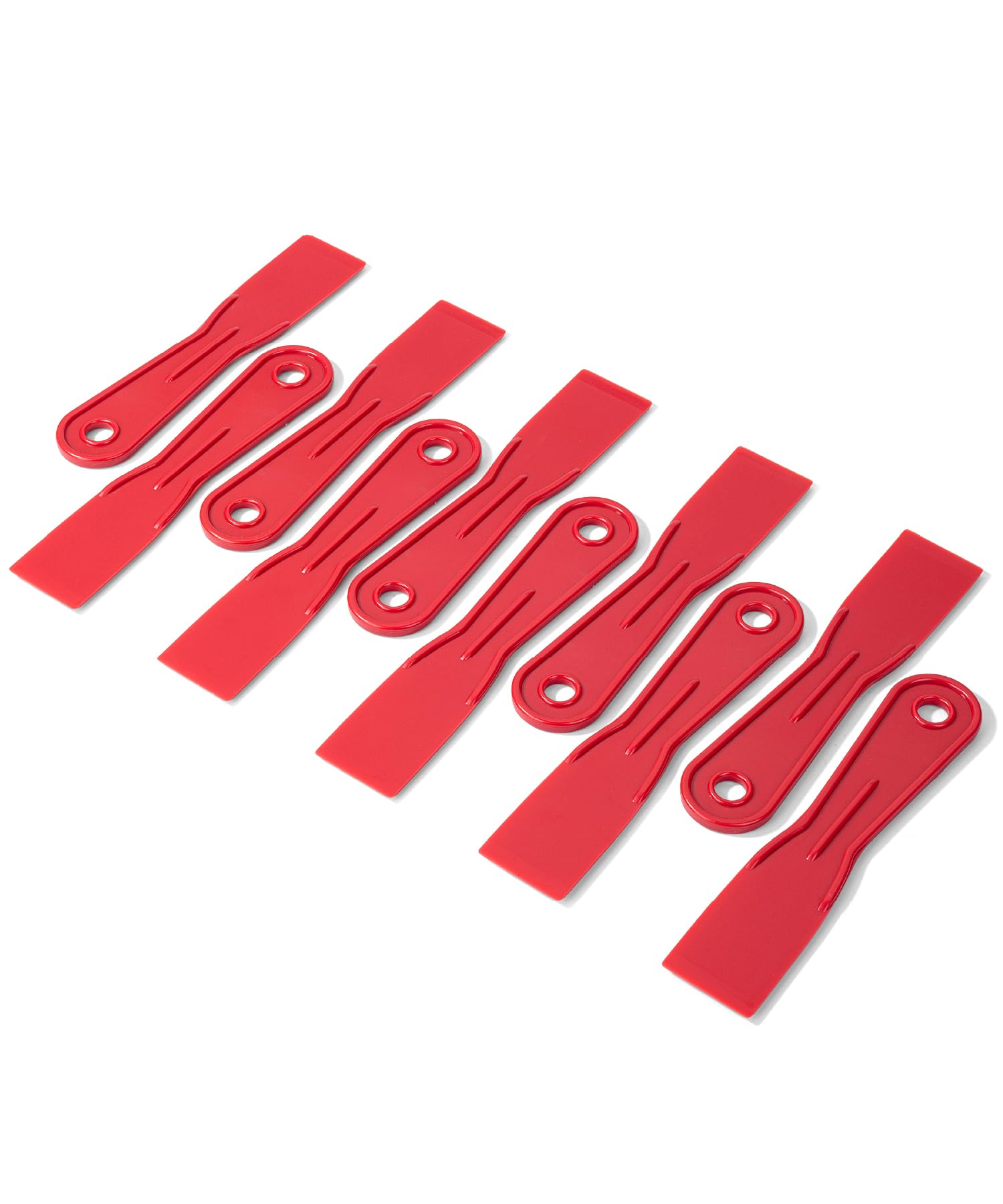
Ten knives, all 1 1/2 inches. That looks like a mistake until you've had a plastic scraper welded to a blob of epoxy: this is the pack you buy when the tool is going to get wrecked rather than maintained. One size, one job, ten chances before you have to think about it again.

They're flexible, light, and edged straight out of the pack, with a handle that's fine for short work. Compound and adhesive wipe off with a paper towel while they're still wet, and there's no rust to chase, which is the whole reason to reach for plastic on a job where the blade ends up buried in residue.

We found the limit quickly: anything that has to look finished. The working edge isn't ground to a clean line on every knife in the pack, and thin plastic doesn't hold an edge once it's worked hard, so the final skim belongs to a steel knife. These take the abuse instead.

Bottom line: The pack to buy for jobs that ruin a knife: ten plastic 1.5-inch blades you can abuse, lose, and replace without a second thought.

Check Latest Price
#07

Prying and scraping

Mister Rui 10-in-1 Putty Knife

95 /100
Kirk Score Outstanding
Handle
PP and TPR
Functions
10-in-1 with hammer end
Blade Width
3.14 inches
Blade Material
Stainless steel
Check Details on Amazon

Pros

  • Hammer end, nail puller, and notches in one tool
  • Stainless blade handles scraping and prying
  • Comfortable PP and TPR grip

Cons

  • Wide 3-inch head is bulky in tight spots

Put this next to the LEVEL5 and the difference in intent is obvious. One is a finishing knife; this is a scraper with a lot of side hustles, a 3-inch stainless blade with a hammer end, a nail puller, and enough cutouts and notches that the maker counts ten functions. We stopped expecting it to feather compound and started reaching for it for everything else.

For scraping paint, prying open a stuck lid, lifting a nail head, or chipping adhesive off a floor, it's the handiest single tool in this group. The blade is sharp, the grip is comfortable and secure in the hand, and the hammer end takes a hit without denting.

What it doesn't do is smooth. A wide blade with cutouts along its edges is the wrong shape for feathering compound, where you want a clean, straight edge and controlled flex, and those cutouts work against you. It will spread a patch in a pinch, and the width helps on small work, but the finish won't be as flat as a dedicated knife leaves it.

Buy it as the tool that lives in a bucket and handles the ugly half of a repair, the scraping, prying, opening, and tapping, and keep a real knife for the part that has to look like nothing happened.

Bottom line: A scraper first and a putty knife second: superb for prying, chipping, and tapping, and the wrong tool for a finish that has to disappear under paint.

Check Latest Price
#08

Small spot repairs

Amazon Basics 2-Inch Flex Putty Knife

93 /100
Kirk Score Outstanding
Handle
Nylon
Blade Width
2 inches
Blade Material
Carbon steel
Handle Attachment
Full tang, two rivets
Check Details on Amazon

Pros

  • Full tang with two rivets feels solid
  • Flexible 2-inch blade for filling and skimming
  • Least expensive steel knife in this group

Cons

  • Nylon handle is slicker than rubberized grips

Not everyone needs five knives. If the list is two nail holes, a cracked corner, and a tub of spackle, one 2-inch flexible blade does the whole job, and this one is the least expensive steel knife in this group, with a full tang and two rivets through the handle rather than a blade molded into plastic.

For a single small knife, the build is the story: taper-ground carbon steel, mirror-polished, with a nylon handle that feels more solid in the hand than the molded grips on the plastic sets. And 2 inches is the right width for filling and skimming small repairs, wide enough to pull a patch flat and narrow enough to work along trim.

Carbon steel is the catch. It takes a keen edge and it spots if it goes away wet, so rinse it, dry it, and don't leave it sitting in the mud pan overnight. Do that and it's the knife that lives in a kitchen drawer for the odd wall ding, small, sharp, and ready when you need it.

Bottom line: For a couple of wall dings rather than a whole room, this flexible riveted 2-inch knife is the least expensive steel blade here, so long as you dry it every time.

Check Latest Price

How We Tested 16 Putty Knives

We built the shortlist by reading listings and hundreds of reviews, then filtering on the things that actually change how a knife behaves: blade material, flex, the widths included in a set, handle shape, and whether there was a hammer end. Anything that arrived dull, with a wobbly handle, or priced like a pro tool without the steel to back it up got cut early. That left 16 knives, ranging from 10-piece plastic packs to single stainless flex blades.

Since then they've lived in a bucket on my bench and gone out on real jobs: filling nail holes and one doorknob-sized hole in a hallway wall, stripping wallpaper in a bathroom, scraping paint off window trim, prying open paint can lids, and spreading compound over taped seams. Each knife got used for both smoothing and scraping, because most people own one and expect it to do both.

Rust was easy to check — I washed each blade, left it wet on a paper towel overnight, and looked for orange the next morning. For sharpness and scratch resistance, I dragged every corner across scrap drywall to see whether it cut clean or tore the paper face, then noted how the edge held after a week of scraping. Sturdiness showed up during prying: handles that twisted loose, blades that kinked instead of flexing, and plastic that softened after a wipe with mineral spirits all got flagged.

Value came down to cost per width we actually reached for, not the sticker price of the set. Several multi-packs sat in the drawer with only the 3-inch and 4-inch ever leaving it, while a couple of two-knife kits earned permanent space. The ones that made the final list are the ones I kept grabbing without thinking about it.

How to Choose a Putty Knife

Match the Blade to the Size of the Repair

Width decides what a knife can do far more than brand or price. A 1- to 1 1/2-inch blade pushes compound into nail holes, cracks, and the gap along trim; 2 to 3 inches is the general patching width; 4 to 6 inches skims and feathers; 6 inches and up is taping territory, where the blade has to span a seam and flatten it. The trap is a set that clusters its sizes, because five knives between 2 and 4 inches look generous and still leave you without a small blade or a wide one. Count the steps between sizes, not the number of knives in the package.

Flex Spreads, Stiff Scrapes

A flexible blade bends to follow the wall, which is how you feather an edge until it disappears under paint. A stiff blade lifts, chips, and pries without folding over. A set of nothing but flex knives will skate across a lump of dried compound, and a stiff blade dragged flat leaves ridges in wet mud. If you do both jobs, get a set with at least one stiff, sharpened blade; the WORKPRO set is the clearest example here. Treat the word flexible with some suspicion too, since on a stamped blade it can mean floppy rather than controlled, and a punched-out edge that arrives at 90 degrees needs sharpening before it scrapes anything.

Stainless, Carbon Steel, or Plastic

Stainless is the low-maintenance default: it shrugs off a damp bucket and wipes clean, which is why most of the sets here use it. Carbon steel takes a keener edge and holds it, but it spots and rusts if it goes away wet, which is fine if you'll dry it every time and annoying if you won't. Plastic won't rust and won't scar a finished wall, so it's the right material for spackling over paint and for epoxy or resin work, but the edge softens with use. Choose the material for how you'll treat the tool, not for the spec sheet.

Look at the Edge and the Handle Joint

Two details on a new knife decide whether it feels good in the hand: the side edges and where the blade meets the handle. Stamped blades often arrive with sharp, unbroken side edges that can cut a thumb or carve a line beside a patch, and a couple of minutes with 220-grit along the sides, working edge untouched, fixes it. At the joint, a full tang with rivets is more solid than a blade molded into plastic, and any seam traps water. Rinse, wipe, and store the knife handle-up rather than leaving it standing in a bucket overnight.

Frequently Asked Questions

Final Verdict

The Rerdeim set is the one to buy first: five stainless blades from 1 to 5 inches cover pinholes, patches, and the skim before paint, and nothing in the roll will rust in a bucket.

If your work runs to seams, the DEKEones set's 6- and 8-inch blades are the difference between a hump you can see and one you can't. And if you'd rather own a single knife that feels broken-in from the first pull, the LEVEL5 is the one to keep.