// data-verified

Best Utility Knives of 2026

A utility knife is the tool you grab without thinking, which is why a bad one is so irritating: the blade rocks in the housing, the lock slips mid-cut, and you're sawing at a box with a blade that went dull two cartons ago. What you want is boring — a blade that stays put, a lock that doesn't budge under pressure, a handle that doesn't dig into your palm by the tenth box.

Over the past four months, my team and I have run 15 utility knives through exactly that kind of work, and the differences are not subtle. A blade that chatters costs you accuracy; a lock that creeps costs you skin.

The surprise was how little the extras matter. A knife with ten spare blades is no bargain if the blade rattles in the housing; a firmly seated blade with a two-second change beats any blade count on the package. Lock design was the real dividing line, and most people only think about it after a slip. The picks below are the ones we'd hand to a friend.

#01

Best Overall

WORKPRO Premium Utility Knife Set

96 /100
Kirk Score Outstanding
Weight
3.2 oz
Set Contents
3 knives, 10 blades
Overall Length
6.3 inches
Handle Material
Aluminum alloy
Check Details on Amazon

Pros

  • Three aluminum knives, not one
  • Three-position slider holds its setting
  • Tool-free blade changes
  • Ten spare blades included

Cons

  • Blade can stick in the extended position

Three full-size knives come in this set, and that changed how we used them. Instead of one cutter migrating from the kitchen to the garage and vanishing for a week, one has stayed on the desk, one lives in the toolbox, and the third has been in a glove box since the first weekend. The bodies are aluminum alloy, 6.3 inches long and 3.2 ounces each, so they feel solid without weighing down a drawer.

The blade slider is what separates this set from cheaper cutters. It has three positions, which means a short stub for slicing tape off a box and full extension for cutting down flattened cartons, and it clicks into each stop instead of drifting through the cut. Blade changes are tool-free: extend the blade, press the release, drop in a fresh SK5 blade. Ten spares come with the set, and those spares are what keep the knives working instead of sitting in a drawer waiting for a hardware run.

Cutting is exactly what we want from a knife at this end of the range. The blades go through double-wall cardboard without tearing it up, and one edge handled a long afternoon of breaking down moving boxes before it needed a swap. The matte body stays grippy when your hands are damp, and the knife is light enough to use overhead for trimming without your wrist complaining.

Bottom line: We recommend it as the default utility knife: three aluminum knives, a slider that stays where you set it, and ten spare blades cover the drawer, the toolbox, and the car.

Check Latest Price
#02

Best for Drywall and Scoring

OLFA L-1 Utility Knife

96 /100
Kirk Score Outstanding
Lock
Ratchet wheel
Blade
18mm snap-off, 8 segments
Handle
High-impact ABS
Weight
2.5 oz
Check Details on Amazon

Pros

  • Eight fresh edges per blade
  • Ratchet wheel holds the depth you set
  • Light 2.5-ounce handle

Cons

  • Takes 18mm snap-off blades, not standard utility blades

Eight sharp edges ride on a single OLFA blade, and that is most of the argument for the L-1. When the front segment dulls you snap it off with the breaker built into the handle and keep cutting, so a blade that would be finished in a standard knife is only getting started. The 18mm blade is thicker than a two-inch utility blade, which is why it tracks through drywall and flooring instead of wandering off your line.

The ratchet wheel is the part we like best. Roll it forward with your thumb to set how far the blade stands proud and it holds that depth under pressure, which is more control than the friction sliders on most box cutters give you. Inside, a stainless-steel channel keeps the blade from wobbling, and at 2.5 ounces the handle is light enough to score board all afternoon without your hand cramping.

This is a construction knife, and it earns its place on scoring and demolition: drywall, carpet, roofing felt, and the heavy double-wall cartons that make a thin blade skate. The handle is long enough to choke up on for detail work, and the body is overbuilt in the way a knife that lives on a tool belt should be. For envelopes and padded mailers, it is more tool than the job needs.

Bottom line: Our pick for drywall, flooring, and anything you score: eight fresh edges per blade and a ratchet lock that does not creep, though it takes OLFA's own blades.

Check Latest Price
#03

Best Folding Knife

Fiskars Pro Folding Utility Knife

95 /100
Kirk Score Outstanding
Lock
Dual-locking system
Blade
CarbonMax razor blade
Weight
6.3 oz
Folded Size
4.5 inches
Check Details on Amazon

Pros

  • Dual lock resists accidental opening
  • Full metal body with real heft
  • Comfortable for long cutting sessions

Cons

  • Heavy at 6.3 ounces in a pocket
  • Pocket clip grips too tightly and can snap

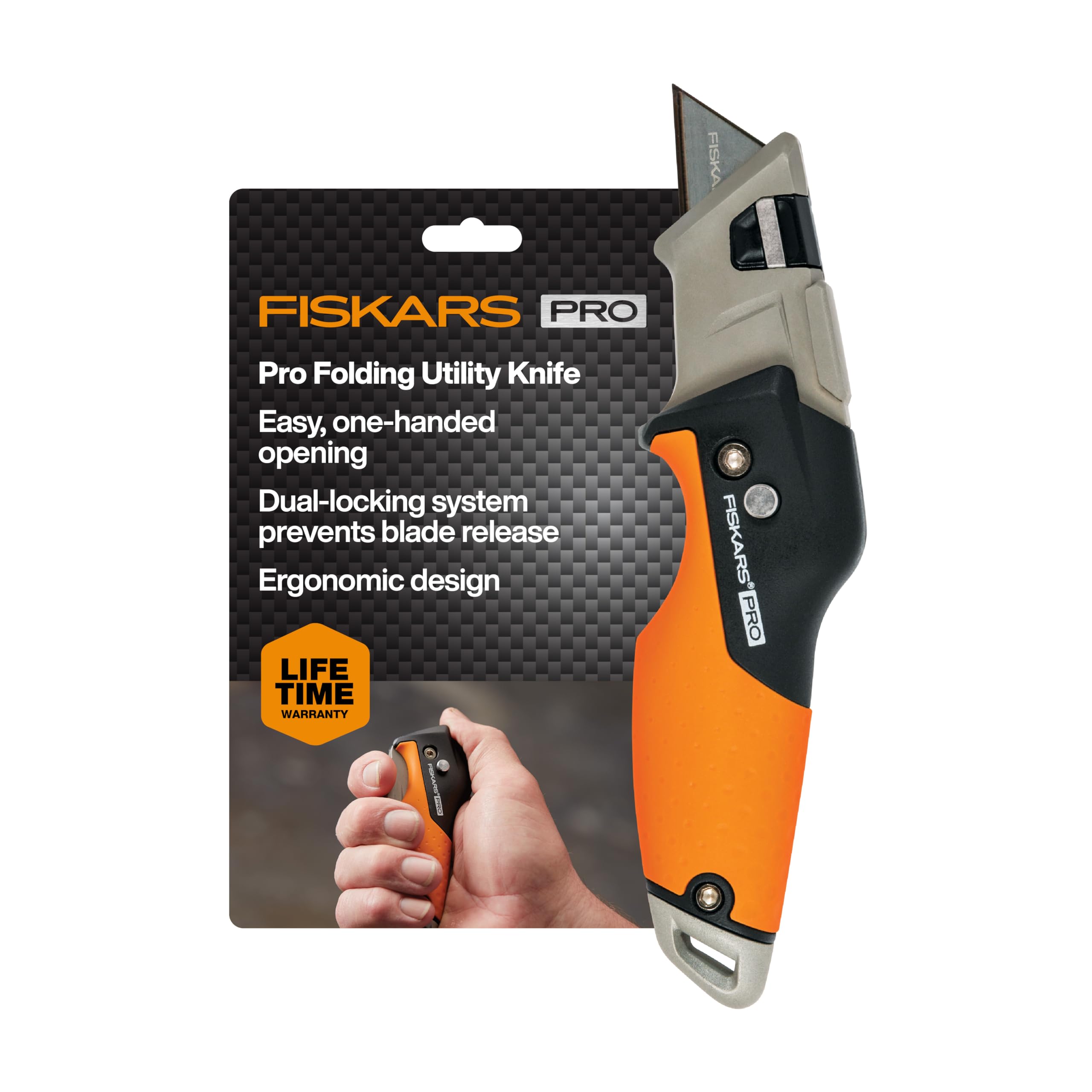
The Fiskars Pro is the heaviest knife in this group at 6.3 ounces, and that is the point of it: full metal from the tail to the blade holder, with a weight that settles a cut instead of skittering across the top of a carton. It flips open one-handed with a push of the thumb, and the CarbonMax blade it ships with outlasted the stock blades on the cheaper knives here in our cutting.

The dual lock is why we hand this one to anyone nervous about a folding knife. The blade has to be released twice before it moves, so it will not open itself in a toolbox or a jacket pocket, and it feels planted when you bear down. Blade changes take seconds, and the ergonomics are the best in this set — the handle fills your palm without a hot spot, even after an hour of cutting.

It folds to 4.5 inches, has a lanyard hole for a tether, and carries a limited lifetime warranty, which is more coverage than most knives here offer. That combination is what makes it the folder we keep coming back to for a work bag, where the knife is carried more than it is used and the lock is the thing you never want to think about.

Bottom line: We choose it when a knife has to live in a pocket or a tool bag — the dual lock makes it the safest folder here, at the cost of weight.

Check Latest Price
#04

Best for Tool Belts

Milwaukee Fastback 6-in-1

95 /100
Kirk Score Outstanding
Carry
Wire belt clip
Weight
3.52 oz
Folded Size
6 inches
Built-in Bit
Reversible Phillips #2 and slotted 1/4-inch
Check Details on Amazon

Pros

  • Built-in Phillips and slotted bit
  • Opens one-handed and locks firmly
  • Wire belt clip holds a pocket

Cons

  • One-year limited warranty is short for a work tool

A reversible Phillips and slotted bit sits in the handle of the Fastback, alongside a wire-stripper notch and a blade holder shaped for scoring. That is the pitch, and it works on a job where you are opening a carton, then a faceplate, then trimming a wire without walking back to the pouch. We reached for it most on small tasks where a screwdriver was the real need and the blade was the bonus.

As a knife it does the job. The blade flicks open one-handed and locks hard, the body is light at 3.5 ounces and 6 inches folded, and the wire belt clip holds a pocket without chewing the fabric. The grip is comfortable through a morning of use, and the shape is slim enough that it disappears in work-pant pocket rather than riding up.

The bit is held by a retaining ball inside the handle, and when that ball works loose the bit drops out and the screwdriver half of the tool is finished. That makes the Fastback a knife with a useful extra rather than a replacement for a dedicated driver — which is fine, as long as that is what you are buying it for.

Bottom line: We recommend it to anyone who wants a knife and a screwdriver in one pocket tool, as long as the knife matters more than the driver.

Check Latest Price
#05

Best for Comfort and Looks

WORKPRO Wood Handle Folding Knife

94 /100
Kirk Score Outstanding
Handle
Rosewood
Weight
8.82 oz
Included
10 extra blades
Overall Length
6.5 inches
Check Details on Amazon

Pros

  • Rosewood handle looks and feels good
  • Back lock holds the blade firmly
  • Quick-change button needs no tools

Cons

  • Stiff blade release, awkward for one-handed opening

The handle is rosewood, dark and close-grained, and it is the reason to pick this knife over WORKPRO's aluminum folders. It looks like a working tool rather than something off a hardware-store pegboard, which is not nothing when it is the knife you reach for every day. At 250 g it is also the heaviest folder here, and that weight does real work: a heavier knife drops through a double-wall carton with less push from your forearm.

The back lock is what we point to for safety. The blade stays where it is put under load and will not fold on your fingers mid-cut, and it takes a deliberate press to release. Ten spare blades come in the box, the quick-change button means no screwdriver at swap time, and the belt clip is screwed on rather than clipped in, so it holds a work belt without rotating.

What we came back to, though, is the feel. The wood warms in the hand in a way aluminum does not, the knife has enough weight to steady a long draw through cardboard, and it looks better on a bench than anything else in this group. It is the one we leave out rather than put away.

Bottom line: We reach for this one when the job deserves a good-looking knife: the rosewood handle and the heft make thick cardboard feel easy.

Check Latest Price
#06

Best Budget Multi-Pack

HORUSDY 4-Pack Box Cutter

94 /100
Kirk Score Outstanding
Blade
SK5 steel
Handle
Aluminum alloy with TPR grip
Weight
12 oz
Set Contents
4 knives, 10 SK5 blades
Check Details on Amazon

Pros

  • Four knives and ten blades in one set
  • Aluminum body with a rubber grip
  • Bright colors make them easy to find

Cons

  • Blade slider can slip under hard pressure

Four knives and ten SK5 blades is the whole proposition, and it is a sensible one: this is the set you buy to leave one in the kitchen drawer, one on the garage bench, one in the truck, and one wherever the last one ended up. The bodies are aluminum with a TPR rubber wrap rather than the brittle plastic on most cheap cutters, and each has a lanyard tail so it can hang on a hook. We spread ours around the house and stopped hunting for a cutter within a week.

For light and middling work they are better than the money suggests. The blades go through tape and single-wall cardboard cleanly, the rubber wrap keeps the knife from slipping when your hands are damp, and the colors mean you can spot one in a toolbox without digging. Two of ours have lived in a kitchen drawer for months and still feel tight.

The limits show up when you lean on them. The aluminum shell is thin enough to flex if you are really bearing down, and a long demolition session is not what these are for — that is when we reach for one of the heavier knives here. For opening packages and flattening the week's boxes, they are all most households need.

Bottom line: We keep a set of these around for the whole house: four aluminum knives and ten blades for less than the fancier singles, as long as you are not cutting for a living.

Check Latest Price
#07

Home and garage

Internet's Best Utility Knife Set

96 /100
Kirk Score Outstanding
Weight
6.38 oz
Blade Length
2 inches
Set Contents
2 knives, 5 blades
Overall Length
6 inches
Check Details on Amazon

Pros

  • Cushioned rubber grip
  • Metal frame feels solid
  • Five spare blades included

Cons

  • Blade does not always lock tight when extended
  • Bulky and heavy for pocket carry

A rubber-wrapped handle on a box cutter sounds like a small thing until you are cutting down a stack of boxes on a concrete floor. This one has the cushiest grip in the group — soft enough to take the pressure off your palm, textured enough that the knife does not skate when your hands are damp — and we preferred it for long sessions to the bare aluminum handles here. The metal frame underneath gives it a solidity the all-plastic cutters cannot match.

Each knife is 6 inches long with a two-inch blade, and the slider moves smoothly through its range. Blade changes are genuinely quick: press the red button on the spine, pull the old blade, drop in a new one. Five spares come in a small pouch, and in our cutting the pair handled cardboard, plastic strapping, and a scrap of carpet without complaint.

Two knives is the right number for most homes — one for the drawer where the packages land, one for the toolbox — and the metal frame means they will take more knocking about than the plastic cutters at the same end of the price range. It is the pair we leave out for other people to use.

Bottom line: We recommend the pair for a two-knife household: the cushioned rubber grip is the most comfortable here and the metal frame takes knocks.

Check Latest Price
#08

Knife in every room

M MEEPO 4-Pack Folding Box Cutter

93 /100
Kirk Score Outstanding
Handle
Plastic
Weight
11 oz
Set Contents
4 knives, 10 blades
Overall Length
6 inches
Check Details on Amazon

Pros

  • Four folding knives in four colors
  • Blade guard covers the edge when closed
  • Ten double-edge blades included

Cons

  • Pivot screws work loose over time

Four folding knives in four colors, ten double-edge blades, and a blade that locks open like a pocket knife. The folding design is what separates this set from the retractable multi-packs here: with the blade closed there is nothing to catch on a drawer or a bag, and the colors make it obvious which one belongs in the kitchen and which lives in the van.

We kept coming back to the blade guard. It is a small piece of plastic that covers the edge when the knife is folded, and it is the sort of detail that matters in a house with kids digging through the junk drawer. The textured handle gives a decent grip, the blades arrived sharp, and the folding action is stiff enough at first that it takes a firm thumb.

These are house and light-trade knives rather than job-site knives. The folding joint takes the strain on any folder, and a plastic handle will not shrug off knocks the way an aluminum one does. For drawers, mail, and the occasional craft project, the four-pack covers a whole house for less than most single knives here.

Bottom line: We suggest it for someone who wants a safe, folding knife in every room: the blade guard and the colors do more work than the price implies.

Check Latest Price
#09

Light desk cutting

TIFICAL 9mm Snap-Off 4-Pack

92 /100
Kirk Score Outstanding
Blade
9mm snap-off, 12 segments
Handle
Thickened ABS
Set Contents
4 knives
Overall Length
5.1 inches
Check Details on Amazon

Pros

  • Twelve snap-off edges per blade
  • Slim body fits a drawer

Cons

  • Thin 9mm blade flexes under hard cutting

A 5.1-inch body and a 9mm blade make this the smallest knife in the group, and it is the one that ends up in a pencil cup rather than a toolbox. The blade snaps off in twelve segments, so a fresh edge is always a click away, and the tail cap doubles as the breaker so there is nothing else to keep track of.

For envelopes, mailers, and the plastic wrap on a new toothbrush, it does the job: light, slim enough for a drawer, and the slider locks the blade at a set length so it does not creep out while you are cutting. The bright colors and the small body mean it does not look out of place on a desk, which is more than we can say for the aluminum knives here.

Twelve segments per blade is the quiet advantage, and it is why we keep one within reach: snap off a dulled edge and you are cutting again without opening the body or hunting for a refill. With four in the pack and a body this slim, there is no reason not to have one in the kitchen drawer and one in the car.

Bottom line: We keep one of these in a desk drawer: the snap-off edge is always fresh and the slim body goes anywhere, but it is not the knife for a move.

Check Latest Price

How We Tested Utility Knives

We built the shortlist from about 60 utility knives on retailer shelves and contractor forums, then filtered by handle material, lock type, blade-change system, spare blades included, and whether the knife sold singly or in a pack. That cut the field to 15, chosen so the group covered folding knives, retractables, snap-off blades, and multi-packs instead of fifteen variations on one tool.

Testing ran four months, mostly in a garage workshop and at the kitchen counter. I broke down every delivery box that came through the house, scored drywall and trimmed linoleum during a bathroom project, and cut carpet, rope, and sheet plastic. At the bench I counted the passes it took to get through double-wall corrugated before the blade started tearing instead of slicing, then repeated the count after each blade change to see how quickly sharpness fell off.

Sturdiness and blade retention got the least gentle treatment. I gripped each blade at the tip and rocked it side to side to feel for play in the housing, then leaned hard into a cut to see whether the lock crept or skipped a notch. Blade changes were timed, and I noted whether the mechanism needed a tool, a second hand, or a clear head. Fit showed up in small ways — a rattle after a week, a belt clip that bent out of shape, a handle that left a hot spot after twenty cuts.

Value was tallied past the sticker: how many usable edges came in the pack, whether the spares actually fit, and how the housing held up after a month of daily use. Knives that developed play, or whose locks loosened, dropped out of contention no matter how sharp they started.

How to Choose a Utility Knife

Start With the Blade, Not the Handle

The knife you pick decides which blades you buy for years. A standard two-inch double-ended razor blade is the cheapest and the most widely stocked, and it gives you two edges before it goes in the bin. An 18mm snap-off costs more per blade but carries eight segments, which is why it suits drywall and flooring. The 9mm snap-off is a light-duty format for paper and packaging.

Pick the format first, then choose the handle around it. Our top pick and the folding knives here all take the standard blade; the OLFA takes 18mm snap-offs and the TIFICAL takes 9mm, so refills are a brand purchase rather than a hardware-store afterthought.

The Lock Is the Safety Feature

Every cut relies on the blade staying exactly where you put it. A slider with click stops is fine for light work, a ratchet wheel holds depth better under pressure, and a dual lock that needs two deliberate releases is the safer arrangement on a folder. The trap is assuming a folding knife is safer because the blade hides away — a folder with a loose lock is worse than a stiff one you have to open deliberately.

Test it before you commit. With the blade locked out, press the spine against a scrap of wood; any movement at the slider or pivot is the thing that will bite you later.

Folding, Retractable, or Snap-Off

Where the knife lives should decide its shape. A folding knife with a pocket clip is the one you will actually carry, and it keeps the blade covered between cuts. A full-size retractable in a drawer is faster to use because there is nothing to open. A snap-off on a belt is the scoring answer.

If you buy only one, buy the shape that matches where you do most of your cutting, not the one with the most features. The Milwaukee Fastback is the clearest example of a knife built around being carried rather than being stored.

Weight and Handle Material

Under 4 ounces a knife disappears in a pocket; past 6 it steadies a heavy cut and tires your hand sooner. Aluminum is the best all-round body — light, stiff, and hard to crack — while plastic keeps the price down and flexes when you lean on it.

A wood or rubber-wrapped handle is about feel, and it earns its place if you cut for an hour at a stretch. Handle the knife if you can, or buy the grip shape you already know fits your hand.

Count the Blades in the Box

Utility blades are consumables, and the included count is the difference between a knife that keeps working and one that sits idle. Ten spares is generous; two or three is a starter. Check that the spares are the same format the knife takes, and whether the handle or a pouch gives them somewhere to live — the Internet's Best set ships a refill pouch, and the M MEEPO knives store blades in the body, which is the most useful place for them.

Frequently Asked Questions

Final Verdict

The WORKPRO Premium set is what we tell most people to buy. Three aluminum knives that hold up in a toolbox, a three-position slider that stays where you set it, and ten spare blades mean the set keeps working long after a single cheap cutter would be in a drawer waiting for a refill.

If your cutting is drywall and flooring rather than cardboard, take the OLFA L-1 and its eight edges per blade. If you want a knife in your pocket every day, the Fiskars Pro's dual lock is worth carrying the extra weight for.