// data-verified

Best Ratcheting Screwdrivers of 2026

The screwdriver in my kitchen drawer is the tool I reach for most, and the ratcheting ones are either the best thing in there or the most annoying. A ratchet that skips under load, or a bit that needs two hands and a pair of pliers to come out of the handle, turns a five-minute job into a twenty-minute one. What a good one buys you is speed with control — a short twist of the wrist drives the screw, and you never have to let go and reset your grip halfway up a ladder.

My team and I spent six months with 12 ratcheting multi-bit screwdrivers, using them on flat-pack furniture, cabinet hinges, outlet covers, and one stubborn ceiling fan. The thing that surprised me: tooth count gets all the attention, but bit retention and a handle that doesn't go slick with sweat are what decide whether you actually reach for the thing. What follows are the ones that earned a permanent spot in the drawer, grouped by the job you're buying for.

#01

Best Overall

Klein Tools 32305 15-in-1

95 /100
Kirk Score Outstanding
Length
9.5 in.
Weight
10.4 oz
Bit Count
15-in-1
Ratchet Settings
Forward, fixed, reverse
Check Details on Amazon

Pros

  • 15-in-1 coverage for common fastener types
  • Three-position forward, fixed, and reverse collar
  • Bits store in the handle
  • Comfortable Cushion-Grip handle

Cons

  • Bit housing can be stubborn to pull out

Fifteen tips live in the handle of the Klein Tools 32305, including Phillips, slotted, square, Torx, combo, and a 1/4-inch nut driver. That is a lot of coverage in one tool, and it means the bits for a furniture build or an outlet cover are already with you instead of scattered in a drawer. The collar switches between forward, fixed, and reverse, so the same driver can ratchet or lock solid when you need control.

What makes it our top pick is how ordinary that coverage feels in use. The ratchet has a smooth, positive action, the Cushion-Grip handle gives you something to push against, and the on-board storage keeps the set together between jobs. We kept reaching for it because it replaced several separate drivers without asking for a separate bit box. The 9.5-inch body is long enough for leverage, though it is not the tool for a cramped cabinet interior.

It is not the smallest or the fastest driver in this group; the Milwaukee and the Craftsman SpeedDrive exist for those jobs. What the Klein does better is cover more fasteners in one handle, and that is the trade most people should make.

Bottom line: The Klein Tools 32305 is our top pick because its 15-in-1 bit load and three-position ratchet cover household repairs without a drawer of separate drivers; it is the one to reach for first.

Check Latest Price
#02

Best Budget

WORKPRO 12-in-1

95 /100
Kirk Score Outstanding
Weight
4.48 oz
Bit Count
12-in-1
Drive Size
1/4 in. hex
Bit Loading
One-handed quick-load
Check Details on Amazon

Pros

  • One-handed quick-load bit changes
  • 12-in-1 coverage for common fasteners
  • S2 steel bits with magnetic tips
  • Light 4.48-ounce body

Cons

  • No nut driver among included bits

The WORKPRO 12-in-1 is our budget pick because its one-handed quick-load mechanism makes bit changes genuinely fast: push a double-ended bit into the auto-locking collar and keep working. The ratchet switches between forward, reverse, and a locked position, and the bits are 1/4-inch hex S2 steel. At 4.48 ounces, it is light enough to keep in a kitchen drawer, and the 12-in-1 range covers the common Phillips, slotted, Torx, and square sizes.

We found the one-handed loading most useful when a job has several fastener sizes, because you are not setting the driver down to fish a bit out of a case. The handle storage holds the six double-ended bits, so the set stays together, and the bits are long enough to reach most furniture screws. If you want a fast, light driver for household repairs rather than a full kit, this is the one.

Bottom line: The WORKPRO is our budget pick because its one-handed quick-load makes bit changes fast and the 12-in-1 range covers most household fasteners; it is the light driver to keep close by.

Check Latest Price
#03

Best for Speed

Craftsman SpeedDrive

94 /100
Kirk Score Outstanding
Bit Count
7 double-ended
Bit Length
2 in.
Bit Storage
6 bits in handle
Drive Action
Bidirectional SpeedDrive
Check Details on Amazon

Pros

  • Drives on both strokes for faster work
  • Seven double-ended bits cover common sizes
  • Handle stores six bits
  • Extended locking holder seats bits securely

Cons

  • No nut driver among included bits

The Craftsman SpeedDrive is the pick for repetitive driving because its ratchet works on both the forward and return strokes, so you are not wasting half your hand motion. The mechanism is built to drive screws with each left and right turn, which is a real advantage on a long run of cabinet screws or outlet plates. Seven double-ended bits cover Phillips, slotted, square, and Torx, and six of them store in the handle.

We liked the two-inch bits because they give a little more reach than stubby insert bits, and the extended locking holder keeps them seated. The trade-off is range: seven double-ended bits cover the common sizes, but this is not the one for every fastener in the house. It is the driver we choose when speed matters more than having the widest set.

Bottom line: The SpeedDrive is the pick for repetitive driving because its ratchet works on both strokes and the two-inch bits give useful reach; choose it when speed matters more than the widest bit selection.

Check Latest Price
#04

Best Compact

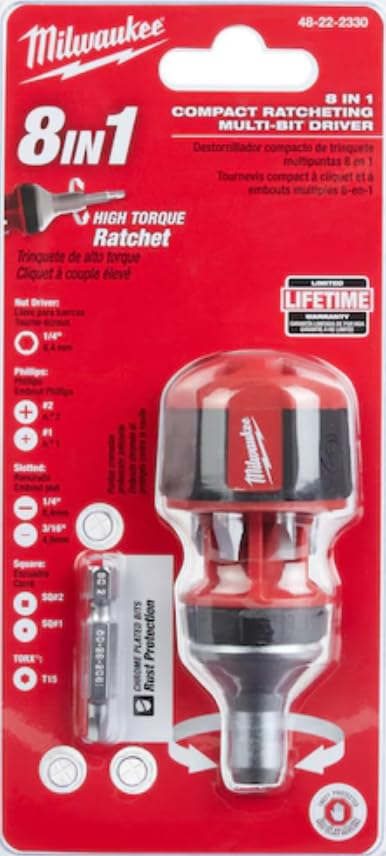
Milwaukee 48-22-2320

94 /100
Kirk Score Outstanding
Body
Compact
Chuck Size
0.25 in.
Bit Storage
In-handle
Maximum Torque
40 in-lb
Check Details on Amazon

Pros

  • Compact body for drawer or bag carry
  • Smooth ratchet with protected direction changer
  • Strong magnet holds bits
  • 40 in-lb torque rating

Cons

  • Premium price for a compact driver

The Milwaukee 48-22-2320 is built around portability: a compact multi-bit driver with in-handle storage, a 0.25-inch chuck, and a 40 in-lb torque rating. It is the one here that slips into a glovebox or a desk drawer without taking over the space.

What we like is that the compact body does not feel like a compromise. The ratchet is smooth, the direction changer sits where your thumb can find it without being easily bumped, and the strong magnet holds bits firmly. We kept it close for small jobs because it is easier to grab than a full-size driver.

The trade-off is range: it does not carry the bit selection of a 15-in-1 driver. If you want one compact tool for quick fixes and do not need every specialty bit, it is the better fit.

Bottom line: The Milwaukee is the compact one we reach for when the tool has to live in a drawer or bag, and its smooth ratchet makes small jobs easy; it is for buyers who value size over the widest bit set.

Check Latest Price
#05

Best Heavy-Duty

Williams JHWWRS-1

93 /100
Kirk Score Outstanding
Drive Size
1/4 in. hex
Blade Length
4 in.
Bits Included
5 bits
Overall Length
9 in.
Check Details on Amazon

Pros

  • 9-inch body and 4-inch blade for reach
  • Strong magnetic shank holds bits
  • Smooth three-way ratchet
  • Substantial hi-impact handle

Cons

  • Only five bits included

Nine inches overall and a four-inch blade make the Williams JHWWRS-1 a full-size driver rather than a pocket tool, and the magnetic shank is the detail that keeps a bit from disappearing into a cabinet. It includes five bits, accepts standard 1/4-inch hex shanks, and has a three-way ratchet with a lock position.

The heft is part of the appeal. At 7.84 ounces, it feels substantial without being clumsy, and the hi-impact handle gives you something to push against on a stubborn screw. The magnet is strong enough to hold a bit before you start, which matters when you are working one-handed.

What we like most is the reach: the long blade gets past obstructions that swallow shorter drivers, and the ratchet has a smooth, positive feel. It is the driver for deep, awkward screws, especially if you already own a 1/4-inch hex bit set.

Bottom line: The Williams is the full-size pick for reach and bit security: its 9-inch body and strong magnet handle deep or awkward screws, though the included bit set is small.

Check Latest Price
#06

Best for Torque

Channellock 131CB

92 /100
Kirk Score Outstanding
Length
8.75 in.
Bit Count
13-in-1
Ratchet Teeth
28-tooth
Torque Rating
225 in-lb
Check Details on Amazon

Pros

  • 13-in-1 coverage with nut driver
  • 28-tooth ratchet and 225 in-lb rating
  • Slim 8.75-inch aluminum shaft
  • Secure in-handle bit storage

Cons

  • Bit dispenser durability is the weak point

A 28-tooth ratchet and a 225 in-lb torque rating are the numbers Channellock puts behind the 131CB, and they explain why this driver feels controlled on a stubborn screw. The 13-in-1 bit load covers Phillips, slotted, square, Torx, and a 1/4-inch nut driver.

The long, slim aluminum shaft is the other reason it earns a place. At 8.75 inches and 8.8 ounces, it reaches into deep holes and gives you a secure grip without a lot of bulk. The bit storage in the handle is easy to access and keeps the six double-ended bits together.

What we like most is the combination of torque and reach: this is the driver for cabinet hardware, outlet boxes, and other spots where a short handle will not do. If you want a workshop driver rather than a pocket tool, this is a strong choice.

Bottom line: The Channellock is the pick for stubborn, deep-set screws because its 28-tooth ratchet and slim aluminum shaft put torque where you need it; it is a workshop driver, not a pocket tool.

Check Latest Price
#07

Best Premium Compact

Wera 838 RA-R M

92 /100
Kirk Score Outstanding
Length
4.86 in.
Weight
3.84 oz
Drive Size
1/4 in. hex
Ratchet Modes
Forward/reverse/0
Check Details on Amazon

Pros

  • Compact 4.86-inch, 109-gram handle
  • Rapidaptor quick-release chuck
  • Fine-tooth ratchet with free-spin
  • Forward/reverse/0 selector

Cons

  • No bits included

The Wera 838 RA-R M is a bit holder first: it takes standard 1/4-inch hex bits through a Rapidaptor quick-release chuck and puts the ratchet in a compact 4.86-inch handle. That makes it a different purchase from the multi-bit drivers here, and a good one if you already have a bit collection.

The mechanism is the reason to choose it. The fine-tooth ratchet is smooth, the free-spin position lets you run a screw down quickly, and the forward/reverse/0 selector is intuitive. At 109 grams, it is light enough to keep in a pocket or a small tool bag without noticing it.

We liked the Rapidaptor chuck most on quick swaps: pull the collar, change the bit, and get back to work. The handle is smaller than many full-size drivers, which suits small work and cabinet hardware, but it is not the tool for a heavy torque job. That is a fair trade for the compact size.

For anyone who already owns good 1/4-inch bits, this is the premium handle that makes them easier to use. If you have the bits, the Wera is the one that feels most precise in the hand.

Bottom line: The Wera is the premium compact handle for anyone who already owns 1/4-inch bits: its Rapidaptor chuck and fine-tooth ratchet feel precise, but it is not a complete set.

Check Latest Price
#08

Tight spaces

Klein Tools 32593 Stubby

93 /100
Kirk Score Outstanding
Length
6.62 in.
Weight
1.6 oz
Bit Count
6-in-1
Nut Driver Sizes
1/4 in., 5/16 in.
Check Details on Amazon

Pros

  • 6.62-inch body for tight spaces
  • Common Phillips, slotted, and nut-driver sizes
  • Smooth ratchet action
  • Light 1.6-ounce handle

Cons

  • Bits can pull loose from the holder

At 6.62 inches long, the Klein 32593 is short enough to get between a cabinet back and a wall, and its 1.6-ounce body keeps the tool light when you are working overhead. It is a 6-in-1 driver with #1 and #2 Phillips, 1/4-inch and 3/16-inch slotted bits, and 1/4-inch and 5/16-inch nut drivers.

The ratchet is what makes the stubby more than a novelty. It has a smooth action, and the short handle gives you control in tight quarters where a full-size driver would bottom out. We liked that the common bit sizes are on board, so you do not need a second tool for the nut driver.

The trade-off is leverage: a short handle cannot give you the same twist as a 9-inch driver, so this is not the one for a stubborn lag screw. It is the driver for outlet covers, drawer slides, and assembly in a cramped space, where a full handle simply will not fit.

What we noticed most is how often the stubby solved a small problem that a full-size driver made awkward. It is not a replacement for a main driver, but it is the one we keep in the kitchen drawer for close-quarters jobs. For a second driver, that is enough.

Bottom line: The Klein 32593 is the stubby pick for tight cabinets and close-quarters assembly, with common Phillips, slotted, and nut-driver sizes in a 6.62-inch body; it is not a high-torque driver.

Check Latest Price

What We Put Every Ratcheting Screwdriver Through

We started by rounding up every ratcheting multi-bit driver we could find from brands we already trust on job sites, then cut anything with a collar that felt like it would crack, a ratchet with no way to service it, or a bit set that skipped square, Torx, and the 1/4-inch nut driver entirely. That left 12, all bought at retail like anyone else would.

Testing ran six months, mostly in a half-renovated house: two dressers assembled on a hallway floor, cabinet doors hung and re-hung, switch plates swapped, a dryer vent snugged down, and a fair amount of crawling under a sink. Every driver got the same jobs — three-inch screws into pine, deck screws into an old fence post, and machine screws into a threaded insert. We counted how many ratchet clicks it took to turn a screw a quarter turn, since fewer clicks means a shorter swing arc and less wrist work in a tight corner, and we noted how much drag each one had when turned by hand in the locked position.

Bit removal got a test of its own: 50 swaps per driver, first bare-handed and then in work gloves, noting which ones needed pliers or a second hard yank. We shook each driver upside down to see whether handle-stored bits stayed put, dropped them onto concrete from waist height, and left a few in a cold garage to see if the grips went brittle. Value came down to what the handle actually held and how many of those bits we'd genuinely use — not the count printed on the package.

How to Choose a Ratcheting Screwdriver

Start with the ratchet action

A ratchet that only drives on the forward stroke is normal; the Craftsman SpeedDrive is the outlier here because it drives on both. For most buyers, smooth action and a direction collar that stays put matter more than tooth count. We prefer a collar with clear forward, fixed, and reverse positions; fixed mode turns the tool into a regular screwdriver when you need control. Test the switch with your thumb before you commit. If it moves easily under your palm, it can reverse on you mid-job.

Count tips, not pieces

A 12-in-1 driver may hold six double-ended bits, so you get 12 tips without 12 separate pieces. Read the bit list for the fastener types you meet: Phillips, slotted, square, Torx, and a 1/4-inch nut driver. On-board storage is only useful if the bit you need releases without a fight. We favor a simple, secure holder over a clever dispenser that jams or drops bits.

Choose reach or compactness

A 9-inch driver gives leverage and reaches past obstructions; a stubby gets into cabinet backs where a full handle will not fit. Compact in a listing can mean a short handle, not a slim shaft, so check both length and shaft diameter. If you work overhead, weight matters too. We keep a full-size driver for furniture and a stubby for tight assembly, rather than expecting one handle to do both. The Williams JHWWRS-1 is the long-reach choice here, while the Klein 32593 is the tight-space one.

Check the bit holder and the warranty

The bit holder and ratchet are the parts that wear out first, so look for a secure grip and a mechanism that feels solid through its full stroke. A lifetime warranty is useful, but it does not cover the frustration of a dispenser that breaks or a bit that pulls out mid-job. We prefer a tool with a straightforward holder and a clear direction switch over a complex design with more to go wrong.

Set a budget around the mechanism

You can get a capable ratcheting screwdriver at a budget price; the extra spend goes toward a smoother ratchet, better bit steel, or a more compact premium handle. Do not pay for a huge bit count if the bits are hard to remove. Put the money into the parts you touch every time: the ratchet, the collar, and the grip. A premium handle-only tool such as the Wera 838 earns its place if you already own a 1/4-inch bit set.

Frequently Asked Questions

Final Verdict

The Klein Tools 32305 is the ratcheting screwdriver we recommend first. Its 15-in-1 bit load covers the fasteners most home repairs actually use, and the forward/fixed/reverse collar makes the ratchet useful rather than fussy. It is not the shortest driver here, but it is the one that can replace the most separate tools in a drawer.

If your work is a long run of repetitive screws, the Craftsman SpeedDrive is the faster alternative. If you need a compact tool for a bag or a tight cabinet, the Milwaukee 48-22-2320 is the better fit. Both give up some bit range to do their specific job well.