// data-verified

Best Rotary Tools of 2026

Some jobs are too small for a full-size tool and too stubborn for a file: a burr on a fresh 3D print, a stripped screw in a cabinet hinge, a rusted bolt no hacksaw will reach. A rotary tool fills that gap — a palm-size motor that cuts, grinds, sands, polishes, and engraves. Set up right, it nearly disappears in your hand.

We've spent seven months putting 12 of them through real work, and the biggest split isn't brand — it's corded versus cordless. Corded models hold speed under load; cordless ones reach the work but live and die by their battery. Weight matters more than the spec sheet admits, since you hold these at odd angles longer than expected.

What reviews skip is that the tool is only half the purchase. Whether the collets grip standard 1/8-inch bits, whether you can swap accessories without a wrench, and whether the case keeps dozens of tiny bits sorted decide how often you reach for it. Here are the ones that earned a spot on the bench.

#01

Best Overall

Dremel 4300-5/40

95 /100
Kirk Score Outstanding
Chuck
Universal 3-jaw
Speed Range
5,000–35,000 rpm
Kit Contents
5 attachments, 40 accessories
Power Source
Corded, 120V
Check Details on Amazon

Pros

  • Chuck takes every shank size, no collets
  • Holds 5,000–35,000 rpm under load
  • Five attachments and 40 accessories included
  • Pivot light reaches into tight work

Cons

  • Cord ties you to an outlet
  • Full-size 1.2-pound body tires overhead

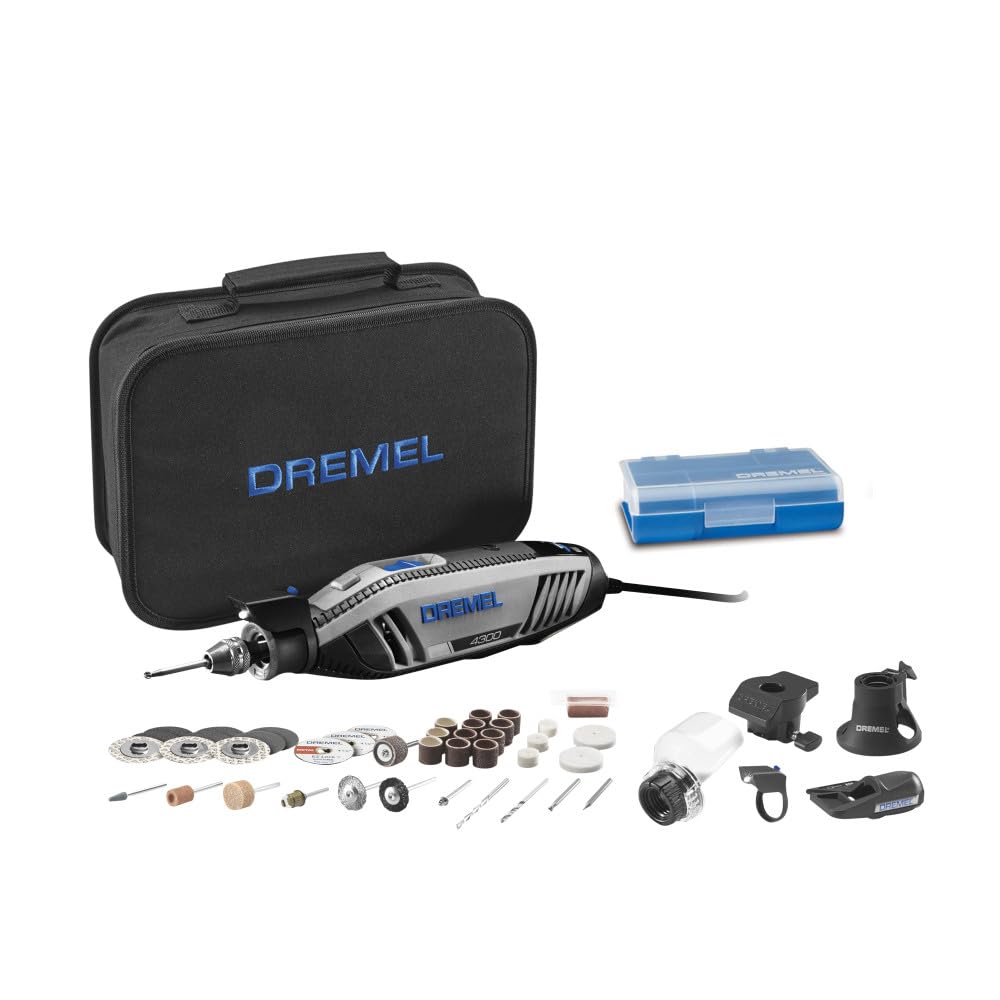
Bit changes are what you do most with a rotary tool, and the 4300's universal three-jaw chuck is the reason we hand it to people first. There's no collet to match to a shank — 1/8 inch, 3/32 inch, the odd 1/16-inch bit from a jewelry kit, the chuck closes on all of them. On a collet-only tool, a project that swaps between a cut-off wheel and a sanding drum costs you two chuck changes before you've made a cut.

The motor backs the chuck up. Dremel rates the 4300 at 5,000 to 35,000 rpm with electronic feedback, which is the spec that matters when a cut-off wheel starts loading: the tool holds the speed you set instead of sagging. The kit carries five attachments and 40 accessories — a shield, a sanding and grinding guide, a cutting guide, a garden tool sharpener, and the pivot light that swings around to light the work rather than the wall behind it. The 1.2-pound body is full-size in the hand, which we like for a straight cut and notice during overhead work.

The cord is the honest trade: constant power and no charging, in exchange for an outlet within reach and a cord across the bench. The other unknown is longevity, which no spec sheet settles — a share of these tools quit early, and that's the one thing we can't reassure you on.

Bottom line: For most benches, this is the rotary tool to buy: corded power that doesn't fade, a chuck that takes every bit you own, and a case that keeps the kit together.

Check Latest Price
#02

Best Cordless

Dremel 8250-5

91 /100
Kirk Score Outstanding
Motor
Brushless
Weight
13.8 oz
Battery
12V 3.0Ah lithium-ion
Speed Range
5,000–30,000 rpm
Check Details on Amazon

Pros

  • Brushless motor and 3.0Ah pack hold speed
  • Digital display shows the speed setting
  • Takes the full Dremel accessory line
  • Limited lifetime warranty

Cons

  • Bulkier in the hand than the pen tools here

This is the most expensive tool in the guide, and it's the one we pick when the work isn't near an outlet. Dremel's brushless motor and the 3.0Ah 12-volt pack are why: brushless runs cooler, and the larger battery means a grinding job finishes before the charge does. If a 4-volt pen tool has left you waiting on a charger mid-project, this is the step up.

Speed runs 5,000 to 30,000 rpm on a dial, and the digital display tells you where you set it — genuinely useful when you move between slow polishing and a high-speed cut on the same piece. It takes the whole Dremel accessory line and the EZ Lock changes, and the five included accessories, charger and bag make it a working kit rather than a bare tool. At 13.76 ounces it's heavier and thicker through the body than the pen-style tools here; we noticed that for a minute and then stopped.

Cordless tools live or die on their electronics, and that's where the limited lifetime warranty earns its keep — it's the longest coverage on this page and the reason the price stings less. This is a tool for repetition: sanding, grinding and cutting where a cord gets in the way.

Bottom line: If your work happens away from an outlet, this is the cordless tool to buy: brushless power, a 3.0Ah pack, and the longest warranty here.

Check Latest Price
#03

Best Kit for the Money

GOXAWEE G4007 140-Piece

89 /100
Kirk Score Excellent
Chuck
Keyless 3-jaw
Accessories
140 pieces
Speed Range
8,000–30,000 rpm
Power Source
Corded, 130W
Check Details on Amazon

Pros

  • 140 pieces, flex shaft and dust shield included
  • Keyless chuck takes any shank
  • 130W motor with 8,000–30,000 rpm

Cons

  • Five fixed speeds instead of a continuous dial
  • Corded only, no battery option

A hundred and forty pieces sounds like marketing until the third project, when the one drum sander you need is already in the box instead of in a shopping cart. GOXAWEE's kit is the most complete here: the tool, a 3.3-foot flex shaft, a keyless chuck, a dust shield, a drill locator, and the bits, wheels, burrs and discs to go with them, all in a case.

The chuck is the part that surprises people. It's keyless and three-jaw, so any shank fits and accessories change by hand instead of by collet — the same convenience the Dremel 4300 asks a lot more money for. Behind it sits a 130-watt motor running 8,000 to 30,000 rpm, which is enough for sanding, cutting and light grinding in wood, plastic and soft metal.

The flex shaft turns a box of parts into a system: the handpiece is pen-sized, so the motor can hang out of the way while you work inside a curve or at the far end of a board. Keep it lightly lubricated and avoid sharp bends, since the shaft is the part that fails first in any kit that includes one. For a first rotary setup, or a second one for the garage, this is the value pick — the money goes into the kit rather than the badge.

Bottom line: If you'd rather buy one box and be done — bits, wheels, a flex shaft and a chuck that takes any shank — this is the best-equipped kit here for the money.

Check Latest Price
#04

Small detail jobs

HARDELL Mini Cordless

88 /100
Kirk Score Excellent
Battery
3.7V, 2,000mAh
Charging
USB-C
Accessories
69 pieces
Speed Range
5,000–18,000 rpm
Check Details on Amazon

Pros

  • Pen-light body is easy to control
  • USB-C charging with a 2,000mAh cell
  • Nose LED lights the work, not the wall

Cons

  • 18,000 rpm ceiling suits finishing, not cutting

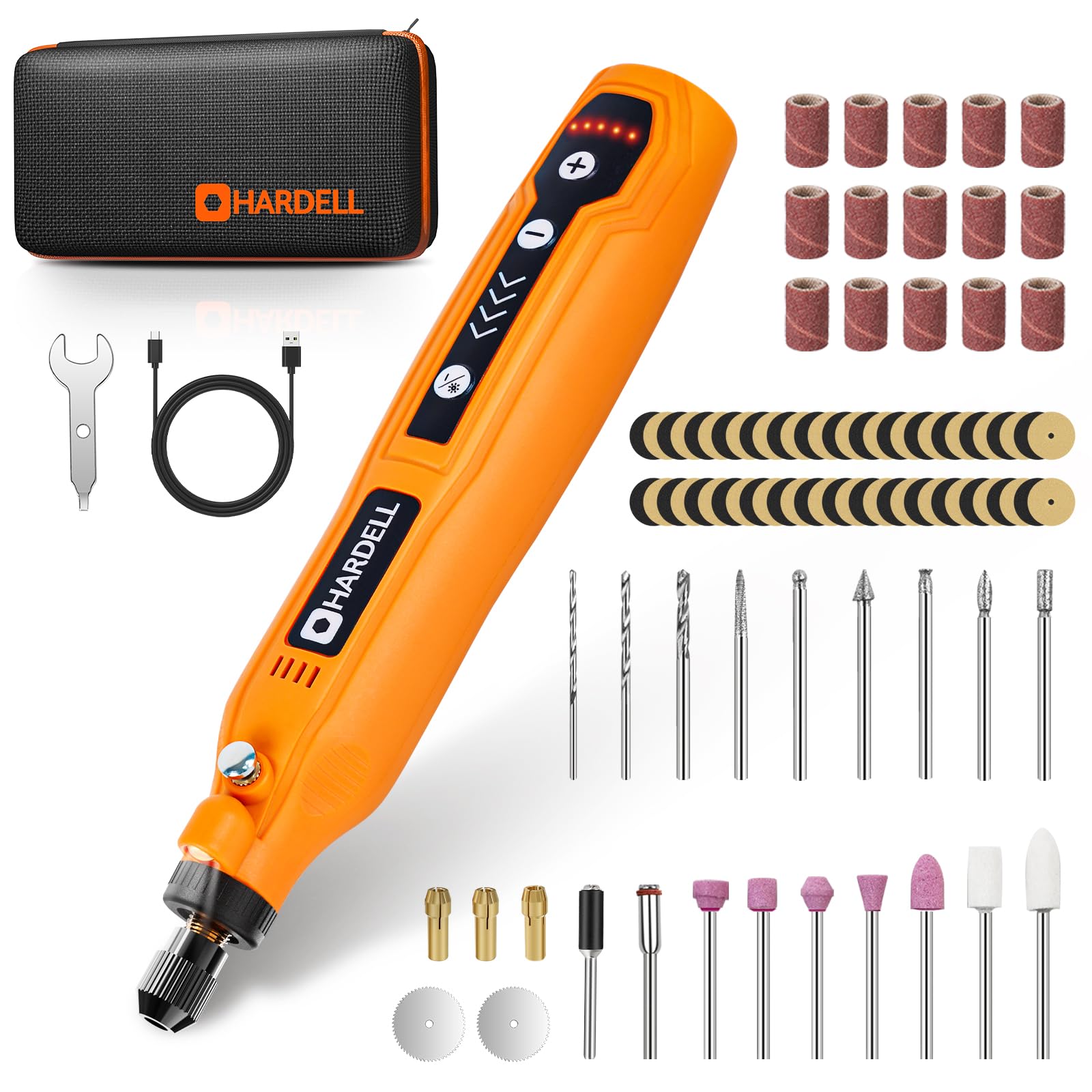
Set the HARDELL next to the Dremel 8250 and the difference is plain: roughly a third of the weight, a fraction of the size, and a 3.7-volt cell where the Dremel carries a 12-volt pack. That's the whole point. This is the tool that lives in a kitchen drawer and comes out for a thirty-second job — a rough edge on a 3D print, a burr on a printed part, a scuff on a plastic trim piece.

At 5,000 to 18,000 rpm it's a finishing tool, and that's better to know before you buy than after. Where it earns its place is control: the light body handles like a pen for engraving and polishing, and the LED at the nose throws light where the bit meets the work instead of behind it. Hardwood and steel are out of reach; plastic, resin, soft metal and small touch-ups are exactly its size.

Charging is USB-C with a 2,000mAh cell, which is the right call for a tool this small — one cable in the drawer, no dock. The speed button sits under your thumb and a light touch can nudge the setting mid-pass, so check it before you start.

One compatibility catch is worth knowing before you order. The three collets run 1.0, 1.6 and 2.3 mm, and 2.3 mm is 3/32 inch. That covers the small-shank burrs, drills and diamond points in the box, but not the 1/8-inch shank most cut-off wheels and sanding drums are built on. Buy it as a detail tool with its own accessories, not as a stand-in for a full-size rotary tool.

Bottom line: For 3D-print cleanup, resin, plastic and small detail work, this is the cordless tool we keep within arm's reach; it just isn't a cutter.

Check Latest Price
#05

Desk detail work

Fanttik F2 Pro

89 /100
Kirk Score Excellent
Weight
7.76 oz
Accessories
55 pieces
Speed Range
5,000–25,000 rpm
Power Source
4V cordless, USB-C
Check Details on Amazon

Pros

  • Magnetic rotating hub keeps 55 bits in view
  • Aluminum case and 220-gram pen body
  • Rear charge indicator and shadow-free LED

Cons

  • Built-in 4-volt cell means charging breaks up jobs
  • Premium price for a 4-volt tool

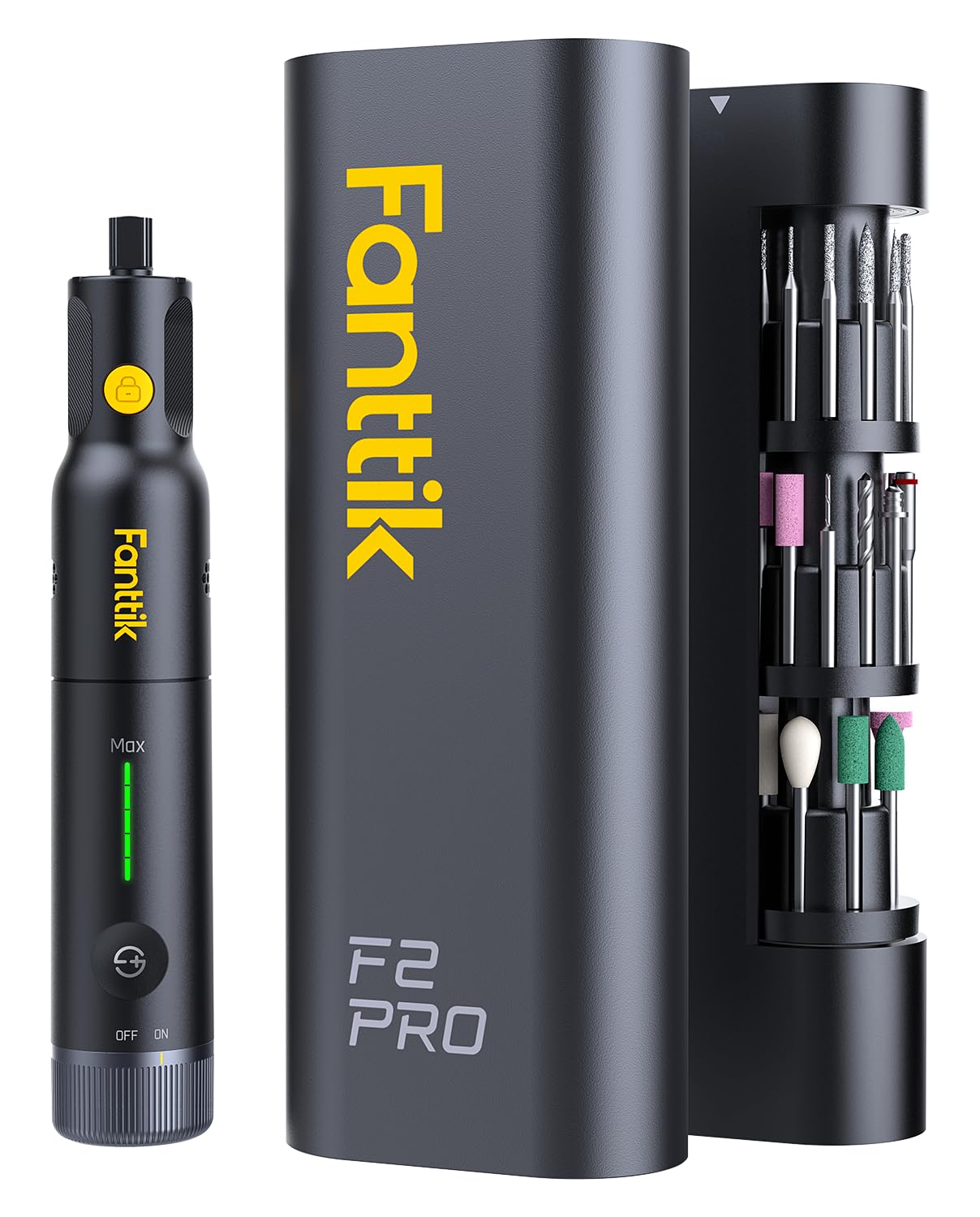
The accessory holder is the first thing anyone notices. It's an aluminum case with a magnetic ring inside that spins 360 degrees, so all 55 bits stand upright and visible while you work instead of sitting in a bag you have to empty out. We've spent more time hunting for the right burr than using it; this answers that with a magnet and a hinge.

The tool is a 4-volt pen, 7.68 inches long and 220 grams, with five speeds from 5,000 to 25,000 rpm. It's the one tool here that looks designed for a desk rather than a toolbox. A rear indicator turns red below 30 percent charge, which is more warning than most 4-volt tools offer, and the front LED is shadow-free right at the nose.

Where it lands is detail work in short sessions. Twenty-five thousand rpm is plenty for polishing, engraving and cleaning up prints, and the shape rolls between your fingers like a pen. It is not a substitute for a 12-volt or corded tool: the 4-volt cell means longer jobs pause for a charge, and the flush pressure-sensitive switch is the part we trust least — if yours ever keeps running after you lift off, stop using it and take it up with the warranty.

Buy it as the second rotary tool on the bench, the one you keep charged for small jobs, and the case earns its shelf space. Buy it as your only one and the recharge breaks will wear on you.

Bottom line: If your rotary work happens at a desk and you like your tools tidy, this is the one to buy — keep a corded or 12-volt tool for anything heavier.

Check Latest Price

How We Tested Rotary Tools

We started by gathering every rotary tool with a genuine following, then filtered hard: collets that accept standard 1/8-inch shanks, a speed dial a thumb can reach mid-cut, and kits whose accessory counts weren't just padding. That left 12 corded and cordless tools, which we bought ourselves and used for seven months rather than a weekend.

Testing happened where these tools actually live — a garage bench and a kitchen table covered in an old towel. We cleaned support material off 3D prints, cut bolts too short for a hacksaw, opened a drywall outlet box, sanded a repaired chair leg, and polished a scuffed aluminum bracket. Cordless models ran against a stopwatch: repeated cut-off passes on a steel bolt, counting how many each finished before the battery sagged, then timing the recharge. The corded ones did the same bolt while we listened for the motor bogging down and checked how warm the housing got.

In the hand, we noted weight after ten minutes of work above shoulder height, whether the switch fell naturally under a thumb, and whether the tool rolled off the bench when set down. Accessory changes were timed — keyless chuck against collet-and-wrench — and we watched for bits slipping under side load, which is usually a collet problem rather than a motor one. Durability meant a drop from bench height onto concrete; value meant counting which accessories we actually reached for out of each case.

How to Choose a Rotary Tool

Corded or Cordless

A cord buys constant speed. Corded tools draw from the wall, so the bit keeps turning at the setting you chose when it loads up in oak or aluminum; a battery tool slows as the cell drains, and the smaller the cell, the sooner that happens. Cordless earns its place when the work isn't near an outlet: a car interior, a ladder, a friend's kitchen table.

Our default for a bench with power is corded, with a 12-volt cordless added later for the jobs the cord can't reach. The trap is reading a 4-volt pen tool as a smaller version of a 12-volt one. It isn't smaller, it's a different class of tool, and it will disappoint anyone who buys it to cut.

Speed Range and Control

Low rpm is for plastic, resin and polishing, where friction melts before it cuts; high rpm is for cutting metal and carving hardwood. The number to look past is the maximum, because 35,000 rpm means little if the motor bogs down under load. Electronic feedback is the feature that holds the spindle at your setting, and it's the difference between a clean edge and a burned one.

A continuous dial gives finer control than five fixed steps. If you engrave or carve, the dial matters more than the top speed does.

Chucks, Collets, and Shank Sizes

A collet grips one shank diameter; a keyless three-jaw chuck grips the range. Since you change bits constantly, the chuck is the part you feel most: the Dremel 4300's universal chuck takes 1/8-inch, 3/32-inch and smaller shanks without a swap.

If you go with collets, check which ones come in the box. 1/8 inch, or 3.2 mm, is the shank most cut-off wheels and sanding drums are built on, so a kit that tops out below it locks you out of the accessory wall at the hardware store.

What Comes in the Kit

Accessory counts sell kits, and most of those pieces are sanding discs and cut-off wheels, which are consumables that wear out in a session. A 40-piece kit of decent bits beats a 140-piece kit of thin ones, so look at the attachments instead: a shield for grinding, a cutting guide and a flex shaft for detail work are worth more than another twenty sanding bands.

Flex shafts are also the weakest part of any budget kit. Treat one as a bonus and keep it lubricated rather than making it the reason you chose the box.

Weight and Hand Fit

You hold a rotary tool like a pen, often for a long time and sometimes overhead. Full-size corded bodies run about 1.2 pounds, 12-volt cordless tools are similar, and 4-volt pen tools are a fraction of that. Light wins for detail and long sessions; heavier tracks straighter through a cut. If you want both, the flex shaft on a bigger tool takes the bulk out of your hand.

Frequently Asked Questions

Final Verdict

The Dremel 4300-5/40 is the rotary tool we point most people to. Corded power means the speed you set is the speed you get, the three-jaw chuck swallows every accessory in the drawer, and 40 of them arrive in the case with the tool.

If your work moves away from an outlet — a car, a ladder, a job site — the 8250 is the cordless version of that confidence, and the price reflects it. Starting from nothing on a small budget, the GOXAWEE kit is the cheapest corded set here and the only one that arrives with a flex shaft and a keyless chuck.