// data-verified

Best Speed Squares of 2026

An out-of-square speed square is a quiet disaster. It doesn't crack or wobble — it throws every line you scribe a degree or two off, and you only find out when the stair stringers don't meet the deck. What matters is whether the corner is truly 90 degrees and whether the numbers still read after a month in a bucket of screws. We spent four months with 14 rafter squares on a deck build, a stair layout, and a run of window trim to find out.

Seven inches is the size most people should start with: it fits a tool pouch and still spans a 2x4. Eight inches adds reach for siding and wider stock, but it adds bulk too, and a 12-inch square is a bench tool you set down rather than carry up a ladder. Readability separates these more than price does, and a hi-contrast or laser-engraved scale wins in a dim garage.

The picks below are the ones that stayed in the pouch after everything else got demoted to the scrap bin.

#01

Best Overall

Swanson Speed Square S0101

96 /100
Kirk Score Outstanding
Size
7 in.
Weight
8 oz
Material
Die-cast aluminum
Graduations
1/8 in.
Check Details on Amazon

Pros

  • Machined 45 and 90 degree corners read true
  • Matte body stays legible in direct sun
  • 7/8-inch heel hooks a board edge
  • Blue booklet explains the pitch scales

Cons

  • Eighth-inch graduations only
  • 8 ounces feels heavy in a shirt pocket

The detail that sold us is the least glamorous one on the tool: a 7/8-inch heel that hooks the edge of a board and stays there while you pull a line across it. Add the 1/4-inch scribe bar and you can carry a parallel mark down a stud without reaching for a tape. The body is die-cast aluminum, machined to a 45 and 90 degree corner, and it came out true against a straight edge on the first check. If you want one square for framing, decking, and trim, this is where we point people.

The matte finish is the part we didn't expect to care about and now do. Polished aluminum turns into a mirror on a sunny deck, which is where most layout actually happens; the matte blue body diffuses that light, so the graduations stay legible without you tilting the square around to find an angle. The die-cast body has also taken the ordinary punishment of a working tool — a drop off a sawhorse, a ride in a bag full of clamps — without the corner peening over.

What's left to say is the teaching material. The blue booklet in the box walks through the pitch and rafter scales that most people never learn, and once you've read it those diagonals stop being decoration. That booklet is why we hand a first square to a beginner in this box rather than a cheaper one, and why this stays our default even though the Irwin below reads finer.

Bottom line: The square we hand anyone buying their first one: machined corners, a heel that holds, and a booklet that makes the scales usable.

Check Latest Price
#02

Best for Easy Reading

IRWIN 1794463 Rafter Square

95 /100
Kirk Score Outstanding
Size
7 in.
Markings
Permanent deep markings
Material
Aluminum
Graduations
1/16 in.
Check Details on Amazon

Pros

  • Sixteenth-inch graduations for finish work
  • High-contrast body reads at arm's length
  • Rust-proof aluminum with a limited lifetime warranty

Cons

  • Denser scale is slower to scan at a glance

Almost every square in this guide graduates in eighths. The Irwin goes to sixteenths, which was the first thing we noticed and the reason it stayed on the bench when the others went back in the bag. Marking a hinge gain, or a piece of 3/4 stock that needs a line at 5/16, means reading one mark instead of counting between two.

The blue body with light, deep-stamped markings is the other half of the story. Contrast does more for legibility than any hi-viz color ever will, and this is the square that proved it to us: dark body, bright numbers, readable at arm's length under shop lights and out in the driveway. The aluminum is rust-proof and the warranty is limited lifetime, which is the right kind of coverage for a tool that lives loose in a truck.

Put it beside the Swanson and the trade is plain. You give up the heel-and-scribe-bar marking workflow and the booklet, and you get finer graduations and a finish that stays readable when your hands are greasy. For trim, built-ins, and finish carpentry, that's the better deal, and it's the square we take to that work.

Bottom line: Buy this one if your work is trim and cabinets rather than framing; the sixteenth-inch scale and contrast finish are what you're paying for.

Check Latest Price
#03

Best Budget

Swanson Speedlite T0118

96 /100
Kirk Score Outstanding
Size
8 in.
Weight
3.2 oz
Material
High-impact structural composite
Graduations
1/8 in.
Check Details on Amazon

Pros

  • 3.2 ounces barely registers in a pouch
  • Bright orange is easy to find
  • 8-inch reach covers siding courses
  • Center-line guide for round stock

Cons

  • Composite body can't serve as a saw guide

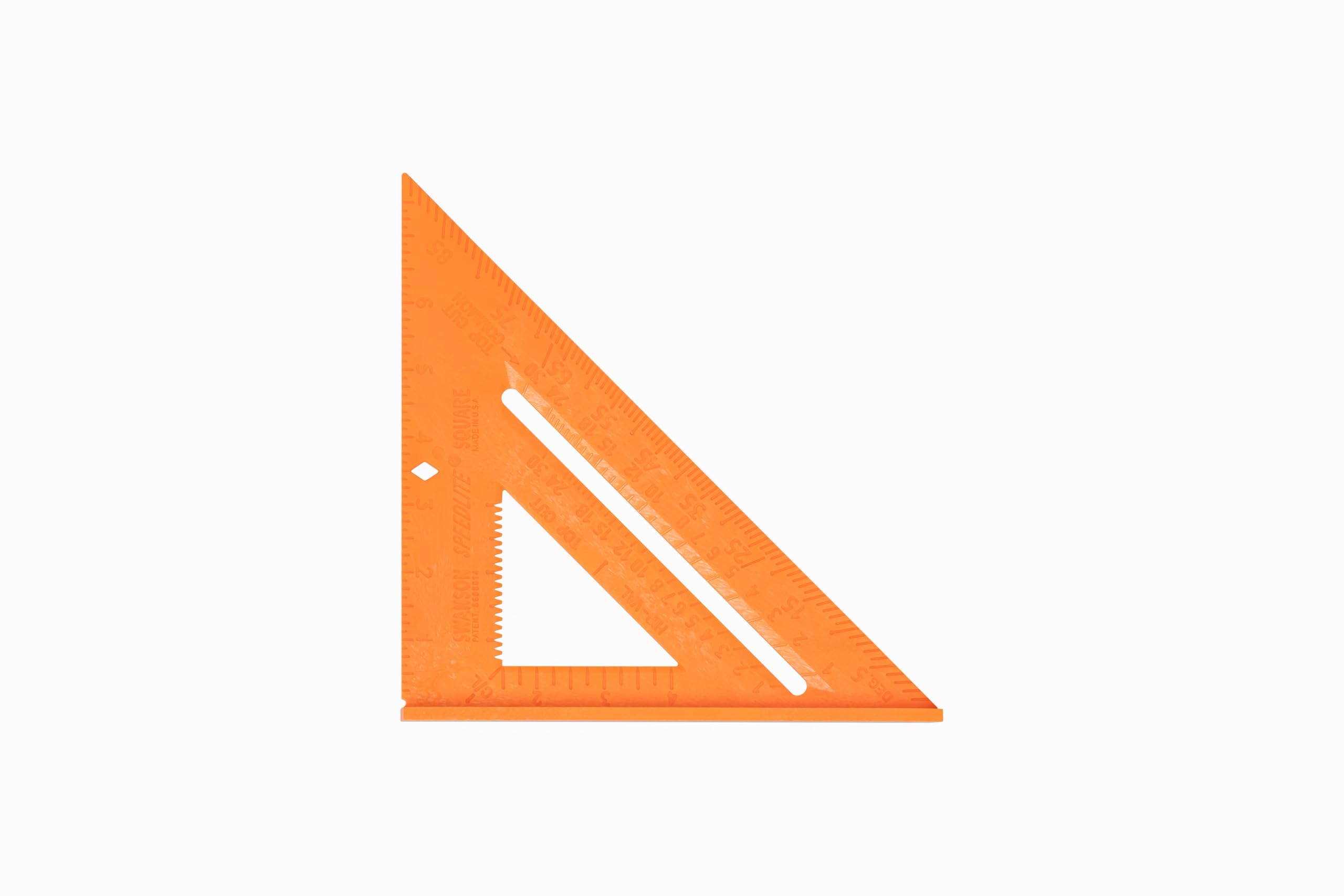
Three point two ounces is what you notice first. The Speedlite is a structural composite triangle, and beside the aluminum squares here it nearly disappears in a pouch until you need it. The orange is the other reason it earns a spot: set it down in grass, on a dark roof deck, or on a bench buried in offcuts, and you'll still find it.

For the money there's no better second square. We recommend it as the one that lives in the truck, the one that goes up a ladder for siding — its 8-inch reach crosses an 8-inch siding course in a single pass — and the one you hand someone learning to frame. It's the least expensive pick here, and it does the two things a square has to do: mark square and mark 45.

Composite is not aluminum, and the difference is worth saying plainly. It's lighter and it won't scratch a finished aluminum trim face while you mark it, but it doesn't have the dent-and-carry-on toughness of a die-cast body. The beveled edge and the 1/8-inch scribe notches do the same jobs as the metal squares, and there's a center-line guide for finding the middle of round stock that we ended up using more than expected.

Bottom line: The square we recommend as a second one: light enough to forget, bright enough to find, and the cheapest way into the category.

Check Latest Price
#04

Best for Scribing

Johnson Johnny Square 1904-0700

94 /100
Kirk Score Outstanding
Size
7 in.
Finish
EZ-Read black matte
Weight
4.8 oz
Material
Aluminum
Check Details on Amazon

Pros

  • Scribe notches every quarter inch up the blade
  • High-contrast black body with white markings
  • Broad fence doubles as a saw guide

Cons

  • Printed graduations wear with hard use

If you mark with a pencil dropped into a notch rather than pressed against an edge, this square was built for you, and it's the one we reach for when a project is more marking than cutting. The scribe notches run every quarter inch the whole length of the blade, past the 6-inch mark, which turns the tool into a marking jig: hook the fence, drop the pencil in the notch you want, and drag a parallel line down a board with no tape involved.

The finish is why it stayed in the front pocket. Black anodized body, white markings, low glare — it reads more easily than bare aluminum under shop lights and doesn't flash at you in the sun. The body has machined edges, the broad fence works as a saw guide for crosscuts and miters, and the distance and angle scales are laid out for stair stringers, which is a job most squares make you do twice.

The catch is simpler than it looks: there's no manual in the box, and the stair and rafter scales are the reason to pick this over a plainer square. You'll find them online in five minutes, but you'll be finding them. Everything else about the tool — the machined edges, the broad fence, the 4.8-ounce body — answers a framing day without complaint.

Bottom line: A marking-first square for anyone who works with a pencil in a notch; the notches and the contrast finish earn it a place.

Check Latest Price
#05

Best for Rough Framing

DEWALT DWHT46031 Rafter Square

95 /100
Kirk Score Outstanding
Body
10.3"L x 7.3"W
Material
Extra-thick extruded aluminum
Graduations
1/8 in.
Check Details on Amazon

Pros

  • Extra-thick extrusion stands up to knocks
  • Wider fence lies flat on cupped lumber
  • Bold black-on-white markings read at a distance

Cons

  • Wide fence won't slip into a tight reveal

Picking this one up is the moment it makes its case. The extrusion is noticeably thicker than the other aluminum squares here and the fence sits wider against the board, so on a crowned or cupped 2x the square lies flat instead of rocking on the high spot. We noticed the difference first on salvaged lumber, which is exactly where a square has to earn its keep.

For framing and tear-out work, this is the square we want in the pouch. The black-on-white markings are bold enough to read from a step away, which matters when you're marking overhead, and the thick body has taken knocks that would have peened a thinner corner. It isn't a finish carpenter's tool and doesn't pretend to be — it's the one you grab when the lumber is rough and the tolerances are generous.

At 10.3 by 7.3 inches it's a full-size body rather than a compact one, so it wants a real pouch pocket and not a shirt pocket. And if your days are cabinets and built-ins rather than framing, the extra thickness buys you nothing you'll feel in the hand. That's the honest boundary of the pick: a framing square's temperament in a speed square's shape.

Bottom line: The one we want on rough lumber: a thick extrusion and a wide fence that holds flat when the board doesn't.

Check Latest Price
#06

Engraved-scale value

Mecurate 7-Inch Rafter Square

93 /100
Kirk Score Outstanding
Size
7 in.
Scales
Laser-engraved
Material
Die-cast aluminum
Graduations
1/8 in.
Check Details on Amazon

Pros

  • Laser-engraved scales won't rub off
  • Thick die-cast body with polished corners
  • Wide base sits flat on a board edge

Cons

  • Eighth-inch graduations only

The worry with a budget aluminum square is the numbers. Printed scales rub away against a tool bag inside a season, and then you're marking from memory. Mecurate laser-engraves its scales into a frosted, oxidized body, so there's no ink to lose — and that single decision is why this one made the list at all.

The rest is sensible. The die-cast body is thickened, the base is wide enough to sit flat on a board edge, the corners are polished so they don't gouge what you're marking, and there's a hang hole at the point for a nail on the wall. The scribe bar does what a scribe bar should. Nothing about it feels skimped at the price.

Where it gives ground to our top pick is the scale: eighths only, no sixteenths, fine for framing and limiting for finish work. The diagonal pitch scales are there to learn on your own. As a second square for the truck, or a first one for someone whose work is 90 and 45 degree marks on 2x stock, it asks very little of your money.

Bottom line: A sensible second square: laser-engraved scales that won't rub away, on a thick body that sits flat, with eighths and no more.

Check Latest Price
#07

Wide stock

Beslands 12-Inch Rafter Square

92 /100
Kirk Score Outstanding
Body
17"L x 12"W
Size
12 in.
Material
Aluminum
Graduations
1/8 in.
Check Details on Amazon

Pros

  • 12-inch reach spans wide stock
  • Laser-etched graduations won't rub off
  • Lipped edge catches the board
  • Black finish cuts glare

Cons

  • 17-inch body is awkward in a pouch

Twelve inches changes what counts as a one-pass cut. Spanning a vinyl plank before you score it, squaring a shingle course, or laying out across a wide board, the extra reach means the square covers the material instead of walking along it. If you've ever cut wide stock with a 7-inch square and a clamped straightedge, this is the tool that ends the ritual.

The build is sound. Aluminum alloy, laser-etched graduations that won't rub off, a lipped edge that catches the board, and a black finish with light markings that reads without glare. It's sold as a 5-in-1 — protractor to 90 degrees, miter square, saw guide, depth scriber — and it does those jobs, though what you're really paying for is reach.

Squareness is the thing to verify. Not every one of these arrives straight, so run the flip test the day it lands: butt it against a factory edge, strike a line along the blade, flip the square, and strike the same line again from the same edge. If the lines don't meet, send it back before it costs you a cut.

For us this is a specialist's square rather than an everyday one. Seventeen inches of body doesn't ride in a pouch, and on small stock the pivot sits so far from your mark that a 7-inch square is simply faster. But for wide material it removes a whole setup step, and that's worth hanging on the wall beside the miter saw.

Bottom line: The wide-stock specialist: buy it when the material is bigger than your 7-inch square, not to replace one.

Check Latest Price
#08

Two-square value

Mr. Pen 7-Inch Rafter Square 2-Pack

92 /100
Kirk Score Outstanding
Pack
2 squares
Size
7 in.
Material
Aluminum alloy
Graduations
1/8 in.
Check Details on Amazon

Pros

  • Two 7-inch squares in one pack
  • Engraved markings don't rub off
  • Light aluminum body won't rust

Cons

  • Embossed numerals are harder to read

Two squares for roughly what one costs elsewhere is the pitch, and it's a fair one if you know what you're getting. The second one lives in the truck, the shed drawer, or the toolbox you lend out; the first stays on the bench. Both are 7-inch aluminum alloy with engraved graduations, a flat edge on one side, and enough body to guide a utility knife along a mark.

They're light, they don't rust, and the engraved markings outlast printed ones in a bag. Where the price shows is the detail: the numerals are embossed rather than inked, so they read as shadow and relief rather than contrast, and they're chunkier than the crisp scales on the Irwin or the Swanson. Under a low rafter or in flat shade, that's a real difference.

Squareness is the other thing. These are sold as layout tools for home projects rather than precision instruments, so check yours against a straight edge before you trust it on a cabinet. For decking, fencing, and shed framing — work where a sixty-fourth disappears into a 2x4 — they're serviceable.

The honest role for this pair is the square you can leave anywhere and not wince about: in the rain, in a truck bed, in a bucket of offcuts. Buy it as a second square, a loaner, or a starter tool for someone filling a first toolbox, and keep the sharper-edged pick for the cuts that show.

Bottom line: Buy the pair as a leave-it-anywhere square for rough work, not as the one you trust when a joint has to close.

Check Latest Price

How We Tested the Speed Squares

We started by rounding up every rafter square we could get our hands on in the 7- to 12-inch range, then narrowed the field by body material, how wide the base flange was, and whether the scales were printed on or cut into the aluminum. That left 14 squares, and we used them for four months on a deck build, a set of stair stringers, and a run of window casing.

Each one lived where a square actually lives — clipped to a pouch or loose in a bag with screws and offcuts. For squareness, we butted the tool against the factory edge of a sheet of plywood, scribed a line, flipped it over, and scribed the same line again; the gap between the two lines is the tool's error, doubled. We ran the same test on the 45-degree corner and on the degree scale, and checked the rafter tables against a framing calculator to see how much measurement range each one really gave us before we needed a second tool.

We read the markings at arm's length in a dim garage and again in direct sun, and ran a thumbnail across each scale to feel whether it was cut in or sitting on top of the finish. Durability meant drops from waist height onto concrete, a week rattling around a tool bag, and a few accidental passes with a saw blade. Value came down to whether the extras — a reference booklet, a pouch — earned their place, and whether stepping up a size actually bought more usable layout for the bulk it added.

How to Choose a Speed Square

Size Comes First

The angle a square marks is set by its corner; length only decides how far that mark reaches. A 7-inch body covers 2x4 through 2x10 layout and still slips into a pouch. An 8-inch square earns its place on siding and trim, where the extra reach crosses a course in one pass. A 12-inch spans vinyl plank, shingles, and wide boards a smaller square has to walk along.

Bigger is not truer. A 12-inch body marks no squarer than a 7-inch one, and it won't ride in a tool belt — the Beslands here is a wall tool, not a pocket tool.

Readability Is the Spec Nobody Prints

What separates a square you trust from one that annoys you is contrast, not color. Deep, light markings on a matte dark body read at arm's length; polished aluminum turns into a mirror on a sunny deck, which is exactly where framing layout happens. Hold any square out in daylight before you commit.

Hi-viz orange helps you find a tool in the grass, not read its graduations. And printed scales wear away long before a die-cast body does, so pay attention to whether the numbers are cut into the metal or laid on top of it.

The Fence, the Heel, and the Scribe Bar

The fence is the lip that hooks the board edge, and a deeper heel — 7/8 inch is the common figure — keeps the square from walking while you pull a line. Scribe notches along the blade let you drop a pencil in and drag a parallel mark without a tape. A lipped edge also lets you run a circular saw's shoe against the body for crosscuts.

If most of your work is marking rather than cutting, notches and heel depth matter more than any angle scale on the tool.

Aluminum or Composite

Aluminum takes drops, doubles as a saw guide, and holds a machined corner through years of abuse; it is also heavier and cold in the hand in January. Composite squares are lighter, cost less, and are kinder to finished trim because they won't scratch an aluminum face you're marking.

What composite won't do is serve as a saw guide, and it doesn't enjoy concrete. Buy aluminum for the tool bag and keep a composite one for siding, overhead work, and anywhere a dropped tool is likely.

Frequently Asked Questions

Final Verdict

The Swanson Speed Square S0101 is the one we tell people to buy first. A machined 45 and 90 degree corner, a 7/8-inch heel that hooks a board, and a matte body that stays readable in direct sun cover framing, decking, and trim — and the blue booklet turns the diagonal scales from decoration into a working part of the tool.

Change the job and the pick changes: the IRWIN for sixteenth-inch layout on trim and cabinets, the Speedlite for siding, overhead work, and a square you won't grieve over, and the Beslands 12-inch when the stock is wider than the square you carry.