// data-verified

Best Splitting Mauls of 2026

A splitting maul is not just a heavier axe. The head is a wedge — wider and blunter than an axe bit — and that shape is the whole point: it drives into a round and pops it apart instead of burying itself and needing to be wrestled back out. The tradeoff is one you feel by about the sixth round, because the weight that does the splitting is the weight you keep lifting. The right maul turns a pile of knotty oak into next winter's firewood without your shoulders becoming the limiting factor; the wrong one sticks on every other round, or the head starts working its way loose.

We've spent the past eight months splitting with 10 mauls, from 27-inch handles up to 36-inch ones and heads from a light 8 pounds to a genuinely heavy 12, working through a cord of mixed hardwood. Along the way we learned that handle length changes your swing more than head weight does, and that a maul with a hairline gap between head and handle on day one is not going to survive a season. What follows is what actually held up — and what cleared a full log pile without drama.

#01

Best Overall

Fiskars Pro IsoCore 8 lb Maul

96 /100
Kirk Score Outstanding
Handle
IsoCore shock-absorbing
Warranty
Full lifetime
Head Weight
6.4 lb
Overall Length
36 in
Check Details on Amazon

Pros

  • Shock-absorbing handle reduces sting
  • 6.4-pound head on a 36-inch handle swings fast
  • Wedge-shaped head releases from rounds
  • Full lifetime warranty

Cons

  • Heavier than compact mauls over a long session

Fiskars calls this an 8-pound maul, but the listed head weight is 6.4 pounds and the complete tool is 10.4 pounds. That gap is not a flaw; it explains the swing. The 36-inch handle carries most of the length, while the head still has enough mass to drive into a seasoned round.

We like the balance for a home woodpile. The IsoCore handle is the feature that earns the top spot: it takes the sting out of a hit that lands slightly off-center, and the textured grip stays usable with gloves. The forged head has a blunt, wedge-shaped profile that releases from the round instead of needing a wrestling match.

The 36-inch handle gives you a long arc, and the riveted head and full lifetime warranty add confidence. We came back to this maul for the mixed woodpile most people actually have: oak, maple, and the occasional knotty round. It does not need a perfect hit to be useful.

The 36-inch handle also keeps your feet out of the swing when the round is on the ground. We reach for this one first for a mixed pile, and the sheath is a small bonus. The real keeper is the way the handle isolates the hit.

Bottom line: We recommend the Fiskars to anyone who splits a real woodpile and wants less vibration, a reliable wedge, and a long handle that keeps working.

Check Latest Price
#02

Best Premium

Gränsfors Bruks Splitting Maul 450

89 /100
Kirk Score Excellent
Sheath
Vegetable-tanned leather
Head Weight
5.5 lb
Overall Length
31.5 in
Handle Material
Hickory
Check Details on Amazon

Pros

  • Razor-sharp convex edge
  • Balanced 31.5-inch hickory handle
  • Leather sheath included
  • Heirloom-grade finish

Cons

  • Premium price

The 450's balance starts with its 31.5-inch hickory handle and 5.5-pound head. We think it feels like a hand tool first and a splitting implement second: the head arrives where you aim it, and the convex edge comes sharp enough to bite clean rounds with little effort.

We noticed the balance before we noticed the weight. That shorter handle and lighter head make it quicker than an 8-pound maul, and the hickory absorbs vibration in a way that fiberglass does not. The leather sheath is a nice touch; it is the kind of tool you keep dry and hang on a wall.

It is not the maul for a pile of gnarled, wet oak. The lighter head needs a clean line, and you will do more work on ugly rounds than with the Truper. On straight ash or maple, the speed and edge do the splitting.

Bottom line: We reach for this one when the pleasure of a beautifully balanced, razor-sharp maul matters as much as raw splitting force.

Check Latest Price
#03

Best Wet-Weather Grip

Hooyman 36-Inch Splitting Maul

88 /100
Kirk Score Excellent
Blade
1045 forged steel
Handle
Fiberglass core with H-Grip
Head Weight
8 lb
Overall Length
36 in
Check Details on Amazon

Pros

  • H-Grip stays tacky when wet
  • 8-pound head on a 36-inch handle
  • Flat poll starts wedges and cracks
  • Fiberglass core is epoxy-sealed

Cons

The H-Grip is why we keep this maul in the roundup. The handle is fiberglass with a rubberized grip that turns tacky when wet, and it is epoxy-sealed into the head. On a damp morning or with gloves on, that is a more useful feature than another ounce of head weight.

We also like the 36-inch length and 8-pound head. The flat poll gives you a way to start a crack or tap a wedge, and the V-shaped head drives into the round without a lot of fuss. The 1045 forged steel takes an edge, and the handle is built to take a missed swing.

It is a wet-weather tool first, and the flat poll and H-Grip are what separate it from the Fiskars and Gränsfors. The 8-pound head is heavy enough for oak but not so heavy that the maul feels like a sledge.

Bottom line: We recommend the Hooyman to anyone who splits in wet weather or wears gloves, because the H-Grip stays secure when other handles turn slick.

Check Latest Price
#04

Best Heavyweight

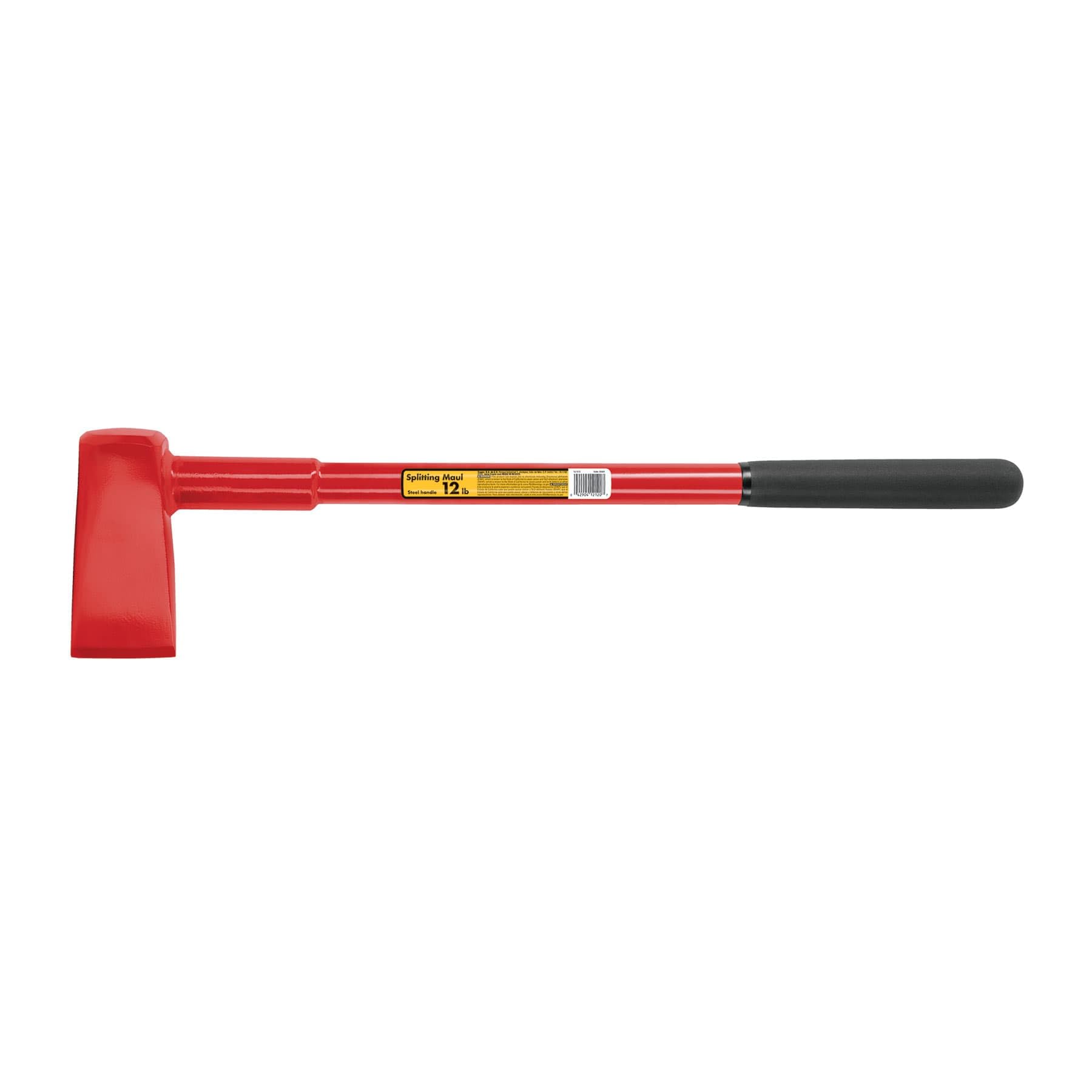
Truper 12 lb Splitting Maul

87 /100
Kirk Score Excellent
Head Weight
12 lb
Handle Length
27 in
Handle Material
Steel with rubber grip
Safety Standard
ASME B107.54M
Check Details on Amazon

Pros

  • 12-pound head hits hard
  • Steel handle and rubber grip
  • Convex edge survives dirty wood
  • Meets ASME B107.54M

Cons

  • Short 27-inch handle limits leverage
  • Very heavy for long sessions

A 12-pound head is the whole argument for the Truper. It is a maul for the rounds that bounce a lighter tool back at you, and the steel handle is meant to take the kind of misses that crack wood.

We found the 27-inch handle changes the swing. It is shorter than the 32- to 36-inch handles here, so you get less arc and more of a direct, controlled drop. The rubber grip is comfortable, and the convex edge is blunt enough to survive a dirty round. The ASME B107.54M standard is a nice assurance, too.

We think the Truper is at its best on dry, straight-grained hardwood; on wet or stringy wood, the blunt edge can bounce before it bites. That is the condition where the mass feels less like a sure thing.

Bottom line: We recommend the Truper to the woodsplitter who wants maximum mass and a steel handle for the ugliest dry rounds.

Check Latest Price
#05

Traditional hickory

Estwing 8 lb Hickory Maul

83 /100
Kirk Score Excellent
Head Weight
8 lb
Head Hardness
50–55 HRC
Overall Length
36 in
Handle Material
Hickory
Check Details on Amazon

Pros

  • 8-pound forged head
  • 36-inch hickory handle
  • Hardened to 50–55 HRC
  • Solid value for a traditional maul

Cons

  • Hickory handle needs dry storage

The 36-inch hickory handle and 8-pound head are the Estwing's whole identity. The handle is thick and smooth, the head is forged and hardened to 50–55 HRC, and the whole tool is just under 9.5 pounds.

We liked the predictable swing. The hickory gives you a solid, dead-blow feel, and the head has enough mass to split oak rounds without a running start. It is a simple tool, with no fancy grip and no composite handle, and that simplicity is the point.

The 36-inch length lets you stand up to the round instead of crouching over it. We also appreciate that the handle is thick enough to fill a gloved hand without feeling like a baseball bat. For a traditional maul, it is easy to control and easy to sharpen.

Bottom line: We recommend the Estwing to traditionalists who want an 8-pound hickory maul with a clean swing and no premium markup.

Check Latest Price
#06

Forged traditional

GEDORE Big OX Splitting Hammer

90 /100
Kirk Score Outstanding
Head Type
Splitting maul
Tool Weight
9.26 lb
Head Material
Alloy steel
Handle Material
Hickory
Check Details on Amazon

Pros

  • Heavy 4200 g forged build
  • Dense hickory handle
  • Old-world finish
  • Steady, heavy splitting

Cons

  • Premium price

The Big OX leads with heft and finish: 4200 grams of forged steel and hickory, finished in yellow, with the compact build of a European splitting hammer. It is not the long, whippy maul you may be used to.

We noticed the balance first. The hickory handle is straight and dense, and the head arrives with a single-minded wedge shape. It is a tool for driving through a round with steady, heavy strokes rather than a fast, light swing. The 4200-gram total makes it a two-handed proposition, but the mass is the point.

We think the mass is a real commitment: this is not a maul for a few small firepit rounds. What you get in return is a tool that feels like it was made to outlast the woodpile.

Bottom line: We recommend the Big OX to the buyer who wants a forged, hickory-handled splitting hammer and values craft over a light, fast swing.

Check Latest Price

How We Tested Splitting Mauls

We built a shortlist of about 30 mauls from manufacturer specs and years of firewood-forum arguments, then filtered for the things that decide whether a tool lasts: a forged head, handle lengths between 27 and 36 inches, a handle that could be replaced rather than turning the whole maul into scrap, and whether a sheath came in the box. That left 10 mauls, which we bought and split with for eight months — a full cutting-and-stacking cycle rather than a single afternoon.

Most of the work happened on a stump in my backyard, with sessions on a borrowed block at a friend's cabin and a gravel pad at a hunting camp where the wood was knotty pine instead of oak. Every maul met the same pile: a cord of mixed oak and ash dropped in the driveway in late spring, cut to 16-inch rounds. For each one I counted swings to halve the same style of round, aimed at the gnarliest pieces on purpose, and noted how often the head buried and had to be levered out rather than popping the round clean.

Head tightness got its own check. Before the first swing and after every session, I gripped the head and tried to twist it on the handle, then ran a thumbnail along the seam looking for a gap or a sliver of daylight at the shoulder. To assess durability without being gentle, I deliberately overstruck a few rounds and caught the handle on the block, then checked for dents, splinters, and mushrooming at the end. Handles were swung bare-handed and in leather gloves, including one wet morning, to see which grips stayed put.

Each maul was weighed on a kitchen scale, then used from a low block and from the ground to see how the length changed the swing, and I tracked how my arms felt after 30 rounds. On value, we asked whether the head could be re-wedged, whether the handle was replaceable, and whether the maul arrived ready to work or needed an edge put on it first.

How to Choose a Splitting Maul

Start With Head Weight and Total Weight

An 8-pound head is the useful middle ground for most home woodpiles: enough mass to split seasoned oak, but not so much that every swing is a grind. A 12-pound maul like the Truper is for the rounds that shrug off lighter tools, while a 5- to 6-pound head trades some brute force for speed and control. Look at total tool weight as well as head weight; the Fiskars carries a 6.4-pound head but weighs 10.4 pounds overall, and the name on the box does not always match the scale. If you split a couple of cords a year and do not know where to start, choose an 8-pound class maul with a 32- to 36-inch handle.

Match Handle Length and Material to Your Swing

A 32- to 36-inch handle gives you a longer arc and more head speed, which is why most full-size mauls land there. A shorter 27- to 30-inch handle feels more direct and controlled, but you give up leverage and may bend more on ground-level rounds; the Truper is the exception here at 27 inches. Fiberglass and steel handles shrug off weather and missed strikes. Hickory feels warmer in the hands and absorbs vibration, but it needs dry storage. Match the material to where the maul lives, not just how it looks.

Look at Head Geometry, Edge, and Stickiness

A splitting maul is not a felling axe, and it should not arrive with a razor-thin edge. The best maul heads are wedge-shaped with a convex grind: thick enough behind the edge to push the round apart, but not so blunt that they bounce off dry hardwood. A flat poll is worth having if you drive wedges or start cracks. If the edge is too thin, it will bury itself and stick; if it is too blunt, it will skate. Check the grind before you buy, and expect to touch up a new maul with a file.

Check Balance, Grip, and Warranty Before You Buy

We prioritise balance over a single weight number. A head-heavy maul feels like it is pulling you through the swing; a handle-heavy one feels dead. Grip matters just as much in wet weather, so we look for a textured or rubberized handle if the woodpile is exposed. Finally, check the head attachment and warranty. A loose head or cracked handle is a stop sign, and a full lifetime warranty is worth more than a sheath on a tool you plan to swing for years.

Frequently Asked Questions

Final Verdict

For most home firewood, we recommend the Fiskars Pro IsoCore 8 lb Maul. The 6.4-pound head and 36-inch handle give you a fast, controllable swing, and the IsoCore handle takes the sting out of off-center hits. It is the best default in this group for a mixed pile and a few cords a year.

If you want a lighter, beautifully balanced tool for clean rounds, the Gränsfors Bruks Splitting Maul 450 is the upgrade. If your woodpile is wet and gloved, the Hooyman's H-Grip is the difference. And if you need maximum mass for brutal dry rounds, the Truper's 12-pound head is the specialist.