// data-verified

Best Stick Welders of 2026

A stick welder's spec sheet is a work of optimism. The badge says 200 amps; the circuit in your garage says 20, and the breaker calls it quits somewhere in the second rod. What you want instead is a machine that lays a steady bead on the power you actually have and lights on the first tap.

We've spent the past seven months running 11 of them — dual-voltage inverters, mini 110-only units, a couple of transformer-style holdovers — on gate hinges, trailer brackets, and plenty of scrap plate. Almost every box advertises hot start, arc force, and anti-stick; the labels matter far less than how the machine is tuned. Dual voltage earns its keep only if you have a 240 outlet to plug into, and weight counts for more than the specs admit, since these get carried to the work.

Weld strength never shows up on a spec sheet either, so most of my notes came down to bead appearance and whether a joint held after a bend test. The picks below are sorted by who they suit, from first machine to truck bed.

#01

Best Overall

DEKOPRO 160A MMA Welder

93 /100
Kirk Score Outstanding
Weight
11.1 lb
Max Output
160A
Input Power
110/220V
Certification
ETL
Check Details on Amazon

Pros

  • Runs on 110V or 220V
  • 160 amps gives real 220V headroom
  • ETL listed, with a legible LCD
  • Leaves budget for a helmet

Cons

  • No welding helmet in the box

Dual voltage usually carries a premium. The 110V-only boxes sit at the cheap end of this set, and the price steps up as soon as a machine accepts 220V. The DEKOPRO is the exception: both voltages, a 160-amp ceiling, and a price in the same bracket as the single-voltage minis.

What the second voltage buys is headroom. On a household circuit it runs 3/32 rods comfortably and will push a small 1/8 rod if the breaker agrees; on 220V it has run 1/8-inch 6011 and 7018 without complaint. That is the difference between a machine for sheet metal and one for a gate frame. The hot start helps too, since our first arc came on the first rod rather than the fifth, and the display stays legible with a helmet down.

Longevity is the part we cannot sign off on. This is a budget inverter, and the failure that shows up is a board that still powers on but will not strike an arc; the machine looks fine and is not. Buy it where returns are easy, keep the receipt, and work it hard in the first month rather than the sixth.

The carton holds the machine, an electrode holder, a ground clamp, a power adapter cable, and a brush. No helmet and no rods, which is the usual omission at this level and worth remembering when you add up what a first weld actually costs.

Bottom line: The one we tell most people to buy: it runs on the outlet you have and the one you may add later, for barely more than a 110V-only box.

Check Latest Price
#02

Best for Adding Lift TIG

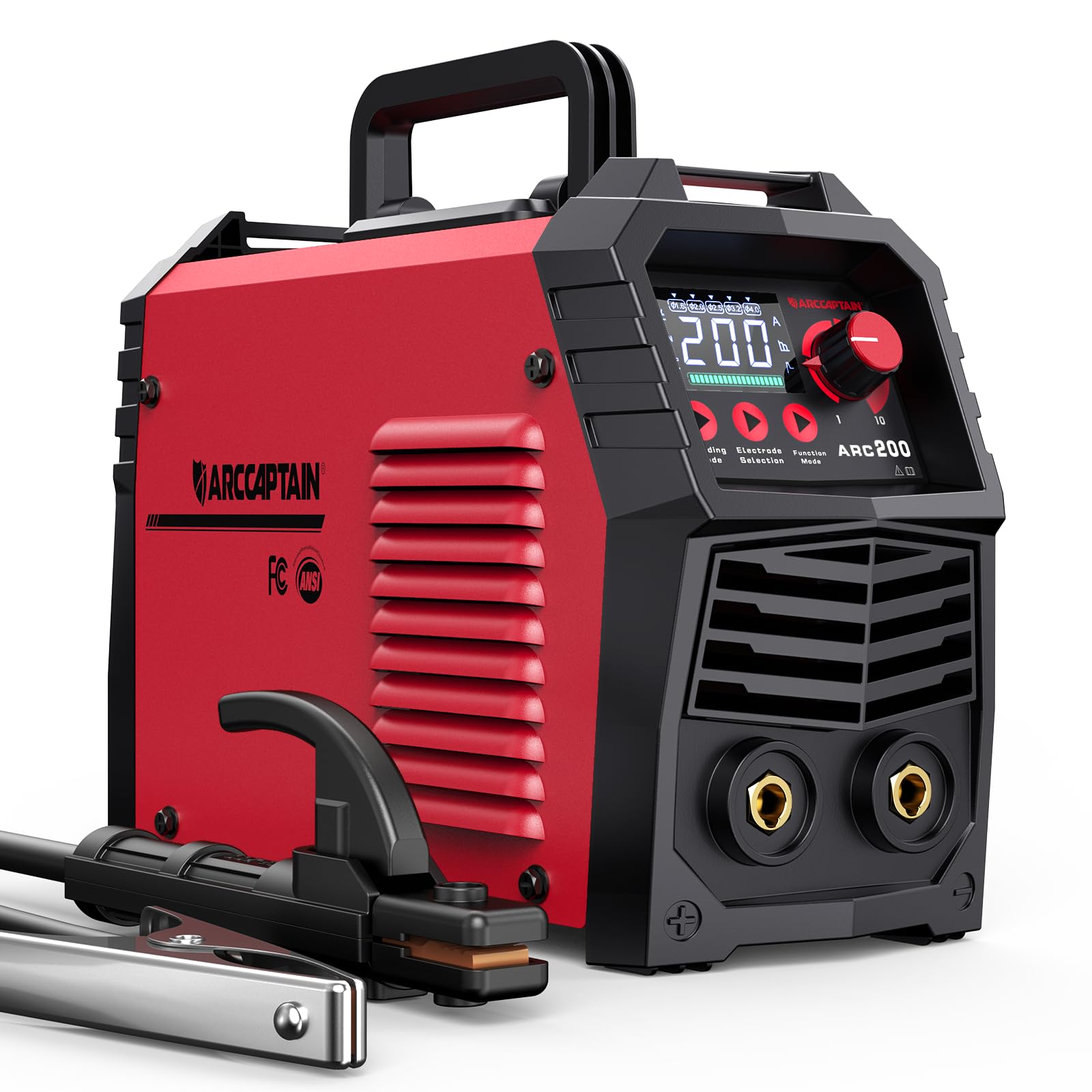
ARCCAPTAIN 200A ARC Welder

91 /100
Kirk Score Outstanding
Weight
11 lb
Processes
Stick and lift TIG
Max Output
200A
Input Power
110V/220V
Check Details on Amazon

Pros

  • Adds lift TIG to a dual-voltage box
  • Synergic control sets current from rod size
  • LED display readable with a helmet on
  • 110V adapter and shoulder strap included

Cons

  • Output runs below the 200-amp badge

The extra money here is not buying amps, it is buying a second process. Switch the ARCCAPTAIN to lift TIG and the same box will run a torch on thin sheet and stainless. The torch is a separate purchase and so is the argon, but the mode is there, and none of the other dual-voltage machines in this group have it.

Synergic control is the part a beginner feels. Set the rod diameter and the machine picks current and voltage, so your first bead does not begin with a guess. It is a starting point rather than an answer, since you will still move the dial once you know what a wet bead looks like, but it gets you into the arc faster than a bare amperage knob.

On 110V, be realistic. A household circuit cannot feed anything near the 200-amp badge, so plan on 3/32 rod and sheet-metal work at that voltage. On 220V it welds quarter-inch steel with a 1/8-inch rod, and the anti-stick function keeps a buried rod from turning the stinger into a heating element. For a shop with a 220V outlet and a nagging interest in TIG, this is the machine we point at.

Two details worth knowing. The 110V adapter in the box means you can test the machine on a wall socket before committing to a 220V circuit, which is a friendlier arrangement than it sounds. And the shoulder strap matters: at 11.02 pounds this is not a pocket welder, but it slings over a shoulder easily enough for the walk to the gate.

Bottom line: Worth the extra money if TIG is on your list: it is the only dual-voltage machine here that also runs lift TIG, and synergic control shortens the learning curve.

Check Latest Price
#03

Best for Tuning the Arc

YESWELDER 205A Stick Welder

90 /100
Kirk Score Outstanding
Weight
8.8 lb
Max Output
205A
Input Power
110V/220V
Arc Controls
Hot start and arc force, 1-10
Check Details on Amazon

Pros

  • Separate hot start and arc force, ten positions each
  • Dual voltage with the adapter included
  • 8.8 pounds in a metal case
  • LED display showing current and mode

Cons

  • Costs more than the top pick

Most machines here give you one knob and a fixed hot start. The YESWELDER 205 splits hot start and arc force into separate ten-position controls, which is the difference between a welder that behaves one way and one you can dial to the rod in your hand.

The rest is sensible rather than exciting: 110V and 220V input with the adapter in the box, a 205-amp badge, 8.8 pounds, and a large LED that shows current and mode. The case is metal, the handle sits on top, and overcurrent, overload, and thermal protection are all part of the package.

The dials earn their keep when a rod misbehaves. Turn arc force down and the arc stays tight instead of digging into thin or dirty steel; turn it up and the rod stops stubbing out as you lean into a joint. Ten positions is more granularity than anyone needs in month one, and it is exactly what you want in month six.

This is the dual-voltage machine we point experienced hobbyists toward, and the one we take when we do not yet know what we will be welding. If you have never struck an arc, the DEKOPRO's single knob gets you welding sooner.

Bottom line: Our pick for anyone who wants to tune the arc: separate hot-start and arc-force dials in a dual-voltage box that weighs under nine pounds.

Check Latest Price
#04

Best Compact Dual-Voltage

HONE 140A ARC Welder

91 /100
Kirk Score Outstanding
Dimensions
9 x 3.9 x 5.6 inches
Duty Cycle
40% at 120A (110V) and 140A (220V)
Input Power
110V/220V
Output Range
10 ~ 120A (110V) / 10 ~ 140A (220V)
Check Details on Amazon

Pros

  • 40% duty cycle at 120 amps on 110V
  • Fits on a shelf at 9 x 3.9 x 5.6 inches
  • Anti-stick eases a buried rod free
  • Display shows real welding current

Cons

  • 140 amps is the ceiling, so thick plate is out

Nine inches by four by six and 9.44 pounds: the HONE is a lunchbox. That is the appeal for anyone welding in a garage where the bench is also the assembly table, because it lives on a shelf and comes down when something breaks instead of claiming the corner a full-size box needs.

The number that decides whether it is enough machine is the duty cycle: 40% at 120 amps on 110V, up from the 25% the earlier version of this model carried. In practice that is a full 3/32 rod, a pause to chip and reposition, and another rod, rather than a thermal cutout teaching you patience. On 220V the ceiling rises to 140 amps, which buys 1/8-inch rod on heavier stock.

Anti-stick is the feature beginners will thank it for. Bury the rod and the machine cuts current instead of turning your stinger into a heating element, which saves electrodes and the temper lost to chipping a stuck rod free. The display and the trouble indicator tell you what the machine is unhappy about instead of leaving you to guess.

For brackets, exhaust, gates, and sheet it is plenty, and the small size changes how often it gets used. We have carried it to the truck for a five-minute repair rather than uncoil an extension cord, and a heavy transformer in the corner of a barn tends to stay in the corner.

Bottom line: For a bench that doubles as a shelf, get this one: small, dual voltage, and geared so a 40% duty cycle keeps you welding instead of waiting.

Check Latest Price
#05

Best Budget Dual-Voltage

S7 250A Stick Welder

91 /100
Kirk Score Outstanding
Weight
9.13 lb
Warranty
2 year
Max Output
250A
Input Power
110V/220V
Check Details on Amazon

Pros

  • Two-year warranty
  • 110V and 220V in one box
  • Covers E6010 through E7018
  • Digital display with hot start and anti-stick

Cons

  • 250-amp rating needs 220V to approach

A two-year warranty is rare at the bottom of this set, and it is the first thing we look at on the S7. Budget inverters are the machines that fail, so a manufacturer willing to cover one for two years is saying something the spec sheet cannot.

The rest is a familiar package: 110V and 220V input, a 250-amp badge, 9.13 pounds, a digital display, and hot start, arc force, and anti-stick. The rod chart covers E6010, 6011, 6013, and 7018, which is nearly everything a home welder touches.

For a first machine with a 220V outlet in the garage, this is the one we name. It does the work, it is covered for two years, and it leaves room in the budget for a helmet, gloves, and a stinger that actually grips.

That last item is not a joke. The holder and ground clamp are the cheap parts of the kit: they function, but the lead goes stiff in cold weather and the jaws do not bite a rusty frame with much enthusiasm. Swapping them for better hardware is the cheapest upgrade you can make to this machine.

Bottom line: The budget answer: dual voltage and a two-year warranty, with enough machine for gates and trailer work if you already have a 220V outlet.

Check Latest Price
#06

Best Starter Kit

Hpoouo 200A Mini Welder

89 /100
Kirk Score Excellent
Weight
7.79 lb
In The Box
Welder, 20 rods, gloves, 2 chipping hammers
Max Output
200A
Input Power
110V
Check Details on Amazon

Pros

  • Rods, gloves, and hammers included
  • 7.79 pounds, fits under a truck seat
  • Runs off a standard 110V outlet
  • Hot start and arc force for cold steel

Cons

  • 110V only, so heavier plate is out of reach
  • Leads run short around a project

Most welders arrive as a bare box and a manual, and you spend again before the first bead on a helmet, gloves, and rods. The Hpoouo skips half of that: twenty 1/16-inch E6013 rods, gloves, two chipping hammers, and a brush come with it. Add a helmet and you are welding the afternoon it lands, and for a first machine that completeness is worth more than another twenty amps on the badge.

It is a 110-volt box with a dial that runs from 20 to 200 amps, in a case about 8 by 4 by 5 inches that weighs 7.79 pounds. Small enough to live under a truck seat, light enough that fetching it from the shed is not a decision. The rods in the box tell you the intent: 1/16-inch means sheet metal, brackets, exhaust, and gate hinges.

Where it surprised us was thin stock. At the low end of the dial the arc is steady enough to stitch sheet metal and exhaust tubing without blowing through, which a box this small has no right to do. Arc force and hot start do their jobs on cold, dirty steel, and the display is easy to read with a helmet down.

The weak point is the plumbing. The ground cable and the rod holder are the parts that let go, so check the crimps on both before the first job and re-terminate anything that pulls free; ten minutes with a crimper saves a call to support. The gloves are thin enough to treat as spares.

Bottom line: Buy it if you want to weld the day it arrives: rods, gloves, and hammers in the box, and it runs off any 110V outlet.

Check Latest Price
#07

110V garages

YESWELDER 125A Mini Welder

89 /100
Kirk Score Excellent
Weight
4.4 lb
Duty Cycle
60% at 125A
Max Output
125A
Input Power
110V
Check Details on Amazon

Pros

  • 4.4 pounds, one-hand carry
  • 60% duty cycle at 125 amps
  • Adjustable hot start and arc force

Cons

  • 110V only, so 125 amps is the ceiling

At 4.4 pounds the ARC-125DS is a one-hand carry, leads and all, and its 60% duty cycle at 125 amps is the best stated rating of the 110V-only machines here. If you do not have a 220V outlet and do not plan to add one, this is the machine to buy.

It is a 110V box with a 20-to-125-amp dial, an LED display, and adjustable hot start and arc force, and it is rated for E6011, 6013, 6010, and 7018 rods below 1/8 inch. That last part is the honest limit: this is a sheet-metal, bracket, and exhaust machine rather than a structural welder.

What you are paying for over the mini kits is duty cycle and finish. The 60% figure is measured at the full 125 amps, so 3/32 rods run back to back without the fan taking over the afternoon, and the case and handle feel designed rather than sourced. The box holds the machine, an electrode holder, and a ground clamp. No rods, no gloves, no helmet.

Bottom line: For a garage with no 220V outlet, this is the one we name: 4.4 pounds, a 60% duty cycle at 125 amps, and enough machine for sheet metal and brackets.

Check Latest Price
#08

Farm and yard

Forney 298 Easy Weld 100ST

90 /100
Kirk Score Outstanding
Weight
13.7 lb
Warranty
12 months
Max Output
90A
Input Power
120V
Check Details on Amazon

Pros

  • Steel case and 8-foot leads
  • 12-month manufacturer warranty
  • Runs on a 120V household outlet

Cons

  • 90 amps rules out 1/8-inch 7018
  • 13.7 pounds is heavy for the output

Ninety amps is the whole story with the Forney 298. That is a 3/32 rod on light plate and angle, and it is not enough for 1/8-inch 7018, which wants more current than this box makes.

What you get instead of output is hardware. The case is steel rather than molded plastic, the electrode holder and ground clamp sit on 8-foot leads, and a 12-month warranty backs it from an established US brand. It is also the heaviest machine here at 13.7 pounds.

The TIG in the model name needs reading twice. There is no torch in the box, and the listing does not explain how gas reaches the torch, so before buying this for stainless, price a torch and confirm what the gas side needs. If TIG is not the point, ignore the whole feature; the stick side is what you are paying for.

Where the 298 makes sense is a farm or boatyard shop that wants a metal-cased 120V box with real warranty support and works on gates, mower decks, and light angle rather than structural steel. The case and the support are what the premium buys, and it is the least powerful machine in the group. If output matters more than hardware, the DEKOPRO does more welding for less.

Bottom line: The machine we point at a farm shop that wants a metal case, eight-foot leads, and a year of warranty support, as long as 90 amps covers the work.

Check Latest Price

How We Tested Stick Welders in a Working Garage

We started with roughly three dozen listings and cut hard: no dual voltage or no published duty cycle, gone; anything that couldn't run on a 20-amp household circuit, gone; anything whose rod range stopped at 1/8 inch, gone. That left 11 machines spanning the price range, from mini 110-volt boxes to a 200-amp unit with lift TIG, and we bought every one at retail.

Each machine lived in a garage shop for seven months, on weekend projects and evening practice: gate hinges, a trailer bracket, thin sheetmetal patches, and a lot of quarter-inch scrap. We ran every unit on a standard 110 circuit first, then on 240 where we had it, burning 3/32 and 1/8 rods until the thermal cutout tripped, noting how long that took and how long the recovery ran. We also counted cold arc strikes — a well-tuned hot start lights on the first tap, while a sloppy one sticks and glows the rod.

For weld strength we welded coupons flat, vertical, and overhead, then cut them, bent them in a vise, and hammered the seams to see whether the fusion held or tore out. Each unit got weighed with its leads coiled and carried up and down stairs and in and out of a truck bed. We judged ease of use by handing the stinger to a neighbor who'd never welded, gave the two lift-TIG-capable machines a pass on DC TIG, and checked back at the end for cracked leads, a loose stinger, or amps that had drifted.

How to Choose a Stick Welder

Match the Machine to Your Outlet

Most disappointment in this category comes from a 250-amp badge plugged into a 110V circuit. A standard 20-amp household outlet puts a hard ceiling on output that no inverter gets around, and that is why a dual-voltage machine earns its keep even if you only use the 110V side today: it can grow with a 220V circuit later. If a 220V outlet is never going to happen, buy a 110V-only machine and put the savings into a better helmet.

Decide this first. Rod size, duty cycle, and how thick the steel can be all follow from what the outlet will give you.

Read the Duty Cycle, Not Just the Amps

Duty cycle is how many minutes out of ten a machine can weld before the thermal cutout stops it, and it falls as amperage rises. A box rated 40% at 120 amps gives four minutes of arc and six minutes of cooling at that setting; turn the current down and you can run longer. In practice this sets your pace on thicker steel, where a 40% machine keeps you working and a 25% one makes you stand around. Compare the figures at the same amperage, because a duty cycle quoted at a lower current flatters the machine.

Which Controls Are Worth Paying For

Hot start boosts current for the instant the rod touches down, arc force adds current as the rod closes on the puddle so it does not stub out, and anti-stick cuts current when you do bury the rod. All three earn their place. What changes between machines is whether they are fixed or adjustable: fixed settings suit a beginner, while the ten-position dials on the YESWELDER 205 are for someone who already knows how 6011 behaves on dirty steel. Synergic control, as on the ARCCAPTAIN, picks current and voltage from the rod diameter so your first bead does not start with a guess.

Weight, Leads, and Where It Lives

A welder you can carry in one hand gets used; a heavy transformer under the bench does not. The inverter machines here run from 4.4 to 9.44 pounds, which is the difference between welding a gate where it hangs and dragging the gate to the welder. Check the leads and the ground clamp while you are at it, because short leads and stiff jaws are the standard cost-cutting on budget machines and the first parts you will replace.

What's in the Box Decides the First Bill

The machine is often the smallest part of the first purchase. A helmet, gloves, and rods are the minimum, and a kit that includes rods and gloves saves a trip, while a dual-voltage machine without an adapter means buying one separately. Spend on the helmet first. It is the one item you cannot improvise, and a cheap lens makes every bead harder to see than it needs to be.

Frequently Asked Questions

Final Verdict

The DEKOPRO is the machine we point most people at. Dual voltage means it works on the outlet you have today and welds better after you add a 220V circuit, and it is certified, readable, and priced so a helmet and gloves do not blow the budget.

If you want to tune the arc rather than just run it, the YESWELDER 205's separate hot-start and arc-force dials are worth the step up. And if a 220V outlet is never happening, the YESWELDER 125 is the best small machine here.