// data-verified

Best Tile Saws of 2026

Any wet saw will get through a ceramic tile. The trouble shows up on day two, when the sliding table shudders through hard porcelain, the water tray tips and dumps half its contents on the floor, and the blade wanders a sixteenth of an inch over a 24-inch plank. I've made that cut with a borrowed saw, and the difference isn't horsepower — it's whether the saw holds its line and keeps the water where it belongs.

Blade size decides more than any number on the box: a 10-inch saw earns its keep on plank tile and pavers, a 7-inch one runs a backsplash all day, and a 4-inch is the only thing that fits on a shelf in a small garage. We've spent seven months with eight of these, and the keepers earned it on straight cuts, dry floors, a fence that squared without a fight, and a sliding table that still tracked true after the fortieth cut. The picks below are sorted by the job, not the price — the right saw for a backsplash rarely suits a patio.

#01

Best Overall

DEWALT D24000S Wet Tile Saw

92 /100
Kirk Score Outstanding
Blade Size
10 in.
Rip Capacity
28 in. with plunge
Max Depth Of Cut
3-1/8 in.
Diagonal Capacity
18 x 18 in.
Check Details on Amazon

Pros

  • 28-inch rip and 18-inch diagonal cover most tile
  • Stand, pump, trays, and porcelain blade included
  • Cutline indicator and steel rollers speed repeat cuts
  • Water stays in the pan and trays

Cons

  • Mounting the motor head takes two people

Twenty-eight inches of rip with the plunge, an 18-by-18-inch diagonal, and a 10-inch blade that cuts 3-1/8 inches deep: those three numbers are what make the D24000S our top pick. They cover every tile in a normal house, from a mosaic backsplash up to a 24-inch floor tile, and they do it on a stand that arrives in the box rather than as another line on the receipt. The frame breaks down small enough to load into a vehicle, so the saw moves between jobs without a trailer.

What we noticed first was how little fiddling a repeat cut takes. The cutline indicator sits right where you're already looking, the stainless rollers run the cart without slop, and the brake stops the wheel fast enough that you aren't standing there waiting between passes. Water is the other half of a pleasant afternoon: the side and rear trays catch what the blade throws, and the pan held the rest in our use, though we still lay plastic behind the saw for the mist that always escapes.

It is heavy, and seating the motor head on the base goes better with a second pair of hands. That same mass is why the cart tracks straight through a long rip instead of shimmying. The value case is straightforward: this saw sits well below the D36000S and covers almost all of the same tile sizes, so the extra money only makes sense if you're actually laying large-format material.

Bottom line: For a whole-house tile job this is the saw we reach for: 28 inches of rip, an 18-inch diagonal, and a stand in the box, at a price that undercuts the bigger DeWalt.

Check Latest Price
#02

Best Budget

SKIL 3540-02 7-Inch Wet Saw

89 /100
Kirk Score Excellent
Blade Size
7 in.
Max Tile Size
12 x 12 in.
Diagonal Capacity
7.25 in.
Cross Cut Capacity
7.75 in.
Check Details on Amazon

Pros

  • 18-pound body one person can move and store
  • Clean cuts in glass, granite, and porcelain
  • Stainless top rinses clean

Cons

  • 12-inch tile ceiling rules out large formats
  • Small reservoir needs frequent refilling

The 3540-02 is the least expensive saw here, and for a lot of people that is the entire argument. It weighs 18 pounds, so one person can carry it up a flight of stairs and put it on a shelf afterward. Setup is a blade, a fence, and a splash guard, and the stainless top means you can rinse the slurry off instead of scrubbing it out of seams.

Twelve-inch tile is the ceiling. The table holds a 12-by-12, the crosscut tops out at 7.75 inches, and the diagonal at 7.25, so a 24-inch plank or a big-format floor tile is simply out of the question. Inside that envelope it cuts cleanly, and the small table is actually an advantage on mosaic sheets, where you want the tile close to the blade. We ended up clamping a straightedge for anything that had to be exact, because the fence doesn't slide smoothly and fighting it costs more time than it saves.

Water is what you plan around. The blade throws spray well past the tray, so set the saw up in the garage or on the patio, on a sheet of plastic, with the door to the finished room shut. Treat it as a garage tool and it behaves like one.

Bottom line: If you're tiling one bathroom and want to spend as little as possible doing it, this is the saw: light, simple, and good enough for 12-inch tile.

Check Latest Price
#03

Best for Large-Format Tile

DEWALT D36000S Wet Tile Saw

89 /100
Kirk Score Excellent
Blade Size
10 in.
Rip Capacity
37 in. (41 in. with plunge)
Crosscut Capacity
8-1/2 in.
Column-to-cart Width
28-7/8 in.
Check Details on Amazon

Pros

  • 37-inch rip halves a 36-inch tile
  • 28-7/8-inch width clears a 30-inch door frame
  • 1,800-watt motor and brake for controlled passes

Cons

  • More capacity than small-format jobs need

Think of the D36000S as our top pick stretched out. The rails carry 37 inches of rip, or 41 with the plunge, and there's 18 inches of clearance left of the blade, which is enough to take a 36-by-36-inch tile and split it down the middle. If the design calls for large-format floor tile or 8-by-48 plank, this is the saw that stops you farming the cuts out to somebody else.

The dimension we didn't expect to care about is 28-7/8 inches from the column to the cart edge, which clears a standard 30-inch door frame. In a remodel that is the difference between cutting in the room you're tiling and running up and down a hallway. The cart runs on ball-bearing rollers, and the 1,800-watt motor and the brake make for fast, controlled passes through hard porcelain.

At 91 pounds the saw lives on its stand, and moving it is a two-person decision. We also learned to give a new blade a few scrap cuts before it touches the good tile, because the included diamond rim is rough on porcelain for its first dozen passes and then settles down. That's an irritant on a saw at this level, but it's one you can plan around in five minutes.

Bottom line: Buy this one if you're laying 24- to 36-inch tile or long planks; it's the only saw here that halves a 36-inch tile and it still fits through a door frame.

Check Latest Price
#04

Best Cordless

Makita XCC01Z Cordless Saw

85 /100
Kirk Score Excellent
Blade Size
5 in.
Water Feed
Integrated, adjustable
Power Source
18V LXT (tool only)
Max Depth At 90°
1-9/16 in.
Check Details on Amazon

Pros

  • Runs on Makita 18V LXT packs you may own
  • Cordless wet cutting in occupied rooms
  • Clean, true cuts in granite

Cons

  • Tool only: battery and charger sold separately
  • 1-9/16-inch depth caps thick stone and pavers

Tool only is the first thing to understand: the XCC01Z arrives with a 5-inch diamond blade and a water supply attachment, no battery, no charger. Anyone already running Makita's 18V LXT packs gets a wet saw that shares power with their drill, which is the whole reason this one earns a place here.

A 5-inch blade cuts 1-9/16 inches deep at 90 degrees and bevels to 45, which is plenty for trimming around a sink or widening a countertop opening, and the compact body is easy to steer with one hand while the other guides the cut. The brake is the feature we used most: stop, reposition, cut again, without waiting on a spinning wheel. Set the water flow light for tile and heavier for stone.

The water attachment is a bottle-and-hose arrangement rather than a pump sitting in a pan, so check both connections before you fill it; a loose fitting makes a mess in a hurry. Depth is the honest limit. This is a saw for cutouts, notches, and openings in installed material, not for ripping 24-inch floor tile, and buying it expecting the second job is how people end up disappointed.

Bottom line: The saw to add if you're already on Makita's 18V batteries and need to cut tile where there's no outlet; if you're not, budget for packs and a charger.

Check Latest Price
#05

Portable benchtop work

PORTER-CABLE PCE980 Wet Saw

88 /100
Kirk Score Excellent
Weight
32 lb
Warranty
3 years
Blade Size
7 in.
Deck Material
Stainless steel
Check Details on Amazon

Pros

  • 32 pounds with a roll cage for carrying
  • Drain plug empties the pan into a bucket
  • Splash guard keeps spray off the operator
  • Stainless deck stands up to water and slurry

Cons

  • Cart play makes long straight rips fussy

The roll cage is why this saw gets carried while the others get left in the truck. It weighs 32 pounds, with a handle over the top and a frame that takes the knocks when it rides in a truck bed or a back seat, and the stainless deck rinses off instead of holding slurry in the seams.

The drain plug is our favorite detail on any saw here. Pull it over a bucket and the pan empties without lifting 30 pounds of dirty water, which is the part of tiling nobody budgets energy for. Add the onboard miter square for repeat rip cuts and a splash guard that keeps most of the spray off you, and this is a saw designed by someone who has cleaned one up at the end of a long day.

Where it lands is a bathroom floor or a backsplash, the kind of job where the saw comes out for a weekend and goes back on a shelf. Support the offcut as the blade finishes its pass, and tiles chip far less at the end of a cut, whichever saw you're using.

Bottom line: The benchtop saw we pick when the job is upstairs and the workshop is a closet: 32 pounds, a roll cage, and a drain plug that makes cleanup easy.

Check Latest Price
#06

Trim and repairs

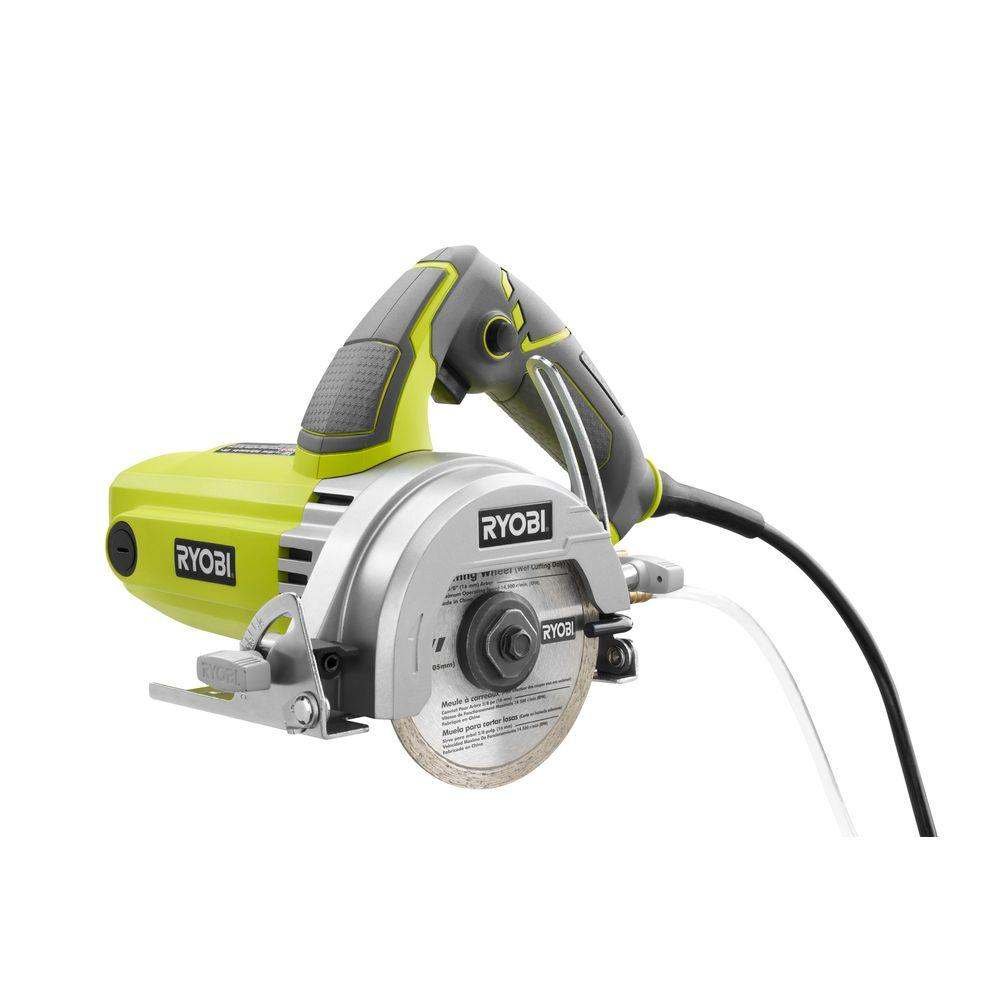
RYOBI TC401 4-Inch Wet Saw

84 /100
Kirk Score Excellent
Amps
12
Weight
9.3 lb
Warranty
30 days
Blade Size
4 in.
Check Details on Amazon

Pros

  • 9.3 pounds, easy to carry and control
  • 12 amps cut with very little chipping
  • Water feed controls dust where a grinder can't

Cons

  • 30-day warranty is the shortest here
  • Blade wears out before the work does

Four inches of blade is the whole story: the TC401 will not halve a 12-inch tile and isn't built to. What it does is reach the cuts a benchtop can't, like notching around an outlet, trimming a threshold, or fitting a repair piece between two set tiles, and at 9.3 pounds with a 12-amp motor it goes to the work instead of the other way around.

The water feed comes out behind the blade rather than on the leading edge, so it lands after the cut instead of on it. Keep the flow adjusted and take the pass slowly; small saws reward a light hand, and this one is no exception.

What surprised us is how little chipping it leaves for its size, with edges cleaner than we expected on ceramic and porcelain trim. That's what makes it worth keeping in the bag between projects, even though it will never be the saw that lays the floor.

Bottom line: A 4-inch handheld for notches, trim, and small repairs rather than floors, and one of the least expensive ways to finish a job properly.

Check Latest Price

How We Tested the Best Tile Saws

We started with roughly 40 wet saws sold at the major retailers and filtered by blade size, rip capacity, table design, and price, then narrowed to eight so the group ranged from a 4-inch benchtop unit up to a 10-inch saw on a stand. We read the manuals before a blade ever turned, mostly to see whether the fence could be squared without one.

Testing ran seven months across three jobs: a guest bathroom in 12x24 porcelain with a mosaic band, a kitchen backsplash in subway tile with a glass strip, and a backyard laid in 20x20 porcelain pavers. Every saw faced all three until its capacity ran out, which we recorded instead of working around.

On cuts, we checked each rip against a square and a straightedge and ran a thumb along the cut edge to feel for chipping, with extra attention on the glass mosaic where a bad wheel shows immediately. We timed setup, filling, and draining, carried each saw up a flight of stairs alone to judge weight and balance, and watched the tray seams and the floor around the stand for leaks and overspray after a full morning of cutting. Vibration got logged with a hand on the table rail mid-cut in hard porcelain.

We also left every saw set up in the garage for the length of the test to see what happened to the rail and sliding table over time — rust, slop, a fence that drifted. Ease of use came down to whether someone who had never run a wet saw could get a square cut on the first try. Value was the last question: after the paver job, would I rent this again or wish I owned it?

How to Choose a Tile Saw

Match capacity to your biggest tile

Rip capacity is how wide a strip the saw can take off; crosscut and diagonal capacities decide what it can halve. Sellers quote a tile size the table will hold, which is not the same thing. A 12-inch square measures about 17 inches corner to corner, so a saw listing a 12-by-12 tile and a 7.25-inch diagonal capacity will rip that tile but never cut it on the diagonal. Measure the diagonal of the largest tile in your design and compare it to the saw's diagonal figure, not to the headline.

If the plans include 24-inch or 36-inch tile, only the rail saws here qualify, and the D36000S is the one that takes a 36-inch tile down the middle. For 12-inch ceramic floors and subway tile, a compact benchtop is plenty.

Water control decides where you can set up

Every wet saw throws some mist, and the gap between an annoying tool and a miserable afternoon is how much of it lands on you and the finished wall. Reservoir-and-pump saws recirculate from a pan, side and rear trays catch what the blade throws, and a splash guard helps without solving it.

Plan the location before you buy: a garage, a patio, or a plastic-sheeted corner with the door to the finished room shut. A saw that sprays wide, like the SKIL, is fine outdoors and wrong in a tiled bathroom you've just grouted.

Accuracy lives in the cart, the fence, and the blade

A saw with a sloppy cart will not cut straight however carefully you push, so check for play before you commit. The fence matters too on repeat rips, and the blade matters most: the one in the box is a starting point, and a continuous-rim porcelain blade is the upgrade that ends chipped edges on hard tile.

Break a new blade in on scrap. A fresh diamond rim cuts rough for its first few passes and then settles, which is a cheap habit that saves expensive tile.

Weight, doorways, and where it lives

The saws here run from about 9 pounds to 91, and that range decides who carries it. Anything near the top of it is a two-person move and wants a permanent spot; if you'll be hauling the saw between rooms or up stairs yourself, an 18- to 32-pound benchtop is the practical ceiling.

Measure the door frame as well. The D36000S is 28-7/8 inches from column to cart edge, just under a standard 30-inch frame, and that is the number that decides whether the saw goes into the room or stays in the driveway.

Corded or cordless

Cordless tile saws trade depth for freedom. The Makita cuts 1-9/16 inches deep on an 18V pack and ships tool-only, which makes sense only if you already own the batteries; in exchange you get a wet saw for an occupied kitchen, a backsplash, or a patio with no outlet.

For anything approaching a floor, stay corded. Sustained cutting drains packs, and the corded saws here spin bigger blades deeper for hours at a time.

Frequently Asked Questions

Final Verdict

The DEWALT D24000S is the saw we point most people to: it covers every tile size a house contains, arrives with its stand and a porcelain blade, and holds a line without a fight. If your project is one bathroom of 12-inch tile, the SKIL 3540-02 does that work for a fraction of the money and is far easier to carry. If you're laying 24-inch or larger tile, pay for the D36000S and its 37-inch rails.

Buy against the largest tile you'll cut, set the saw up where the water can go, and spend the difference on a good blade.