// data-verified

Best Tungsten Electrodes of 2026

A tungsten electrode is the part of a TIG setup that does the least and matters most: it's the non-consumable rod the arc jumps from, and the alloy inside it decides whether that arc starts clean, holds steady at 40 amps, and keeps its shape through a long bead. The color band on the end isn't decoration — red is thoriated, blue is lanthanated, purple is a non-radioactive tri-mix, green is pure — and each one behaves differently on steel versus aluminum. Get the alloy or the diameter wrong and you'll spend the afternoon re-grinding points instead of finishing the joint.

I've had electrodes that struck on the first tap and others that made me want to throw the torch across the shop, and the difference is rarely the price. Over the past four months we've put 16 packs through real work — thin-gauge steel, aluminum, and plenty of low-amp fussing — watching how each one started, held, and wore down. Value only means something once you know how many re-grinds you get before a rod is too short to clamp.

Size and compatibility trip people up more than quality does. A 1/16-inch electrode suits thin material and low amps, 3/32 is the all-rounder, and 1/8 handles the heavy stuff, but any of them still has to fit your torch's collet and match the amperage you're running. The packs below are the ones that stayed on the bench.

#01

Best Overall

Midwest 2% Lanthanated 3/32"

96 /100
Kirk Score Outstanding
Diameter
3/32 in
Composition
2% lanthanated (WL20/EWLa-2)
Pack Quantity
10 electrodes
Check Details on Amazon

Pros

  • One class covers AC aluminum and DC steel
  • Holds a point through a mixed session
  • Slim case keeps ten rods together
  • Safety data sheet and certificate included

Cons

  • Coating on some ends makes collet insertion stiff
  • Costs more than the equivalent Patriot pack

Most people should learn one tungsten and stop thinking about it, and this is the pack we hand them: 3/32 inch, 2% lanthanated, blue-coded, ten rods. The diameter sits in the middle of what a home TIG machine will do, and lanthanated runs on AC for aluminum and DC for steel without a class change between projects. Nothing about it is exotic, and that's the point — it's the rod that makes the machine feel predictable.

On the grinder it behaves. Our rods came to a point cleanly and stayed usable through a session of mixed steel and aluminum work, and the slim plastic case they arrive in slides into a toolbox drawer instead of spilling loose tungsten across the bench. One small annoyance: a couple of rods had enough coating on the ends that they took a firm push to seat in the collet. Scuff the end with a file before you start blaming your torch.

Two things worth knowing. Any 2% lanthanated rod can split down the middle if you lean on the grinder and cut across the tip, so keep the pressure light, grind along the length, and use a wheel that only sees tungsten — that habit saves more rods than any brand choice. The other is money: Patriot sells the same class in the same diameter for less, and what the extra buys here is the longer track record of the pack plus a U.S. supplier that publishes a safety data sheet and a certificate of conformance with the rods, which matters if you weld for anyone but yourself.

Bottom line: We tell most people to start here: 3/32 inch, 2% lanthanated, one pack that handles steel and aluminum on the same machine without a class swap.

Check Latest Price
#02

Best for Low-Amperage Precision

CK LaYZr 3/32"

93 /100
Kirk Score Outstanding
Length
7 in
Diameter
3/32 in
Composition
EWG tri-mix: 1.5% lanthanum, 0.08% zirconium, 0.08% yttrium oxides
Pack Quantity
10 electrodes
Check Details on Amazon

Pros

  • Clean, reliable starts at low current
  • Holds tip geometry instead of balling
  • Non-radioactive tri-mix, no thoriated dust
  • Runs on both AC and DC

Cons

  • Premium price for a low-to-medium amperage rod

Low amperage is where tungsten gets fussy: the arc wants to wander, the point turns into a mushroom, and the start takes two taps instead of one. The LaYZr is aimed squarely at that. CK blends 1.5% lanthanum with small amounts of zirconium and yttrium oxides and sells it as EWG, a non-radioactive class known for holding tip geometry instead of balling up.

On thin stainless and small steel parts, where the whole weld is over in seconds, it's the pick we make from this group. Starts came cleanly at low current and the point kept its shape instead of flattening after a couple of tacks, which means fewer trips to the grinder. It also tolerates small changes in tip-to-work distance, which is why CK pitches it for automated setups as well as hand work.

The catch is that the premium only pays back in a narrow band. CK rates it for low to medium amperage, so it isn't your rod for quarter-inch aluminum or anything near the top of the machine's range — that's the 1/8-inch TOOLIOM's job. It's also the most expensive electrode here. If your work is thin, small, and fussy, the extra per rod buys fewer re-grinds and a steadier arc.

Bottom line: We keep this one for thin stainless and small parts, where its low-amperage starts and point retention are worth the premium.

Check Latest Price
#03

Best Thoriated for DC Work

YESWELDER Red WT20 3/32"

94 /100
Kirk Score Outstanding
Diameter
3/32 in
Packaging
Sealed aluminum tube
Composition
2% thoriated (WT20/EWTh-2)
Pack Quantity
10 electrodes
Check Details on Amazon

Pros

  • Sealed aluminum tube keeps ends oxide-free
  • Tight, stable DC arc on steel
  • Color-coded red for instant identification

Cons

  • Rods bend rather than snap when scored

The first thing we noticed was the container. These red thoriated rods ship in a sealed aluminum tube rather than a bag or a thin sleeve, and that isn't marketing fuss — tungsten that sits in humid shop air oxidizes at the ends, and oxidized ends make for a scratchy start. If your storage is a damp garage or a truck box, the tube is the feature you're paying for.

The rod itself is the traditional red class: 2% thoriated, 3/32 inch, seven inches, ten to a pack. Thoriated is a DC electrode and has been the standard on steel for decades because the arc stays tight and it doesn't scatter the way a pure tungsten rod will. If you learned on red, this will feel like nothing changed, because nothing has.

We're happy to leave this as the DC steel pick of the group. What annoyed us is mechanical: the rods bend when you score them instead of snapping cleanly, so shortening one mid-job takes a couple of extra passes with the wheel. Not a defect, but if you break rods in half to stretch a pack, expect a bend rather than a click.

One class note that isn't about this brand at all: thoriated rods carry thorium, so grinding dust needs the same care as any red electrode. A wheel you don't use on anything else, dust control, and no compressed air to blow the powder off the bench covers it.

Bottom line: We recommend the red thoriated pack for DC steel work, and the sealed aluminum tube is what keeps the ends clean between jobs.

Check Latest Price
#04

Best Budget Lanthanated

ARCCAPTAIN 2% Lanthanated 1/16"

93 /100
Kirk Score Outstanding
Length
7 in (175 mm)
Diameter
1/16 in (1.6 mm)
Packaging
Vacuum packed
Composition
2% lanthanated (WL20/EWLa-2)
Check Details on Amazon

Pros

  • Cheapest lanthanated pack in this group
  • Vacuum packed, so ends arrive bright
  • Covers both AC and DC work
  • Light and easy to handle at the torch

Cons

  • 1/16 inch limits it to thin, low-amperage work

Ten vacuum-packed 1/16-inch lanthanated rods for less than most of the picks here makes this the easy first pack for someone learning on thin steel or aluminum, and that's how we treat it. At this diameter the rod suits sheet metal, small tubing, and anything where the machine runs low and a 3/32 rod would soak up more heat than you're putting in.

In use it's unremarkable in the way you want an inexpensive tungsten to be. Starts come easily at low current, the vacuum pack means the ends are bright when you open it rather than dull with oxide, and the rods came through a run of thin aluminum without demanding constant attention.

The one thing that gave us trouble was the grinder: a couple of rods split before we got a point on them. That happens at 1/16 inch across a lot of brands, and it's mostly technique — light pressure, lengthwise strokes, and a wheel that hasn't been used on steel. If you're heavy-handed at the bench, buy the 3/32 Midwest pack instead; if you're careful, this is a lot of rod for the money.

Bottom line: We hand this to hobbyists learning on thin sheet: ten lanthanated 1/16-inch rods for less than most of the picks here.

Check Latest Price
#05

Best Sampler Set

MELTSTAR 5-Class Mix Set

91 /100
Kirk Score Outstanding
Length
7 in (175 mm)
Diameter
1/16 in (1.6 mm)
Composition
Five classes: red, grey, blue, green, turquoise
Pack Quantity
10 electrodes, 2 of each color
Check Details on Amazon

Pros

  • Five classes in a single box
  • Color coding makes each class obvious
  • Two rods of each is enough to judge
  • Cheaper than buying five separate packs

Cons

  • Only 1/16 inch, so nothing for heavier work
  • Restocking means buying another mixed box

Five colors, two rods of each: red, grey, blue, green, and turquoise, all 1/16 inch and seven inches long, in one box. It's a sample pack, and it solves a specific problem — you don't yet know which class suits the way you weld, and buying a full pack of each to find out costs real money.

Where we found the box genuinely useful is in making the differences obvious. Being able to look down and see which rod is which matters more when you're new than any spec table, and switching classes inside one session teaches you what a sharp-point rod feels like against one that balls at the tip — the lesson you otherwise only read about.

The catch is size. Everything in the box is 1/16 inch, so it won't tell you whether you want a 3/32 rod for general work, and once you find a favorite you're buying another mixed box to restock it rather than a straight pack of the one you want. Fine for a first purchase, irritating by the second.

Bottom line: We recommend the sample box to anyone who hasn't settled on a class yet; five colors in one box answers that faster than reading about it.

Check Latest Price
#06

Best for Heavy Amperage

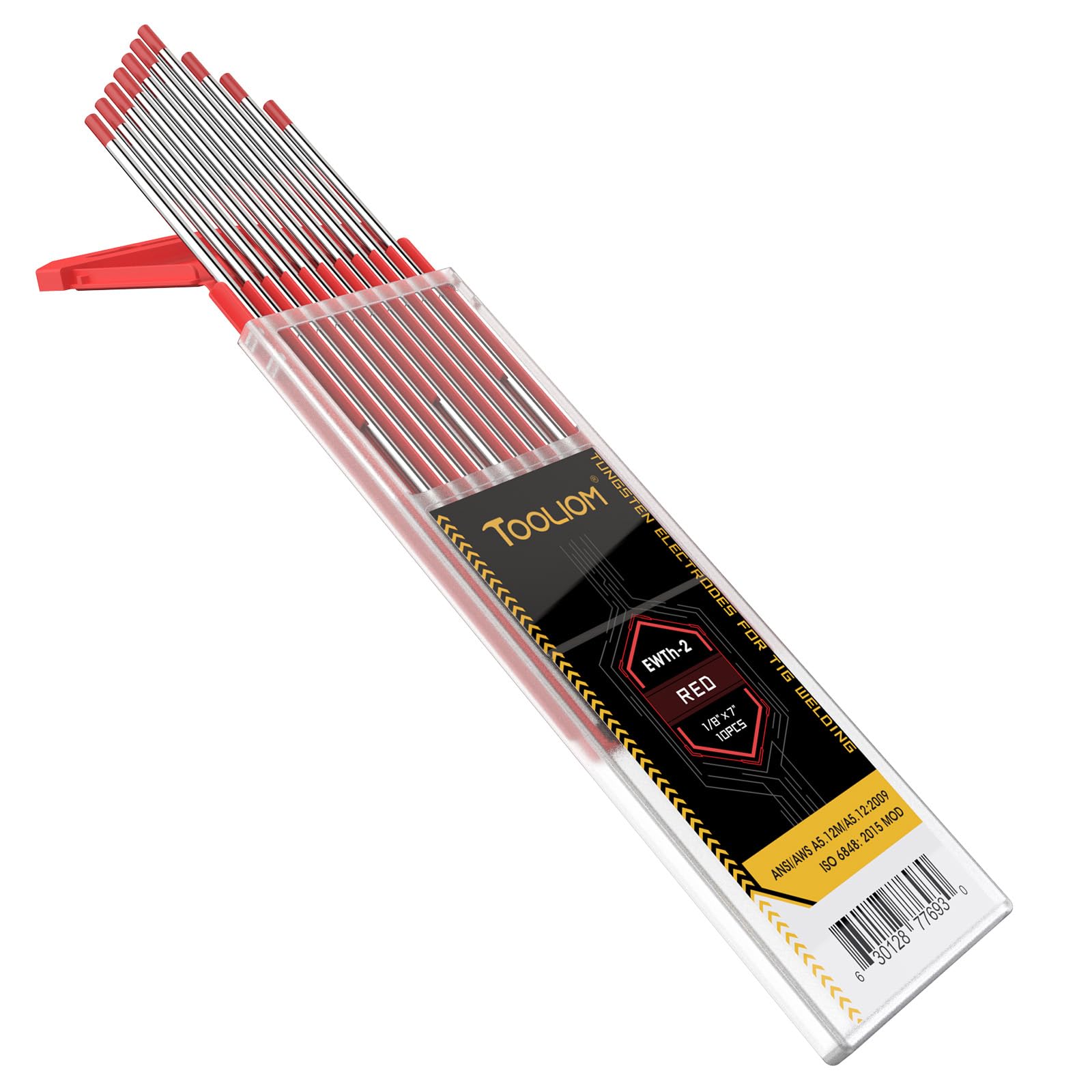
TOOLIOM EWTh-2 1/8"

92 /100
Kirk Score Outstanding
Length
7 in (175 mm)
Diameter
1/8 in (3.2 mm)
Packaging
Vacuum sealed
Composition
2% thoriated (EWTh-2)
Check Details on Amazon

Pros

  • Carries high current without cooking
  • Holds shape on thick aluminum
  • Vacuum sealed, arrives clean

Cons

  • Needs a matching 1/8-inch collet and torch setup
  • Priciest pack of the picks here

Every other pick here is 1/16 or 3/32 inch. This one goes bigger: 1/8 inch, red thoriated, ten rods, vacuum sealed, for work where the machine is running near the top of its range and a thinner rod would glow and spit before the weld was finished.

On thick aluminum and heavy steel the extra diameter is the whole argument. A bigger rod carries more current without cooking, holds its shape under heat, and gives you more margin before it overheats, so a wandering travel speed doesn't end the pass. The vacuum seal matters here too — these are rods you'll keep for the occasional heavy job, and they come out of the pack bright.

The trade-offs are practical rather than performance ones. You need an 1/8-inch collet and collet body to run it, so this is a second setup rather than a replacement for your everyday rod, and it's the priciest pack we picked. If your machine has the top end and you weld thick aluminum, though, this is what makes the upper half of the dial usable.

Bottom line: We keep the 1/8-inch pack for thick aluminum and the top of the machine's range, where nothing else in this group carries the current.

Check Latest Price
#07

Budget tri-mix

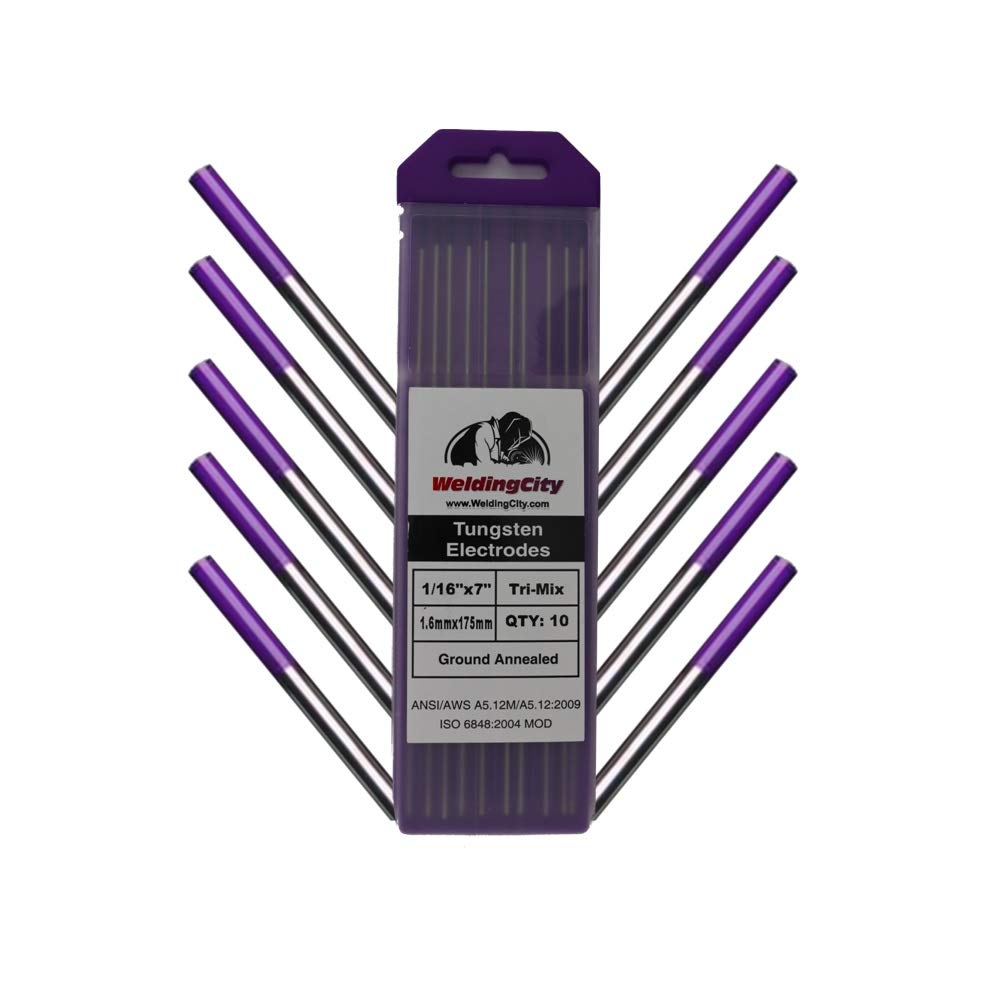
WeldingCity EWG Tri-Element 1/16"

92 /100
Kirk Score Outstanding
Length
7 in
Diameter
1/16 in (1.6 mm)
Composition
EWG tri-element (purple), 1.5-1.8% mixed rare earth oxides
Pack Quantity
10 electrodes
Check Details on Amazon

Pros

  • Least expensive non-radioactive pick here
  • Works on steel and aluminum
  • Ten rods per box
  • Purple coding separates it from thoriated rods

Cons

  • 1/16 inch only goes so far on current

Tri-mix electrodes — the non-radioactive blends of lanthanum, zirconium, and yttrium oxides — are usually the expensive corner of the tungsten shelf. This box is the cheap way in: 1/16 inch, purple-coded EWG, ten rods, and the least expensive non-thoriated electrode in this group.

What you get is a generalist. It starts on steel and aluminum without drama, and the roughly 1.5 to 1.8% mixed rare-earth content is the same idea CK charges a great deal more for in the LaYZr, just without the low-amperage refinement that makes the CK worth its price. For a box to learn across a couple of materials, that's a fair trade.

The ordering trap is the listing rather than the rod. The same purple class and the same box are sold in diameters from 0.040 inch up to 5/32 inch, so it's easy to land a size your collet won't hold. Read the size field rather than the photo, especially if you're buying for a small torch.

For a hobbyist who wants a non-radioactive rod and doesn't want to spend tri-mix money to find out whether they like tri-mix, this is the box we point to. It doesn't hold a point the way the LaYZr does at low current, and at 1/16 inch it won't carry heavy amperage — but it is honest tungsten near the bottom of the price range, which is what a practice pack should be.

Bottom line: We point budget-minded, non-radioactive shoppers here: a purple tri-mix that works on steel and aluminum without the premium price.

Check Latest Price
#08

Value 3/32 pack

Patriot 2% Lanthanated 3/32"

91 /100
Kirk Score Outstanding
Length
7 in
Diameter
3/32 in
Composition
2% lanthanated (WL20/EWLa-2)
Check Details on Amazon

Pros

  • Same class as our top pick for less money
  • Clean, consistent arc on steel and aluminum
  • Simple pack with no extras to pay for

Cons

  • One class and one size only

Same class, same 3/32 diameter, same blue coding as our top pick, for less money. If that's all you needed to hear, it's a fair call — the Patriot rods welded everything we put them to, and per rod they're the better value of the two.

Where the Midwest pack pulls ahead is paperwork rather than metal. A published safety data sheet, a certificate of conformance, and a supplier you can call are worth something if you weld for customers and have to hand someone documentation. On your own bench, they aren't.

It's also the plainest listing in the group: one class in one size, no sampler, no 1/16 inch if your machine is small, no 1/8 inch if your work is thick. What you're buying is a workhorse rod in the most useful diameter, sold without extras.

For a shop that grinds through electrodes and doesn't need the paperwork, we rate this the better buy of the two blue 3/32 packs. For a first purchase, where you might want to call someone with a question, the Midwest pack still earns its premium.

Bottom line: We rate the Patriot pack the better buy of the two blue 3/32 options if you don't need supplier paperwork, and it welds just as cleanly.

Check Latest Price

How We Tested TIG Tungsten Electrodes

We built the shortlist from the alloys a home shop actually reaches for — thoriated, lanthanated, zirconiated, and a non-radioactive tri-mix — then filtered out listings that didn't state the AWS classification, the diameter, or the length. Sellers who couldn't confirm the material got dropped. That left 16 packs in 1/16-, 3/32-, and 1/8-inch, which we ran for four months on mild steel, stainless, and aluminum.

Every electrode got the same first test: a cold start at low amperage to see whether it struck on the first tap or needed a scratch, followed by a full bead to watch whether the arc wandered or stayed put. On aluminum we checked that the tip balled evenly instead of mushrooming off to one side. We clamped each one into a standard 17 torch and a smaller 9 torch collet to see if it slipped, seized, or cracked at the seam.

Durability was the slow part. We counted re-grinds, dunked hot tips into the puddle on purpose to see how much contamination a fresh point could rescue, and noted which ones split lengthwise or snapped at the collet. We also laid all ten electrodes from each pack side by side to check they were straight and ground to the same angle, since an uneven pack quietly ruins your arc consistency. At the end we measured what was left of each rod and divided the pack cost by the usable inches to see which ones were genuinely the better buy.

How to Choose Tig Tungsten Electrodes

Match the class to your current and your metal

Three classes cover almost everything a home or small-shop welder does. Blue 2% lanthanated is the generalist: it runs on AC for aluminum and DC for steel, holds a point better than pure tungsten, and needs no special handling. Red 2% thoriated is the traditional DC electrode for steel and higher current, but it contains thorium, so grinding dust wants a dedicated wheel, dust control, and no compressed air on the bench. Purple or chartreuse tri-mix classes are non-radioactive and shine at low amperage on thin material.

If you weld on one machine and move between metals, buy lanthanated and stop there. The exceptions are narrow: red for DC steel at higher current, tri-mix for fussy low-amp work, and a sampler box only if you genuinely don't know which class suits you yet.

Size the diameter to the work, not to the torch

Diameter is an amperage decision. A 1/16-inch rod is for thin sheet and low current, 3/32 inch sits in the middle of what most machines do and suits the widest range of work, and 1/8 inch is for thick plate at the top of the dial, where a thin rod would glow, spit, and put tungsten in the weld.

The mistake runs both ways: buying 1/8 inch because it looks serious and then running it so far below its comfort zone that the arc wanders, or buying 1/16 inch and over-driving it on stock that needs more heat. If you keep only one diameter, keep 3/32 inch.

Look at the packaging and at how the rod grinds

Tungsten oxidizes at the ends when it sits in humid air, and oxidized ends start badly. A sealed aluminum tube or a vacuum pack is worth a little more money than a bag that lets rods rattle together and chip their tips before you've used one. Storage counts as much as the pack itself: a tube in a drawer beats a loose bundle on a damp shelf.

On the wheel, expect to lose a few rods. Splitting and cracking during grinding turns up across classes and brands, and it usually comes down to pressure and technique: light strokes along the length, a wheel reserved for tungsten, and a square concentric point rather than a needle.

Count cost per rod, not pack price

Ten-rod packs are standard, and the spread between classes is wider than the spread between brands. A budget 1/16-inch lanthanated pack can cost about half what a premium tri-mix pack does, and both will weld; the premium buys point retention and low-amp stability, which only pay back if that is the work you actually do.

Sampler sets sit at the top of the per-rod curve, and that's fine as a one-time purchase because you're buying information. Once you know your class and diameter, buy a straight ten-pack of it and put the difference into a wheel you keep for tungsten.

Frequently Asked Questions

Final Verdict

For most people the answer is the Midwest 2% lanthanated 3/32 pack. It sits in the middle of the range in both size and class, which is exactly why one box covers steel, stainless, and aluminum on a home machine without a swap.

Two honest alternatives. If price matters more than supplier documentation, the Patriot pack is the same class and diameter for less, and it welds just as cleanly. If your work is thick plate at the top of the machine's range, nothing here but the TOOLIOM 1/8 inch will carry the current.