// data-verified

Best Tool Bags of 2026

The worst thing a tool bag can do isn't wear out — it's give out while you're carrying it. A seam lets go halfway up a flight of stairs, a zipper splits open in the bed of a truck, and suddenly your sockets are rolling toward a storm drain. I've had that happen with a cheap canvas tote, and it's why I now load every bag heavier than any reasonable person would before I decide whether to trust it. What a good one actually fixes is smaller and more daily than that: a mouth wide enough to see what you're grabbing, a bottom that doesn't wick water off wet concrete, and pockets sized for the tools you really own.

Over the past seven months, my team and I have filled, hauled, and dropped 14 tool bags, from open-top totes to backpacks with more pockets than I have tools. The thing that surprised me most is how little the pocket count on the tag tells you. Sixteen shallow slots can hold less than eight deep ones, and you don't find that out until a framing square won't fit and your screws are buried past the first knuckle. Below, the bags that survived the loading, the weather, and me.

#01

Best Overall

WORKPRO 16-Inch Wide Mouth Tool Bag

95 /100
Kirk Score Outstanding
Base
Waterproof molded
Pockets
8 interior, 13 exterior, 8 loops
Dimensions
15.75"L x 8.66"W x 9.84"H
Load Rating
33 lb
Check Details on Amazon

Pros

  • Framed mouth stays open while you work
  • Molded waterproof base handles wet ground
  • 29 pockets and loops keep tools upright
  • Padded handle and shoulder strap included

Cons

  • Exterior pockets are shallow for long tools

A bag you can't see into is a bag you end up dumping out. The WORKPRO's internal metal frame holds the mouth wide while the double-pull zipper runs around the top, so we could reach in and pull out a driver with one hand instead of holding the sides apart with both. That is the detail that put it at the top of this list, and it's the one you'll notice on every single job.

The rest is quietly sensible. A molded waterproof base lets you set the bag down on wet pavement or gravel without soaking the tools, and it doesn't sag into a puddle shape when the bag is half loaded. WORKPRO rates it to 33 pounds across 29 pockets and loops, with 8 inside, 13 outside, and 8 loops for pliers and drivers, plus a padded handle and a shoulder strap that both take a full load. The 600D polyester is doubled where it wears, and our sample is still square at the corners.

Sixteen inches is the middle of this group, and for most people it's the right middle. It swallows a compact drill, two batteries, a charger, and a full set of hand tools, but it won't take a recip saw the way the 21- and 23-inch bags do. That's the compromise that makes it the only bag a lot of people need: big enough for a real kit, small enough to ride on the passenger seat.

Bottom line: We tell most people to start here: it stands open while you work, keeps tools dry on wet ground, and holds a compact drill plus a full hand-tool set.

Check Latest Price
#02

Best for Service Calls

VETO PRO PAC TECH-MCT Tool Bag

95 /100
Kirk Score Outstanding
Base
Waterproof molded
Handle
Over-molded comfort grip
Capacity
13 liters
Dimensions
14"L x 12"W x 14"H
Check Details on Amazon

Pros

  • Holds its shape loaded or half empty
  • Vertical slots fit long drivers and pump pliers
  • Waterproof base and comfortable over-molded handle

Cons

  • Premium price for a compact 13-liter bag

A bag that collapses when you set it down costs you time at every stop. The VETO doesn't: the polymer shell holds the mouth up and the walls square whether the bag is full or nearly empty, and that's the property that makes it feel like a piece of equipment rather than a sack with a strap.

We also like the vertical layout, which is the reason service techs keep buying it. The footprint is compact at 14 by 12 by 14 inches and 13 liters, but the slots are tall enough for long drivers and water pump pliers, so the tools you reach for most stand upright where you can see them. A waterproof molded base, an over-molded handle that doesn't cut into your hand under load, and a stainless tape clip within thumb reach are the details you notice after a week.

Thirteen liters is a hand-tool volume, and that's the limit worth understanding before you buy. A full set of drivers, pliers, and a meter fits beautifully; two drills and their batteries alongside them do not. For someone who works out of one light bag and walks into a lot of buildings, that's the right shape. For a remodeler who needs every tool on every trip, it's a second bag.

Bottom line: For anyone who works out of one bag all day, the shell stays open, the slots stand tools upright, and the base keeps them dry.

Check Latest Price
#03

Best Tool Backpack

Klein 55421BP-14 Tool Backpack

95 /100
Kirk Score Outstanding
Base
Fully molded
Weight
6 lb
Pockets
39 interior
Dimensions
14.5"L x 7.25"W x 20"H
Check Details on Amazon

Pros

  • Hands free for ladders and stairs
  • 39 pockets in a slim 7.25-inch-deep body
  • Molded bottom stands up on rough ground

Cons

  • Main zipper can bind around the top corners

Climbing a ladder with a tool bag in one hand is how you end up making two trips. The Klein 55421BP-14 puts the load on both shoulders and gives you 39 interior pockets in a body only 7.25 inches deep, narrow enough to swing through a doorway and short enough front to back to sit on a step without tipping into the drop.

Open it up and the layout makes sense for the trades it's aimed at: tall slots across the back panel for screwdrivers and wrenches, a hard molded front pocket that keeps safety glasses from being crushed, a small zipper pouch for parts, and a fully molded bottom that stands the bag up in gravel. At 6 pounds empty it feels substantial without being a burden, and the water-resistant shell shrugs off a wet floor.

It's a hand-tool carrier, and it doesn't pretend otherwise. The deep narrow body is all pockets, so a laptop or a full-size drill has nowhere sensible to go, which is the right call for an electrician or HVAC tech whose kit is meters, drivers, and pliers. We carried it loaded up a flight of stairs and through a parking garage and never once wished for a tote handle.

Bottom line: The backpack we hand an electrician: hands free for ladders, 39 slots for hand tools, and a molded bottom that stands up anywhere.

Check Latest Price
#04

Best for Laptop and Tools

DEWALT DWST560102 Tool Backpack

94 /100
Kirk Score Outstanding
Pockets
43
Dimensions
7.75"D x 13.75"W x 18.75"H
Laptop Sleeve
Fits up to 15 inches
Water Resistance
IP54 compartment, waterproof base
Check Details on Amazon

Pros

  • Padded laptop compartment up to 15 inches
  • 43 pockets including a drill and battery bay
  • Waterproof base and an IP54 compartment
  • Stands upright on its hard base

Cons

  • Laptop sleeve trades away some tool capacity

A laptop has no business in a tool bag, which is why the DEWALT gives it its own padded compartment, sized for machines up to 15 inches. That one decision is why this pack is here: if you write up jobs on a laptop or carry a tablet to site, the alternative is a second bag or a screen full of scratches.

The tool side isn't an afterthought. There are 43 pockets, including a separate bay for a drill and batteries, an oversized slot for long tools, and a dedicated bottle pocket. The 1680 denier fabric and dirt-repellant tarpaulin wipe down with a rag, the base is waterproof, and one compartment is sealed to IP54 for anything that can't take a soaking. Storage volume runs to nearly 2,000 cubic inches.

Loaded, it carries like a heavy backpack rather than a tote, and the waterproof base means you can drop it on a wet slab without thinking about it. That's the trade: you get hands-free capacity and a dry laptop, and you accept the height. At 18.75 inches tall it's a big wear on stairs and it sits high on your back when it's full, so the heaviest items belong in the bottom bay.

For a service tech with a computer it's the most practical bag here, and the price sits where the other pro packs do. For a woodworker who never opens a laptop on site, the Klein backpack is the lighter, simpler choice.

Bottom line: If a laptop travels to site with your tools, this pack keeps it padded and separate while 43 pockets handle everything else.

Check Latest Price
#05

Best for Bulky Power Tools

Milwaukee 23-Inch Canvas Tool Bag

94 /100
Kirk Score Outstanding
Material
Canvas
Dimensions
23"L x 12"W x 12"H
Load Rating
100 lb
Interior Pockets
6
Check Details on Amazon

Pros

  • Swallows a full cordless combo kit
  • Rated to 100 pounds
  • Handles attached with metal fasteners
  • Removable shoulder strap included

Cons

  • Zipper and the rails beneath it are the weak point
  • Only six interior pockets for the size

Twenty-three inches long, 12 wide, 12 tall, rated to 100 pounds: this is the bag you buy when your tools arrive in cases and the cases come with batteries. We loaded ours with a cordless saw, two drills, a charger, and a battery bag, and there was still room to lay a jacket on top.

Think of it as a duffel with sleeves. The six interior pockets stop tools from sliding into each other, the reinforced handles are attached with metal fasteners rather than stitching alone, and the removable shoulder strap is the difference between carrying it and dragging it. The canvas takes a beating without showing it, and the long zipper opens the whole bag flat.

It's a hauler, not a workstation. There's no framed mouth to hold the bag open, so you'll dig for small items and you'll want a second bag for the tools you use every five minutes. For a remodeler moving a whole kit from the truck to a teardown in one trip, that's a fair trade. If you want the same length with tidier manners, the Makita below is the better-behaved version.

Bottom line: When the load is a combo kit rather than hand tools, this 23-inch bag swallows it in one trip and takes the knocks.

Check Latest Price
#06

Best Large Tote for Tool Kits

Makita 831271-6 21-Inch Tool Bag

94 /100
Kirk Score Outstanding
Pockets
6 exterior, 4 interior
Material
Industrial fabric
Dimensions
21"L x 12"W x 11"H
Check Details on Amazon

Pros

  • Zipper runs wide without snagging
  • Fits a recip saw and full-size drills
  • Cheapest of the large bags here

Cons

  • No shoulder strap in the box
  • Ten pockets is thin for a 21-inch bag

If the Milwaukee bag is a duffel with sleeves, the Makita is the tidier version of the same idea. Twenty-one inches long and 11 inches tall, with a zipper that runs the whole length and opens wide without snagging, it's the large bag we keep coming back to when a kit needs to travel neatly and come out the way it went in.

Six exterior pockets and four inside hold batteries, a charger, bits, and a tape where you can reach them, and the main compartment takes the rest. We fit a recip saw, a hammer drill, an impact driver, a charger, and a stack of batteries, with room left for a top-handle saw. The industrial fabric is thick, the handles are reinforced, and the base is firm enough that the bag doesn't fold in on itself when it's empty.

What it doesn't try to do is organize a trade. It's a hauler for full-size tools, and the pockets are there to keep small pieces from migrating rather than to give every driver its own home. The long, low shape slides under a bench seat or along a van shelf, which matters more than it sounds when the alternative is stacking cases.

Bottom line: A long, low hauler for full-size tools, with a clean-running zipper and enough room for a recip saw and a stack of batteries.

Check Latest Price
#07

Small hand-tool kits

Amazon Basics 12-Inch Tool Bag

95 /100
Kirk Score Outstanding
Weight
1.1 lb
Pockets
9 internal, 7 external
Material
600D Oxford polyester
Dimensions
12.2"L x 5.5"W x 7.9"H
Check Details on Amazon

Pros

  • Light enough to forget in a trunk
  • 16 pockets in a compact 12-inch body
  • Stiff PE base holds its shape

Cons

  • Not water resistant
  • Can arrive with a strong odor

Twelve inches sounds bigger than it is. This bag arrives roughly the size of a lunch cooler at 12.2 by 5.5 by 7.9 inches, and that's the point: it's for the screwdrivers, pliers, tape, and loose hardware that live in a closet, a trunk, or under a sink, not for a drill.

At just over a pound empty, it's the bag we hand someone who wants tools in the car without knowing they're there. The 16 pockets, nine inside and seven outside, are tight enough that nothing shifts, the PE base is stiff enough to hold the bag's shape when you set it down, and the double zippers run smoothly. The 600D Oxford cloth and double-stitched seams are better than the price suggests.

Whether it earns a place comes down to expectations. It's the least expensive bag here by a distance, and for a first apartment, a bike kit, or a glovebox it's exactly enough. It's also genuinely small: full-size hammers, long levels, and pry bars don't fit, and the exterior pockets suit short items only. Buy it as a compact kit and you'll be happy; buy it expecting a toolbox and you'll be returning it.

Bottom line: Spend the least and get a genuinely tidy small bag for a trunk, a closet, or a first apartment's worth of hand tools.

Check Latest Price
#08

Large hand-tool loads

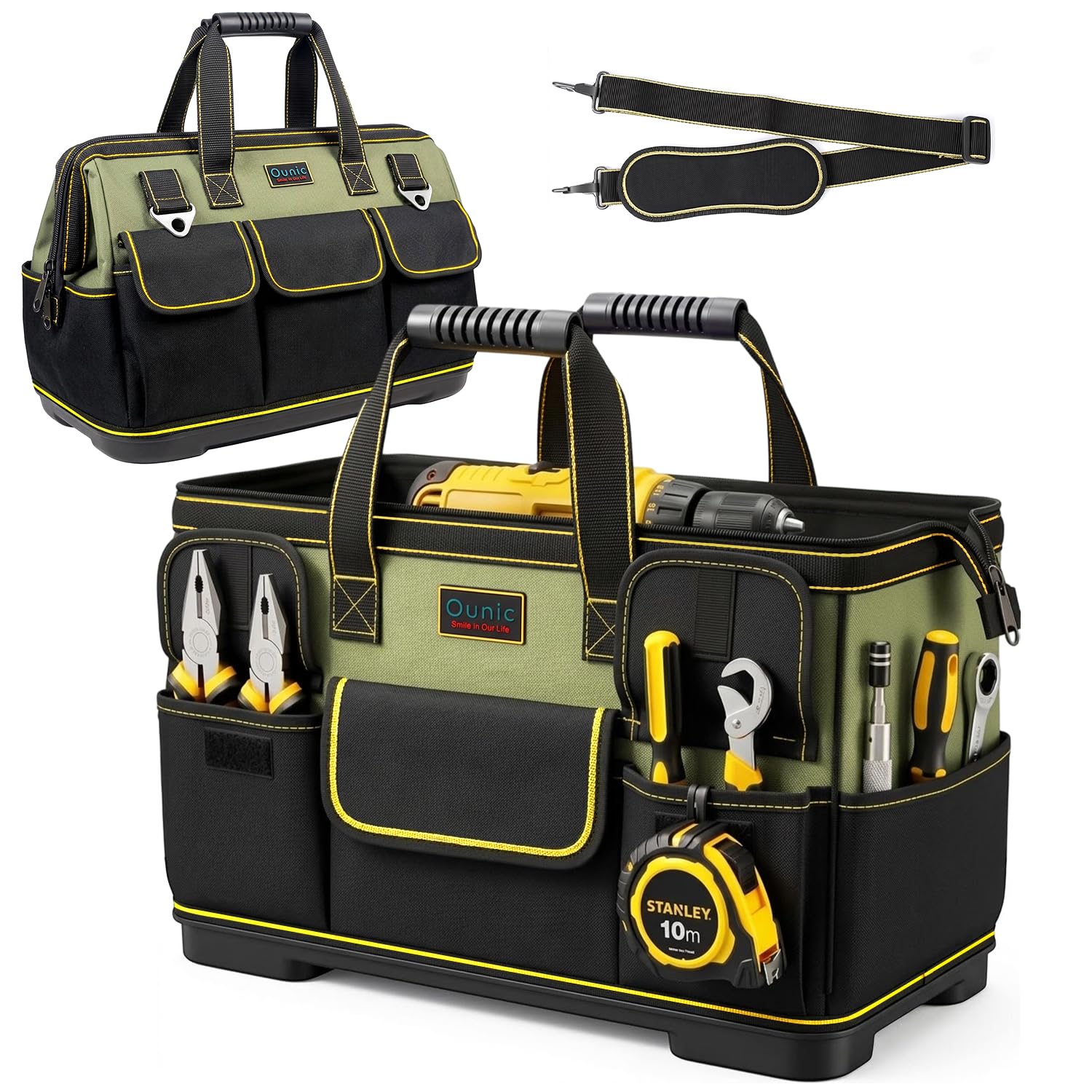
Ounic 18-Inch Heavy Duty Tool Bag

93 /100
Kirk Score Outstanding
Pockets
8 inside, 8 outside
Capacity
2600 cubic inches
Dimensions
18.5"L x 9"W x 12.2"H
Load Rating
66 lb
Check Details on Amazon

Pros

  • Stiff five-layer walls hold their shape
  • Hard PP base keeps tools off wet ground
  • Tall interior fits long tools upright
  • Shoulder strap and padded handle included

Cons

Five layers is the claim on this bag's fabric, running Oxford cloth, a waterproof film, a PE board, a second waterproof film, and more cloth, and the effect is walls that feel like a thin panel sheathed in fabric. Set it down empty and the sides stay up; drop a hammer in and they don't bow.

An 18.5-inch body, 12.2 inches tall, and 2,600 cubic inches of space means a hammer stands upright and a small vacuum fits with its accessories beside it. The 16 pockets, split evenly inside and out, are sized for pliers and tapes rather than pens, and the double-pull zipper opens the whole top. A padded handle, a shoulder strap, and a hard PP base rated to 66 pounds round it out.

The zipper is where a bag like this gets tested, and on a stuffed bag it's doing the most work: overfill the corners and it can jump its track. Load it to the 66-pound rating rather than past it and it behaves. That's a small caveat on a bag that gives you a wide open mouth, stiff walls, and a dry floor for the tools without the shoulder strain of a backpack.

Bottom line: A big open tote with stiff walls and a hard base, and the pick when you want capacity without putting it on your shoulders.

Check Latest Price
#09

Daily professional use

Klein 5541610-14 Tool Bag

95 /100
Kirk Score Outstanding
Weight
6 lb
Pockets
40
Material
1680d ballistic weave
Dimensions
12.4"L x 12.2"W x 10"H
Check Details on Amazon

Pros

  • Orange interior makes tools easy to spot
  • 40 pockets plus a molded base
  • 1680d ballistic weave holds up loaded

Cons

  • Deep, tight pockets bury small parts

The interior is orange, and that's not a style choice. In a bag with 40 pockets, a bright lining is what lets you spot the small socket or the odd Torx driver without pulling three things out first, and it matters most at the end of a dusty day when every handle looks the same.

The rest is pro-grade hardware: 1680d ballistic weave, a fully molded bottom that keeps the bag standing and the tools out of puddles, a large zipper pocket for small parts, and a shoulder strap. Loaded past comfortable, it still doesn't collapse on itself, which is what cheap totes do first. It measures 12.4 by 12.2 by 10 inches, a square footprint that rides close to the body.

This is a bag for someone who works out of one box all day and wants to see everything at a glance, and it's very good at that. It's also a lot of money for a compact tote, and if capacity matters more to you than the layout, the 18-inch Ounic gives you more room for less.

Bottom line: For the pro who works out of one bag all day, the orange lining and 40 pockets make a missing tool easy to spot.

Check Latest Price

What We Put Every Tool Bag Through

We started with a list of around 60 bags sold by the big tool brands and a few general retailers, then narrowed it by format, footprint, and price so we weren't comparing a small tote to a rolling chest. Fourteen made the cut, and they stayed in rotation for seven months across a home garage, the bed of a pickup, two kitchen remodels, and one fourth-floor walk-up with no elevator.

Every bag got the same starting load: a cordless drill, a hammer, two pouches of hand tools, a socket set, and a quart of screws. From there I kept adding until the bag refused, counting what actually fit and noting whether the pockets were deep enough for a combination wrench or so shallow that fasteners disappeared below the rim. I zipped and unzipped each one single-handed in work gloves, then overstuffed it until the sides bulged to see whether the zipper track held its line or split at the curve.

Each bag was set down in a wet driveway, on gravel, and in the grass overnight, then hauled by one handle up a staircase and dropped from tailgate height onto concrete. Afterward I checked corner stitching, rivets, and whether the base had gone soft or kept its shape. I also carried every loaded bag roughly a quarter mile from the truck to the work area, which is where shoulder straps either earn their place or cut into you, and weighed at the end whether each bag was still worth what it cost after that wear.

Two patterns came out of it. Wide-mouth openings mattered more than raw volume, and the bags with hard, molded bottoms came back looking the same as the day we unboxed them.

How to Choose a Tool Bag

Start with how you carry it

Three formats cover most buyers. A tote with a top handle and shoulder strap is the generalist: it sits on the floor beside you and you work out of it. A backpack puts the load on both shoulders and frees your hands for ladders, stairs, and the long walk from a van, which is worth real money if you climb anything regularly. A framed wide-mouth tote splits the difference by standing open while you reach in.

If you climb ladders weekly, buy the backpack and don't debate it. If you park close and work on one floor, a tote is easier to live with because you can see into it from above.

Match the length to your longest tool

Bag sizes describe the outside, not the usable space. A 12-inch bag handles screwdrivers, pliers, and loose hardware and nothing longer. Sixteen inches is the practical minimum for a compact drill standing on its base, and 21 to 23 inches is where recip saws, circular saws, and combo kits start to fit.

The trap is depth. A 16-inch bag that's 8.66 inches wide holds a drill upright; a 12-inch bag that's 5.5 inches wide never will, whatever the length says. Measure your longest tool, add two inches, and ignore the model name.

Pockets need depth, not just quantity

Sixteen pockets two inches deep are worse than eight that fit a wrench. Shallow exterior pockets let long drivers ride high and catch on door frames; deep, tight slots swallow small fittings you then have to fish out with two fingers.

Look for a mix instead: tall slots or loops for drivers and pliers, wide flat pockets for tapes and testers, and a bright interior lining, which does more for finding a tool than four extra pockets ever will.

The base decides where you can set it down

A molded or hard plastic base keeps the bag upright and keeps moisture away from the tools, and it's the difference between setting the bag in gravel and hunting for a dry patch. It costs weight, and a heavy base plus a heavy load is a bag you carry in two hands.

The VETO's polymer shell and the polypropylene base on the Ounic both hold shape under a full load, while a canvas bag with only a reinforced panel will slump when it's half empty. If you work on wet ground or in a truck bed, prioritize the hard base.

Spend on zippers, handles, and load ratings

Zippers fail before fabric does. Look for metal teeth, a double pull so you can open from either end, and a gusset that keeps grit out of the track. Handles should be stitched and riveted rather than stitched alone, and a shoulder strap should come in the box rather than as an extra purchase.

Rated loads across these bags run from 33 to 100 pounds. Treat the number as a ceiling, not a target, and put the heaviest items directly over the base where the structure can take them.

Frequently Asked Questions

Final Verdict

The WORKPRO 16-inch wide-mouth bag is the one we point most people to. It stands open while you work, keeps tools dry on a wet driveway, holds a compact drill plus a full hand-tool set, and costs less than most of this list. That combination is what a general repair kit actually needs.

Leave it for two specific reasons. If you climb ladders, the Klein backpack's 39 pockets and molded base are worth the step up. If a laptop travels to site with you, the DEWALT's separate padded compartment settles the choice.