// data-verified

Best AC Coil Cleaners of 2026

The first hot weekend of the year is a bad time to discover your AC is breathing through a felted blanket of dust. Coil cleaner is the unglamorous fix: it lifts the grime that collects on evaporator and condenser fins so air can move and the system doesn't work overtime. I've cleaned coils in a cramped air-handler closet and on a windy condenser pad, and the difference between a good foam and a weak spray shows up fast—one clings and lifts, the other runs off before it does much.

Over the past four months, we tested 14 coil cleaners side by side, from aerosol foams to concentrates and ready-to-use gallons. We compared cleaning performance on genuinely dirty coils, sprayability into tight fin gaps, scent while working, and cost per cleaning. The best ones foamed, clung, and rinsed clean without leaving a film; the weaker ones either ran off early or needed more scrubbing. The picks below are the ones I'd reach for before cooling season, not after the house stops feeling cool.

#01

Best Overall

Frost King ACF19 Foam Coil Cleaner

93 /100
Kirk Score Outstanding
Form
Aerosol foam
Size
19 oz
Rinse
No rinse required
Scent
Lemon
Check Details on Amazon

Pros

  • No rinsing needed indoors or out
  • Works on coils, fan blades, filters, and drain pans
  • Mild lemon scent suited to indoor work
  • Least expensive cleaner in this set

Cons

  • Foam sits on the surface of dense fins

Nineteen ounces of foam, no rinse, and a lemon scent mild enough for indoor work — the ACF19 is the can we hand people who ask what to buy for a single condenser. It's the least expensive cleaner in this guide and the least fussy of them: shake it, spray the coil, and let it drain.

The low-VOC formula is what makes it flexible. We used it on an outdoor condenser, on the coil behind a window unit's grille, and on the drain pan where standing water turns sour; on the pan it deodorizes as much as it cleans. Fan blades and washable filters are fair game too, which is more than most cans here will do.

Penetration is where it gives ground. On a tightly packed coil the foam sits proud of the fins and works on the surface, so a coil that hasn't been touched in years wants two passes — or a stronger alkaline product later in the season. Check that the spray nozzle is tucked under the cap before you climb a ladder; a can that arrives without one can't be used.

For a yearly clean of one outdoor unit and one window air conditioner, none of that matters much. We keep a can on the shelf for the drain pan alone, because it lifts the film that makes a pan smell like a wet basement, and the lemon note is gone within a day.

Bottom line: Our default for most homes: a cheap no-rinse can that handles a condenser, a window unit, and a musty drain pan without a sprayer, a hose, or a second product.

Check Latest Price
#02

Best for Multiple Units

Leak Saver Foam Blaster (6-Pack)

93 /100
Kirk Score Outstanding
Form
Focused high-pressure foam
Rinse
Evaporator no-rinse, condenser light rinse
Scent
Citrus
Volume
18 fl oz (pack of 6)
Check Details on Amazon

Pros

  • Focused high-pressure spray reaches between fins
  • No-rinse on evaporators, light rinse on condensers
  • Six cans suit multi-system households
  • Mild citrus scent for indoor work

Cons

  • Some cans jet instead of foaming
  • Six cans is more than one condenser needs

The Foam Blaster's nozzle is the whole idea. Instead of the wide, shaving-cream spray most aerosols here put out, it sends a narrow, high-pressure stream that pushes foam between the fins, which is exactly where the dirt that costs you capacity sits. We noticed it most on a tightly finned condenser, where a surface foam beads and runs.

A can goes further than the volume suggests, because you aren't fogging the entire cabinet: two or three passes across the coil face, a few minutes of dwell, then a light rinse on a condenser and nothing at all on an evaporator. Six cans is the catch. A single-condenser house will store four of them, but a main system plus a mini-split head plus a rental unit makes the pack the sensible buy.

Delivery isn't perfect. Some cans come out as a jet before settling into foam, and a few stop spraying with product left inside, so shake hard and keep the can upright. The citrus scent is mild enough to work indoors, and the instructions read like they were written by people who clean coils for a living.

Bottom line: Worth the money if you keep more than one system running: the focused spray drives foam between the fins instead of sitting on them, and six cans cover a season.

Check Latest Price
#03

Best No-Rinse Evaporator Foam

NU-Calgon 417175 Evap Foam (2-Pack)

91 /100
Kirk Score Outstanding
Form
Self-rinsing foam
Count
Pack of 2
Rinse
No rinse required
Formula
Fortified with corrosion inhibitors
Check Details on Amazon

Pros

  • Self-rinsing on indoor evaporator coils
  • Corrosion inhibitors suit aluminum fins
  • Two cans per pack leaves a spare

Cons

  • Nozzle clogs and sprays only at some angles

Evap Foam is built to disappear. The foam breaks down quickly and the coil's own condensate carries the loosened dirt into the drain pan — that's what self-rinsing means here, and it's why you can treat an A-frame coil above a finished ceiling without dragging a hose indoors.

The formula carries corrosion inhibitors, and that counts on a thin aluminum fin pack. The alkaline cleaners that make short work of an outdoor condenser are exactly the ones you don't want sitting on an indoor coil, and this foam is mild enough to leave there. Grease and oil liquefy on contact; we had good results on a musty air handler where the smell, not the visible dirt, was the complaint.

Delivery is the thing to plan around. The nozzle can plug within the first half-minute of spraying and only works at certain angles, and tilting the can to reach the bottom of a coil makes it worse — which is why the two-can pack is the version to buy, since a spare is worth having. Annoying, but this is still the formula we trust indoors, because it's matched to evaporator work rather than borrowed from condenser duty.

What it won't give you is the shaving-cream show. If a thick blanket of foam is how you judge progress on a coil, one of the aerosols here will suit you better; if you want the dirt gone and the pan to carry it away, this is the one.

Bottom line: The evaporator specialist here: a self-rinsing foam with corrosion inhibitors that treats an indoor coil gently, if you can keep the nozzle spraying.

Check Latest Price
#04

Best Low-VOC Concentrate

Simple Green Foaming Coil Cleaner

90 /100
Kirk Score Outstanding
Form
Liquid concentrate
Size
1 gal
Rinse
Self-rinses on condensing coils
Formula
Low-VOC, non-caustic & non-flammable
Check Details on Amazon

Pros

  • A gallon covers several seasons of cleaning
  • Low-VOC, non-caustic, non-flammable formula
  • Self-rinses on condensing coils

Cons

  • Foam depends on the sprayer you use
  • Needs a pump or hose-end sprayer, sold separately

A gallon of concentrate is the right shape of purchase if you clean coils more than once a season. There's no propellant, no half-empty cans, and no nozzle to clog — one jug and a pump sprayer cover the condenser now, again in the fall, and next spring.

The formula is the mildest of the concentrates here: low-VOC, non-caustic and non-flammable, which we like for a unit sitting against siding or beside a bed of plants. On a condensing coil it self-rinses, with the wet coil and the next rain doing most of the work, though we still run a hose over anything heavily soiled.

Whether you get a clinging foam depends almost entirely on what you spray it with. Mixed at the label ratio in a basic hand sprayer it can go on disappointingly flat; a hose-end or foamer nozzle produces the thick application the label shows. With a plain sprayer, expect wet-and-soak rather than shaving cream.

So this is a tool for the outdoor unit, not the air handler. Buy it if your coils are outside and you can rinse; skip it if the coil you need to clean sits above a ceiling or a finished floor, where a no-rinse foam is the only sensible option.

Bottom line: The jug to buy when the job is a big outdoor condenser: mild, low-VOC, self-rinsing on condensing coils, provided you already own a decent sprayer.

Check Latest Price
#05

Best Alkaline Concentrate

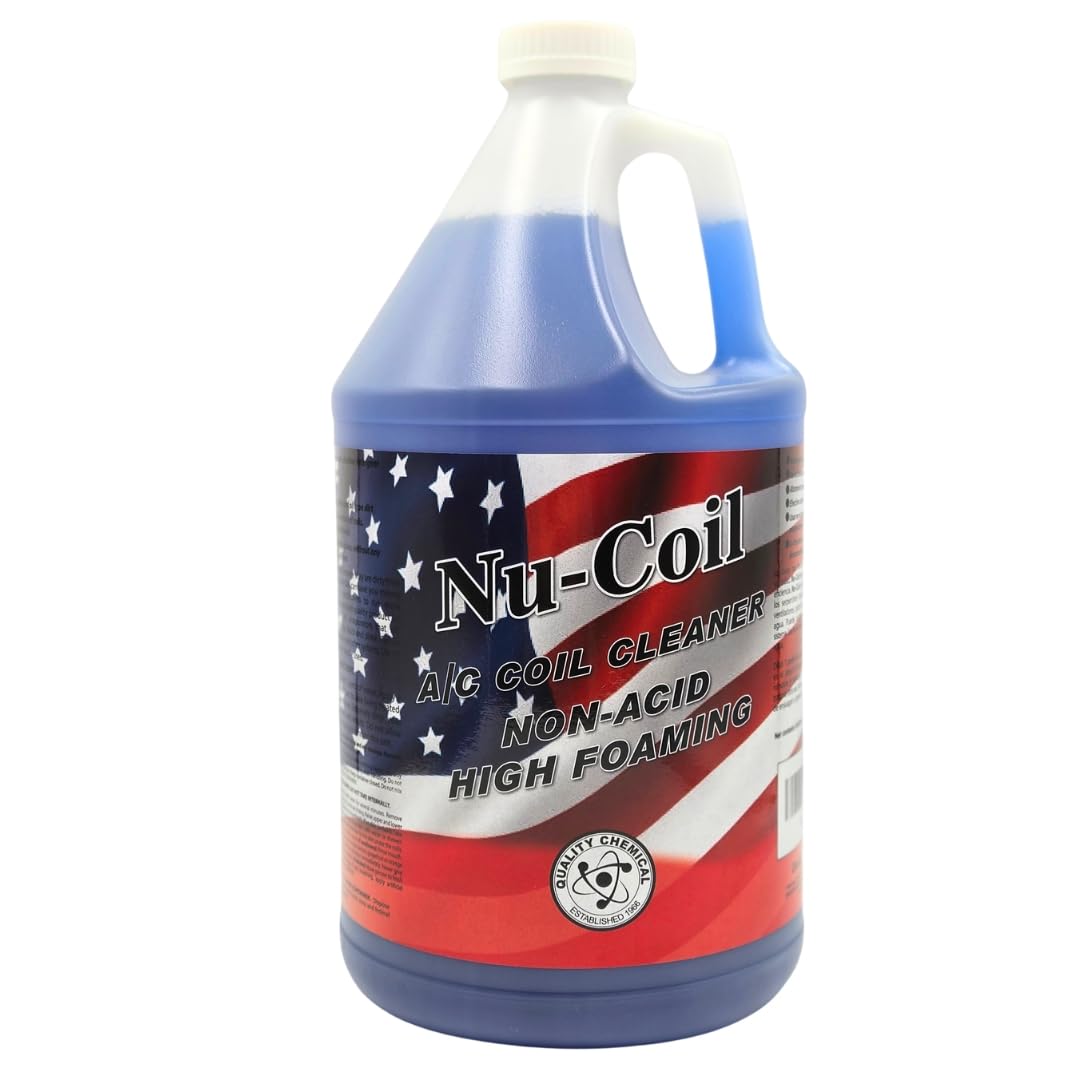
Quality Chemical Nu-Coil Concentrate

90 /100
Kirk Score Outstanding
Form
Alkaline foaming concentrate
Size
1 Gallon (128 fl oz)
Formula
Non-acid, non-flammable
Dilution
1 part product with 2 parts water
Check Details on Amazon

Pros

  • Dilutes 1 to 2, so a gallon lasts
  • Alkaline formula cuts grease and oil
  • Non-acid and non-flammable

Cons

  • Foam can come up flat when mixed as directed
  • Exterior coil surfaces only, not indoor evaporators

One part Nu-Coil to two parts water. That ratio is why a gallon goes as far as it does — mix a quart at a time in a pump sprayer and you can finish a pair of condensers and their fan blades without going back for more.

We reach for this when a coil has been ignored. It's an alkaline detergent, non-acid and non-flammable, and it cuts the greasy film that a mild foam beads off — the grime you get near a kitchen exhaust or a dryer vent. On a badly soiled condenser it lifts in one pass what a light aerosol struggles with at all.

Foaming is the weak spot. Mixed as directed in cold water it can come up nearly flat, and a flat application slides off a vertical coil before it has done much. Warm water and a coarse nozzle help, and so does a second pass on the worst panels.

The routine is the trade: you mix, you spray, you wait a few minutes, you rinse, and you don't let an alkaline cleaner dry on the fins. Do that and one jug covers a whole cooling season of dirty coils, which is why it stays in the lineup despite the mixing.

Bottom line: Our pick for a filthy outdoor coil: an alkaline concentrate cut 1 to 2 with water that lifts grease and sludge from fins and fan blades.

Check Latest Price
#06

Whole-house upkeep

Arm & Hammer AC Coil Cleaner (3-Pack)

92 /100
Kirk Score Outstanding
Foam
Self-expanding
Form
Aerosol foam
Size
19 fl oz (3-pack)
Rinse
Evaporator no-rinse, condenser light rinse
Check Details on Amazon

Pros

  • No-rinse indoors, light rinse outdoors
  • Three cans cover both coils in one order
  • Neutralizes odors from the air handler

Cons

  • Costs more per ounce than single-can foams

Three cans, two jobs. Arm & Hammer sells this cleaner in a three-pack because most houses have an evaporator above the furnace and a condenser outside, and the cans divide between them: no rinse indoors, a light rinse outdoors.

The foam is self-expanding and clings where it lands rather than running down the cabinet, and it does the two things you want on an indoor coil — lifting dust and surface buildup, and leaving the air handler smelling neutral instead of chemical. On the condenser it wants a hose afterward, which is the same deal as every other aerosol here.

What earns it a place is the split: one order, one product, enough foam for both coils, and odor control that holds up on a musty air handler. The catch is arithmetic — three cans cost more per ounce than a single can of our top pick, so you're paying for the convenience of covering the whole house at once rather than for a better formula.

Bottom line: A sensible middle path for a house with both coils to keep up: three cans that split between no-rinse indoor work and a rinsed outdoor condenser.

Check Latest Price
#07

Older mixed-metal coils

Coil Safe Evaporator Coil Cleaner

91 /100
Kirk Score Outstanding
pH
Neutral
Form
Liquid concentrate
Size
1 gal (128 fl oz)
Formula
Phosphate-free, non-corrosive
Check Details on Amazon

Pros

  • Neutral pH is gentle on aluminum fins
  • Self-rinsing, so condensate carries it off
  • A gallon lasts years of seasonal upkeep

Cons

  • Barely foams, so coverage is hard to see
  • No sprayer included

Neutral pH is the reason to buy this one. Alkaline cleaners work, and they're also why an old coil can come out looking etched; Coil Safe keeps the chemistry mild and adds sodium gluconate to hold minerals in suspension, which is what we want on a fin pack that's already thin.

It's a gallon of concentrate with a lemon note and no drama. Spray it on, let it dwell, and the coil's own condensate — or a hose — carries it off. ComStar sells to commercial accounts, and the label shows it: it assumes you already know what a coil cleaner is for.

Speed is where it loses ground. Without a thick foam lifting the dirt, a badly soiled coil needs dwell time and probably two applications, and you want a pump sprayer with a fan tip for an even coat. That's a slower afternoon than a can of aerosol.

The payoff is on the coils you don't want to attack: an older evaporator that has been cleaned before, a mixed-metal assembly, anything where a strong alkaline bath feels like a gamble. For a homeowner with one coil and a sprayer it's a sensible long-term buy; for a single dirty condenser in spring, an aerosol is less fuss.

Bottom line: The choice for older or mixed-metal coils: a neutral-pH, non-corrosive concentrate that self-rinses and won't attack a thin aluminum fin pack.

Check Latest Price
#08

Ducts and filters

ERRECOM Clima-Net AC Cleaner

88 /100
Kirk Score Excellent
Use
Ducts, filters and coils
Form
Liquid
Size
34 fl oz (1 liter)
Scent
Lavender
Check Details on Amazon

Pros

  • Cleans ducts and filters, not just coils
  • Nozzle switches between stream and spray
  • Mild alkaline formula with a light lavender scent

Cons

  • Liquid runs off vertical coils faster than foam

Most coil cleaners stop at the coil. Clima-Net is aimed at everything the air touches — ducts, washable filters, evaporator and condenser faces — which makes it the bottle for a musty split-system head or a central return that smells worse than the coil looks.

The nozzle gives a straight stream or a coarser fan depending on how you set the tab, which is genuinely useful: a stream for washing down a filter, a fan for coating a coil face. One liter is sized for a split system rather than a cabinet-sized condenser, so you aren't paying for volume you won't use.

It's a liquid rather than a foam, and the lavender note is noticeable for a day. Nothing here is harsh: the formula is alkaline but mild, made in Italy, and sold as a between-service maintenance product rather than a rescue.

That last part is the boundary worth knowing. For a coil matted with lint and pet hair, the foams in this guide do more; for keeping a system that's already clean from turning musty — filter, coil face, the reachable housing — this is the bottle we keep on the shelf.

Bottom line: The one to buy when the coil isn't the whole problem: a liquid cleaner for ducts, filters, and coil faces on central and split systems.

Check Latest Price

How We Tested AC Coil Cleaners

We started by pulling together more than 20 coil cleaners from HVAC brands, hardware-store staples, and concentrate lines, then narrowed the list by formula type, rinse instructions, and whether the package could reach a coil without a separate sprayer. Fourteen made the cut. I tested them over four months on central-air evaporator coils, outdoor condenser coils, a ductless mini-split, and a window unit—usually on a Saturday morning when the house was quiet and I could pull a panel without rushing.

For each one, I sprayed from about six to eight inches away and watched whether the foam expanded into a thick blanket or ran straight down the fins. I noted whether the nozzle delivered a fan or a stream, clogged, dripped, or reached the back of the coil, and whether the color made it easy to see missed spots. After the dwell time on the label, I rinsed as directed—or left it alone for no-rinse formulas—and checked the drain pan and fin edges for leftover film or grit. I also noted whether a self-rinsing formula actually cleared the condenser without a hose.

Cleaning performance was judged on visibly dirty coils before and after, not on how dramatic the foam looked. I tracked scent during use and for a few hours afterward, since a coil cleaner can linger in a closed closet. I also compared value by calculating cost per cleaning—concentrates got measured at label dilution, ready-to-use bottles at full strength—and noted whether bottles, caps, and nozzles held up after repeated use. Ease of use came down to setup and cleanup: how much plastic I had to drape, whether the bottle was comfortable to hold at an angle, and how messy the rinse was. I flagged acid-based formulas versus neutral or non-acid ones because runoff needs more care.

How to Choose an Ac Coil Cleaner

Match the cleaner to the coil

Evaporator coils live indoors, above a drain pan and often above a ceiling you don't want to open twice. That rules out anything needing a hose: you want a no-rinse foam carrying corrosion inhibitors, and you want it mild, because the alkaline chemistry that's fine on a condenser can pit a thin indoor fin pack. Condensers are the reverse — outdoors, dirty, and rinsable — so a stronger alkaline concentrate earns its place there. Buying one product for both? Take a no-rinse foam and rinse it off the outdoor unit anyway.

The word self-rinsing does a lot of work on these labels. It means condensate or rain carries the residue off a wet coil, not that you can skip a rinse on a dry, heavily soiled condenser.

Foam is a delivery method, not a strength rating

A thick blanket of shaving-cream foam looks like work happening, and on a loosely packed coil it is. On a dense fin pack it can sit on the face and never reach the dirt. Fast-breaking foams like Nu-Calgon's are designed to liquefy and drain, which is why they look underwhelming and still clean. What matters is whether foam gets between the fins: a narrow, driven spray like the Foam Blaster's does that better than a wide fog, and a concentrate applied with a fan-tip sprayer soaks a coil more evenly than either.

Cans, jugs, and what a cleaning costs

An aerosol is the right buy for one coil, once a year: no sprayer, no mixing, nothing to store. A concentrate wins once you're doing two units or cleaning every season — a gallon cut 1 to 2 with water outlasts several cans, and it costs less per cleaning even though the jug looks expensive on the shelf. Count cleanings, not ounces. Three nineteen-ounce cans for a house with one condenser is more product than a year needs; a gallon is waste if you never open it again.

Reach, drip, and what's around the coil

Shut the unit off at the disconnect before you spray anything, and put glasses on — alkaline foam bouncing off a coil is not something to get in your eye. Indoors, the drain pan catches everything, so clear the drain line before you start. Outdoors, wet down the plants and the siding first and rinse them afterward. A pump sprayer with a fan tip gives the most even coat on a big condenser; an aerosol with a straw or flip nozzle is what reaches the narrow gap on a mini-split head.

Never mix two coil cleaners hoping for a stronger result. Apply one, let it work, rinse, and start again if the coil needs it.

Frequently Asked Questions

Final Verdict

For most households, the Frost King ACF19 is the whole answer: one no-rinse can that handles a condenser, a window unit, and a musty drain pan, with nothing else to buy.

Step up to the Leak Saver six-pack if you maintain more than one system and want foam driven into the fins rather than laid on top. And if every coil you own sits outdoors where you can rinse, a jug of Simple Green plus a pump sprayer will outlast every can here.