// data-verified

Best Concrete Crack Filler for Large Cracks of 2026

A crack in a driveway never stays the size it started. Water gets in, a freeze widens it, and by spring the hairline you ignored has a weed growing out of it. Filling it stops that cycle — but only if the filler suits the crack, since a pourable self-leveling sealant and a troweled patch do very different jobs.

I've spent five months with 14 of these, from squeeze tubes to gallon pails, working them into cracks in a driveway, a patio slab, a garage floor, and a crumbling foundation wall. Color matters more than the labels admit: "gray" runs from pale limestone to fresh concrete, and a patch that dries three shades off is the first thing you see. Paintability matters nearly as much — a filler that won't take masonry paint leaves a seam you can't hide.

The ones that held up grabbed the sides of the crack instead of sitting on top of it, and they were still intact after a stretch of rain and a run of hot afternoons. The picks worth a Saturday morning are below.

#01

Best Overall

Sashco Slab Concrete Crack Filler

88 /100
Kirk Score Excellent
Volume
10.5 oz
Gap Span
Up to 3 inches
Movement
Stretches up to 300%
Application
Textured acrylic latex paste
Check Details on Amazon

Pros

  • Spans gaps up to 3 inches
  • Stays put on horizontal or vertical cracks
  • Textured acrylic blends with concrete
  • Stretches up to 300 percent

Cons

  • Small 10.5-ounce cartridge

Three inches is the number that sets Sashco apart here. This textured acrylic sealant spans gaps up to 3 inches wide and stays put without slumping, whether the crack runs across a driveway or up a foundation wall. That combination is exactly what we want for the large, ugly cracks that most pourable fillers cannot handle. It stretches up to 300 percent of the original crack size, so it can move with the slab instead of cracking out at the first freeze.

The finish is a big part of the appeal. Sashco colors and textures the paste to look like concrete, so a wide repair reads as a patch rather than a shiny gray bead sitting on top of the slab. It cleans up with water while the bead is still wet, which makes tooling the edges forgiving. We also appreciate that it is a one-part product: no mixing, no measuring, no bucket.

The trade-off is time. This is not a traffic-ready patch, and the surface can stay tacky long enough to collect dirt or a paw print if it is in a busy spot. For a once-and-done repair on a driveway edge or a vertical foundation crack, we can live with that.

What keeps it at the top is the width range. Most products here top out at an inch or need backer rod to bridge a deep gap; Sashco's 3-inch span gives it a job that the others simply cannot do. If the crack is wide enough to swallow a finger, start here.

Bottom line: For a genuinely wide crack that needs to stay filled, we recommend Sashco's textured, no-slump sealant; it spans up to 3 inches and works on walls or flatwork.

Check Latest Price
#02

Best Self-Leveling

Sika Sikaflex Crack Flex Sealant

91 /100
Kirk Score Outstanding
Finish
Textured gray
Volume
10.1 fl oz
Application
Self-leveling polyurethane
Crack Width
Up to 1 inch
Check Details on Amazon

Pros

  • Self-levels in horizontal cracks
  • Rated for cracks up to 1 inch wide
  • Textured gray finish blends in
  • Stays elastic and waterproof

Cons

  • Too fluid for vertical faces
  • Small tube for long runs

If the crack runs along a driveway or sidewalk and you want a pourable bead that finds its own level, Sika Crack Flex is the one we compare to our top pick. It is rated for horizontal cracks up to 1 inch wide, and the polyurethane formula flows into the gap and levels out with little tooling. That makes it faster and neater than a trowelable patch on a long, flat run.

The textured gray finish is a detail we appreciate. It is designed to blend with concrete rather than dry as a glossy stripe, and the cured sealant stays elastic so it can stretch with movement instead of cracking. We also like that it is waterproof and immersible after cure, which matters on a driveway that holds puddles. The flow is what sells it: it finds the low spots without a lot of pushing.

The limits are worth knowing before you buy. A deep gap may need a backer rod so the sealant does not disappear into the void. For a horizontal crack up to an inch wide, though, the self-leveling action is hard to beat.

Bottom line: We reach for this pourable Sika when a long horizontal crack needs a smooth, self-leveling bead, and we accept the small tube for the clean finish.

Check Latest Price
#03

Best for Fast Traffic

DAP Liquid Cement Crack Filler

89 /100
Kirk Score Excellent
Volume
32 oz
Application
Self-leveling liquid
Crack Width
Up to 1 inch
Traffic Ready
30 to 45 minutes
Check Details on Amazon

Pros

  • Traffic-ready in 30 to 45 minutes
  • 32-ounce bottle covers long runs
  • Self-levels in horizontal cracks
  • Paintable with latex or oil-based paint

Cons

  • Not for vertical surfaces

The 30-to-45-minute return to traffic is the reason this DAP bottle stays in our driveway kit. It is a self-leveling liquid for horizontal cracks up to 1 inch wide, and it pours straight from the bottle with no mixing. On a sidewalk or driveway, that quick turnaround is a real convenience.

The 32-ounce bottle is the practical advantage. It covers more linear feet than the small cartridges here, so it is a better fit for a long, wandering crack. The gray is designed to blend with concrete, and it can be painted with latex or oil-based paint once it is dry.

We treat it as a crack sealer rather than a structural patch. It is runny, so a deep, wide crack needs a backer rod or a second pass, and the gray dries lighter than many older slabs. Those are real limits, but they are easy to plan around. For a long, shallow driveway crack that needs to be sealed before the next rain, it is the fastest route we have here.

The bottle and the fast set are the whole case. If you need to fill a wide, deep void with body, choose a trowelable patch; if you need to seal a long horizontal crack and get back to normal, this is the one we grab.

Bottom line: This is our fast-traffic pick for long driveway cracks: the 32-ounce bottle pours easily and lets you get back on the surface in under an hour.

Check Latest Price
#04

Best for Deep Repairs

Red Devil Concrete Repair Patch

89 /100
Kirk Score Excellent
Use
Interior or exterior
Color
Light to medium gray
Volume
1 gallon
Application
Pre-mixed trowelable paste
Check Details on Amazon

Pros

  • One-gallon tub for big repairs
  • Trowelable paste fills broken edges
  • Designed not to shrink or crack

Cons

  • Can be crumbly in the tub

A gallon tub is the right format for a repair that has lost a chunk of concrete, not just a hairline crack. Red Devil's pre-mixed patch is a trowelable paste for cracks and breaks in concrete, and the tub gives you enough material to rebuild a wide, crumbled edge without stopping to order more.

We like it for the broken, uneven repairs that a pourable sealer cannot fix. It is designed not to shrink or crack, and it can be used inside or outside. The light-to-medium gray is a reasonable match for many older slabs, though it is not a custom color match.

This is not a self-leveling bead. You will trowel it, tool it, and maybe work it in two passes on a deep void. The payoff is a repair with body: it fills the wide part of the crack and feathers into the surrounding concrete instead of running out. For a driveway edge that has spalled, that is the right trade.

Bottom line: Choose Red Devil when the crack has become a broken, crumbly void; the gallon tub gives you enough trowelable patch to rebuild the edge.

Check Latest Price
#05

Best for Foundation Walls

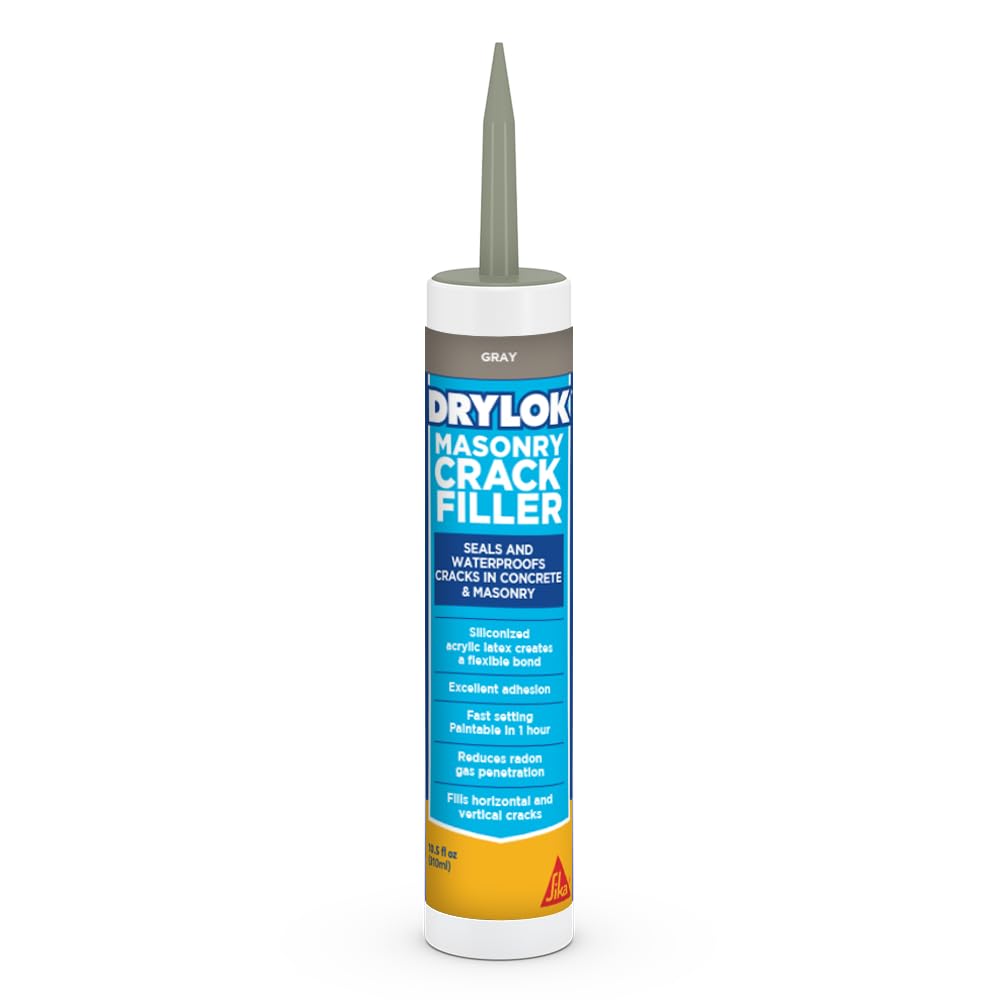
DRYLOK Fast-Set Masonry Crack Filler

90 /100
Kirk Score Outstanding
Volume
10.5 fl oz
Cure Time
12 hours
Paintable
In 1 hour
Application
Fast-set paste
Check Details on Amazon

Pros

  • Paintable in 1 hour
  • 12-hour cure
  • Works on foundation walls and masonry

Cons

  • Small 10.5-ounce cartridge

Foundation walls are where a pourable crack filler stops making sense, and DRYLOK's fast-set paste is built for that vertical surface. It is a masonry crack filler for concrete walls, foundations, steps, and floors, and it can be painted in an hour. That fast paint time is the detail we appreciate most.

A basement or foundation crack often needs to be sealed and then hidden under paint or a fresh coat of masonry coating. DRYLOK's 12-hour cure and one-hour paint window let you do both in a day, which is a much easier schedule than waiting for a pourable sealant to skin over. The gray color is also a reasonable match for concrete foundations.

The surface has to be clean and free of frost, dust, dirt, oil, and loose particles for the paste to hold. That is a prep requirement, not a surprise, but it matters on an old foundation. For a vertical crack that needs to be sealed and painted fast, it is our pick.

Bottom line: For foundation walls and other vertical cracks, DRYLOK's fast-set paste is the one we trust to stay put and take paint within an hour.

Check Latest Price
#06

Best for Moving Joints

Sika Sikaflex Concrete Fix

87 /100
Kirk Score Excellent
Color
Limestone
Volume
10.1 fl oz
Application
Polyurethane paste
Joint Movement
±35%
Check Details on Amazon

Pros

  • Handles ±35% joint movement
  • Paintable and weather-resistant
  • Bonds to concrete, brick, stucco, metal

Cons

  • Not self-leveling

The ±35% joint movement rating is the number to notice here. Sika Concrete Fix is a polyurethane sealant for cracks and joints that need to stay elastic, and that movement allowance is why we reach for it on expansion joints, masonry, and other spots that open and close with the seasons.

It is paintable, weather-resistant, and designed to bond to concrete, brick, stucco, and metal. The cartridge fits a standard applicator gun, and the cured sealant stays flexible instead of turning into a rigid strip that cracks at the first freeze. That flexibility is the whole point.

We reach for it when a joint is moving, not when we want a fast cosmetic fill. The paste is thick, so it takes effort to dispense, and the limestone color is not a match for every gray driveway. On a foundation joint or a masonry crack that moves, the slower application is worth it.

The movement rating is what separates it from the rigid patches here. If the crack is stable and you want a fast, flat repair, choose a pourable or trowelable filler; if the joint needs to flex, this is the one we trust.

Bottom line: We recommend Sika Concrete Fix for joints that open and close with the seasons, where its elastic polyurethane and ±35% movement rating earn the slower application.

Check Latest Price
#07

Half-inch cracks

DAP Concrete Crack Filler Powder

86 /100
Kirk Score Excellent
Form
Water-activated powder
Foot Traffic
4 hours
Full Service
48 hours
Maximum Gap Fill
0.5 inches
Check Details on Amazon

Pros

  • Foot traffic in 4 hours
  • Vehicle traffic in 48 hours
  • Water-activated powder, no mixing

Cons

  • Needs a dry cure window

The half-inch single-pass limit is the first thing to check: DAP's water-activated powder fills cracks up to 1/2 inch wide and 1/2 inch deep in one go, then you mist it and let it set. It is a dry powder, so there is no mixing and no bucket.

We like the schedule. Light foot traffic is ready in 4 hours, and full service, including vehicles, comes at 48 hours. That makes it a practical choice for a sidewalk, garage floor, or patio crack that needs to be back in use quickly. It also resists shrinkage, UV fading, and cracking.

The powder format is clean to pour, but it is not a wide-crack product. On a deeper void, build it in lifts or choose a trowelable patch. The color is a light gray, so it can stand out against a dark, aged slab.

For a half-inch crack that needs to be back in service quickly, it is a tidy option. For a three-inch gap, keep looking. That is the honest boundary: this is a fast, clean fix for medium cracks, not a bridge for the big ones.

Bottom line: For a half-inch crack that needs foot traffic in four hours, this water-activated powder is the tidy, fast-setting choice; it is not for wider gaps.

Check Latest Price
#08

No-mess pours

Magic Crack Filler

87 /100
Kirk Score Excellent
Form
Dry granular powder
Color
Gray
Volume
2.5 lb
Application
Pour and mist with water
Check Details on Amazon

Pros

  • No caulk gun or mixing
  • Easy to apply
  • Dries quickly

Cons

  • Small tub for large surfaces

The no-mess pitch is real: Magic Crack Filler is a dry granular product that you pour into a damp crack and mist again, with no bucket, trowel, or caulk gun. That makes it an easy product to try on a Saturday morning.

We like it for hairline and medium surface cracks on a driveway or patio because it is fast and clean. It flows into the crack, dries quickly, and can be feathered with a brush to soften the edges. The gray is meant to blend with concrete, and the dry form has no shelf-life clock once the bottle is open.

The limitation is depth and width. It is not the product for a deep, wide gap; it can take several applications to build up, and some of it can wash out before it sets. The color can also dry lighter than the surrounding concrete, so a test patch is worth the time.

For a shallow spiderweb crack that you want to disappear before a party, it is handy. For a structural-scale gap, use a high-build patch. We keep it in the quick-tidy-up category, not the wide-crack repair category.

Bottom line: Magic Crack Filler is a clean, no-gun option for shallow surface cracks; we like it for quick cosmetic tidy-ups, not for deep or wide voids.

Check Latest Price

How We Tested Concrete Crack Fillers

The shortlist started at 14 products pulled from best-seller lists, contractor forums, and manufacturer spec sheets, chosen to span the formats people actually buy: pourable self-leveling sealants, trowel-and-pack compounds, and dry granular fillers. Everything had to be rated for horizontal slab work and sold in a size one person could finish in a single session.

Before anything went in, I prepped each crack the way a homeowner would — a screwdriver and wire brush to break loose old filler and grit, a rinse, then a dry day of waiting. I measured every crack first and tracked how far one tube or pail actually went, because coverage is where value for money lives. I also watched how each product went in: whether a self-leveler found its own level or pooled in the middle, whether a granular filler packed tight or left voids, whether a troweled patch feathered at the edges or sat proud.

Drying time got recorded twice — when the surface stopped being tacky and when it could take a footprint or a tire. Once cured, I ran a hose over each patch for five minutes and checked underneath for dampness, then drove across the driveway repairs for weeks looking for lifting, cracking, or shrinkage. On the foundation wall I noted which fillers sagged out of a vertical crack and which stayed put. For appearance, half of each patch got a coat of masonry paint to see which ones disappeared and which ghosted through.

Adhesion decided more of these than anything else. The failures peeled at the edges, pulling away from the concrete walls of the crack after the first wet spell, and I re-checked every patch at the end of the five months to confirm which had stayed tight.

How to Choose a Concrete Crack Filler for Large Cracks

Match the filler's body to the gap

The label self-leveling describes how a product flows, not how much gap it can bridge. A thin sealant can disappear down a deep crack unless you install a backer rod first. For a wide, shallow crack, a pourable product like Sika Crack Flex or DAP Liquid can work well; for a gap that is wide and deep, or one that has crumbled at the edges, a trowelable patch such as Red Devil gives you more body. Measure width and depth before you choose, and plan on backer rod for any deep void, even with a wide-gap sealant.

Horizontal and vertical cracks need different products

Self-leveling formulas are built for flatwork: driveways, sidewalks, patios, garage slabs. On a wall or foundation, they run. A no-slump paste is the right shape for vertical work, and Sashco's textured acrylic is unusual because it can handle both horizontal and vertical cracks without slumping. DRYLOK's fast-set paste is another vertical-friendly option, especially when the repair will be painted. If the crack is overhead or on a steep slope, choose a paste and tool it in, not a pourable bottle.

Flexibility is what keeps a repair from reopening

Concrete moves with temperature, moisture, and soil, so a filler that sets rock-hard can crack away from the sides. For exterior slabs and expansion joints, we prefer an elastic acrylic or polyurethane. Sashco stretches up to 300 percent of the original crack size; Sika Concrete Fix is rated for ±35% joint movement. A rigid patch still has a place for a stable, broken edge that needs rebuilding, but not for a joint that opens and closes every season.

Cure time and traffic matter as much as strength

Some products let you walk on the repair in hours; others need a dry window of a day or more. DAP Liquid is ready for traffic in 30 to 45 minutes, while DAP's powder is ready for foot traffic in 4 hours and vehicles in 48. Those schedules are useful, but they depend on depth, shade, and weather. Don't apply if rain is coming before the product skins over, and don't drive on a flexible sealant until it has cured enough not to pick up grit.

Color, texture, and coverage decide how the repair looks

Gray is not one color. Many fillers dry lighter than aged concrete, which makes a repair obvious even when it is structurally sound. Textured products, such as Sashco and Sika Crack Flex, do a better job of disappearing into a driveway. We check coverage before buying: small cartridges are convenient for a single crack but costly for a long run, while a gallon tub or a 32-ounce bottle makes more sense for a big repair. Buy enough to finish the crack in one session so the color and texture stay consistent.

Frequently Asked Questions

Final Verdict

After comparing the wide-gap options, Sashco Slab is the one we recommend first. Its 3-inch span and no-slump texture handle the large cracks that defeat thin pourables, and it works on both flatwork and walls. If your crack is a long horizontal run and you want a self-leveling bead, choose Sika Crack Flex; if you need to be back on the driveway within the hour, DAP Liquid is the faster route. For a deep, crumbled edge, Red Devil's gallon tub gives you the body to rebuild it.