// data-verified

Best Concrete Patch of 2026

The crack in my driveway started as a hairline I could ignore and widened until it swallowed a quarter. Concrete doesn't fail all at once — it works at a seam through a couple of freeze-thaw cycles, and by the time you spot it, water is already getting underneath. A good patch seals that gap and holds through the next winter instead of crumbling out by spring.

Over the past six months, my team and I have used 12 different patches on a cracked driveway, a heaved sidewalk, a patio and a garage floor — pre-mixed tubs, caulk-style tubes, pourable self-leveling jugs, dry granular fill. The differences show up fast: some skim over and shrink away from the edges, others grab the concrete and stay put.

Nobody warns a first-time buyer that gray is not one color. Two products from the same shelf can cure a shade apart, and a repair you can see from the sidewalk will bother you more than the crack ever did. Match the patch to the shape of the failure, and the job is an afternoon instead of a weekend.

#01

Best Overall

Red Devil 0641 Concrete Patch

89 /100
Kirk Score Excellent
Use
Interior and exterior
Color
Light to medium gray
Format
Pre-mixed paste, 1 gallon
Cleanup
Soap and water
Check Details on Amazon

Pros

  • One gallon covers a season of small repairs
  • Trowel-ready paste holds its shape
  • Cleans up with soap and water

Cons

  • Fixed light-to-medium gray misses dark concrete
  • Thick paste can't reach hairline cracks

A gallon tub is a lot of patch, and that's the case for this one: it handles the hairline crack across the driveway, the chipped lip of a step, and the crater where a downspout has been dumping water for years, all from one container. It's premixed, so there's no bucket, no measuring, and no half-used bag of powder turning into a brick in the garage. We kept coming back to it for exactly that reason — one purchase, several jobs, no second trip to the store.

It's thick enough to hold a trowel edge instead of slumping, which is what lets you pull it flush with the slab and feather the ends of a repair into the surrounding concrete so it doesn't read as a lump. Water cleanup is the other thing we appreciated: a wet sponge takes the haze off the slab before it sets, and there's no solvent smell hanging around the front walk. Work in sections with a sponge within reach rather than trying to cover the whole driveway before anything skins over.

The winter is where this gets decided. A patch that looks perfect in July is being tested by freeze-thaw, and a fill that sits proud of the surface, or wasn't pressed hard against the crack walls, is the one that cracks and flakes out by spring. Keep the lifts shallow, press the material in with a trowel or a putty knife, and this is still the tub we point people to first.

Bottom line: For the mix of cracks, chips, and holes most homes actually have, we point people to this tub first: it's the biggest single container here, tools out flush, and cleans up with water.

Check Latest Price
#02

Best Textured Blend

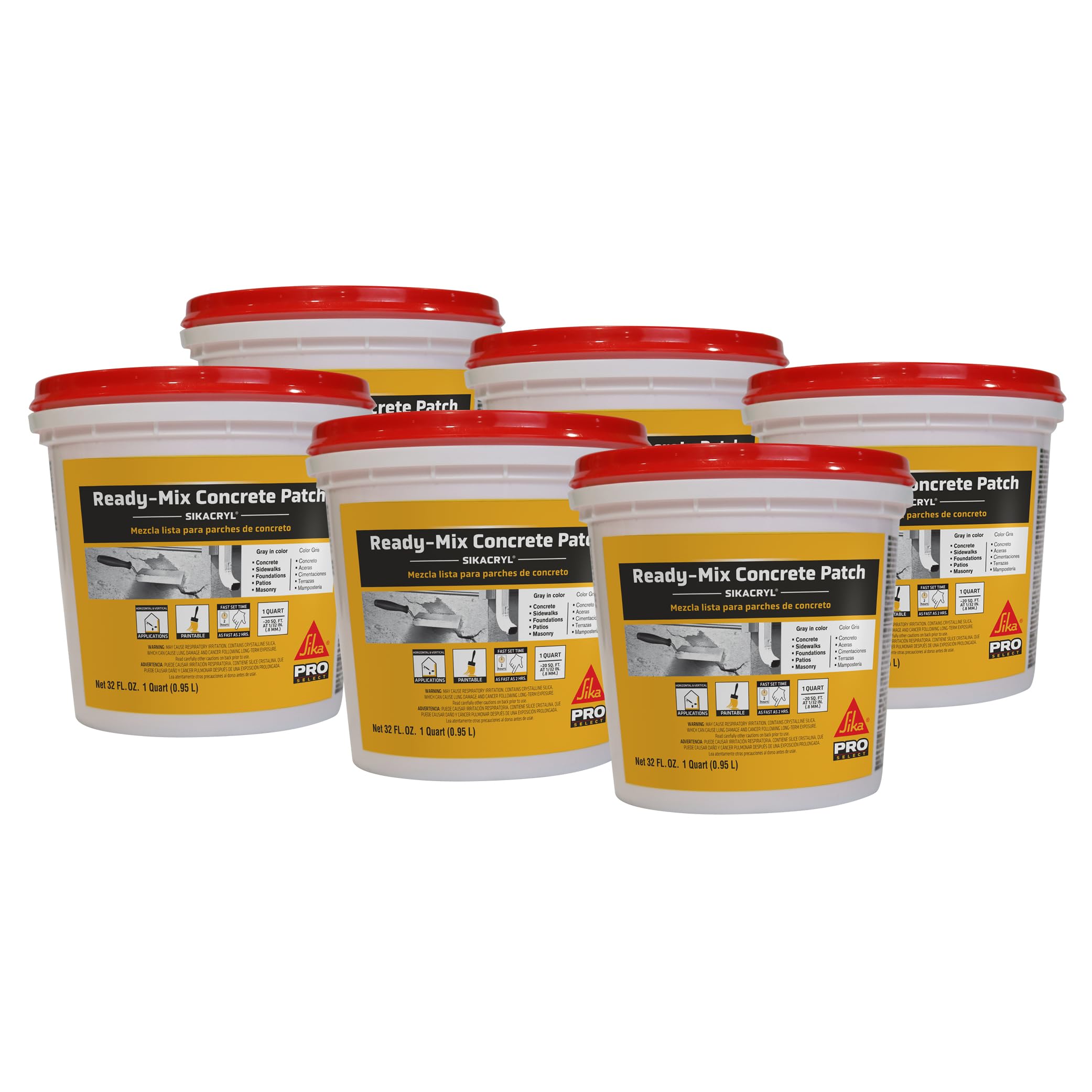
Sika Sikacryl Concrete Patch

89 /100
Kirk Score Excellent
Finish
Textured gray
Format
Pre-mixed paste, 1 qt (6-pack)
Cleanup
Water
Material
Acrylic latex
Check Details on Amazon

Pros

  • Gritted finish blends into concrete
  • Stays put on vertical faces
  • Water cleanup and low-VOC formula

Cons

  • Sold only as a six-quart case

The Red Devil tub is the workhorse; this is the one for a repair you'll be looking at. Sika builds a grit into the acrylic so a patch reads as concrete rather than a smooth gray scar, which is exactly what you want on a front step, a porch slab, or a spalled band along a foundation wall that you see every time you pull into the driveway.

It goes on like putty and stays where it's put, so it works on vertical faces — the spot under a hose bib, the face of a step riser, the edge of a stoop — where a self-leveling liquid would run straight down to the bottom. Cleanup is water, the formula is low-VOC, and there's nothing to mix beyond stirring the surface. We got further with a quart than we expected on a run of small spall repairs.

Deep fills are the thing to watch. Build them in thin layers rather than one thick slug, because a heavy bead can stay soft well past the set time on the label, and a patch that's still soft underfoot is one you'll be redoing. Two thin passes take longer and hold better, and on a vertical edge that's the difference between a repair that lasts and one that sags.

Bottom line: We reach for Sika when the repair will be seen: the gritted acrylic blends into concrete and stays put on vertical faces where a pour-in filler can't follow.

Check Latest Price
#03

Best for Hard Repairs

Rust-Oleum Concrete Patch & Repair

89 /100
Kirk Score Excellent
Use
Interior and exterior
Color
Gray
Format
Two-part epoxy, 24 oz
Paintable
8 hours
Check Details on Amazon

Pros

  • Cures harder than the surrounding concrete
  • Paintable in eight hours
  • Sands flush for a flat repair

Cons

  • The priciest way to fill a small crack

Rust-Oleum calls this stronger than concrete, and the two-part epoxy is the reason: mix the components and you get a repair that cures hard and takes paint in eight hours. What we care about is the timing — a basement floor or garage slab can be patched in the evening and back in service the next morning, and a chip at the edge of a step stops being the thing everyone catches a toe on.

It flows into a quarter-inch crack and it sands, so you can knock the excess down flush once it's hard instead of leaving a ridge for a broom to catch. For small, high-traffic failures — a spalled edge, a crack across a garage floor, the seam where a slab meets a wall — that combination is hard to beat.

Thin is also the problem. Out of the container it's runny enough to find the low end of a sloped slab, and on anything vertical it wants to slide before it kicks. Let it stand a few minutes to thicken before you load a putty knife, and mix small batches, because once it starts to go, it goes.

One condition matters more than the label lets on: it wants a clean, dry, sound slab. On a surface that's damp or cold, the epoxy can stay tacky well past eight hours, and a coat that never fully bonds is worse than the crack was. Sweep it out, wait for a dry day, and skip it when the temperature is heading down.

Bottom line: When a repair has to take traffic and paint the same day, this is the epoxy we hand people: it cures harder than the slab around it and sands flat.

Check Latest Price
#04

Best for Narrow Driveway Cracks

DAP Liquid Cement Crack Filler

89 /100
Kirk Score Excellent
Cure
24 hours
Format
Self-leveling liquid, 32 oz
Crack Width
Horizontal cracks up to 1 inch
Traffic Ready
30 to 45 minutes
Check Details on Amazon

Pros

  • Self-levels into narrow cracks
  • Traffic-ready in 30 to 45 minutes
  • No mixing

Cons

  • Only for level, horizontal cracks
  • Dries lighter than weathered concrete

A quarter-inch crack in a driveway is a miserable thing to trowel paste into: the patch sits on top rather than in the gap, traffic wears at it, and by spring you're back where you started. This bottle is the answer to that specific problem. It's a low-viscosity liquid you shake and pour, and it finds its own level down inside the crack instead of bridging over it. DAP rates it ready for traffic in 30 to 45 minutes.

It starts to skin faster than we expected, so work in short stretches on a long crack rather than trying to lay down 30 feet in one go. The bottle is a squeeze-and-pour affair, which is fine for a sidewalk and less fine for a hundred feet of driveway apron — plan on a couple of passes along the same crack rather than one heroic pour.

What it won't do is build height. Pour it into a broken-out corner or a hole and it levels at the bottom and stays there, which means a second pour and then a third. For anything deeper than it is wide, a paste or a packable powder is the right tool. This one is for the long, narrow, straight cracks that let water into a slab.

Bottom line: For a long, narrow crack in flat concrete, we haven't found an easier fix: shake, pour, and drive on it inside the hour.

Check Latest Price
#05

Best No-Mess Granular Filler

Magic Crack Filler

87 /100
Kirk Score Excellent
Color
Gray
Format
Dry granular, 2.5 lb
Activation
Water
Crack Types
Hairline to large
Check Details on Amazon

Pros

  • No mixing, no bucket, no cleanup
  • Dry bag has no shelf life
  • Fills hairline through large cracks

Cons

  • Can dry lighter than the surrounding concrete

A bag of dry granules won't rebuild a broken-out corner of a step, and it isn't meant to. What Magic Crack Filler does is close long runs of cracking across a flat slab with no bucket, no trowel, and no hose-down afterward. You sweep the granule into the crack, mist it with water, and it sets into a firm, slightly rubbery fill that moves with the slab instead of cracking out of it — a trade we're happy to make on a driveway with crack after crack after crack.

Hairline and wider cracks both take it, and because it goes down dry you can pour, level with a brush or a trowel, and keep moving down the slab. There's no shelf life to manage either: an opened bag stays usable, which is more than you can say for a tub of paste that skins over between jobs. A 2.5-pound bag covers a surprising amount of driveway, though the wider the crack the more passes it takes.

Where it stops is a hole, and a wide crack under regular traffic will want topping up after a season of tires rolling over it. Keep it for the flat, running cracks and it does the job with less mess than anything else here. It's also the one we hand someone who has never patched anything and doesn't want to learn on a visible slab.

Bottom line: If the problem is a driveway full of long cracks, this is the least fussy way we know to close them — sweep, mist, and walk away.

Check Latest Price
#06

Stone and tile

Bauer Instant Polymer Cement

0 /100
Kirk Score Fair
Yield
Up to 20x cement mix
Format
Ready-to-use paste, 2 kg
Materials
Concrete, stone, tile, brick
Water Resistance
Waterproof
Check Details on Amazon

Pros

  • Bonds stone, tile, brick, and concrete
  • Ready to use from a resealable bag
  • Workable by hand on small chips

Cons

  • Costly for the area one bag covers

Bauer's pitch is yield: a 2 kg bag of ready-to-use polymer that the company claims goes up to 20 times further than a conventional cement mix. Read that as a claim about thin applications, because that's what this is built for — bedding, sticking, and skimming, not filling a rut at the end of a driveway.

Where it earns a place is stone and tile. It bonds concrete to brick, tile to a step, and a loose paver back down onto its bed, and because it's a paste in a resealable bag there's nothing to mix and nothing to clean out of a bucket afterward. It tools with a finger, which is how a lot of small vertical repairs actually get done: a chip in a stone sill, the edge of a brick, the corner of a step.

Depth is the limit. Load it more than a quarter inch thick and it takes a long time to set, and thick applications are exactly where this kind of polymer can stay soft instead of hardening. Thin lifts, pressed in and smoothed, behave far better than one deep slug, so use it for bedding and facing rather than filling a void.

Buy it for the repair that needs two things stuck together rather than a gap filled — a rocking paver, a loose tile, a chipped stone threshold. For a straight run of driveway cracks, a tub of paste does the job with less fuss and more forgiveness.

Bottom line: We buy this for stone, tile, and paver repairs where the patch has to stick two things together, not for filling a rut in a driveway.

Check Latest Price
#07

Slabs that move

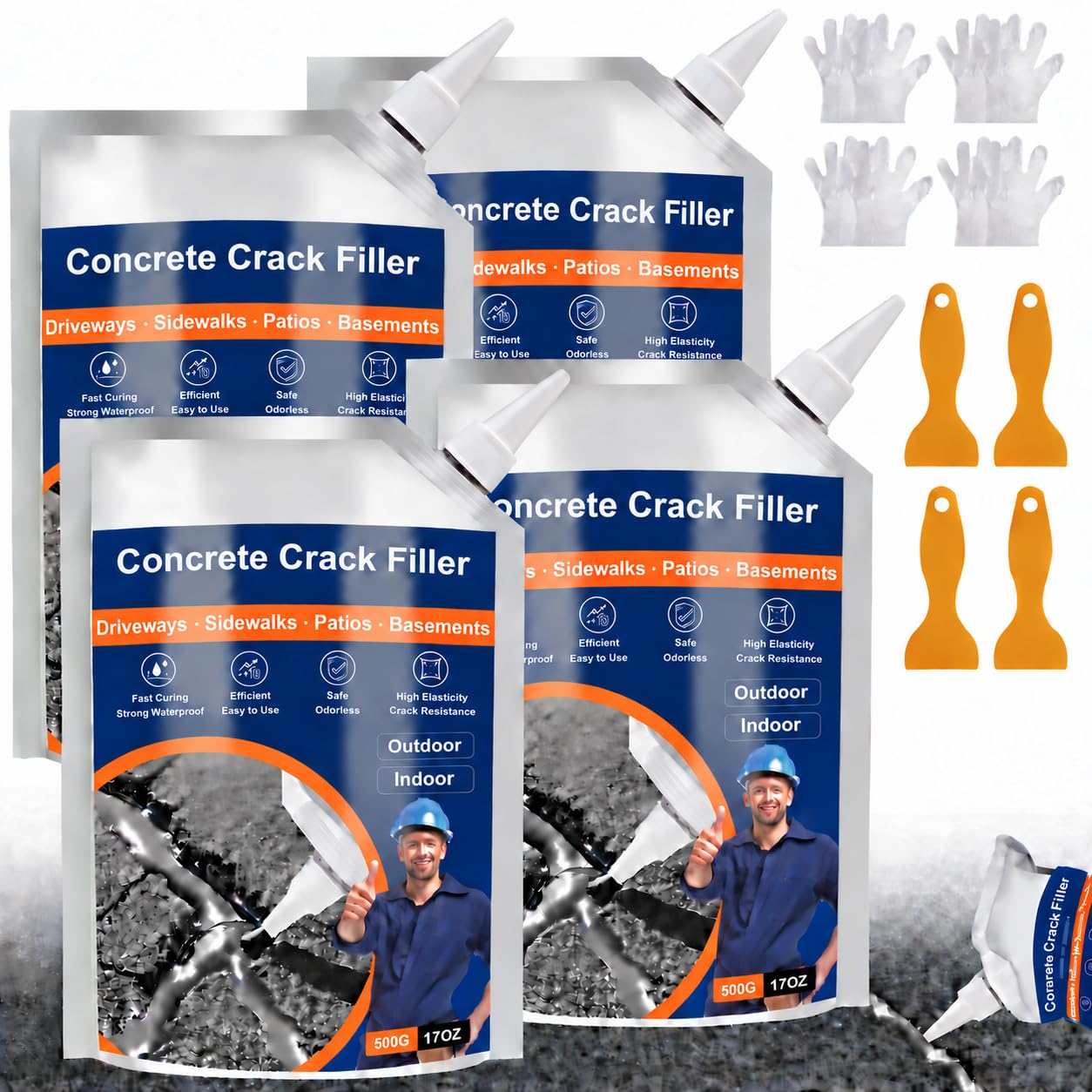
MOSAMNI Self-Leveling Crack Filler

84 /100
Kirk Score Excellent
Type
Self-leveling
Format
4 pouches, 70 oz total
Non-tacky Time
As little as 2 hours
Water Resistance
Waterproof
Check Details on Amazon

Pros

  • Flexible seal moves with the slab
  • Four resealable pouches with nozzles
  • Non-tacky in about two hours

Cons

  • Flat, horizontal surfaces only

Concrete moves, and a rigid patch in a joint that opens and closes with the seasons will crack out again within a year. This is a flexible sealant rather than a cement: it cures into something elastic that stretches with the slab instead of fighting it. For expansion joints, the seam where a driveway meets a garage floor, and the hairline crack that keeps reappearing in the same place, that's the behavior you want.

The packaging is the other good idea. It comes as four 17.5-ounce pouches with nozzles, so you open one at a time and the rest stay sealed — much better than a bottle that skins over between jobs. It flows into a gap and levels itself, and the surface goes non-tacky in about two hours, which means you aren't out there guarding it all afternoon.

One thing to know before you buy: don't plan on painting over it. The gray can bleed through a topcoat, so on a driveway you want color-matched, this isn't the filler. On a joint or a garage floor where close enough is close enough, it's a tidy, sensible fix that comes in a package you can actually finish.

Bottom line: For expansion joints and cracks that keep reopening, a flexible filler beats a rigid patch — we keep this one for flat work and skip it anywhere paint has to match.

Check Latest Price
#08

Single-pass crack fills

DAP Concrete Crack Filler Powder

86 /100
Kirk Score Excellent
Format
Water-activated powder, 1.62 lb
Gap Fill
1/2 in. wide by 1/2 in. deep
Foot Traffic
4 hours
Vehicle Traffic
48 hours
Check Details on Amazon

Pros

  • Fills a half-inch crack in one pass
  • Foot traffic in four hours, cars in 48
  • No mixing and no shelf life

Cons

  • Light gray stands out on darker concrete

No bucket, no mixing: this is a dry powder that goes into the crack dry, gets leveled with a putty knife or a finger, and is set off with a mist of water. DAP rates it for a half-inch-wide, half-inch-deep crack in a single pass, with foot traffic in four hours and a car back over it in 48.

We like the traffic times for exactly that reason. Two days sounds long until you put it next to a paste that wants a dry day, a trowel, and a return visit to feather the edge. Pour, level, mist, and the driveway is back in service by the weekend — on a straight, even crack that's a good trade.

Dry powder has an advantage that doesn't show up on the label: it doesn't care how long it sits. A tub of paste opened and closed over two seasons is a gamble; this bottle is the same in year three as it was the day it arrived. For the homeowner who fixes one crack a year, that's worth something.

Where it can let you down is a hard winter. Water gets behind a fill that isn't packed tight, and the bond to the old concrete is the first thing to go, so cracks that looked sealed in October can be open again by March. It's still the fastest single-pass fill here for a straight half-inch crack — go into it expecting to top up a stubborn one rather than assuming it's permanent.

Bottom line: For a straight half-inch crack you want filled in one pass without mixing, this is the powder we suggest keeping on the shelf — with a top-up penciled in after a hard winter.

Check Latest Price

How We Tested Concrete Patches on Real Cracks

To build the shortlist, I started with what each product claims to fill — hairline seams versus wide, deep craters — plus whether it's pre-mixed or a powder you add water to, and whether it's poured, troweled, or squeezed from a tube. I cross-checked those claims against reviews that mentioned shrinkage, patches popping out after a winter, and gray that dried too light, then bought 12 to try.

Testing ran six months on genuine failures: a driveway crack an inch wide at the surface, a heaved sidewalk slab, a spalled patio corner, a garage floor, and a chipped basement step. Each product went into a crack of the size it was built for, and we photographed and marked every repair, then checked back at 24 hours, one week, and after the first hard freeze to see whether the fill had cracked, sunk, or pulled loose from the sides.

Ease of use was judged by the mess: how cleanly the product went in with a putty knife or caulk gun, how long it stayed workable, and whether it needed a second pass as it settled. We checked consistency straight out of the container, timing how long the material took to skin over and cure, and whether it was truly paintable at the hour the label promised. Every finished repair got hosed down to see whether water beaded or soaked back into the seam, and we compared the cured color against the surrounding slab in daylight. Cost per foot of crack filled settled the value question.

How to Choose a Concrete Patch

Match the Form to the Crack

A paste from a tub is the most versatile thing you can buy. It fills holes, rebuilds chipped edges, trowels flush, and stays where it's put on a vertical face. A self-leveling liquid belongs only on flat work, but it wicks down into a narrow crack that a paste can't reach. A dry powder or granule sits in between: pour it, level it, mist it with water, and it's the quickest option for a long run of straight cracks across a slab.

If you're buying one product, make it a paste. It covers the widest range of jobs and forgives a shaky hand. Add a pour-in liquid when the job is specifically a long, narrow crack in a driveway or garage floor.

Depth and Width Set the Number of Passes

A crack an inch wide and two inches deep is not one pour. Deep fills sag, shrink, or stay soft, and cure times are usually quoted per quarter inch of depth — DAP's mortar repair wants 48 hours for the first quarter inch and another 48 for every quarter inch after it.

Probe the depth with a nail or a screwdriver before you open anything. If it's deeper than about a quarter inch, plan two or three thin lifts and give each one its full cure before the next goes in.

Color and Texture Are Half the Repair

Fresh patch is gray. Concrete that has been outside for five years is everything from buff to near-black, and a light gray fill on a weathered driveway reads as a scar from the street even when it's structurally perfect. That matters on a front walk and doesn't matter at all on a garage floor or in a basement.

Two cheap fixes: test the color on an inconspicuous corner first, and dust a little sand over the wet patch or draw a broom across it so it picks up the texture around it. Fillers with grit built in, like the Sika acrylic, blend better on broom-finished and exposed-aggregate concrete than a smooth paste does.

Buy for the Job, Not the Container

The biggest tub is rarely the best value if half of it skins over in the garage. A quart or a 32-ounce tub handles most household repairs; a gallon makes sense when you have a driveway apron or a run of steps to do. Dry powders and granules don't spoil, so a bag you don't finish is still usable next spring — an opened tub of paste is not.

Judge the price by the cracks you actually have rather than by the number on the shelf. A small container of the right filler for your crack beats a bargain bucket of the wrong one.

Frequently Asked Questions

Final Verdict

Start with the Red Devil gallon. It's the biggest single container here, it handles the ordinary mix of cracks, chips, and spalled edges, it tools out flush, and it cleans up with water — for most people it's the only thing they need to buy.

Two exceptions are worth the extra trip. Sika's textured acrylic is the better choice when the repair is somewhere you'll be looking at it, and DAP's pour-in liquid is the better choice when the job is one long, narrow crack across a flat driveway. Each is better at that one thing than the gallon is.