// data-verified

Best Chalk for a Chalk Line of 2026

There's a tradeoff built into every chalk line: the chalk that shows up brightest — the one you can read from the far end of a 20-foot deck — is usually the same one still ghosting the siding months later. Chalk is cheap, but a bad bottle costs you time: a faint line you have to snap twice, a nozzle you clear with a nail, a bottle that goes slick in a dusty glove. I've been through 16 bottles and pouches of marking chalk over the past six months, from fine white micro powders to semi-permanent dyes, snapping lines on framing lumber, deck boards, concrete, and tile backer.

The thing nobody tells a first-time buyer is that grind matters as much as color. Ultra-fine chalk slips through the reel and leaves a crisp edge, then runs out faster; coarser chalk holds on longer and clogs. Damp mornings turn a few of these to paste inside the reel. The picks below are the ones that drew clean lines, stayed visible, and came back off when I wanted them off.

#01

Best Overall

Tajima Micro Chalk White

94 /100
Kirk Score Outstanding
Color
White
Container
10.5 oz easy-fill bottle
Line Size
0.3 mm
Chalk Type
Ultra-fine micro chalk
Check Details on Amazon

Pros

  • Ultra-fine grind snaps a crisp, thin line
  • Easy-fill nozzle keeps refills tidy
  • Bright white reads clearly on dark surfaces
  • Wipes off sealed and painted surfaces

Cons

  • Can sit light on slick surfaces

The line is the reason to buy this bottle. Tajima mills this white chalk fine enough to snap a genuinely thin mark — the listing puts the line at 0.3 mm — and in our testing it laid down a crisp edge instead of the fat, fuzzy stripe a coarse powder leaves. On dark sheathing, zip walls, and house wrap it reads from across the room, which is what you want when you're sighting down a wall and don't want to walk back for a closer look.

The container is the quiet second win. The easy-fill nozzle tops off a reel without a funnel and without a white dusting across the bench, and 10.5 ounces is enough that we stopped thinking about running out mid-job. We also appreciated how it behaves when a measurement changes: a damp rag lifts the line off sealed and painted surfaces, so a wrong mark isn't a permanent scar.

White is a contrast decision, not a default. On pale plywood, light concrete, or fresh drywall it's the wrong color and you'll want blue or pink instead; kept for dark substrates, fine trim, and detail work, it's hard to beat. If most of your work is pale lumber, buy the dark blue below and keep this one for the darker half of the job.

Bottom line: This is the bottle we recommend first: a thin, sharp line, tidy refills, and chalk that wipes away when the layout changes.

Check Latest Price
#02

Best for Long-Lasting Marks

Tajima Dark Blue Marking Chalk

93 /100
Kirk Score Outstanding
Color
Dark blue
Container
10.5 oz easy-fill bottle
Chalk Type
Semi-permanent dye, ultra-fine
Fade Resistance
Fade-resistant line
Check Details on Amazon

Pros

  • Fade-resistant line survives weather and traffic
  • Ultra-fine dye snaps clean and sharp
  • Easy-fill nozzle, no funnel needed
  • Readable in dim basements

Cons

  • Dye can stain finished and coated surfaces

This is a dye rather than a dusting of powder, and that's the entire decision. Tajima labels it semi-permanent and fade resistant, and it behaves that way: the line goes down dark and stays readable through weather and through the traffic of everyone who walks the slab after you've gone home. For floor layout, where a line gets walked on for days before the material goes down, that's precisely the property you want.

Everything else is the package we liked on the white bottle: the same 10.5-ounce container, the same easy-fill nozzle, and an ultra-fine grind that snaps clean instead of smearing. Even in a dim basement the dark blue reads clearly against pale concrete and subfloor, which surprised us for a color this deep — contrast is doing the work, not brightness.

Take the permanence seriously, though. On porous surfaces this outlasts the job, and it can leave a shadow on finished concrete or anything you plan to coat, so keep it on subfloors, framing, and exterior layout rather than the wall you're about to paint. If you need a line that disappears by lunchtime, this isn't it — the standard temporary blues are.

Bottom line: Buy the dark blue when the mark has to survive rain, foot traffic, and a week of other trades — just keep it off finished surfaces you care about.

Check Latest Price
#03

Best for Damp, Dark Sites

CE Tools Manly Pink Chalk

92 /100
Kirk Score Outstanding
Color
Fluorescent pink
Weather
Hydrophobic
Container
10 oz (283.5 g)
Chalk Type
Ultra-fine
Check Details on Amazon

Pros

  • Fluorescent pink is easy to spot on dark substrates
  • Hydrophobic powder shrugs off damp
  • Fine grind clings and snaps a clean line

Cons

  • Wears off smooth cement under traffic

Picture a damp subfloor in a half-finished basement, the sort of job where an ordinary blue powder turns gray before the slab dries. That's where this pink earns its place: the chalk is hydrophobic, so it repels water rather than soaking it up, and the fluorescent color stays loud against gray concrete and dark sheathing.

Visibility is the headline. In our testing the pink was the easiest of these to pick out from across a dim room, and it snaps fine and clean, which matters when you're marking a cut line rather than roughing out an area. It also held its own in sawdust, where paler powders tend to vanish. The 10-ounce bottle is a comfortable size for a tool bag, and the fine grind clings to the line well enough that we weren't re-snapping the same mark twice.

Where it makes sense is the ugly half of the job: basements, garages, wet slabs, and anything outdoors in the week before the weather turns. On those surfaces the pink is the line you can actually find, and finding it is most of the battle.

Bottom line: For damp subfloors and dim basements, the fluorescent pink is the easiest line to find; expect to refresh it on smooth cement.

Check Latest Price
#04

Best Bulk Buy

Irwin Strait-Line Indigo 4 lb

90 /100
Kirk Score Outstanding
Seal
Airtight flip-cap
Color
Indigo blue
Container
4 lb (64 oz) tub
Chalk Type
Permanent staining
Check Details on Amazon

Pros

  • Airtight flip-cap keeps moisture out
  • Permanent indigo resists weather and wear
  • Bulk tub suits crews and big layouts

Cons

  • Dark line is hard to read on wet concrete

Four pounds is roughly six times the chalk in the bottles here, and it arrives in a wide tub with a flip cap rather than a squeeze bottle. That changes the routine: you pour into the reel, then seat the lid, which seals airtight and keeps moisture out between jobs. If you've ever opened a half-used bottle to find a lump, that cap is the feature you're paying for.

The chalk itself is a permanent staining indigo, sold for harsh outdoor conditions and months of jobsite wear. We used it where the line had to survive — exterior layout, slab work, anywhere a rain shower or a crew walking through wasn't going to end the mark — and it held. That's a different job than a temporary blue, and it's the reason to keep a tub around.

Permanent also means permanent: this is a stain, and it does not lift out of raw concrete or unfinished wood, so keep it away from anything you plan to coat or leave natural. Buy the tub if you lay out floors or frame regularly and want one container to last a season; for a single project, a bottle is plenty.

Bottom line: Crews laying out floors get their money's worth from this tub; a homeowner with one deck project should stay with a bottle.

Check Latest Price
#05

Low-light work

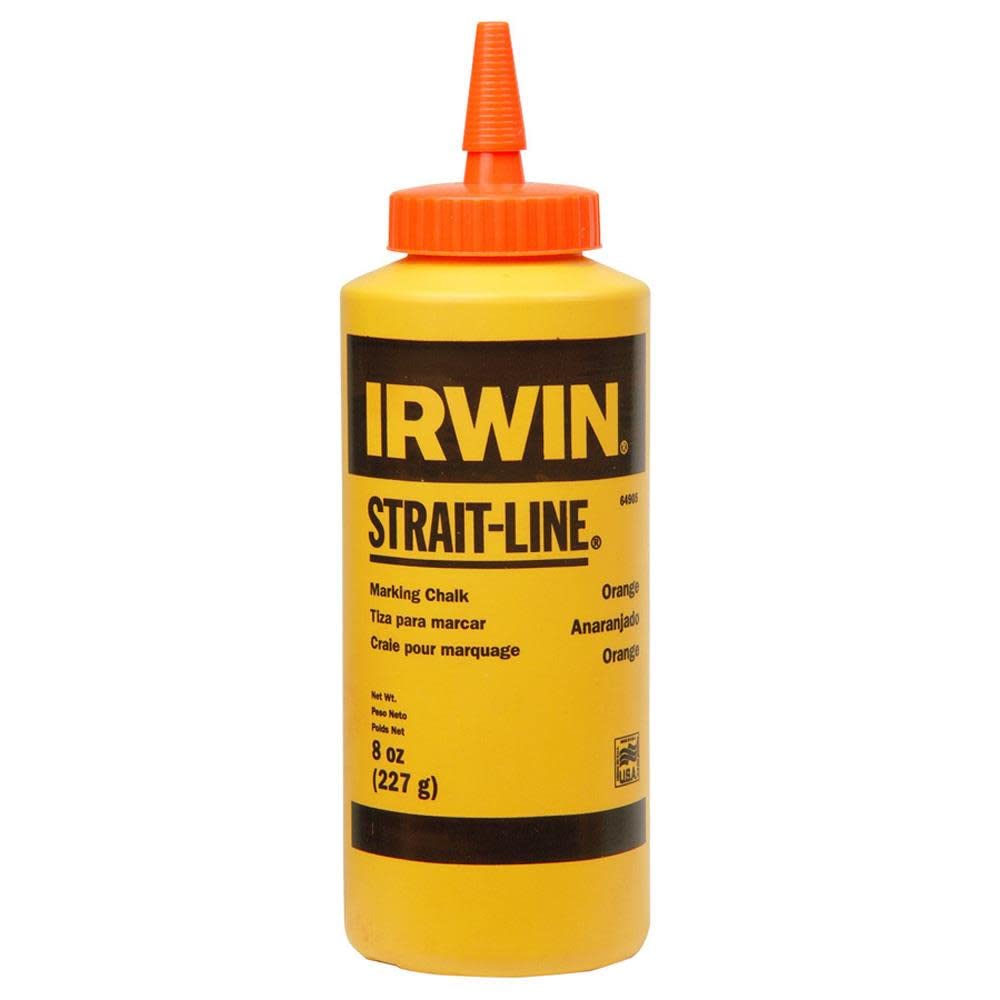
Irwin Strait-Line Orange 8 oz

90 /100
Kirk Score Outstanding
Color
Fluorescent orange
Weather
Weather resistant
Line Size
0.5 mm
Chalk Type
High-visibility marking chalk
Check Details on Amazon

Pros

  • Costs the least of the bottles here
  • High-visibility orange for low light
  • Weather-resistant for exterior layout
  • Wipes off walls and cabinets

Cons

  • Blends into gray concrete

This is the cheapest bottle in this group, and it makes sense as the second color on the shelf: a bright, weather-resistant orange for exterior layout without much of an outlay. Eight ounces is a modest bottle, but it's enough to keep a second color on hand for the jobs that need one, and the listed line is a 0.5 mm mark — a touch broader than the Tajima bottles here.

Fluorescent orange is genuinely useful in low light and on dark surfaces, which is exactly what Irwin sells it for, and in our testing it wiped off painted walls and cabinet boxes cleanly — handy when you're setting cabinets and don't want a shadow left behind. It's weather resistant too, so exterior trim and fence layout are fair game. Toss one in the truck for dim corners and outdoor work.

Bottom line: A cheap, bright orange for exterior trim and dim corners — as long as the surface you're marking isn't gray concrete.

Check Latest Price

How We Tested Marking Chalk

I started by reading through a couple dozen listings and narrowing on what a spec sheet can actually tell you: grind size, whether the dye is standard or permanent-staining, bottle weight and fill design. Anything that needed a funnel, or shipped in a bag that wouldn't reseal, got cut early. That left 16 bottles and pouches, which I used over six months across a shed framing project, a deck rebuild, and a tile layout in the garage.

Every bottle got filled at least twice, with a reel and a scrap of cardboard on the bench, and I noted whether the nozzle put the chalk in the reel or on my hands. I handled each one with a work glove on to see whether the grip held once my palms got dusty.

For line quality, I snapped eight-foot lines on framing lumber, pressure-treated decking, poured concrete, and cement backer board, then checked the edge under a raking light to see whether it fuzzed or doubled. Visibility got judged at 15 feet and again at 30, on both light and dark surfaces — a few colors that looked sharp on plywood disappeared entirely against concrete.

I left sample lines on a south-facing wall for six weeks and watched which went ghostly and which held through sun and rain. The permanent-staining chalks got a separate pass: after the line was cut, I scrubbed with a stiff brush and dish soap to see what lifted and what stayed in the pores. Value came down to counting — I weighed each bottle before and after a full reel so I knew roughly how many fills I was getting per ounce, regardless of what the label said.

How to Choose Chalk for a Chalk Line

Match the Color to the Surface

Chalk works by contrast, which means the brightest bottle on the shelf can be the wrong one on your material. White and black belong on dark substrates — house wrap, dark sheathing, shadowed framing. Blue, red, and pink read on pale lumber, concrete, and drywall. Orange is a low-light and exterior color that can sink into gray concrete rather than pop off it.

The trap here is buying the color you like looking at instead of the one your material needs. Snap a test line on an offcut of the actual surface, in the actual light, before you commit a whole reel to it.

Decide How Long the Mark Has to Last

Temporary chalk lifts with a thumb or a damp rag, which is what you want on interior trim and anything headed for paint. Semi-permanent dyes, like the Tajima dark blue, hold a line through weather and foot traffic. Permanent staining chalks, like the Irwin indigo, are for slabs, framing, and exterior layout where the mark can stay put.

Permanent also means permanent on porous surfaces: it doesn't lift out of raw concrete, and it can ghost through a coating later, so keep those bottles away from anything you plan to paint or seal. If the line only needs to survive until the next step, a standard temporary blue is the safer investment.

Match the Grind to Your Reel

Fine chalk — the Tajima bottles list a 0.3 mm line — snaps a thin, precise mark and suits a fine-line reel. Coarser powder gives a wider, softer, more forgiving line that some framers prefer for rough layout. A very fine powder in a thick, loosely wound line produces a fuzzy mark and dusts out of the housing.

Know which reel you're loading before you buy, and check the second one: a worn or slightly mismatched hook and line will undo the difference between a good powder and a great one.

Bottles, Tubs, and Filling Without a Mess

Most chalk line chalk comes in 8- to 10.5-ounce bottles with a nozzle or a flip cap; a four-pound tub exists for people refilling several times a week. An easy-fill nozzle saves a funnel and the dusting of powder that follows one, and an airtight cap matters more than capacity, because moisture is what turns a good powder into a lump.

Buy a bottle for a season of home projects and a tub for daily layout work. Store whichever you choose sealed and dry, and don't leave the cap off between fills.

Frequently Asked Questions

Final Verdict

The Tajima Micro Chalk in white is the bottle we recommend to most people: it snaps the thinnest, cleanest line here, refills without a mess, and wipes off when a measurement changes. Keep it for dark substrates and detail work, where white has the contrast to do its best.

If your marks have to survive weather and traffic, step up to the Tajima dark blue dye or the Irwin four-pound tub. If the job is damp or dim, the pink is easier to find. Start with the white, then add a second color when a specific surface asks for one.