// data-verified

Best Compact Flashlights of 2026

A compact flashlight has one job: be there when the power cuts, the road goes dark, or the dog slips the leash at 10 p.m. The catch is that the two things people want most — real brightness and a body small enough to forget about — pull against each other. Punchy little lights tend to bulge in a jeans pocket, and the ones you can hang on a keyring often struggle to light a stairwell. The right pick splits that difference for the way you'll actually use it.

We've spent four months carrying 16 compact flashlights on evening walks, in glove boxes, and through a two-day outage. Power source decides more than any other spec: a built-in rechargeable cell means one less thing to buy, while AAA lights run on gas-station batteries but get pricey with daily use. Lumen ratings deserve a side-eye, too, since most lights only touch their peak number briefly before stepping down.

Size and button feel ended up mattering more than any number printed on the box. We sorted the keepers from the forgettable by how they handled a dark basement, a front pocket, and a drop onto concrete, and the picks below run from keychain-small to shirt-pocket penlight.

#01

Best Overall

Streamlight MicroStream USB

95 /100
Kirk Score Outstanding
Length
3.87 in
Output
250 lumens
Weight
1.28 oz
Charging
USB rechargeable
Check Details on Amazon

Pros

  • Vanishes in a pocket at 1.28 ounces
  • USB charging with a charge indicator
  • 250 lumens and a 68-meter beam on high
  • Removable clip works on a hat brim

Cons

  • Longevity is uneven; some units quit within months

At 3.87 inches and 1.28 ounces, the MicroStream disappears into a front pocket and stays there. Clipped to the seam it sits flatter than a pen, and you stop noticing it by mid-morning. That is the whole argument for our top pick: the light you have at dusk is the one that never got left in a drawer. The clip comes off if you prefer, and it grips a hat brim when you need both hands.

On high it puts out 250 lumens with a 68-meter beam, enough to find a path out of the woods or light a fuse panel; low drops to 50 lumens and a wider, friendlier pool for close work. Be realistic about high. The listed runtime is about an hour and a half, so we treat it as a burst setting and switch down for a long walk — and the two-step output means no strobe or SOS to click past in the dark.

Charging is what earns it a permanent spot. There's a built-in lithium-ion cell, a USB cable in the box, and a charge indicator that tells you where you stand, so you're never hunting AAA cells at the wrong moment. The body is aluminum and polycarbonate, rated IPX4 for rain and splashes, tested to a one-meter drop, and backed by a limited lifetime warranty.

One thing to know going in: the tail switch wants a firm, straight press. Use a thumb rather than a fingertip and it's fine, but a gloved hand in a hurry will find it fussier than the big switch on the GearLight TAC.

Bottom line: We recommend it as the default for one-light buyers: tiny, USB rechargeable, and bright enough for a night walk or a dead breaker panel.

Check Latest Price
#02

Best Keychain Light

OLIGHT IMINI 2

95 /100
Kirk Score Outstanding
Throw
21 m
Output
50 lumens
Weight
0.69 oz
Charging
Built-in USB plug
Check Details on Amazon

Pros

  • Turns on by pulling it off its magnetic cap
  • 0.69 ounce and 2.17 inches long
  • Built-in USB plug, no cable needed
  • Magnetic base sticks to metal for hands-free work

Cons

  • One output level only, no dimming
  • About an hour of runtime per charge

There's no button on the IMINI 2. Pull the body off its magnetic cap and the light comes on; let it snap back and it's off. That reads like a gimmick until you're at a locked door with an armful of groceries — one hand, one motion, nothing to fumble for.

At 55 millimeters and 19.5 grams it's the light that genuinely stays with you, which is why it's our pick for keychain carry. Fifty lumens and 21 meters of throw won't walk you off a trail after dark, but they'll find a keyhole, a dropped screw, or a breaker panel, and the 80-degree beam spreads wide enough to be useful at arm's length. The magnetic base is the sleeper feature: stick it to a fuse box or under a hood and you get both hands back.

Charging is built in — a USB plug at the tail, no cable to lose — and the aluminum body is rated to survive a 1.5-meter drop. What you give up is flexibility, since there's one output level and about an hour of runtime per charge. As an emergency light on a keyring that's a fair trade; as a working light it isn't.

Bottom line: For keys, we pick this: 19.5 grams, a pull-to-light magnetic cap, and a USB plug built into the tail.

Check Latest Price
#03

Best Penlight

Streamlight Stylus Pro

95 /100
Kirk Score Outstanding
Length
5.9 in
Output
100 lumens
Batteries
2 AAA (included)
Water Resistance
IPX4
Check Details on Amazon

Pros

  • Pen-slim 0.6-inch body sits in a shirt pocket
  • Focused beam reaches 62 meters
  • Runs on two AAA batteries, included
  • Removable pocket clip

Cons

  • No recharging; needs AAA batteries
  • 100 lumens is modest for outdoor use

The Stylus Pro is a pen that lights up: 5.9 inches long, six-tenths of an inch around, 1.6 ounces. The shape is the point. It rides in a shirt pocket or a tool roll exactly where a pen goes, and it handles like one when you're aiming light into a cabinet, a wheel well, or the back of a rack.

A hundred lumens doesn't sound like much beside the four-figure claims elsewhere on this page, but the beam is focused out to 62 meters and it's aimed rather than sprayed, which is what inspection work wants. Two AAA batteries come in the box, the aluminum body is IPX4 rated, and the warranty is limited lifetime. We also like that the clip is removable — keep it on a pocket, or take it off and drop the light in a bag.

This is the pick for anyone whose flashlight lives with their tools rather than their keys. No charging routine, no sealed cell to age out, and fresh AAAs in every drugstore and junk drawer, so a long outage never leaves it dark. The trade is output and length: it won't light a yard, and 5.9 inches is too much for a jeans pocket.

Bottom line: We reach for this one when the light belongs with the tools: pen-slim, aimable, and fed by AAA cells you already have.

Check Latest Price
#04

Best Single-Mode Light

GearLight TAC 2-Pack

95 /100
Kirk Score Outstanding
Modes
Single mode
Length
5.31 in
Output
1,040 lumens
Batteries
3 AAA per light (not included)
Check Details on Amazon

Pros

  • One press turns it on or off
  • Zoom head swings from flood to spot
  • Two lights with belt clips and lanyards
  • Aluminum body with a 10-foot drop rating

Cons

  • No low setting, only full output
  • Three AAA per light, not included

No strobe, no SOS, no half-presses to cycle through five brightness levels: the TAC has one mode and one switch, and a press turns it on or off. That single decision is why we keep recommending it to people who are tired of fighting a flashlight in the dark — you never pass through a flash mode to reach the light you wanted.

The body is 5.31 inches of aluminum with a claimed 1,040 lumens and a 10-foot drop rating, and the head slides from a wide wash to a tight spot. Two lights, two lanyards, and two belt clips come in the box; the clips are the useful part, because a light that already lives on a work bag is a light you don't have to remember.

Where it gives ground is flexibility and feeding. A thousand lumens with no lower setting is a lot for reading a label, and each light takes three AAA cells that aren't included. At 5.3 inches it's a jacket, glovebox, or tool-bag light rather than a jeans-pocket one — and for the money, two simple aluminum lights with clips is a fair swap for giving up modes.

Bottom line: We point people here when they want a flashlight to behave like a light switch: one mode, one press, and a spare for the car.

Check Latest Price
#05

Best Rechargeable Pair

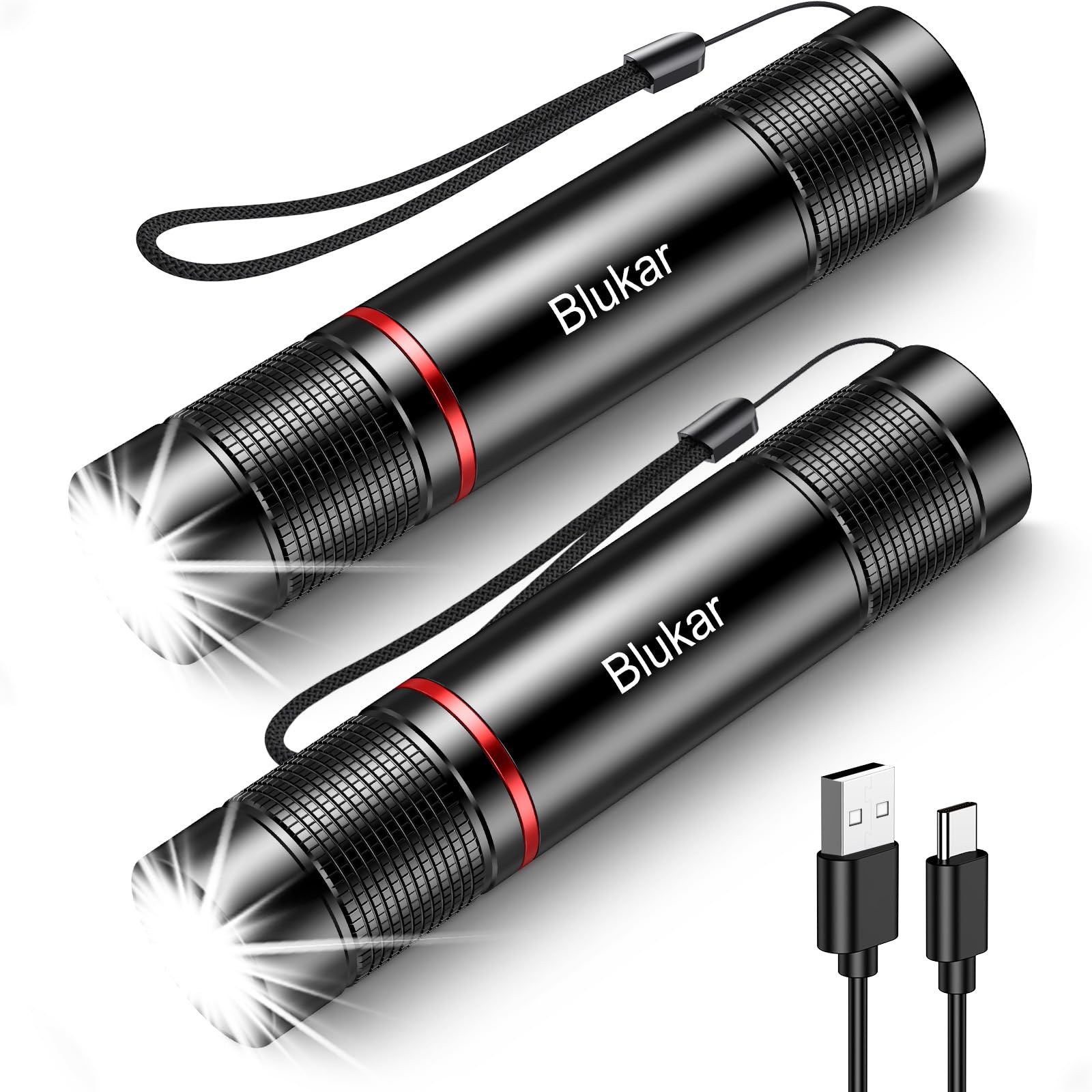
Blukar Rechargeable 2-Pack

91 /100
Kirk Score Outstanding
Length
4.4 in
Output
2,000 lumens
Battery
1,800 mAh built-in
Charging
USB-C
Check Details on Amazon

Pros

  • Two USB-C rechargeable lights in one box
  • 1,800 mAh built in, no disposable cells
  • Four modes with a zoom head
  • 4.4-inch body fits a jacket pocket

Cons

  • Mode cycle runs through strobe and SOS
  • Not the light to trust in rain

The Blukar listing claims 2,000 lumens. Treat that number as decoration: a 4.4-inch body with an 1,800 mAh cell can't sustain it, and nothing else here with a comparable power supply claims a quarter of it. What you're actually buying is a matched pair of USB-C rechargeable lights, which is the real argument for the set.

Charging is the feature that matters. Each light has an 1,800 mAh cell built in, a USB-C port, and a cable in the box, so there's no drawer of dead AAAs and no special charger to lose. Four modes — high, low, strobe, SOS — plus a zoom head cover the basics, and the 4.4-inch body fits a jacket pocket or a console bin without much thought.

Two annoyances. The mode order puts strobe and SOS in the cycle, so getting back to off means clicking past both, which is exactly the wrong thing to be doing in a hurry. And the water story is muddled enough on the listing that we'd keep these out of the rain rather than test the claim.

As a pair of everyday lights, though, they make sense: two USB-C lights that charge from the same cable as your phone, for about what one rechargeable pocket light costs. We'd put one in the car and one by the door, and not expect either to be the light we reach for on a night hike.

Bottom line: We like this pair for a car and a kitchen drawer: two USB-C lights that never need batteries, whatever the box claims.

Check Latest Price
#06

Two bright lights

GearLight S1000 2-Pack

93 /100
Kirk Score Outstanding
Modes
5 modes, zoomable
Length
6.1 in
Output
1,040 lumens
Batteries
3 AAA per light (not included)
Check Details on Amazon

Pros

  • Two lights, two holsters, two straps
  • 1,040 lumens with a zoom head
  • Aluminum body with a 10-foot drop rating
  • Cheapest route to two bright lights here

Cons

  • 6.1 inches long; not a pocket light
  • Five modes you must click through

Two lights, two belt holsters, two hand straps, and a five-mode zoom head: the S1000 pack is the closest thing here to a kit, and it's the cheapest way in this group to get two lights with this much claimed output. One by the door, one in the glovebox, and nothing to think about after that.

Each light is a 6.1-inch aluminum body with the usual five modes, a bezel you slide to change the beam from flood to spot, and a claimed 10-foot drop rating. Three AAA cells per light run it, which aren't included but are the easiest batteries on earth to stock, and the holster is the piece we didn't expect to use — a light that lives on a hook or a belt is a light you can actually find in the dark.

Size is the honest catch. At 6.1 inches long and 1.57 inches around, this is a glovebox, jacket, or toolbox light, not something that disappears in a pocket, so don't buy it expecting the MicroStream treatment. As a pair of bright, inexpensive lights to scatter around the house and cars, it's the best value in this guide.

Bottom line: We keep this on the list for bright light in two places: two aluminum lights, two holsters, and a zoom beam for very little money.

Check Latest Price
#07

Lowest cost

Lepro LED Flashlight

93 /100
Kirk Score Outstanding
Length
4.2 in
Output
140 lumens
Batteries
3 AAA (included)
Water Resistance
IPX4
Check Details on Amazon

Pros

  • Least expensive light in this group
  • Zoom head with IPX4 splash resistance
  • AAA batteries included
  • 4.2-inch body fits a coat pocket

Cons

  • Durability is the shakiest here

A hundred and forty lumens is the smallest output here outside the keychain light, and that's the honest place to start with the Lepro: it's a small, cheap light for jobs that don't need more. It measures 4.2 inches, runs on three AAA cells that come in the box, zooms from spot to flood, and carries an IPX4 rating and an aluminum body.

Where it earns its spot is price and simplicity. It's the least expensive light in this group, it takes the most common battery there is, and it handles the basic pocket jobs — finding a dropped socket, lighting a hallway during an outage, looking under a car seat. For a light that lives in a drawer and comes out twice a month, that's plenty.

Bottom line: Think of it as the drawer spare we keep recommending: cheap, simple, zoomable, and working the moment it leaves the box.

Check Latest Price
#08

Whole-house stash

EverBrite 30-Pack

95 /100
Kirk Score Outstanding
Length
3.5 in
Output
50 lumens
Set Size
30 flashlights
Batteries
90 AAA (included)
Check Details on Amazon

Pros

  • Thirty lights and ninety batteries in one box
  • Six colors to sort by room or car
  • 3.5 inches and 1.12 ounces each
  • Cheapest way to light a whole house

Cons

  • 50 lumens and not water resistant
  • Zinc-carbon cells can leak in storage

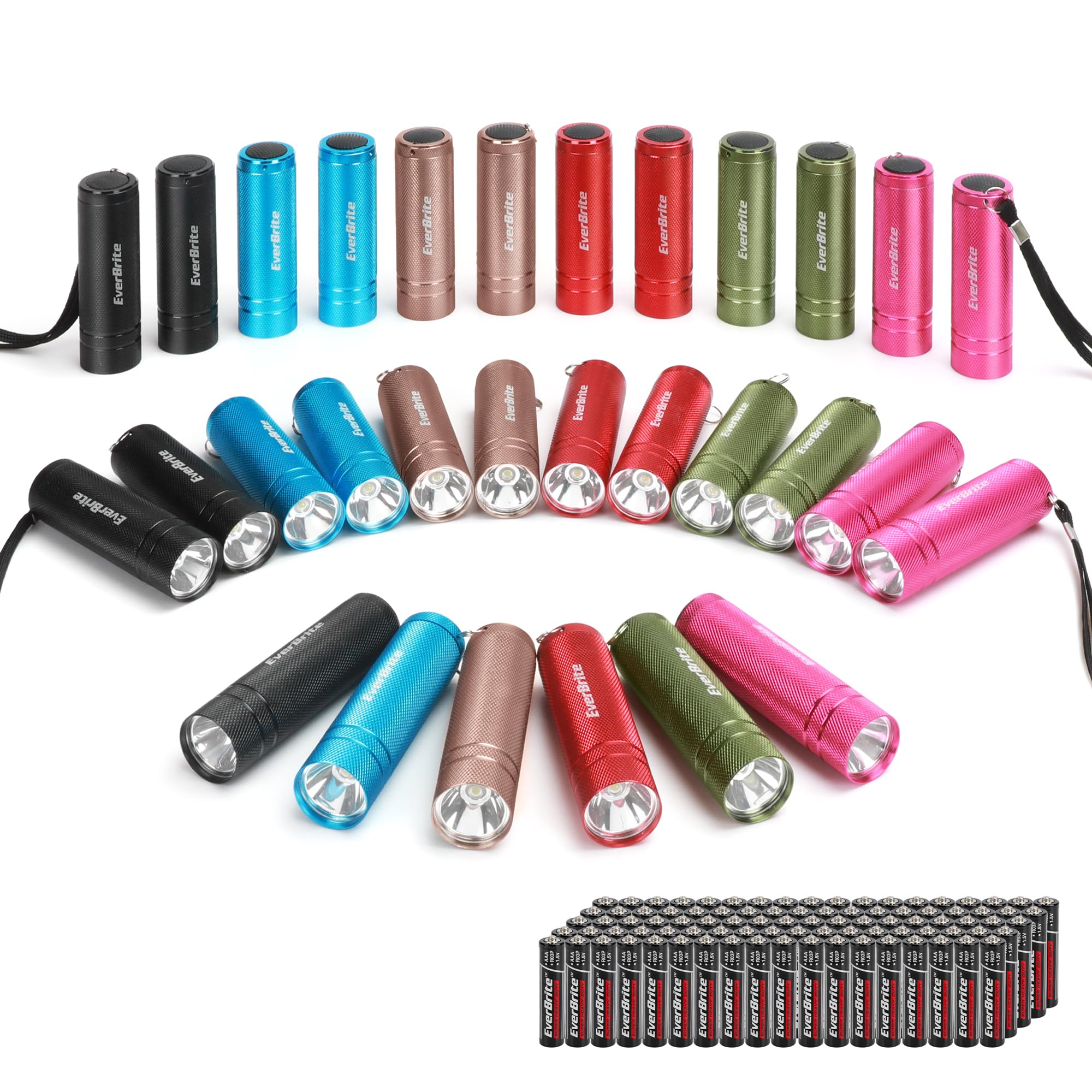
Thirty flashlights, ninety AAA batteries, six colors, cells already loaded behind a plastic tab: the EverBrite box isn't the light you carry, it's the light you leave everywhere. That's a different product from everything else in this guide, and it's worth judging on those terms.

Each one is 3.5 inches and 1.12 ounces of aluminum with a lanyard, and 50 lumens is genuinely useful at arm's length — a drawer, a fuse panel, a stairwell during an outage, a tent in the yard. The colors do real work, too: a magenta light is one you can find in a dark drawer.

The limits are worth saying plainly. Fifty lumens won't walk a dog down an unlit road, the lights aren't rated water resistant, and the zinc-carbon cells in the box are the kind that leak if they sit for years — pull the batteries from any light you're storing long-term.

Bought as a household stash — hall closet, two cars, garage, camper, plus a handful for gifts or a classroom — it's the most useful box here, and the one to buy before a storm rather than after. Bought as your only flashlight, it's thirty of the wrong thing.

Bottom line: We buy this box for drawers, cars, and outage kits: thirty working lights, batteries in, ready to scatter.

Check Latest Price

How We Tested 16 Compact Flashlights

We started with spec sheets on more than 60 compact lights, filtering for size (front pocket or keyring, nothing that needed a holster), power source, and price. That left 16, each of which spent four months in rotation: clipped to a pocket on evening walks, rolling around a glove box, dangling from a keyring, and sitting on a nightstand for 2 a.m. noises. For brightness we ignored the box — we bounced each beam off a white ceiling in a blacked-out basement, then walked the same unlit stretch of road to see how far the hotspot actually reached. Every zoomable model got its focus ring worked to check whether it tightened the beam or just smeared it.

Durability got tested the way it happens in real life: we dropped each light from waist height onto concrete three times, then checked the lens, tail cap, and body for cracks and rattles. Clips and keyring loops were yanked, stuffed into bags alongside keys, and left to fight it out, and every light took a few minutes under a running faucet. Buttons got pressed one-handed, in the dark, and with winter gloves on, and we noted which ones fired off inside a pocket and whether the mode sequence forced us through strobe to get back to high.

Battery life we tracked rather than guessed: how often each light needed a charge, whether the port cover stayed put, and how fast the AAA models burned through cheap batteries. At the end we re-checked every switch and lens for fogging, flicker, and rattles, and noted which ones we'd reached for without thinking. Those made the list.

How to Choose a Compact Flashlight

Start With Where It Lives

A light on a keyring, a light clipped inside a pocket, a penlight in a shirt pocket, and a two-pack in a glovebox are four different products, and the specifications only start to matter once you've picked which one you're buying. Length alone doesn't settle it: a 1.57-inch body is what makes a 6-inch light impossible in jeans, while the Stylus Pro's 0.6-inch barrel is why a 5.9-inch light disappears in a shirt pocket. Check diameter as well as length, against the pocket you actually use.

The word compact is the usual trap here. In a listing it often means the light fits a console, a pack, or a toolbox rather than a front pocket, and the photographs hide scale. A tape measure against your own pocket beats any description.

Rechargeable or Standard Batteries

Built-in lithium-ion and AAA power two different ownership experiences. USB charging means no battery budget and full output until the cell is empty — the MicroStream is our model for how well that works at pocket size — but a dead light then needs a cable, and a sealed cell ages with the light. AAAs win during a multi-day outage: you can feed the light from a junk drawer, a neighbor, or a gas station, and keep a spare set in the glovebox.

If you'll own one light and use it often, we favor USB charging. If you'll own one light and it's for emergencies, favor AAA plus a spare pack of cells.

Output, Beam Shape, and Burst Modes

Lumens describe total output; a focused beam is what reaches across a yard. A 100-lumen penlight with a tight spot can be more useful at 60 meters than a 1,000-lumen flood, and a zoom head lets one light do both at the cost of a visible hotspot in the beam. Read runtime figures knowing they're usually quoted for the lowest setting — a light this size gives you a burst of full output and then expects you to step down.

For walking and close work, a low or medium setting with long runtime matters more than the headline number. For spotting something at distance, look at throw rather than lumens.

Modes, Switches, and Gloves

The controls are where compact lights get irritating. Five-mode lights put strobe and SOS between you and off, and a switch sized for a bare fingertip becomes a problem in gloves or in a hurry. Single-mode lights like the GearLight TAC solve it by refusing to have modes at all; the alternative is a light with a genuinely usable low setting or mode memory.

Before buying, ask how many presses sit between dark and light, and whether you can find the button without looking at it. That's the question that decides whether a light gets carried or left in a drawer.

Water, Drops, and the Word Tactical

IPX4 means rain and splashes; IPX7 means it can be dunked. For a light that lives in a car, a boat bag, or on a tool belt, the higher rating is worth paying for; for a bedside drawer light, IPX4 is enough. Drop ratings of a meter or more generally describe the body surviving, not the switch or the emitter, which are the parts that actually fail.

Military-grade aluminum and tactical are marketing words with no standard behind them. Look for an IP rating and a real warranty instead.

Frequently Asked Questions

Final Verdict

The Streamlight MicroStream USB is the light we recommend first, because it solves the two things that make small flashlights useless: it's light enough to stay in a pocket, and it charges from a cable instead of a drawer of batteries. If your light lives on your keys, the OLIGHT IMINI 2 is the better shape. If it lives with your tools, the Stylus Pro's penlight body and AAA cells are the easier fit.

Pick the pocket first, then the light.