// data-verified

Best Corded Drills of 2026

Halfway through a deck rebuild last spring, my cordless drill quit with 30 screws left to drive and both batteries sitting on the charger in the garage. I finished the run with a borrowed corded drill and haven't thought about it the same way since. A corded drill delivers the same torque on screw 300 as it did on screw one — no fade, no waiting, no spare battery to buy — and it typically costs less than the battery-powered version of the same tool. What you give up is a cord to manage and an outlet within reach, which is a fair trade for anything that lives in a garage or a workshop.

We've spent the last six months putting 12 corded drills through deck framing, cabinet installs, and one long afternoon of basement anchors, and what separated them had less to do with the amp rating on the box than with how they felt after 20 minutes in your hand. Weight and balance matter more than most shoppers expect, especially overhead; a keyed chuck grips a bit harder but costs you time on every change; and the bit sets bundled into some boxes are thinner than the drill they come with. The picks below run from a compact 3/8-inch model for furniture and trim to a hammer drill that will chew through brick.

#01

Best Overall

DEWALT DWD115K Corded Drill

93 /100
Kirk Score Outstanding
Chuck
3/8-inch keyless, ratcheting
Motor
8 A
Speed
0–2,500 rpm
Torque
150 in-lb
Check Details on Amazon

Pros

  • 8 amps handle spade bits and hole saws
  • Keyless chuck grips without slipping
  • Mid-handle balance keeps it steady one-handed

Cons

  • Weight shows up when drilling overhead

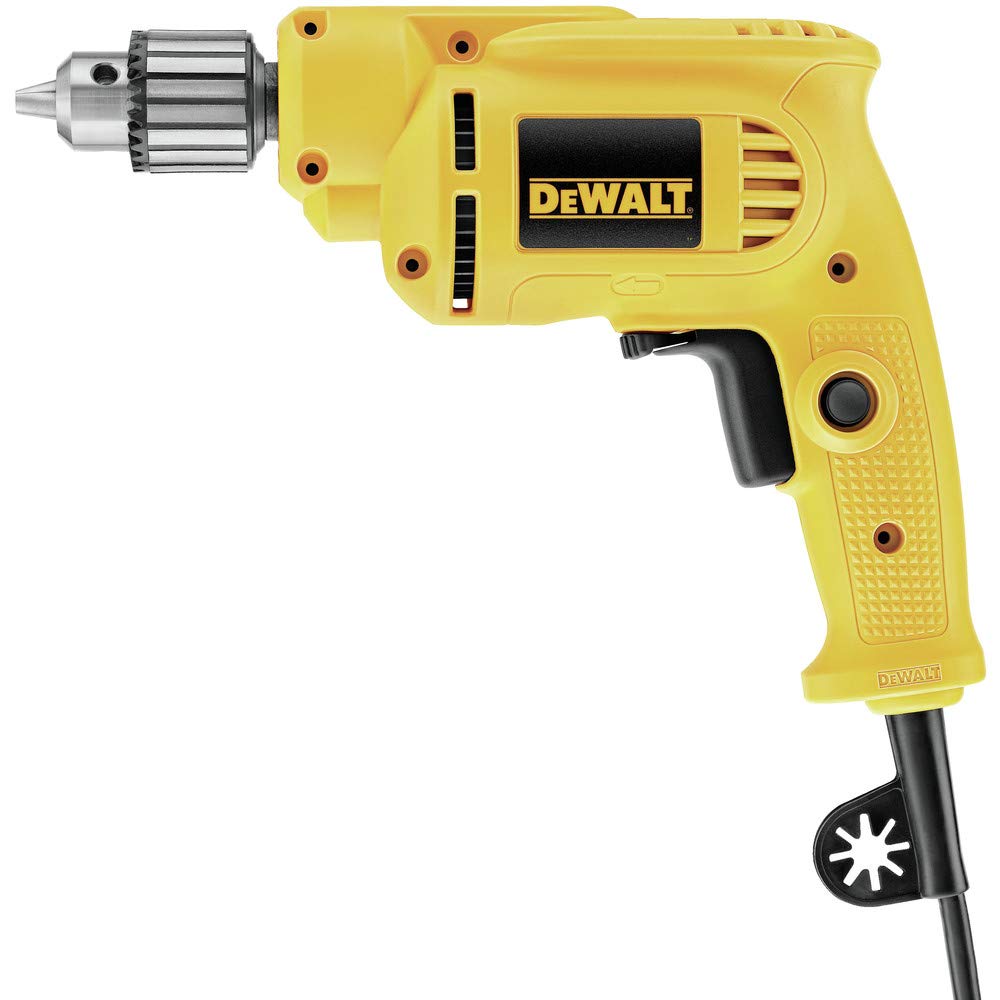
This is the corded drill we hand to someone who says they just want a drill. The handle sits in the middle of the body with the motor's weight right under your palm, and that balance is the first thing we noticed — the DWD115K steadies up in one hand in a way a nose-heavy drill doesn't. An 8-amp motor turning 0 to 2,500 rpm gives it enough headroom for a 1-1/2-inch spade bit, and the variable trigger keeps all that power on a leash for a pilot hole.

The chuck is the other reason it holds the top spot. It's an all-metal ratcheting keyless, so a bit seats with a couple of clicks and a twist, and then it stays put — no key to hunt for, no shank slipping halfway through a hole. Corded power means the tool is ready the moment you pick it up, which is the quiet advantage of a drill that never needs a charge.

What it asks in return is a lighter touch at the bottom of the trigger. There's no clutch here, and 8 amps will cam out a screw head if you pull the trigger all the way, so we start slow, let the bit bite, then squeeze. That's a habit rather than a hardship. The case, meanwhile, is a tighter fit than it needs to be: the cord has to be coiled just so before the lid will close.

Bottom line: This is the corded drill we recommend first: 8 amps of headroom, a keyless chuck that grips without slipping, and a handle that keeps the weight under your hand.

Check Latest Price
#02

Best Keyed Chuck

DEWALT DWE1014 Keyed Chuck Drill

93 /100
Kirk Score Outstanding
Chuck
3/8-inch keyed
Motor
7 A
Speed
0–2,800 rpm
Weight
3.5 lb
Check Details on Amazon

Pros

  • Keyed chuck holds smooth-shank bits tight
  • 2,800 rpm clears chips fast
  • 3.5-pound body is easy to hold overhead

Cons

  • Trigger is hard to feather at mid speed

A keyed chuck is the whole argument for this drill. Instead of spinning a collar by hand, you seat the bit and give the chuck key a turn, and the jaws clamp down on a smooth shank hard enough that it won't spin, walk, or work loose halfway through a hole. That matters with the bits a keyless chuck struggles to hold — a brad point in hardwood, a dowel jig, anything where a slipping bit ruins the work rather than merely annoying you.

We liked it most for drilling rather than driving. The 7-amp motor runs to 2,800 rpm, quicker than the top pick and slower only than the Skil, so small bits clear chips and the hole arrives fast. At 3.5 pounds the DWE1014 is easy to hold at shoulder height, and the lock-on switch saves your grip on a long run of holes. It is loud up there, though: at full speed we reach for ear protection.

What's missing is a case. The box holds the drill and its chuck key and nothing else, which leaves the key loose in a toolbox where it will eventually hide. Tape it to the cord and it stays with the tool. Small housekeeping, but a keyed drill without its key is a paperweight, and there's nothing in the box to keep the two together.

Bottom line: Buy this one if your work is mostly drilling: the keyed chuck will not let a bit slip, and at 3.5 pounds it's easy to hold up.

Check Latest Price
#03

Best for Masonry

Skil HD182002 Hammer Drill Kit

91 /100
Kirk Score Outstanding
Kit
100-piece bit set
Chuck
1/2-inch keyed
Motor
7.5 A
Speed
0–3,000 rpm
Check Details on Amazon

Pros

  • 100-piece set covers wood, metal, and masonry
  • Hammer mode drills brick and block
  • 1/2-inch chuck takes larger shanks
  • Two speeds with a low range for hole saws

Cons

  • Durability is the weakest in this group

One hundred pieces come in the box: screwdriving bits in two lengths, high-speed steel twist bits, masonry bits, brad points, spades, nut drivers, a countersink, a bit gauge, plus a side handle, a depth gauge and a chuck key. If you own no bits at all, that is a complete start in a single purchase, and it's the honest reason to look at this Skil rather than one of the DEWALTs. Count the contents when it lands — sets have turned up short a piece, and the chuck key is the one that stops the drill dead.

The hammer action is the other half of the pitch. This is the only drill of the three that will rattle through brick and block, and the 1/2-inch keyed chuck takes shanks the 3/8-inch bodies can't, with a two-speed gearbox to drop into the low range for a hole saw. It is not a rotary hammer — a day of coring concrete is a rental, not a homeowner's afternoon — but for anchor holes in a basement wall it does the job.

That kit and the hammer mode are what you're paying for, and they're worth it when masonry is genuinely on your list. They don't make this the drill to buy for a renovation that runs for months, where the DEWALTs are the safer long-haul bet, but that isn't the job in front of most buyers.

The piece we didn't expect to lean on is the depth rod. Set it once and every anchor hole in a run stops at the same depth, which is the difference between a plug that sits flush and one that doesn't. It's a small accessory doing a job that a wrap of masking tape usually does badly.

Bottom line: For brick, block, and a first set of bits, this is the one to get — just don't make it the only drill in a months-long renovation.

Check Latest Price

How We Tested Corded Drills

We built the shortlist from specs first: amp rating, chuck size and type, whether the trigger was variable-speed, cord length, and what came in the box. Anything with a fixed-speed trigger got cut, as did models with a pattern of chuck complaints. Twelve drills made the final cut — a mix of compact 3/8-inch models, mid-handle designs, and one hammer drill with a bit set — and we used them for six months on real projects rather than a bench.

Most of that time happened on a deck rebuild and a garage cabinet job. We drove 3-inch screws into treated lumber until our forearms quit, bored holes through doubled 2x10s and timed each one, and started bits on smooth plywood and tile to see which triggers let us feather the speed without the bit walking. Chucks got timed, not just judged: we swapped bits 20 times on each drill to compare a keyed chuck against a keyless one. Every drill was weighed, then held overhead on a ladder for two minutes to see how balance held up at arm's length. In the basement we switched the hammer drill to masonry and watched how much pressure it took to keep the bit biting.

Durability got the least gentle treatment: each drill came off a workbench onto a concrete floor, then went back to boring holes so we could feel for wobble or a chuck that had slipped. We also checked cords for strain at the boot, switches for grit, and inventoried every box to see whether the included bits, case, and chuck key were worth having or just filler.

How to Choose a Corded Drill

The chuck matters more than the amperage

Two chucks cover nearly every corded drill. A keyless chuck is spun tight by hand; a keyed chuck uses a toothed key to close the jaws. A good keyless chuck, the all-metal ratcheting kind, is fast and holds a hex-shank bit perfectly well. A keyed chuck simply grips harder, which is what you want with a smooth shank in a doweling jig or a pocket-hole setup.

The trap is the cheap keyless chuck. It's the first place a low-priced drill saves money, and a chuck that slips or seizes turns the whole tool into a doorstop. Spin the collar before you buy if you can, and buy keyless if you change bits constantly, keyed if you bore more than you swap.

What amps and rpm actually tell you

Amperage measures how much power the motor draws, not how much it delivers to the bit, so the amp number is a rough guide rather than a guarantee. Spindle speed is more honest: 2,500 to 3,000 rpm suits small twist bits in wood and metal, clearing chips quickly and cutting fast.

Big holes are a different job. A hole saw or a large spade bit wants torque at low speed, and that is where a heavier, slower drill earns its keep. Match the tool to the biggest bit you plan to turn, not to the biggest number on the label.

Driving screws without a clutch

None of these drills has a clutch, so nothing stops the motor when a screw bottoms out. The torque goes straight into the screw head, and an 8-amp drill can cam one out in a heartbeat. The technique is trigger discipline: start slow, let the bit bite, squeeze, and stop before the head sinks below the surface.

Long deck screws and lag bolts are where a corded drill is genuinely the better tool, because the torque never fades. A hundred short cabinet screws are where your wrist starts filing complaints.

Weight, balance, and where you'll use it

A mid-handle body puts the motor under your palm and balances in one hand; a spade or right-angle body is built for two hands and heavy bits. Three and a half pounds sounds light until you hold it at shoulder height for ten minutes, so think about where the work is. Overhead and inside cabinets favor the lighter drill; the bench favors the powerful one.

And be careful with the word compact. In a product listing it describes the body, not your ability to fit that body between a stud and a wall.

Frequently Asked Questions

Final Verdict

The DEWALT DWD115K is the corded drill we recommend to most people. Eight amps gives it headroom for spade bits and hole saws, the ratcheting keyless chuck grips without fuss, and the mid-handle balance keeps it steady in one hand.

Buy the DEWALT DWE1014 instead if your work is mostly boring holes and you want a keyed chuck that will not let a bit slip. Buy the Skil if masonry is on the list and you don't own a single bit yet. Either way, you get a tool that is ready the moment you pull the trigger.