// data-verified

Best Rotary Hammer Drills of 2026

Rotary hammers come down to one tradeoff: corded models hit harder and never ask for a charger, while cordless ones follow you to the far corner of the yard where there's no outlet. Both kinds earn their keep, and both can let you down — a hammer that binds in concrete without a working safety clutch, or rattles your fillings loose by the third hole, is a tool you stop reaching for. Over eight months, my team and I put nine of them through concrete, block, and old bathroom tile.

What surprised me: the mode selector and side handle matter as much as the motor. You switch from drill to hammer to chisel with gloves on, in bad light, kneeling in dust, and a stiff selector turns a two-second change into a two-minute fight. A handle that rotates where you need it and a depth rod that holds its setting are the quiet luxuries here.

Below are the nine we'd buy again, sorted for how people actually use them — anchors and small cores, tile removal, and the occasional weekend of demolition.

#01

Best Overall

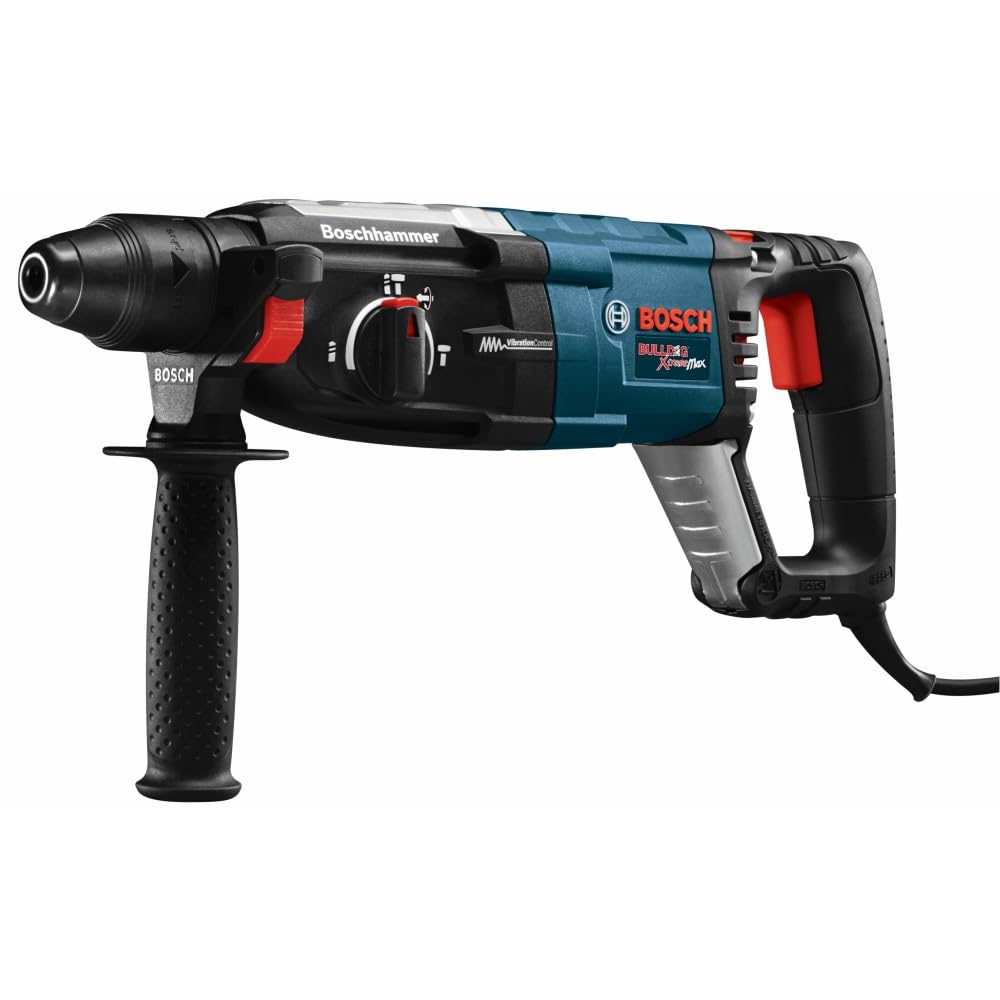
Bosch GBH2-28L Bulldog Xtreme Max

92 /100
Kirk Score Outstanding
Weight
6.39 lb
Power Source
Corded electric
Impact Energy
2.4 ft-lbs
Kickback Control
Yes
Check Details on Amazon

Pros

  • 2.4 ft-lbs impact energy
  • KickBack Control stops rotation on bind-up
  • 2.9 kg body is manageable overhead
  • Vario-Lock chisel indexing

Cons

  • One-year warranty is short for a premium tool

Kickback control is the reason the Bosch GBH2-28L is our top pick. A rotary hammer can twist hard when a bit binds in rebar or old concrete, and this Bosch uses an integrated sensor to stop rotation before that kick reaches your wrists. That safety net sits alongside 2.4 ft-lbs of impact energy from an 8.5-amp motor and a 1-1/8-inch SDS-plus capacity, so it is not a compromise pick: it has the power for anchor holes and the control for tile and light chipping.

We also appreciate how manageable it feels for a corded hammer. At 2.9 kg (about 6.4 pounds), it is easy to hold overhead, and the handle gives you a solid place to push without fighting the tool. The three modes cover drilling, hammer drilling, and chipping, and Vario-Lock lets you index a chisel to the angle you need. Counter-balanced vibration control is not a luxury on a tool you use for a whole afternoon; it is the difference between finishing the row and stopping to shake out your hands.

The cord is the obvious trade. You get continuous power and no battery platform to buy into, but you also get a tether and a need for an outlet or a heavy extension cord. The Vario-Lock indexing is the detail we keep coming back to: it lets you set a chisel angle and work in hammer-only mode without fighting the tool around.

Bottom line: For most concrete drilling and light chipping, the GBH2-28L is the corded rotary hammer we recommend: strong, controlled, and easier to handle than its size suggests.

Check Latest Price
#02

Best Cordless

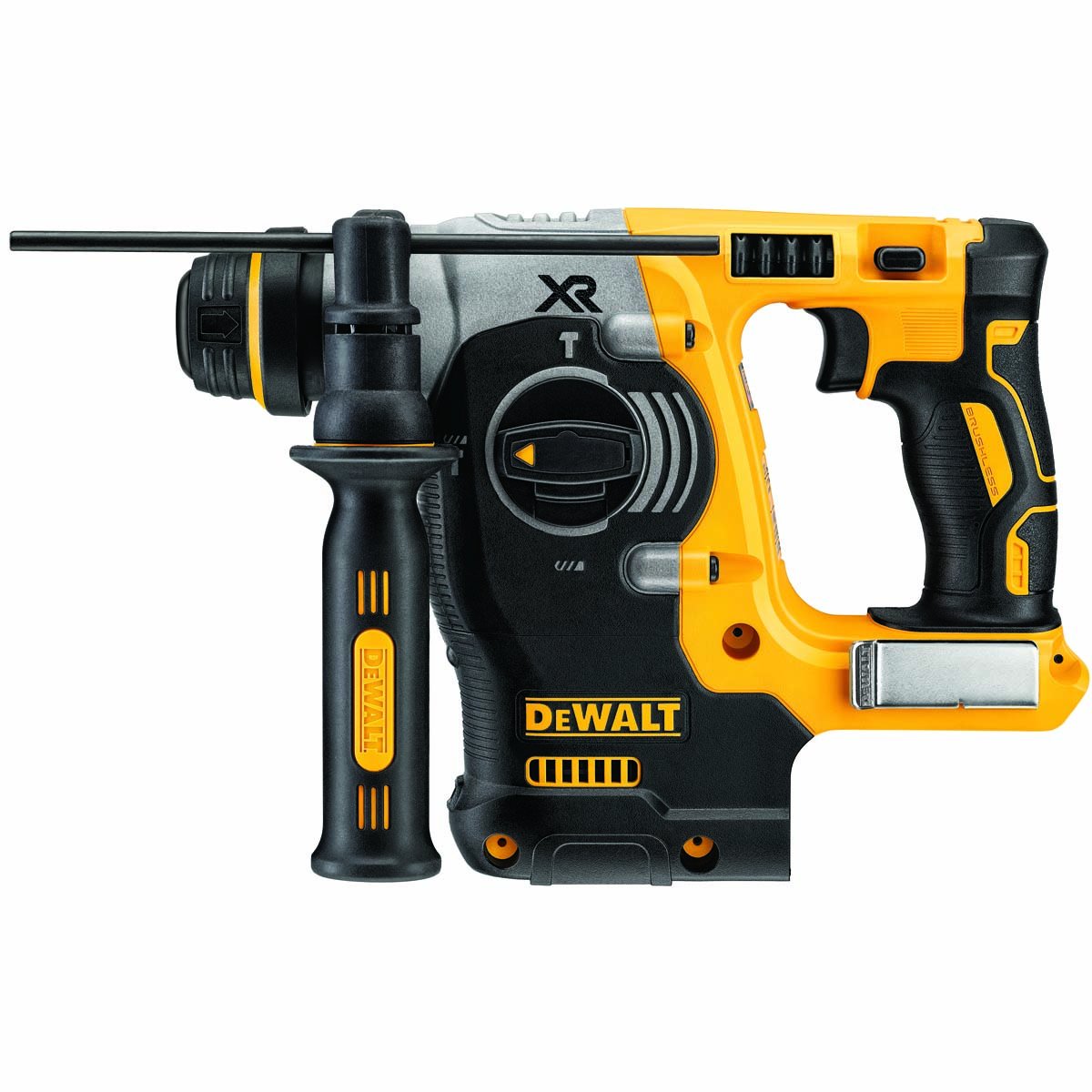
DEWALT DCH273B 20V MAX

94 /100
Kirk Score Outstanding
Modes
3
Weight
6.4 lb
Power Source
20V MAX battery
Impact Energy
2.1 J
Check Details on Amazon

Pros

  • 2.1 J impact energy
  • SHOCKS vibration control
  • Three working modes
  • 6.4 lb for a 1-inch hammer

Cons

  • Durability is inconsistent over time

If your truck already carries DEWALT 20V MAX batteries, the DCH273B is the cordless rotary hammer that makes the most sense. It delivers 2.1 joules of impact energy, switches among drill, hammer drill, and chip modes, and weighs 6.4 pounds. That is enough tool for anchor holes, cable tray, and small chipping jobs without dragging a cord across a finished floor.

We were impressed by the SHOCKS handle. Vibration control is one of those features that is easy to list and hard to feel until you are 20 holes into a ceiling, and the DCH273B keeps the sting out of the grip better than the compact models here. The 360-degree side handle and depth rod are included, and the tool balances well enough that we could keep a hand on the body and the other on the trigger when working at chest height. It is not a featherweight, but the 6.4-pound figure is reasonable for a 1-inch SDS-plus hammer.

The catch is the bare-tool package: batteries and a charger are separate, so the real cost depends on what you already own. If you are starting from scratch, price the batteries into the decision before you commit. Otherwise, the DCH273B is the cordless hammer we reach for when the work is overhead, awkward, or far from an outlet.

Bottom line: The DCH273B is the cordless pick for 20V MAX users who need 1-inch capacity and real vibration control without a cord.

Check Latest Price
#03

Best Premium Cordless

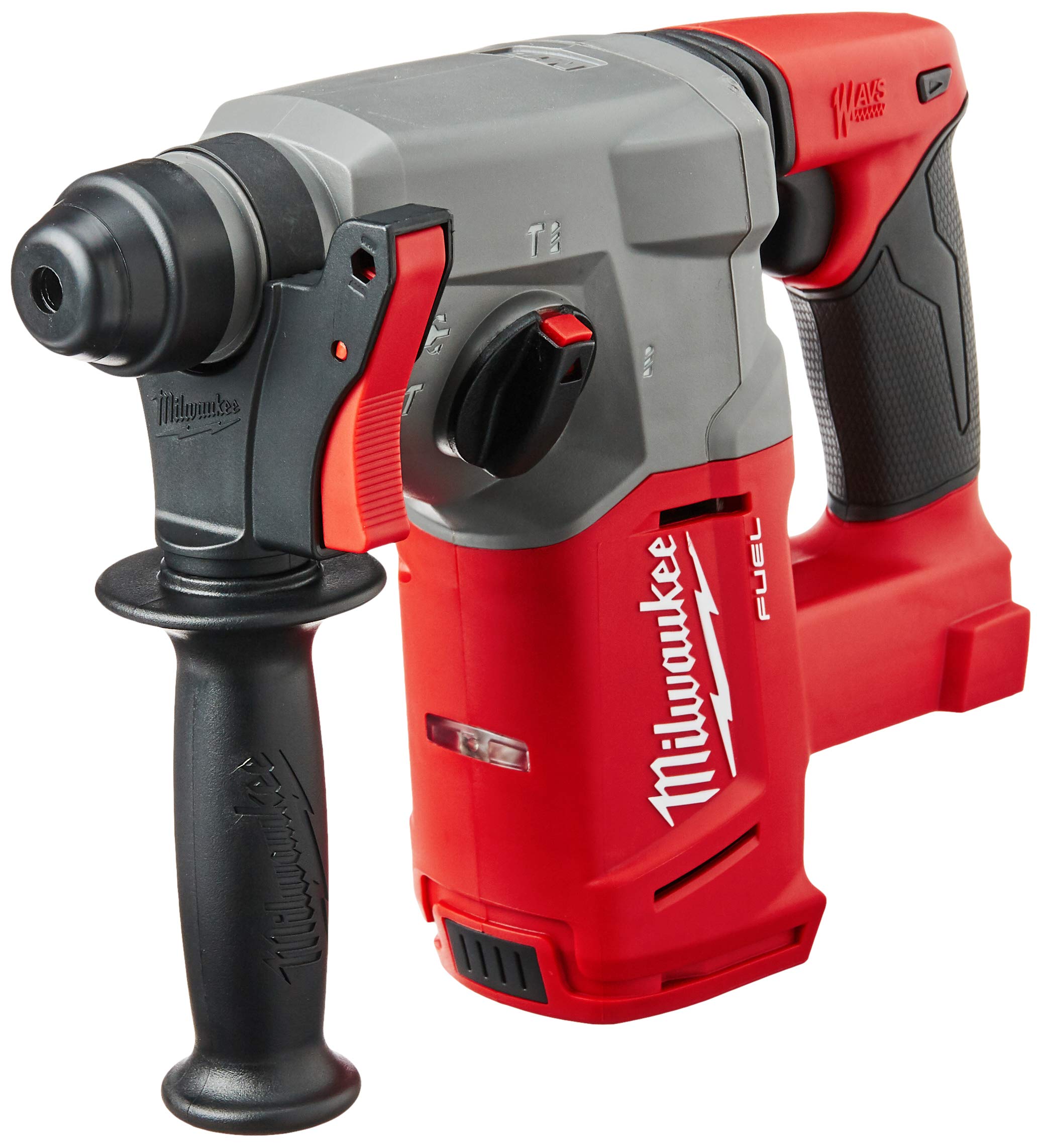
Milwaukee 2712-20

94 /100
Kirk Score Outstanding
Modes
3
Weight
6.9 lb
Power Source
18V battery
Impact Energy
1.7 ft-lbs
Check Details on Amazon

Pros

  • Compact 1-inch body
  • 1.7 ft-lbs impact energy
  • Three working modes
  • Five-year tool warranty

Cons

  • Bare tool only; battery and charger extra
  • Premium price relative to other cordless picks

The Milwaukee 2712-20 is the premium cordless choice for someone who already owns Milwaukee 18V batteries and wants a compact 1-inch SDS-plus hammer. It has 1.7 ft-lbs of impact energy, a 6.9-pound body, and three modes. The shorter body fits into spaces where a longer corded hammer will not, and the tool feels dense and controlled in the hand.

The controls are straightforward, and the handle sits at a comfortable angle for horizontal drilling. We liked the balance with a 5.0 Ah pack, though the front end gets heavy when you hold it overhead for long stretches. The trigger is easy to feather at the start of a hole, and the mode selector has a firm detent that does not wander when you set the tool down. The body is compact enough to keep in a bag or a small case.

The Milwaukee 18V platform is the attraction here: one battery for drills, impacts, and this hammer, plus a five-year tool warranty that is the longest in this group. For a crew already standardized on Milwaukee batteries, that shared platform is the real savings; for a homeowner with no packs, the math is less compelling. It is the cordless hammer for someone who wants one system and does not mind paying for the compact build.

Bottom line: The Milwaukee 2712-20 is the premium cordless pick for Milwaukee 18V owners who want a compact 1-inch hammer and the longest warranty here.

Check Latest Price
#04

Best Budget Corded

ENEACRO ENRH3201

92 /100
Kirk Score Outstanding
Modes
4
Weight
12.6 lb
Power Source
Corded 13 amp
Impact Energy
5.5 ft-lbs
Check Details on Amazon

Pros

  • 5.5 ft-lbs impact energy
  • Four working modes
  • Safety clutch and vibration control
  • Accessory kit includes bits and chisels

Cons

  • Early failures are a risk

ENEACRO built this one around a 13-amp motor and a 5.5 ft-lb impact rating, and that is the figure that gets your attention. This is a corded hammer with enough meat to drive anchors, break out tile, and chew through a concrete wall, and it does it with four modes, a safety clutch, and a set of bits and chisels in the case. For a budget corded tool, it is unusually complete.

The trade is weight. At 12.6 pounds, the ENRH3201 is a two-handed tool, and you feel it when you are working overhead or holding a chisel at an awkward angle. The upside is that the mass helps steady the tool when you are chipping, and the vibration-control handle takes some of the buzz out of longer runs. The 360-degree auxiliary handle is easy to reposition, and the safety clutch is the feature we care about most when a bit binds.

The kit is the reason this one earns a budget spot. You get three SDS-plus drill bits, a point chisel, a flat chisel, a depth gauge, grease, spare carbon brushes, and a case. That is enough to start a project without a second order for consumables. The 24-month warranty is a useful backstop. We treat it as a value tool for a homeowner or a contractor who wants a spare corded hammer, not as the smoothest tool in the group.

Bottom line: The ENEACRO ENRH3201 is the budget corded hammer we point to for tile and concrete work, with a big motor and a kit that covers the basics.

Check Latest Price
#05

Best Compact Cordless

DEWALT DCH172B 20V MAX

91 /100
Kirk Score Outstanding
Weight
4.59 lb
Power Source
20V MAX battery
Impact Energy
1.4 J
Maximum Capacity
5/8 in
Check Details on Amazon

Pros

  • 4.59 lb compact body
  • 1.4 J impact energy
  • SHOCKS vibration control
  • Belt hook included

Cons

  • Bare tool only; batteries not included

The DCH172B is not trying to be the only rotary hammer in your truck. It is a 5/8-inch, 1.4-joule compact that weighs 4.59 pounds and is built for drilling anchor holes overhead and in tight spots. If your work is mostly 3/8- and 1/2-inch holes for shelves, railings, and strut, that smaller envelope is a feature: the tool is easy to hold with one hand and does not wear you out on a ladder.

We like it for punch-list work and finished spaces. The SHOCKS handle reduces vibration, the belt hook keeps it close when you are moving between locations, and the compact body fits where a full-size hammer will not. It is a drilling specialist, so tile removal and light demolition are jobs for a three-mode model such as the DEWALT DCH273B or the Bosch GBH2-28L.

With a compact 20V MAX pack it balances nicely; with a large pack it gets nose-heavy. We keep it in the category of a second cordless hammer rather than a primary one: it is the tool you grab for a handful of overhead holes, not the one you choose for a basement slab. The depth rod and side handle are included, and the belt hook is a small detail that earns its keep on a ladder.

Bottom line: For overhead anchor work up to 5/8 inch, the DCH172B is the compact cordless hammer that saves your shoulders on a ladder.

Check Latest Price
#06

Low-cost chipping

Berserker 26FA

90 /100
Kirk Score Outstanding
Modes
3
Weight
9.5 lb
Power Source
Corded 9 amp
Impact Energy
3.3 ft-lbs
Check Details on Amazon

Pros

  • 3.3 ft-lbs impact energy
  • Three working modes
  • Complete bit and chisel kit
  • 9.5 lb is manageable for a corded hammer

Cons

  • No reverse function

The Berserker 26FA leads with 3.3 ft-lbs of impact energy, a 9-amp motor, and a 9.5-pound body. That is a lot of hammer for a budget corded tool, and the kit is unusually generous: three SDS-plus bits, a flat chisel, a point chisel, a depth gauge, grease, a wrench, spare brushes, and a case. If you need to drill a few dozen holes and break out a small tile floor without spending much, it is a sensible place to start.

It is a three-mode tool, and the hammer-only setting is the one that earns its keep on tile and thinset. The 360-degree handle gives you a second grip, and the aluminum housing feels sturdier than the price suggests. We did not find it as refined as the Bosch or the DEWALT: the controls are basic, and the tool has a blunt, utility feel that is fine for occasional work.

The cord is a limitation, but that is the nature of a budget corded hammer. The tool is happiest when you can set it down between runs and work at a comfortable height; it is not a finesse tool for overhead trim work.

This is the one we recommend as a spare or a first hammer for a homeowner who is not ready to spend on a premium brand. It has enough power for a small remodel and a kit that saves a separate trip for bits, but it is not the tool we choose for daily production or for a crew that needs every convenience.

Bottom line: The Berserker 26FA is the budget kit we point to for occasional concrete and tile work, with enough power and accessories to start a small remodel.

Check Latest Price
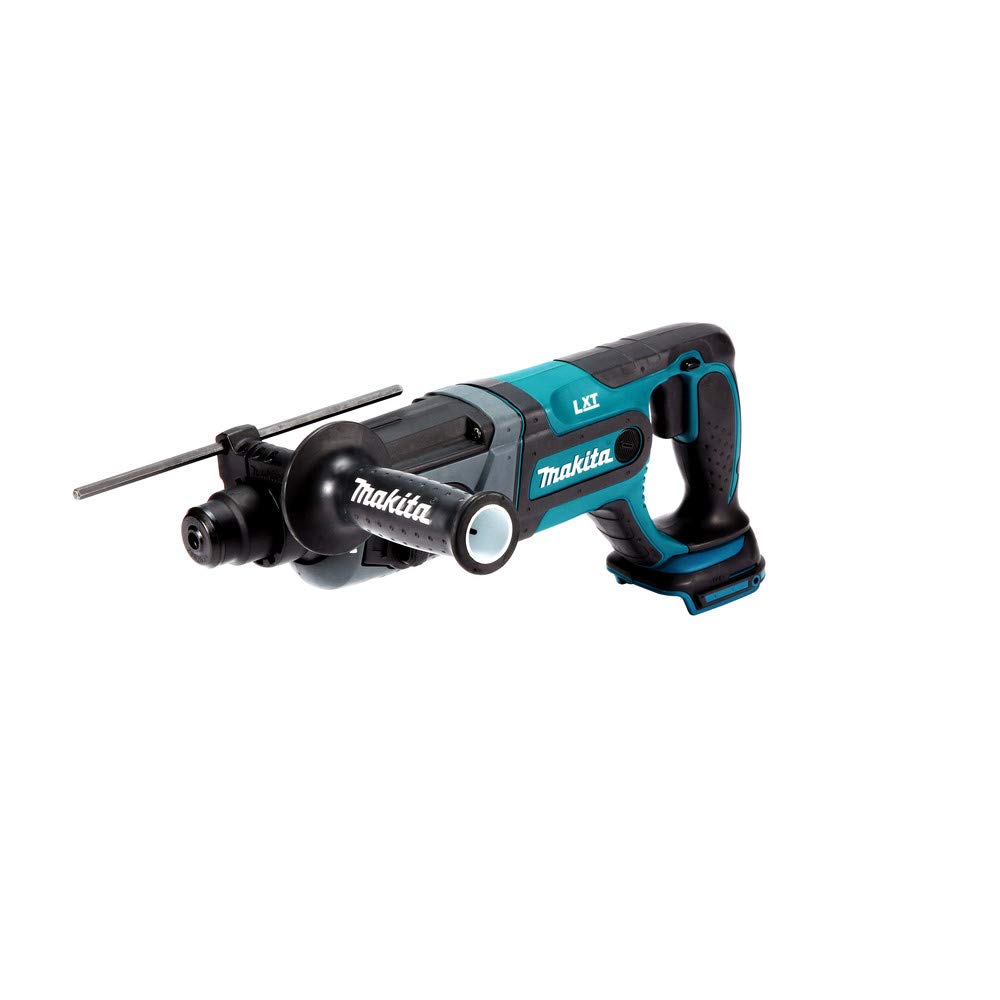
#07

Small-hole cordless

Makita XRH04Z

92 /100
Kirk Score Outstanding
Modes
3
Weight
7.4 lb
Power Source
18V LXT battery
Maximum Capacity
7/8 in
Check Details on Amazon

Pros

  • 7.4 lb compact body
  • Three working modes
  • Torque-limiting clutch
  • 0-4,000 bpm

Cons

  • Bare tool only; batteries and charger extra

Makita's XRH04Z is a 7/8-inch SDS-plus hammer, and that smaller ceiling is the point. It runs on the 18V LXT platform, weighs 7.4 pounds, and offers three modes, with 0-1,200 rpm and 0-4,000 bpm. For electricians and plumbers who mostly drill 1/2- to 3/4-inch holes for conduit, anchors, and pipe supports, it is a compact cordless option that does not demand a 1-inch tool.

The torque-limiting clutch is the detail we appreciate. If a bit binds, the clutch disengages the gears instead of letting the tool twist your wrist, and that is the kind of protection that matters on a ladder. The side handle and depth gauge are included, and the body is short enough to fit between joists. It is not the lightest compact here, but it is balanced and easy to control with one hand on the body.

The 7/8-inch maximum capacity is the limit to accept. It will handle most anchor and conduit work, but it is not the tool for core drilling or large holes. We see it as a specialist's cordless hammer: excellent for repetitive small-hole drilling, less useful as a one-tool solution for a remodel.

Bottom line: The Makita XRH04Z is the cordless pick for small anchor and conduit holes, with a compact three-mode body that fits between joists.

Check Latest Price

How We Tested the Rotary Hammers

We started by pulling every SDS-plus rotary hammer we could find, corded and cordless, then narrowing by chuck size, impact energy, number of modes, and whether the tool shipped as a bare tool or a kit with bits and a case. Nine made the cut, and I used them for eight months across a fence-post project, a basement remodel, and a full bathroom gut.

Every hammer drilled the same holes: half-inch and one-inch anchors in cured concrete, cores through block, and overhead holes into a slab ceiling — the last one being where weight and balance showed up fast, since a ten-pound tool gets heavy by the third hole. Tight overhead work also exposed size, with the compact models fitting between joists where the long ones wouldn't. Cordless models drilled until the battery quit and I counted holes rather than trusting the gauge. I changed bits with work gloves on and noted how many tries the collar took.

For power and drilling performance, I timed each hole and watched whether the bit walked or the motor bogged down. I forced bits off-angle on purpose to see whether the safety clutch slipped the way it should or the tool kicked back into my wrist. Chipping mode got a real workout on thinset and an old footing, which is where vibration control separated the comfortable tools from the hand-numbing ones.

After eight months, I checked chucks for slop, cords and boots for cracking, and case hinges for wear. And I weighed what came in each box against what you'd still need to buy — a bare tool only makes sense if you already own the batteries.

How to Choose a Rotary Hammer Drill

Start With the Power Source

Corded hammers give you continuous power and no battery platform to buy into; cordless models free you from an outlet but add batteries and chargers to the real cost. We favor a corded hammer for a first tool unless you already own a battery system. The trap is the bare-tool listing: price two packs and a charger before you compare it with a corded model.

Match Impact Energy to the Hole

For anchors, railings, and most tile work, a 5/8- to 1-inch SDS-plus hammer has enough capacity; step up to 1-1/8 inches if you regularly drill larger holes. Impact energy matters more than amp ratings for concrete speed. A compact 1.4-joule model is easy overhead but not a chipping tool; a 2.4 ft-lb corded hammer is the better all-rounder. Do not buy a 12-pound hammer for ceiling work unless the job demands it.

Count the Modes

Three modes matter if you plan to chip: rotation only for drilling, hammer drilling for concrete, and hammer only for chisels. A two-mode compact drill is fine for anchor holes but cannot remove tile. Check that the mode selector is easy to turn with gloves and that the tool accepts SDS-plus chisels. If tile or thinset is part of the project, put three modes ahead of a smaller body.

Weigh Vibration and Control

Overhead work rewards a lighter tool: 4.5 to 7 pounds is comfortable, while 10 to 13 pounds wears you down fast. Vibration control is not a luxury; it is what lets you finish a row of holes. A safety clutch or kickback control is worth paying for because a bound bit can twist the tool hard. Do not trade away control for a bigger motor.

Budget for the Kit

Bare tools look cheaper until you add batteries, a charger, and bits. A corded kit with a case, chisels, and a depth gauge can be the better first purchase. Check the warranty too: coverage ranges from one year to five years in this group. Good SDS-plus bits are part of the tool's performance, so leave room in the budget for a few quality sizes.

Frequently Asked Questions

Final Verdict

We recommend the Bosch GBH2-28L as the default corded rotary hammer. It combines 2.4 ft-lbs of impact energy with KickBack Control and a 2.9 kg body that is easier to manage than a big corded hammer. If you need cordless, the DEWALT DCH273B is the better fit for 20V MAX owners, with 2.1 J and effective vibration control. The compact DEWALT DCH172B is the specialist for overhead 5/8-inch holes, not a replacement for a chipping hammer.