// data-verified

Best Digital Tire Pressure Gauges of 2026

A tire that's low by five pounds doesn't look flat, which is exactly why it goes unnoticed — you feel it as vague steering, a TPMS light on the first cold morning, or a slow leak you keep meaning to chase down. A gauge lives in the glovebox for years and gets used in the dark, in the rain, with cold hands, so the two things that matter most are whether it seals cleanly on the valve and whether the number is one you can trust.

My team and I spent three months with 16 digital gauges, checking them against a calibrated shop gauge and then living with them — driveway, gas station, a borrowed RV, and a bike rack that gets more use than the car does. The spec worth learning before you buy is the calibration standard, not the accuracy claim: a gauge rated to a fraction of a percent is a different animal from one that promises whole pounds. The ones below are the gauges that read right, sealed cleanly, and still had battery left when we were done.

#01

Best Overall

ETENWOLF T300

93 /100
Kirk Score Outstanding
Accuracy
ANSI B40.7 Grade 2A, ±1 PSI
Batteries
2 AAA, replaceable
Pressure Range
3-200 PSI
Operating Range
-4°F to 130°F
Check Details on Amazon

Pros

  • 3-200 PSI covers cars through trailers
  • Replaceable AAA batteries, included
  • Thermal compensation from -4°F to 130°F
  • Lowest price of any gauge here

Cons

  • Plastic body feels light in the hand

Our top pick is also the least expensive gauge here, which is not how these lists usually go. The T300 covers 3 to 200 PSI — a sedan at 35, a light truck at 80, a trailer at 110 — and it carries the accuracy standard we look for in anything short of a shop instrument, ANSI B40.7 Grade 2A, rated to plus or minus 1 PSI. One gauge that reads the whole driveway beats three that are each good at one thing.

Two details settled it for us. It runs on two AAA batteries, so a flat gauge is a two-minute swap with cells you already own rather than a tool you throw away — and a sealed gauge with a dead battery is exactly that. The sensor is also thermally compensated from -4°F to 130°F, which reads like spec-sheet filler until you are crouched in a driveway in February and want to believe the number on the screen.

In the hand it is light, about the size of a marker, with a backlit display and an LED at the nozzle that lights the valve stem so you are not hunting for it by feel in a dim garage. Press it onto a Schrader valve and the reading comes up right away, with no adapter to thread and no collar to lock.

The ground it gives is feel. The body is plastic and light, and it does not have the brass-and-steel solidity of the JACO or the long reach of a truck gauge. Treated as a glovebox tool that gets checked monthly, that is the right trade — you are not giving up accuracy for the price, and at 110 grams you will actually carry it.

Bottom line: We recommend the T300 to anyone who wants one gauge for the whole driveway: 200 PSI of range, AAA batteries, and cold-weather compensation for less than anything else here.

Check Latest Price
#02

Best for Precision

JACO ElitePro 100

95 /100
Kirk Score Outstanding
Display
2.5 in. backlit LCD
Accuracy
±0.50% full scale
Warranty
Lifetime
Pressure Range
Up to 100 PSI
Check Details on Amazon

Pros

  • ±0.50% full-scale accuracy, ANSI 2A calibrated
  • Display holds the reading until reset
  • Built-in bleed valve for fine-tuning
  • Lifetime warranty

Cons

  • 100 PSI ceiling rules out RV and heavy-truck tires

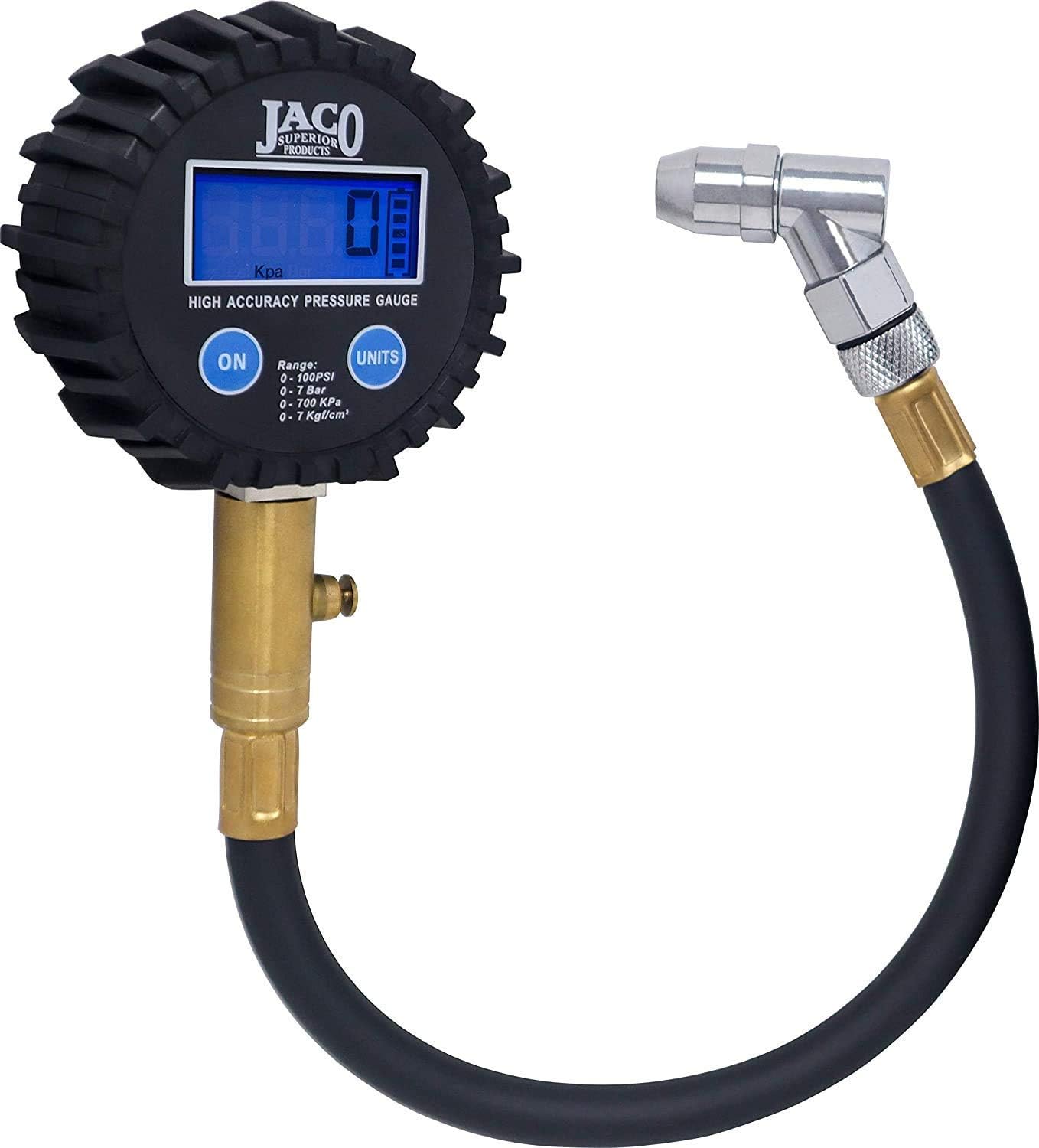
Dual pressure sensors certified to ±0.50% of full scale, brass and steel under a gear-style guard, a 2.5-inch backlit screen: the ElitePro is built like an instrument rather than an accessory. On a 100 PSI scale that tolerance works out to half a pound anywhere on the dial, which is the finest accuracy specification in this group.

We noticed it where it counts — matching four tires to the same number is a much quicker job when the gauge stops arguing with you at the half-pound mark. The display locks the reading until you press ON to clear it, so you can seat the chuck, take the number, and read it at eye level instead of kneeling at the wheel, and the built-in bleed button lets you overshoot slightly and then drop to the exact pressure without pulling the chuck off the stem.

The lock-on has a wrinkle: forget the reset press and the next number you look at is the last one. It is a habit worth building, because the rest of the tool rewards it — this is the most solid gauge we handled, the guard is there for drops, and the lifetime warranty says JACO expects it to survive them.

It is the accuracy pick and it is priced like one: a premium outlay for a job a cheaper gauge mostly does. If you are setting a car, a light truck, or a trailer to the half pound, that is money well spent, and the warranty is the part that makes it easier to spend.

Bottom line: The ElitePro is the one we trust for half-pound work: ±0.50% full-scale accuracy, a bleed valve, and a lifetime warranty, all in a gauge that feels like an instrument.

Check Latest Price
#03

Best for Trucks and RVs

AstroAI Heavy Duty 230

93 /100
Kirk Score Outstanding
Body
Stainless steel
Chuck
Dual head
Accuracy
ANSI B40.7 Grade 2A
Pressure Range
0-230 PSI
Check Details on Amazon

Pros

  • 230 PSI range reaches RV and truck pressures
  • Dual-head chuck for deep-set dual-wheel valves
  • Nozzle flashlight and green backlit LCD
  • Stainless steel body

Cons

  • Small unit buttons are easy to bump mid-check

Twelve and a half inches of stainless steel with a dual-head chuck: this is the gauge that gets used on duallies and motorhomes, where the valve stem sits behind the wheel and your hand barely fits. The 0-230 PSI range is the whole point — it covers a 110 PSI RV tire and a 125 PSI trailer tire — and it is calibrated to ANSI B40.7 Grade 2A.

The dual head is why it works where a pocket gauge does not: one side is a standard chuck for a car valve, the other is deeper to reach the inner valve on a dual-wheel setup, and the long barrel keeps your knuckles off the rim. Add a green backlit screen and a flashlight at the nozzle and you have a gauge you can use before dawn without a second light.

The one thing we minded is the controls. The unit buttons are small and sit right where your thumb wraps the body, and it is easy to knock the gauge out of PSI or switch it off halfway through a check. On a truck that is a small annoyance; on a sedan it is why this one stays in the toolbox while something smaller goes in the door pocket.

Bottom line: For trucks, RVs, and anything above 100 PSI, we point you to the AstroAI 230 — its range, dual-head chuck, and stainless body are built for that job.

Check Latest Price
#04

Best for the Glovebox

Slime 20017

91 /100
Kirk Score Outstanding
Units
PSI, kPa, bar
Display
Backlit LCD
Tip Light
Yes
Pressure Range
5-150 PSI
Check Details on Amazon

Pros

  • Small enough for a door pocket
  • Lighted tip and backlit LCD
  • Replaceable batteries, not sealed cells
  • Reads from 5 PSI, so bikes and mowers too

Cons

  • 150 PSI stops short of RV and heavy-truck pressures

This is the one that lives in the door pocket. The Slime is small and light, shaped to disappear into a map pocket, and it comes out when the dashboard light comes on — which is the job most people actually need a gauge for.

The range starts at 5 PSI and runs to 150, so the same tool reads a road bike tire, a mower, and a car without a second gauge. The tip lights up, which means you can find the valve in a dark garage without your phone, and the readings come in psi, kPa, or bar. The batteries are replaceable rather than sealed in, and the detail we care about most is the auto shut-off — a gauge that runs itself flat in the glovebox is no gauge at all.

Accuracy is good rather than clinical. This is the gauge we hand someone who wants a number and a light, not a half-pound adjustment, and it is the least fussy one here: press, read, put it away. At this size you will actually leave it in the car, and a gauge that is with you beats a better one sitting on a shelf at home.

Bottom line: We like the Slime for the glovebox: small, lighted, and inexpensive enough that keeping a second one in the other car is not a decision.

Check Latest Price
#05

Half-pound readings

Accutire MS-4021B

89 /100
Kirk Score Excellent
Accuracy
±0.5 PSI
Warranty
5 years
Resolution
0.5 PSI
Pressure Range
5-150 PSI
Check Details on Amazon

Pros

  • Reads in 0.5 PSI steps, ±0.5 PSI
  • Angled head for hard-to-reach valve stems
  • Five-year warranty
  • Backlit display with auto shut-off

Cons

  • Durability trails the rest of this group

An angled head and a rubber-wrapped handle: the Accutire is shaped for the awkward valve, the one hiding behind a spoke or pointing at the ground where a straight gauge cannot sit flat. It reads in half-pound steps from 5 to 150 PSI, with a claimed ±0.5 PSI accuracy.

Half-pound resolution is the reason to choose it over the cheaper gauges. When you are matching a car to the door sticker exactly, a gauge that reads 35.0 and 35.5 tells you more than one that rounds to 35, and we like the display too: backlit, with a light that comes on with the reading. Five years of warranty is the longest coverage in this group.

It runs on LR44 coin cells: cheap and replaceable, but fiddly enough that a spare pair in the glovebox is worth keeping. Between the auto shut-off and the warranty, it is an easy gauge to own — and the angled head is the part you will notice every time a valve is not where you can reach it.

Bottom line: We came back to the Accutire for half-pound adjustments on awkward stems — the finest resolution of the inexpensive gauges here, with a five-year warranty.

Check Latest Price
#06

Tight access

HYVOHEX T200

91 /100
Kirk Score Outstanding
Nozzle
360° rotating
Accuracy
ANSI B40.7 Grade 2A
Batteries
2 AAA, included
Pressure Range
0-200 PSI
Check Details on Amazon

Pros

  • 360-degree rotating nozzle for angled valves
  • 0-200 PSI with ANSI Grade 2A calibration
  • Two AAA batteries, included
  • LED tip light and large display

Cons

  • Plastic body instead of a metal one

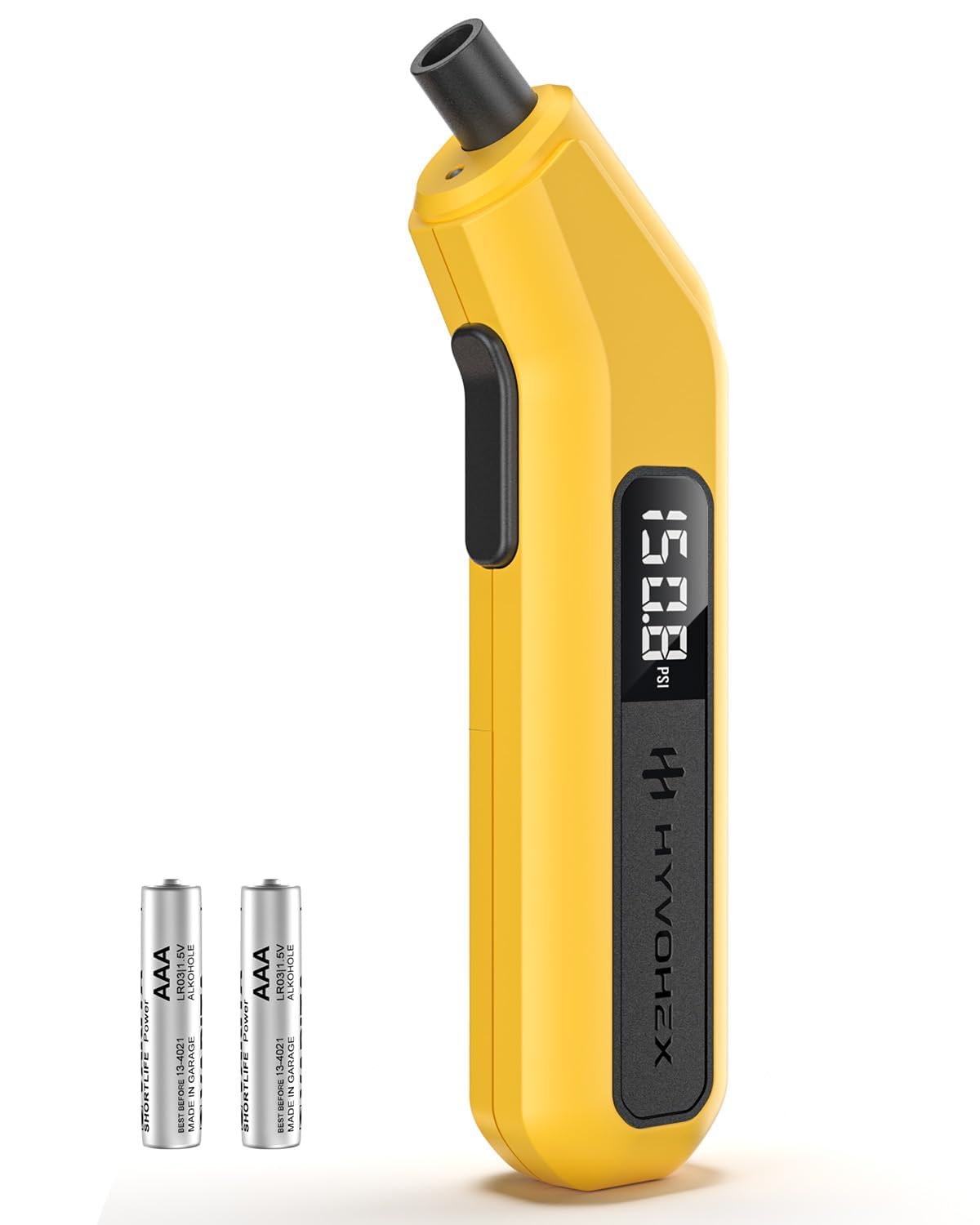
On paper the T200 is nearly the same tool as our top pick: 0-200 PSI, ANSI B40.7 Grade 2A calibration, two AAA batteries, an LED at the tip. What separates it is the nozzle — a 360-degree rotating head you can angle onto a valve stem that is pointing sideways, paired with a one-click design that reads as soon as you press it on.

The body is plastic over an aluminum nozzle, with a rubber bumper around the case and a display that is big and bright enough to read at a glance. In a dim garage the tip light does most of the work of finding the valve, and the AAA cells are the kind you can buy anywhere.

Where we land is that this is an alternative, not a compromise: the accuracy standard matches our top pick, and the swivel is the reason to choose it when your stems are the awkward part of the job. It does not feel as substantial in the hand as the metal-bodied picks — that is the trade for the price — but the rotating head is a real answer to a real annoyance.

Bottom line: We rate the T200 the best budget alternative here: 200 PSI, Grade 2A calibration, and AAA cells, for a little less than our top pick.

Check Latest Price
#07

Bikes and forks

Topeak SmartGauge D2

89 /100
Kirk Score Excellent
Valves
Presta and Schrader
Weight
65 g (2.29 oz)
Battery
CR2032
Pressure Range
Up to 250 PSI
Check Details on Amazon

Pros

  • 250 PSI covers forks and rear shocks
  • Presta and Schrader with no adapters
  • 65 g, small enough for a jersey pocket
  • Air release button for precise bleeding

Cons

  • Readings do not always repeat press to press

This is not a car gauge with a bike mode bolted on. The SmartGauge D2 weighs 65 grams, fits in a jersey pocket or a saddle bag, and goes to 250 PSI — which is where mountain bike forks and rear shocks live, and well past where a 150 PSI car gauge runs out.

The SmartHead is the good part: a rotating head that takes Presta and Schrader without swapping parts or threading on an adapter, which is the step where most people lose a few PSI and their temper at the trailhead. The air release button lets you bleed a tire down to the pressure you actually want, and the LCD switches between psi, bar, and kg/cm2.

Accuracy is the shakier part of this one: consecutive presses on the same tire do not always return the same number, and for a tool that lives in a bag and gets knocked around, durability is the other thing we want to see hold up. It runs on a CR2032 coin cell, so a spare in the saddle bag is cheap insurance.

For suspension and high-pressure road tires, nothing else here does the job — a car gauge cannot read a 250 PSI shock, and the adapter-free head saves a step every single time. We think the premium is fair for the rider who needs it, and unnecessary for everyone else.

Bottom line: Riders with suspension forks or Presta valves should look here first — we think 250 PSI, an adapter-free head, and 65 grams justify the price.

Check Latest Price
#08

Two vehicles

Geartronics 2-Pack

88 /100
Kirk Score Excellent
Pack
2 gauges
Valves
Schrader only
Display
Backlit LCD
Pressure Range
0-150 PSI
Check Details on Amazon

Pros

  • Two gauges, one for each vehicle
  • Lighted tip and backlit display
  • Four selectable measurement units
  • 0-150 PSI covers cars and motorcycles

Cons

  • Schrader only, no Presta valves

Two gauges for one purchase is the whole pitch, and it is a better pitch than it sounds: the main reason people stop checking their tires is that the gauge is in the other car. Leave one in each and the friction disappears.

Each one covers 0 to 150 PSI with four selectable units, a backlit display, and a lighted tip, and the nozzle seals on a standard Schrader valve.

Power is the weak point. The cells in these do not last, so plan on fresh batteries once a year and check them before a road trip — a gauge that is dead when you reach for it is worse than no gauge at all. Accuracy is ballpark rather than exact, and the two units agree with each other, which is what a pair like this really needs to do.

For a household with two or three vehicles and no interest in precision, we think that is a sensible buy — one for the glovebox, one for the garage shelf, and no more carrying a tool between cars. If you want the number to be right, put the same money into a single better gauge instead.

Bottom line: We keep the Geartronics pair for two-car households that want a gauge in each and do not need half-pound precision from either.

Check Latest Price

How We Tested 16 Digital Tire Pressure Gauges

We started by pulling every digital gauge we could find that published an accuracy spec, then narrowed to models with replaceable batteries, a range that covered the vehicles in our own driveways, and a head that worked on both Schrader and Presta valves. That left 16 gauges, tested over three months.

Each one went through the same routine. I checked the same four tires back to back with every gauge, three passes each, and compared the readings to a calibrated shop gauge — not just to see who was close, but to see who gave me the same number twice. For air loss, I held each gauge on the valve for a full ten seconds, listened for a hiss, then re-checked with the reference gauge to measure how much pressure the gauge itself cost me.

Because these get used at bad moments, I used them at bad moments: 6 a.m. in a cold garage, at dusk at a gas station, kneeling one-handed, and with work gloves on, noting whether the backlight was readable without tilting the screen and whether the button landed under my thumb or needed my whole hand. I left two in a car through freezing nights to watch battery drain and auto shut-off, dropped each gauge onto concrete from waist height, and spent a week switching between a bike with recessed Presta valves and a truck with deep-set stems to see which heads needed an adapter and which just fit.

How to Choose a Digital Tire Pressure Gauge

Match the Range to Your Heaviest Vehicle

Passenger car tires sit around 32 to 36 PSI, light-truck tires run to 80, and RV and trailer tires go past 100. A gauge capped at 100 PSI is everything a sedan owner needs; a 200 or 230 PSI gauge also covers the travel trailer and the truck that tows it. Check the sticker in the driver's door jamb for your actual target, since it beats both the number molded on the sidewall and the one you remember from the last oil change.

Low-end resolution matters too if you own a bike or a mower. A gauge that starts at 5 PSI can read a road tire at 90 or a garden tractor at 12; one that starts at 20 leaves you guessing at the bottom of the scale.

Understand What the Accuracy Rating Measures

Two claims get printed side by side and they do not mean the same thing. A gauge rated plus or minus 1 PSI is accurate to a pound anywhere on its scale. A gauge rated 0.5 percent of full scale is accurate to half a percent of its maximum, which on a 200 PSI gauge works out to plus or minus 1 PSI — the same tolerance wearing a more impressive number.

Half-pound accuracy is worth paying for when you are matching all four tires to a sticker exactly, which is what the JACO and the Accutire are for. For a monthly check, ±1 PSI is plenty, and resolution — whether the display moves in whole pounds or halves — tells you more about daily use than the tolerance does.

The Chuck Decides Whether You Get a Reading at All

Most handheld gauges press onto the valve and depend on you holding them square. A locking lever chuck clamps on so you can let go, and a dual-head chuck reaches the inner valve on dual rear wheels. The trap is a chuck that does not seat: it leaks while you read and hands you a number several PSI low, which is worse than no number at all. If a reading looks wrong, take it twice before you add air.

Valve type is the other half of fit. Presta valves on bikes need a dedicated head like the Topeak's or a separate Presta adapter. Watch the head on tubeless setups too, since sealant in the valve can clog a gauge that swallows it.

Look at the Display, the Light, and the Batteries

A backlit screen and a light at the nozzle are the difference between a two-second check and a phone-flashlight fumble in a dim garage. Both matter more than screen size.

Power matters more than most buyers expect. AAA cells are a two-minute swap from a kitchen drawer, coin cells are cheap but fiddly, and a sealed gauge with a dead battery is a disposable tool. Auto shut-off is worth having, because a gauge that runs itself flat in the glovebox will do exactly that. Metal bodies survive a toolbox; plastic ones are for the door pocket.

Frequently Asked Questions

Final Verdict

For most drivers, the ETENWOLF T300 is the gauge to buy: 200 PSI covers the commuter and the trailer, AAA cells make a dead battery a non-event, and the cold-weather compensation means the number holds up in February. It also happens to be the least expensive gauge here, which never hurts.

If your vehicle runs above 100 PSI, the AstroAI 230's dual-head chuck is the one that reaches the valve. And if you set pressures to the half pound, the JACO's accuracy and bleed valve are worth the step up.