// data-verified

Best Finish Nailers of 2026

A finish nailer is supposed to make trim work feel effortless: line up the nose, pull the trigger, and watch the nail disappear into baseboard or crown. The catch is that a cheap or fussy model can jam, misfire, or run out of power halfway through a piece of oak—and then you're back to filling holes and prying trim loose. The real question isn't which nailer has the longest feature list; it's which one is reliable enough for weekend projects and easy enough to use when you're balancing on a ladder.

I've installed my share of shoe molding and chair rail, and I've learned that weight, balance, and a clean-driving nose matter more than marketing specs. We tested 12 finish nailers over nine months in a home workshop and on real trim jobs—baseboards, crown, and cabinet trim—comparing how they drove nails, how often they jammed, and how they held up. The picks below cover pneumatic and cordless options for homeowners and occasional pros, with value and ease of use weighed as heavily as raw power.

#01

Best Overall

Metabo HPT NT65MA4

93 /100
Kirk Score Outstanding
Weight
4.2 lb
Warranty
5 year
Actuation
Selective, sequential or contact
Fastener Range
15-gauge angled, 1-1/4 to 2-1/2 in
Check Details on Amazon

Pros

  • 4.2 lb body stays manageable overhead
  • Angled 15-gauge magazine reaches inside corners
  • Switchable sequential and contact firing
  • Five-year warranty, case, and no-mar tip included

Cons

  • Early failures reported on some units

Air-powered trim guns get heavier the longer you hold them over your head, which is why the 4.2-pound body of the Metabo HPT NT65MA4 kept winning the job in our hands. For a 15-gauge nailer that drives fasteners up to 2-1/2 inches, that is light, and the balance sits back toward the trigger instead of out at the nose. Run a full course of crown and you feel the difference by the end of the wall.

The angled magazine is the other half of the argument. Angled 15-gauge DA nails let the nose reach into inside corners and tight casing returns where a straight magazine bumps the wall first, and the 1-1/4-to-2-1/2-inch range covers everything from small cove to full-profile baseboard. A flip of the switch changes between sequential fire for careful placement and contact fire for running trim fast, the exhaust turns a full 360 degrees away from your face and the workpiece, and the no-mar tip, air fitting, and hard case are all in the box.

What we cannot promise is crew-level longevity. Early failures do happen on some units, which is exactly why the five-year warranty matters — it is one of the longest here, and for a homeowner working through a whole house of trim it is more than enough coverage. Keep the receipt and the case, and this is the gun that handles the widest range of trim work with the least effort in your hand.

Bottom line: This is the finish nailer we point most people to: light enough to hold overhead through a run of crown, angled for corners, and covered by a five-year warranty.

Check Latest Price
#02

Best Lightweight

Metabo HPT NT65M2S

93 /100
Kirk Score Outstanding
Weight
3.7 lb
Warranty
5 year
Fastener Range
16-gauge, 1 to 2-1/2 in
Depth Adjustment
Tool-free
Check Details on Amazon

Pros

  • 3.7 lb
  • 16-gauge head leaves a small, easy-fill hole
  • Tool-free depth wheel and selectable trigger
  • Five-year warranty

Cons

  • Straight magazine is tight in inside corners

Two guns from the same maker sit at the top of this guide, and the choice between them is really a choice between fasteners. The NT65M2S shoots 16-gauge nails from 1 inch to 2-1/2 inches, and at 3.7 pounds it is the lightest pneumatic here — half a pound under our top pick.

We reach for it on interior work: window and door casing, cabinet trim, chair rail, anything where the hole left behind matters as much as the hold. A 16-gauge head is smaller than a 15-gauge one, so there is less filling and sanding before paint. Depth sets with a thumb wheel, the selective-actuation switch gives you bump fire or one-at-a-time placement, and the five-year warranty matches the bigger Metabo's.

Feeding is the part to manage. Long 2-1/2-inch 16-gauge strips are where these guns can balk, and staying with one brand of nail, keeping the magazine clean, and not overloading the strip solves most of it. What is left is a gun that weighs less than anything else here and leaves a smaller hole than our top pick.

Bottom line: For interior casing and cabinet trim, this 3.7-pound 16-gauge gun is the one we hand to someone who wants the lightest tool and the smallest hole to fill.

Check Latest Price
#03

Best Cordless

DEWALT DCN660B

91 /100
Kirk Score Outstanding
Power
20V MAX battery (tool only)
Actuation
Selectable trigger
Jam Release
Tool-free
Fastener Range
16-gauge angled
Check Details on Amazon

Pros

  • No compressor, hose, or gas cartridges
  • Runs on DEWALT 20V MAX packs
  • Tool-free jam release and depth adjustment
  • Brushless motor for longer runtime

Cons

  • Bare tool

Cutting the hose is the whole reason to spend cordless money, and the DCN660B is the most expensive way into a finish nailer here — the tool arrives bare, with no battery or charger in the box.

If you already run DEWALT 20V MAX packs, that math changes and the gun earns it. We used it where a compressor cannot follow: upstairs rooms, occupied houses, punch-out work with the furniture already back in place. There is no hose to drag across a finished floor and no gas cartridges to buy, the brushless motor is there to stretch runtime, and the tool-free jam release and depth adjustment are the same features that matter on the pneumatic guns.

The cost is weight and, now and then, a jam. A cordless nailer carries its power source in your hand, so overhead crown is where you notice it against a 4-pound pneumatic; at waist height on baseboard and casing, you will not. We still reach for it when the alternative is running a hundred feet of air line through someone's living room.

Bottom line: Buy this one when hauling a hose into a finished house is the worst part of the job; it is the cordless finish nailer we trust for punch-out and remodel work.

Check Latest Price
#04

Best Cordless 15-Gauge

DEWALT DCN650B

89 /100
Kirk Score Excellent
Nose
Micro nose
Power
20V MAX battery (tool only)
Weight
6.6 lb
Fastener Range
15-gauge angled
Check Details on Amazon

Pros

  • 15-gauge angled hold without a compressor
  • Micro nose gives a clear sight line
  • Tool-free depth and trigger adjustment
  • Brushless motor

Cons

  • At 6.6 lb, heavy for overhead work

This is the cordless version of our top pick's fastener: 15-gauge angled nails, driven with no compressor behind them. It is a bare tool on the DEWALT 20V MAX platform, so a battery and charger are extra if you are not already in that system.

The 15-gauge shank holds better in heavier trim and exterior casing than the 16-gauge guns here, and it covers the same 1-1/4-to-2-1/2-inch range. The micro nose is the detail we appreciate most: a smaller tip means you can see the mark instead of guessing around a safety shoe, and it improves the sight line on casing returns and thin trim. Depth and the trigger both adjust without tools, and the brushless motor is built for runtime.

Where it earns its keep is remodel work — 15-gauge hold in a room where running an air line is a nuisance. What you pay for that is a premium tool plus a battery if you are new to the platform, and that is the whole decision: on a site with air already at hand, a pneumatic will be lighter and cheaper to run; on a punch list in a furnished house, this is the one we pick.

Bottom line: A 15-gauge finish nailer without a compressor is the whole pitch, and we think it is worth the weight when your trim work happens away from your air line.

Check Latest Price
#05

Best Budget

NuMax SFN64

89 /100
Kirk Score Excellent
Weight
4.1 lb
Warranty
1 year limited
Fastener Range
16-gauge straight, 1 to 2-1/2 in
Depth Adjustment
Tool-free wheel
Check Details on Amazon

Pros

  • Lowest price in this guide
  • Weighs 4.1 lb and handles easily
  • One-piece hardened steel drive blade
  • Tool-free depth wheel

Cons

  • One-year warranty is the shortest here
  • Strips can jam before they run out

The least expensive finish nailer here still shoots the full range: 16-gauge straight nails from 1 inch to 2-1/2 inches, a 4.1-pound body, a one-piece hardened steel drive blade, and a depth wheel you turn by hand.

It is the gun we suggest to someone who already owns a compressor and has a basement, a rental, or one room's worth of baseboard and casing to finish. Setup is quick, the body is easy to hold with one hand while the other holds the board, and straight 16-gauge strips are easy to find at any hardware store.

Where the savings show is drive power at the top of the range. In dense trim and with 2-1/2-inch nails it can leave a head proud, and the fix is a nail set and a hammer rather than a return. For paint-grade work in a house you are fixing up, that is a fair trade for the lowest price in this guide; for stain-grade trim you want right the first time, budget for one of the Metabos.

Bottom line: If you already own a compressor and just need a trim gun for a few rooms, this is the value pick we recommend; just expect to finish some nails by hand.

Check Latest Price
#06

Value 15-gauge

3PLUS HDA1564SP

90 /100
Kirk Score Outstanding
Weight
5.51 lb
Exhaust
360° adjustable
Actuation
Interchangeable trigger
Fastener Range
15-gauge angled DA, 1-1/4 to 2-1/2 in
Check Details on Amazon

Pros

  • 15-gauge angled DA at a budget price
  • Interchangeable single-shot and bump-fire trigger
  • No-mar tip, work contact element, quick jam release
  • Ships with wrenches and safety glasses

Cons

  • 5.51 lb is heavy for one-handed work
  • Jams show up more than on the pricier picks

Baseboard, shoe molding, and cabinet trim are what this gun was built for, and we think that is the right way to read it: 15-gauge angled DA hold near the bottom of the price range in this guide, which is more fastener than the cheapest 16-gauge option here offers.

The magazine runs 1-1/4 to 2-1/2 inches, the trigger swaps between single shot and bump fire without tools, and there is a work contact element, a no-mar tip, a fully adjustable exhaust, and a quick-clear jam release. Nothing is missing from the box, either — it ships with the wrenches and a pair of safety glasses, so nails and an air line are all you need to add.

For a homeowner trimming out a basement or a few rooms, this is a lot of 15-gauge gun for the money: it holds the same DA strips as our top pick and drives them into base, shoe, and cabinet trim without complaint on a clean run. It is the value answer to a specific question — yes, you can get angled 15-gauge hold without Metabo money. Buy good nails and do not expect it to feel like a gun that costs twice as much.

Bottom line: We recommend this to the homeowner who wants a 15-gauge angled gun for base, shoe, and cabinet work without paying name-brand money.

Check Latest Price
#07

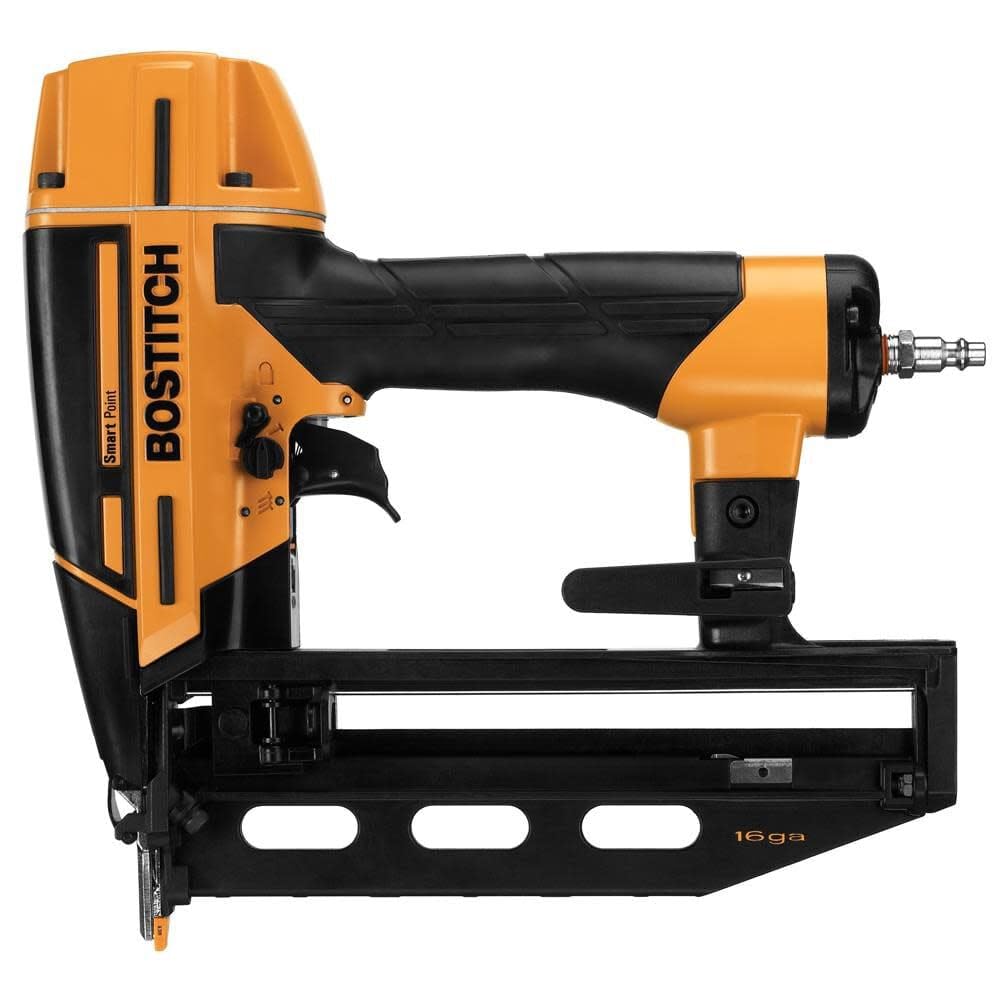
Precise placement

BOSTITCH BTFP71917

90 /100
Kirk Score Outstanding
Nose
Smart Point
Weight
7.3 lb
Warranty
7 year limited
Fastener Range
16-gauge, 1-1/4 to 2-1/2 in
Check Details on Amazon

Pros

  • Small Smart Point nose for accurate placement
  • Oil-free operation will not stain raw wood
  • Seven-year limited warranty
  • Dial-A-Depth and tool-free jam release

Cons

  • 7.3 lb

The nose is what you notice first on the BOSTITCH BTFP71917. Smart Point puts a small contact tip right where the nail fires, so you can see the mark you are aiming at instead of working around a bulky safety shoe, and it does not walk off a pencil line on a prefinished board.

Oil-free operation is the second thing, and it matters more than it sounds on trim you plan to stain rather than paint: there is no oil mist to spit onto raw wood. Dial-A-Depth sets countersink with a twist, the jam release is tool-free, the trigger selects sequential or contact fire, and the warranty runs seven years — the longest in this guide.

Loading takes a little practice: the strip has to sit squarely in the channel before the latch closes, and rushing it is how you end up with a misfeed on the first nail. The kit helps otherwise, with a case, an air fitting, and spare no-mar tips — fit one before the first run on finished wood, because the bare nose will mark what you are nailing.

What you are buying, then, is precision and a clean driver. If your work is mostly flat, painted, and at waist height, one of the lighter pneumatics here is easier to live with; if a wandering nose or an oil spot would cost you a board, the trade goes the other way.

Bottom line: We recommend this one when the trim is the finish: no oil mist, a nose you can see around, and a seven-year warranty, provided you can handle the weight.

Check Latest Price

How We Tested Finish Nailers for Real Trim Work

We began by building a shortlist of 15- and 16-gauge finish nailers in angled and straight formats, including pneumatic models, cordless bare tools, and kits with cases or air dusters. I filtered out duplicates in the same size and anything that seemed like a stretch for home use—too heavy, too specialized, or dependent on a compressor the average homeowner doesn't own. The final 12 spent nine months moving between my garage shop and a hallway trim project.

In the shop, I ran each nailer through pine baseboard, oak chair rail, MDF crown, and cabinet face frames. I fired several hundred nails per tool, including deliberate awkward shots into knots and at shallow angles, and counted every jam and misfire. I weighed each one ready to work—battery in the cordless models, hose coupler on the pneumatics—and held it overhead for two-minute stretches while fitting crown, because a tool that feels fine at waist height can turn into a wrist workout above your head.

To judge nail driving and power, I drove 2-inch fasteners into oak and checked whether heads sat flush or stood proud, then adjusted depth and repeated the pass. I also tested functionality and ease of use by reloading, clearing jams, switching actuation modes, and noting whether controls were reachable with one hand. Durability got a less gentle treatment: each nailer rode in a job-site bag, got set down on concrete, and ran through long sessions without cleaning. Build quality showed up in wobbly depth stops, loose magazine screws, and triggers that felt gritty after a few hundred nails; reliability was the sum of those observations—few stoppages, consistent depth, and no loose fittings. For home use, I paid attention to compressor cycling, hose drag, battery changes, and whether the kit contents actually added value.

How to Choose a Finish Nailer

Match the gauge to the trim

The 16-gauge guns here leave a smaller hole than the 15-gauge ones, which is why we reach for them on interior casing, cabinet trim, and small moldings where filling and sanding before paint is the slow part of the job. The 15-gauge angled guns take a thicker shank for baseboard, door casings, and heavier exterior trim, and their angled magazines reach into inside corners where a straight one bumps the wall.

Buy strips that match both the gauge and the magazine angle. A 16-gauge angled gun will not take the straight strips that fit the NuMax or the Metabo NT65M2S, and a box of the wrong ones is a wasted trip.

Pneumatic or cordless

If you already own a compressor, pneumatic is the better value: lighter tools, no batteries to charge, and the NuMax costs less than a spare cordless battery. Cordless earns its premium where the air line is the actual problem — occupied houses, upstairs rooms, punch lists after the furniture is back in place.

The two DEWALT guns here run on 20V MAX packs and both arrive as bare tools, so the real cost includes a battery and charger unless you are already in that system. That single fact decides the purchase for most people.

Weight and balance

This set runs from 3.7 pounds to 7.3 pounds, and the spread matters most in one place: overhead. Running crown with a 7-pound gun is a different job than running baseboard with it. Balance counts too — a body that sits back toward the trigger is easier to hold on a line than a nose-heavy one.

If your work is casing and base at waist height, weight is a minor consideration and you can buy for other strengths. If it is crown, tall casing, and anything on a ladder, buy the lightest gun your gauge allows.

Nose, jams, and warranty

A small nose is worth paying for. The micro nose on the DEWALT DCN650B and the Smart Point tip on the BOSTITCH both let you see the mark instead of working around a bulky safety shoe, which is the difference between a clean set and an extra hole to fill on thin trim.

Most picks here have a quick-clear or tool-free jam release; what separates them is how often you need it. Warranty is the other clue to how hard a gun can be run: seven years on the BOSTITCH, five on both Metabos, one on the NuMax.

Frequently Asked Questions

Final Verdict

After working through seven guns, the Metabo HPT NT65MA4 is the one we keep recommending: 15-gauge angled fasteners up to 2-1/2 inches, 4.2 pounds in the hand, and a five-year warranty behind it. It covers baseboard, casing, and crown without a change of tool, which is what most trim work asks for.

If a compressor is not happening, the DEWALT DCN660B is the cordless gun to buy, provided you are already on the 20V MAX platform. And if the lightest possible tool is the priority, the 16-gauge Metabo HPT NT65M2S saves half a pound and leaves a smaller hole to fill.