// data-verified

Best Wire Cutters of 2026

A dull pair of wire cutters doesn't just slow you down. It chews the end of the wire, sprays stray strands across the workbench, and leaves a burr you have to chase with a file. I've wrestled enough bargain-bin pairs — and pinched my palm on enough stamped handles — to know that a clean snap or a ragged fight usually comes down to the jaw, not the price tag.

Over the past three months I've cut with 14 different pairs, from compact 6-inch side cutters to 8-inch angled models, and a few patterns showed up fast. For fine work — component leads, floral wire, stranded speaker wire — a flush-cutting edge matters more than muscle. Once you're into 12-gauge copper or a stubborn zip tie, the high-leverage pivot and the angle of the head start earning their keep, and grip comfort becomes the sleeper: you feel a hard handle around the twentieth cut, not the first.

None of these will do everything, and the right pair for trimming craft wire on the kitchen table is not the one you want in a toolbox cutting romex. That's the whole point of the list below.

#01

Best Overall

Klein D248-8 8-Inch Diagonal Cutters

96 /100
Kirk Score Outstanding
Handle
Plastic-dipped
Head Design
Angled, short jaw
Cutting Edge
Induction-hardened
Overall Length
8 in
Check Details on Amazon

Pros

  • High-leverage joint cuts with less hand force
  • Angled head reaches into boxes and panels
  • Short jaws get close to terminals and tie heads
  • US-made tool steel at a midrange price

Cons

  • Dipped handles go firm on long cutting runs

Leverage is the whole argument for a diagonal cutter, and it's why this Klein took the top spot. The rivet sits closer to the cutting edge than on a conventional pair, which the company credits for 36 percent more cutting power; in the hand that translates to 12-gauge copper and stubborn zip ties parting on a squeeze rather than a grunt. The head is angled forward as well, so you can watch the cut line when the wire is jammed at the back of a box.

Eight inches of tool with short jaws and beveled edges is a deliberate combination. Short jaws get close to a terminal without the tip fouling on anything, and the bevel means the edge stays strong on anything the size of house wire. The knives are induction hardened, the steel is US-made, and the dipped handles are shaped with a curve along the fore edge that keeps your hand from sliding forward onto the jaws.

The beveled edge is also the limit. It leaves a small V rather than a flat face, so this is the wrong tool for trimming a zip tie hard against a panel or leveling a component lead on a board — that's the Hakko's job. Keep it for cutting to length, which is most of what a diagonal cutter is for, and the V never matters.

Where it earns its keep is the middle of the work: roughing in a circuit, trimming tie wire, cutting hanger strap and stakes to length. Ours lives in the tool bag rather than the drawer, which is the highest compliment we give a hand tool.

Bottom line: We recommend the D248-8 as the general-purpose cutter for anyone who cuts wire more than a few times a month: the leverage does the work, and the angled head reaches into boxes and panels.

Check Latest Price
#02

Best for All-Day Work

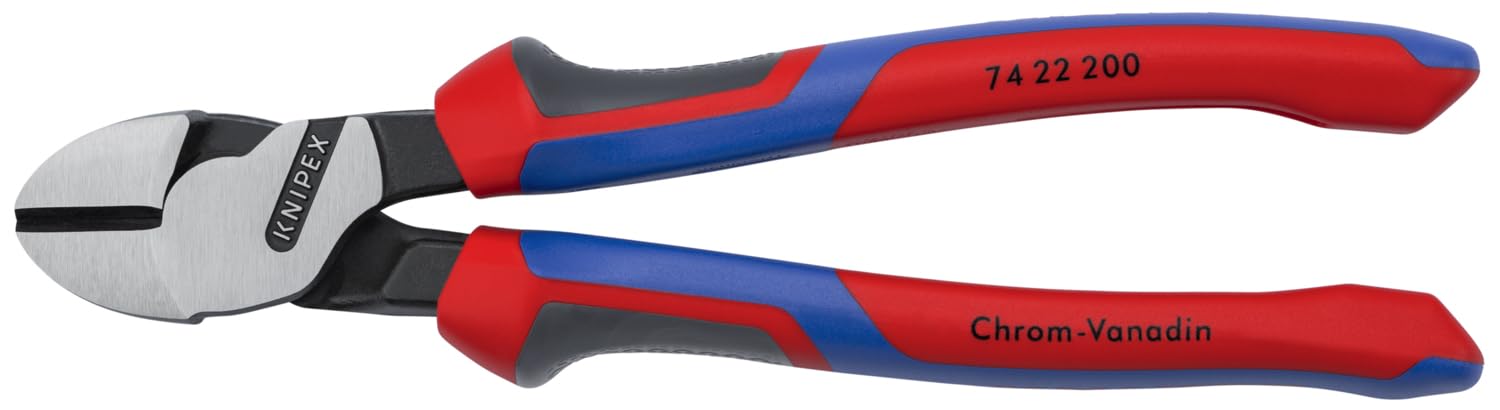
Knipex 74 22 200 Angled Diagonal Cutter

95 /100
Kirk Score Outstanding
Joint
Forged-on axle
Handle
Comfort grip
Head Design
Angled
Overall Length
8 in
Check Details on Amazon

Pros

  • Comfort grips stay comfortable through long runs
  • Forged-on axle holds up to heavy, continuous use
  • Matched edge angle and ratio cut with less effort
  • Angled head works in tight spots

Cons

  • Highest price of any cutter in this set

Same 8-inch length, same angled head, and the highest price of any cutter here — on paper the Knipex looks like a duplicate of our top pick. Pick both up and the difference is in the hand: molded comfort grips instead of dipped plastic, and an axle forged onto the jaws rather than a rivet that can work loose with age.

Knipex rates it at 20 percent less effort than a conventional diagonal of the same length, and what we can talk about is the geometry behind that number. The cutting-edge angle and the transmission ratio are matched so the jaws bite early and finish a cut without a second squeeze, and on copper, MC cable and tie wire it feels like cheating next to a hardware-store pair. The forged axle is what pushes it into daily-use territory; there's no rivet to tighten halfway through a job.

Where it stops being the obvious answer is the bill and the drawer it lives in. If a cutter comes out twice a year to trim a lamp cord, the Klein cuts just as well for less and you'll never miss the grips. If it's in your hand six hours a day, the grips and the joint stop being luxuries and start being the reason your palm still feels fine at four o'clock.

Bottom line: If you cut wire for a living, the extra money buys molded comfort grips and a forged-on axle — we rate it the most comfortable all-day cutter in this group.

Check Latest Price
#03

Best for Fine Electronics

Hakko CHP-170 Micro Flush Cutter (2-Pack)

95 /100
Kirk Score Outstanding
Pack
2 cutters
Capacity
Up to 16 AWG soft wire
Cut Type
Flush
Jaw Length
8 mm
Check Details on Amazon

Pros

  • Flush face leaves no spur to catch on
  • Spring return saves your hand on repeat cuts
  • Slim angled head reaches into tight work
  • Two cutters in the pack

Cons

  • Limited to soft wire up to 16 AWG

An 8 mm jaw is a different tool from the 8-inch diagonals that make up most of this list, and after a stretch of board work we stopped reaching for anything else. What we appreciate most is the spring: it opens the jaws on every cut, which is the difference between a hundred clean snips and a sore hand at the end of an evening.

The rest of the design follows the same idea. The head is angled so your knuckles stay clear of the work, the grips are slim and slightly tacky, and the two faces meet flush, so a trimmed zip tie or a clipped component lead comes out flat with no spur to catch a forearm later. Rated to 16 gauge soft wire, it's happiest on 24-gauge hookup wire, LED leads and print supports. The two-pack is the quiet bonus: one lives at the bench, one in the kitchen drawer.

The edge is the trade-off. It's hard and thin, which is exactly what makes a flush cut possible, and it doesn't like anything harder than copper or soft steel: memory wire, piano wire and hardened staples will chip or roll it, and once the two faces stop meeting in the same plane the flush cut is gone. Keep a heavier diagonal for that work and these will last.

Bottom line: For leads, ties and print supports, these two flush cutters leave the flattest cut of anything here — and the second pair quietly earns its keep.

Check Latest Price
#04

Best Value

Channellock 337 7-Inch Diagonal Cutter

95 /100
Kirk Score Outstanding
Grip
Ergonomic
Material
High carbon steel
Warranty
Limited lifetime
Overall Length
7 in
Check Details on Amazon

Pros

  • US-made high-carbon steel
  • Limited lifetime warranty
  • 7-inch handles give leverage without bulk
  • Clean cuts on ground wire and cable

Cons

  • Edge needs a firmer squeeze on fine wire than our top picks

Nothing about the 337 is trying to impress you. Polished steel, a simple grip, no molded comfort handles and no styling — just a 7-inch frame of US-made high-carbon steel with a ground edge and a limited lifetime warranty behind it.

That's not a complaint. It goes through #6 solid ground wire, romex and cable with a clean bite, and the long handles give enough leverage that you're not leaning on the tool. The weight sits balanced in the hand, the joint is smooth out of the box, and the finish doesn't look like it came from a bargain bin.

Our read is that this is the pair to buy when you want one good cutter and no ceremony. It costs less than the Klein and the Knipex, cuts nearly as well on the wire most people actually handle, and the warranty means a failure is a phone call rather than a replacement purchase.

Seven inches is also the length most people should buy: short enough to sit in a pouch or a kitchen drawer, long enough to lean into a bundle of cable. If your hands are large or your days are full of heavy conductor, the extra inch on the Klein is worth having; for everything else, this is the sensible middle.

Bottom line: A US-made 7-inch cutter with a lifetime warranty for less than the premium picks — we think it's the smart middle of this group.

Check Latest Price
#05

Best Budget Two-Pack

IGAN-P6 6-Inch Wire Cutters (2-Pack)

93 /100
Kirk Score Outstanding
Capacity
Up to 12 AWG
Material
Chrome vanadium steel
Cutting Edge
13/16 in
Overall Length
6 in
Check Details on Amazon

Pros

  • Two cutters in the pack
  • Spring-loaded jaws reduce hand fatigue
  • 13/16-inch edge handles stems and bundles
  • Lifetime warranty on a budget tool

Cons

  • Spring holds the jaws wider than small hands like

The second cutter in the pack is the reason to buy this one. A 6-inch spring-loaded diagonal is the right size for floral wire, artificial stems, beading wire and cable ties, and a spare means one can live with the craft supplies while the other stays in the toolbox.

We were surprised by how much the extra edge helps: 13/16 of an inch is long for a cutter this size, so you can lay the whole edge across a stem or a bundle of wire instead of nibbling at it from two directions. The spring does the opening for you, the chrome vanadium steel is heat treated and ground, and the pair arrives genuinely sharp with a full lifetime warranty behind it.

The limit is the steel. The blades are sharp, but they mark against hard wire, so we keep these to craft stock and soft copper and reach for something heavier on anything else — the 12-gauge rating is for soft electrical wire, not fence wire or hardened ties. Treat them as craft and light-duty electrical cutters and they'll serve you for years.

Bottom line: The pair we reach for at the craft table: spring-loaded, properly sharp, and inexpensive enough to keep one with the floral supplies and one in the toolbox.

Check Latest Price
#06

Tight spaces

IRWIN Vise-Grip 2078306 6-Inch Diagonal

95 /100
Kirk Score Outstanding
Handle
ProTouch grips
Material
Nickel chromium steel
Cutting Edge
Induction hardened
Overall Length
6 in
Check Details on Amazon

Pros

  • Short frame reaches into boxes and gutters
  • Machined jaws hold the work while cutting
  • Slender ProTouch grips suit smaller hands
  • Meets ANSI specifications

Cons

  • Tips can give way when pushed onto thick wire

Six inches of cutter is a deliberate compromise, and the IRWIN makes it in exchange for access. The short frame gets into a junction box, a panel gutter or a tight bundle where an 8-inch pair simply won't fit, and the machined jaws hold what you're cutting while the induction-hardened edge does the work.

The details aim at the same job. Nickel chromium steel takes a corrosion-resistant finish, the ProTouch grips are slender enough for a smaller hand, and the whole thing is short enough to sit in a plier pouch without a fight. It meets ANSI specifications, for whatever that's worth on a shelf full of claims.

What you give up is mass behind the edge. Six-inch handles put less force at the jaws than the Klein or the Knipex, so the same cut takes more from your hand, and on 10-gauge and thicker you feel it. Ours has been comfortable on 14 and 12 gauge, on zip ties and on small cable; when a job turns into a long run of heavy wire we put it down and pick up something longer.

Our take is that this belongs in a bag as a second cutter rather than an only one. It's the pair you want when the wire is in a bad place and you need a short tool to reach it, not the pair you want in front of a panel full of branch circuits.

Bottom line: The short cutter we keep in the bag for awkward spots: it fits where an 8-inch pair won't, as long as you don't ask it to chew through heavy cable.

Check Latest Price
#07

Light household jobs

Craftsman CMHT81646 6-Inch Diagonal

93 /100
Kirk Score Outstanding
Handle
Bi-material grip
Material
Drop forged steel
Cutting Edge
Induction hardened
Overall Length
6 in
Check Details on Amazon

Pros

  • Lowest price in this set
  • Comfortable bi-material grips
  • Drop-forged steel with induction-hardened edges

Cons

  • No spring return slows a run of cuts

The CMHT81646 is the least expensive cutter in this group, and it doesn't pretend otherwise: a 6-inch drop-forged frame, induction-hardened edges and bi-material grips, with nothing extra in the box.

For the money it does an honest job on the small stuff. Floral wire, artificial stems, zip ties, fishing line and light household cutting all go through cleanly, the grips are thick enough to keep the handles from digging into your palm, and the finish has stayed put.

The edge is the compromise. On anything tougher than soft wire it needs a determined squeeze and leaves a rougher end than the Klein or the Channellock, so a length of 12-gauge will have you wishing for a longer handle.

Our advice is to buy a couple and scatter them — kitchen drawer, garage shelf, glovebox. It's a cutter you won't mourn if it goes missing, and for the small cuts a house actually generates it is plenty of tool.

Bottom line: The one to buy in multiples: inexpensive, comfortable in the hand, and perfectly adequate for floral wire, ties and light household cutting.

Check Latest Price
#08

Garage and site

WORKPRO 6-Inch Diagonal Cutters

92 /100
Kirk Score Outstanding
Handle
Bi-material
Material
50CrV steel
Overall Length
6 in
Cutting Edge Hardness
Up to 65 HRC
Check Details on Amazon

Pros

  • Cutting edge rated up to 65 HRC
  • Bi-material handles stay grippy
  • Crisp bite on copper and cable ties

Cons

  • Wants wiping and dry storage to stay rust-free

Two hardness numbers explain why this one made the list: 50CrV steel heat treated to 48 HRC through the body, with the cutting edge high-frequency treated to 65 HRC. On a 6-inch cutter that costs less than most of the others here, that is a lot of specification — and you can feel it in the bite, which is crisp rather than soft.

The rest is sensible rather than exciting. Bi-material handles keep the grip from sliding when your hands are damp, the 6-inch frame slips into a tool bag pocket, and there's nothing on the tool that asks to be handled carefully.

Our honest read is that the numbers are the argument and the track record is the open question. A 65 HRC edge should hold up well against copper and cable ties, and we have no reason to doubt it, but hardness is a claim rather than a season of use — we have the latter on the Kleins and not yet on this one. Buy it as a second or third cutter and it's a bargain; buy it as your only one and you're trusting a spec sheet.

Bottom line: A garage-drawer cutter sold on hardness numbers: crisp jaws and grippy handles, with edge life that only a few months of use will settle.

Check Latest Price

How We Tested Wire Cutters

I started by pulling together everything I could find in the category — roughly 40 pairs from names like Klein, Knipex, Channellock, Irwin, Craftsman, Hakko, and Workpro — and narrowed it by jaw type, pivot design, size, grip material, and price. Fourteen made the final cut, and I've been using them for three months.

The testing lived where wire cutters actually live: a garage workbench and a kitchen table. I rewired a lamp and an outlet, snipped 12- and 14-gauge solid copper, cut stranded speaker wire and zip ties, trimmed floral wire and small component leads in a third hand, and worked through soft annealed wire alongside stiff spring steel. At each pair I counted how many cuts it took before the wire started bending instead of slicing, and watched whether the cut end stayed flat or frayed and needed a second snip. I also checked whether the tips closed fully at the point, since that's what makes fine work possible.

To test durability, I left a few pairs in a damp garage over a weekend, dropped them on concrete, and wiped them down with an oily rag the way most people actually treat tools. I noted rust flecks, jaw play at the pivot after a few hundred cuts, and how quickly the finish wore at the contact points. For function and comfort, I made repeated cuts bare-handed and then in gloves, judging how much hand strength each pair demanded and whether the grips stayed soft or went slick.

Versatility and value came last. I asked whether one pair could reasonably handle both delicate and heavy work, and whether the extra money showed up in a jaw that stayed sharp — not just in a nicer handle.

How to Choose Wire Cutters

Flush, Beveled, and What the Cut Leaves Behind

A flush cutter's two faces meet in the same plane, so the cut comes out flat: no spur on a zip tie, no spike on a component lead. A beveled edge, which is what most diagonal cutters have, leaves a small V. That V is stronger and handles heavier wire, but it catches on skin and fabric.

The trap is buying a flush cutter for general wire work. Those edges are thin and hard, and fence wire or a hardened staple will chip them. Buy flush for ties and fine leads — the Hakko is the one we keep at the bench — and beveled for anything structural.

Length Is Leverage, and the Joint Matters More

Every extra inch of handle buys force at the edge, which is why an 8-inch Klein or Knipex feels so different from a 6-inch Craftsman on the same piece of 12-gauge. But length isn't the whole story. Where the joint sits matters more, and a high-leverage pair puts its pivot close to the cutting edge so a shorter tool bites as hard as a longer one.

Our rule: if your hand aches at the end of a job, go up an inch or look for a high-leverage joint before you change anything else.

Match the Steel to the Wire You Actually Cut

Every capacity figure on these pages assumes soft copper. Hardened wire — piano wire, memory wire, coat hanger, hardened staples and screws — will chip or roll any edge here, and a harder, longer-lasting edge is also a more brittle one.

That is the whole durability argument in this category: the cutters that hold an edge for years are the ones that fail suddenly when someone cuts something they shouldn't. Keep one sharp pair for copper and a cheap pair for everything else.

Handles, Springs, and What the Extra Money Buys

A dip-coated handle is fine for a dozen cuts. Molded dual-material grips and a spring return are what make a hundred cuts comfortable, and the spring does the opening for you after every squeeze — trivial until you've cut a few hundred ties without one.

Beyond that, money buys edge steel, joint geometry and grip. If the cutter comes out twice a month, spend it on a second pair instead. If it's in your hand daily, buy the Knipex or the Klein and stop thinking about it.

Frequently Asked Questions

Final Verdict

Our pick is the Klein D248-8. It's the balance we keep coming back to: a high-leverage joint that makes house wire feel easy, an angled head that reaches into boxes, and US-made steel at a midrange price.

If the cutter is a work tool you hold all day, step up to the Knipex for the grips and the forged axle. If your cutting happens at a bench on 24-gauge wire, skip both and take the Hakko two-pack.